

Telemedicine Market Size and Forecast (2026–2034), Global and Regional Growth, Trend, Share and Industry Analysis Report Coverage: By Component (Product (Hardware, Software, and Others) and Services (Tele-consulting, Tele-monitoring and Tele-education), By Modality (Store and Forward, Real Time, and Others), By Application (Teleradiology, Telepsychiatry, Telepathology, Teledermatology, Telecardiology, and Others), By End User (Hospitals & Health Systems, Clinics & Physician Practices, Patients/Homecare, Payers, and Others) and Geography
2026-07-23
Healthcare
Swetal (Research Analyst)
Description
Telemedicine Market Overview
The global
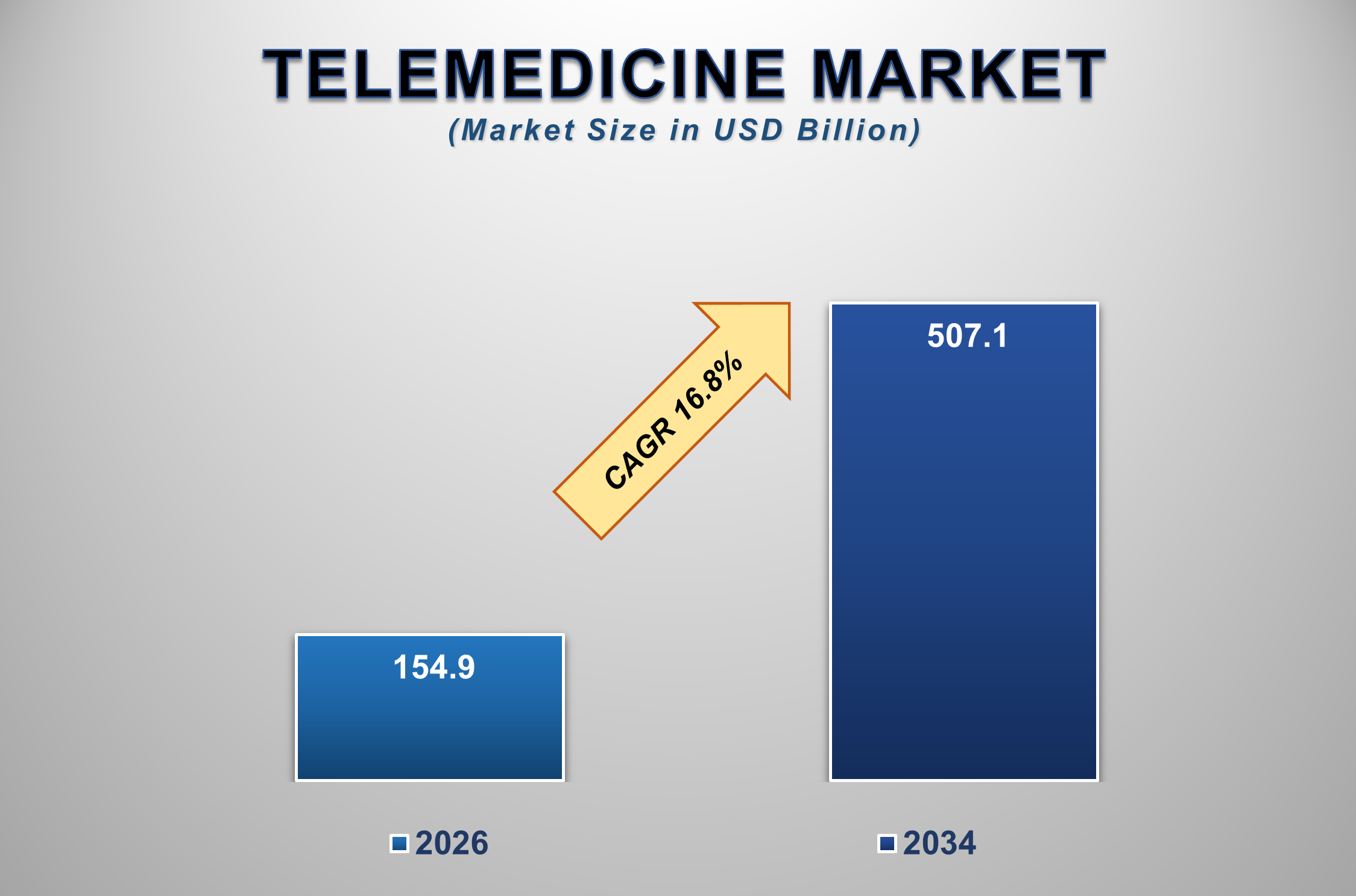
telemedicine market was valued at USD 154.9 billion in 2026 and is projected to
reach USD 507.1 billion by 2034, expanding at a CAGR of 16.8% during the
forecast period. The rising trend of
telemedicine can be attributed to more healthcare organizations using digital
technologies to enhance medical care, improve clinical efficiency, and minimize
healthcare costs. Using telemedicine solutions, patients can find out results
of remote consultations and evaluations and receive physical therapy or diagnosis
through electronic devices and the internet. The growth of the telemedicine
market is supported by rising demand from patients, the growing number of
incidents of chronic diseases, progress in internet technologies and smartphone
diffusion, and supportive legislative conditions for using virtual medicine.
Meanwhile, artificial intelligence (AI) technologies, cloud computing
developments, and digital wearables make telemedicine more efficient by
ensuring instant diagnostics, constant monitoring of patients, and personalized
treatments.
Telemedicine Market Drivers and
Opportunities
Increasing
Demand for Remote and Accessible Healthcare Services is Driving Market Growth
The rising need to
enhance access to quality healthcare in rural and underdeveloped areas, along
with increasing patient interest in convenient virtual consultation, is
propelling the adoption of telemedicine among hospitals, clinics, and even
in-home care settings. Rising incidences of chronic ailments, an aging
population, and the requirement for continuous healthcare management are
contributing to the rising demand for remote healthcare services. Furthermore,
favorable government regulations are adding another dimension to support market
growth. For instance, in January 2026, the U.S. The Department of Health and
Human Services (HHS), along with the Drug Enforcement Administration (DEA),
approved a fourth temporary extension of telemedicine flexibilities in which
eligible patients will be allowed to get prescriptions for controlled drugs
without an initial in-person visit. This will ensure continuity of access to
healthcare services by senior citizens, rural populations, disabled
individuals, and those who are being treated for any mental illness or
substance use disorder.
Advancements in
Digital Health Technologies Fueling Market Expansion
The developments in
AI, cloud computing, portable devices, remote monitoring of patients, and fast
internet are resulting in improvements in the quality and efficiency of
telemedicine services. These technologies enable real-time monitoring of
patients, AI-assisted decision-making, a secure exchange of health data, and
teleconsultations, leading to better care provided to patients. In addition to
technological advancements, several regulatory steps support the spread of
digital health technologies, such as guidelines issued by the National
Institute of Mental Health and Neurosciences (NIMHANS), a medical institute
located in Bengaluru, in May 2026. The guidelines promote safe and ethical use
of digital mental health solutions in India by telling users, developers, and
health practitioners how to use them properly.
Expansion of
Telemedicine for Chronic Disease Management and Home-Based Care Presents
Significant Opportunities
The increasing
adoption of telemedicine for managing chronic diseases and providing care at
home offers several opportunities for market growth. The rising rates of
chronic diseases like diabetes, heart diseases, respiratory problems, and brain
disorders lead to an increase in demand for various services such as continual
monitoring of patients, regular consultations with physicians, and customized
treatment plans. Telemedicine, along with RPM, connected medical devices,
wearable technology, and artificial intelligence and analytics, will allow
healthcare providers to track patients’ progress and improve compliance. In
addition, the growing elderly population and the rising preference for home
care are creating demand for virtual home health care services. As healthcare
systems continue moving toward value-based care while working to reduce costs
and improve access to advanced care, telemedicine will become a more important
player in chronic disease treatment and home care, providing precious
opportunities for technology providers, healthcare companies, and digital
health platform makers.
Telemedicine Market Scope
|
Report Attributes |
Description |
|
Market Size in
2026 |
USD 154.9
Billion |
|
Market Forecast
in 2034 |
USD 507.1
Billion |
|
CAGR % 2026-2034 |
16.8% |
|
Base Year |
2025 |
|
Historic Data |
2021-2025 |
|
Forecast Period |
2026-2034 |
|
Report USP |
Pricing and
Cost Structure Analysis, Product Innovation Benchmarking, Whitespace
Assessment, Company Share, Company Heatmap, Growth Factors, and more |
|
Segments Covered |
●
By
Component ●
By
Modality ●
By
Application ●
By End
User |
|
Regional Scope |
●
North
America ●
Europe ●
APAC ●
Latin
America ●
Middle
East and Africa |
|
Country Scope |
●
U.S. ●
Canada ●
U.K. ●
Germany ●
France ●
Italy ●
Spain ●
Russia ●
China ●
India ●
Japan ●
South
Korea ●
Australia
●
Mexico ●
Brazil ●
Saudi
Arabia ●
UAE ●
South
Africa
|
Telemedicine Market Report
Segmentation Analysis
The global
telemedicine market industry analysis is segmented by component, modality,
application, end user, and region.
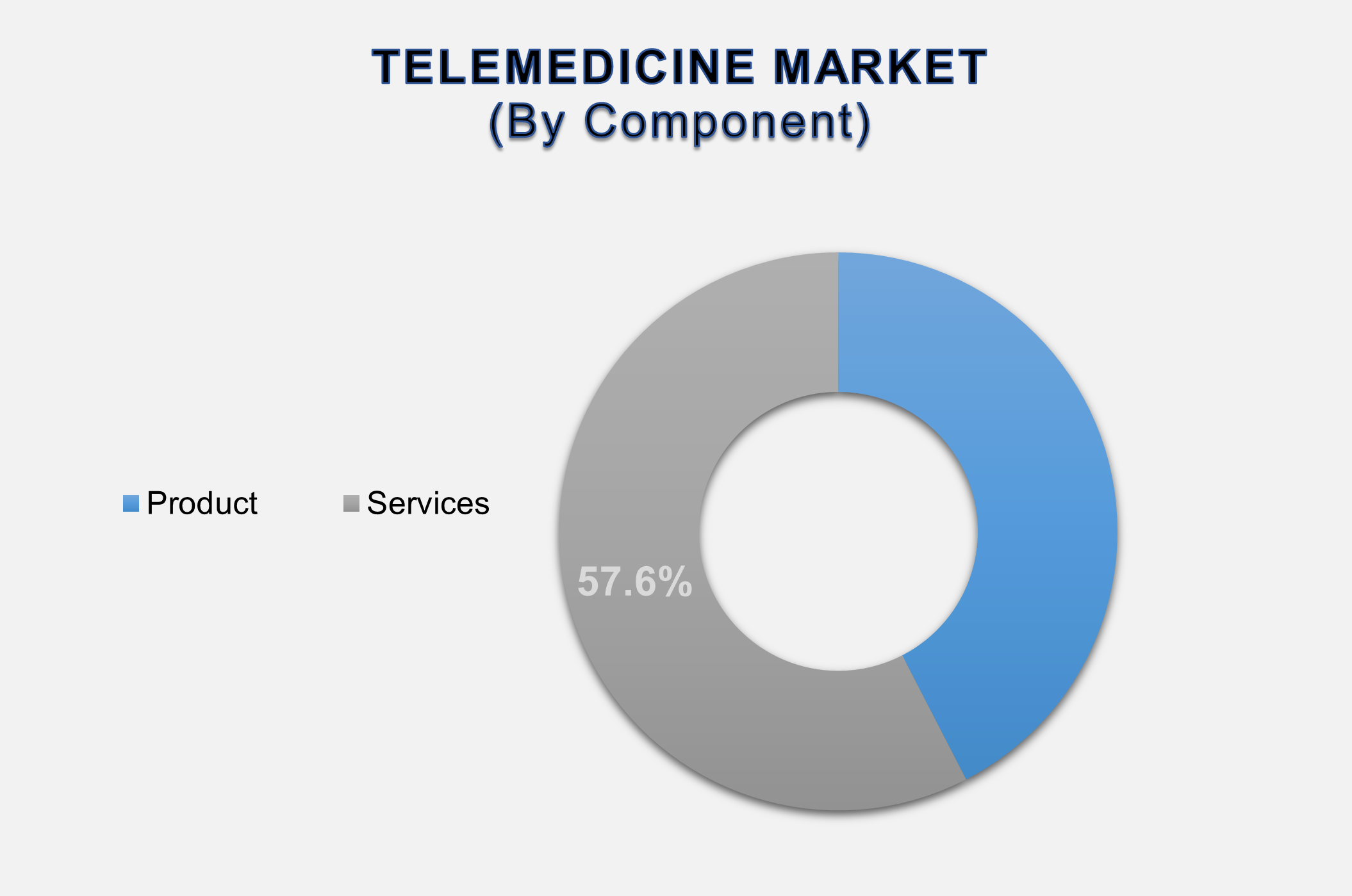
Services Segment
Is Expected to Dominate the Telemedicine Market During the Forecast Period
During the
timeframe of this prediction, services are anticipated to dominate the
telemedicine field. This is mainly due to the growing demand for
teleconsulting, telemonitoring, telepsychiatry, chronic disease management, and
various digital health solutions. Health services are seeking to outsource
their telemedicine operations and utilize subscription services to offer
telemedicine services to better serve patients, cut operational costs, and
provide continuity of care. The increasing presence of behavioral health and
value-based care furthers the demand for specialized telemedicine. Furthermore,
the importance of analytic and performance services used by providers to
enhance healthcare delivery processes are rising. For example, in April 2026,
Iris Telehealth introduced its Iris Insights project, which is an intelligent
platform that helps medical organizations acquire actionable operational and
clinical insights for managing their behavioral health services. Such
advancements boost efficiency and improve outcomes obtained by service users.
Store and
Forward Segment Is Expected to Lead the Telemedicine Market by Modality
The
store-and-forward method is presumed to dominate the telemedicine sector due to
its ability to provide asynchronous communication between patients and doctors.
The process of this method involves transferring and retaining medical
information, such as diagnostic images, lab samples, health records, and other
patient-related medical information securely. Its applications extend mainly to
radiology, dermatology, ophthalmology, pathology, and dentistry sectors, where
medical professionals can make informed decisions based on available imaging
data and patient records without any direct physical contact. The development
of various networks, including electronic health registers (EHRs) and AI-based
medical imaging, has made this methodology even more effective.
Teleradiology
Segment Is Expected to Dominate the Application Segment
The segment of
teleradiology is set to be the leading segment in the telemedicine market in
terms of applications during the forecast period. This is due to the increasing
demand for timely diagnostic imaging services, rising imaging procedure
volumes, and the lack of radiologists worldwide. The technology of
teleradiology facilitates the transmission of medical images like X-rays and CT
scans to remote radiologists to ensure timely interpretation, thus allowing
healthcare providers to provide quick and precise diagnostics regardless of the
location of the hospitals. The growth of Picture Archiving and Communication
Systems (PACS), utilization of artificial intelligence (AI) in image analysis,
and improvement of connectivity have made efficient remote teleradiology
services possible for healthcare providers. It is worth noting that
teleradiology technology is being used more frequently and more widely and,
therefore, is more accessible to hospitals, diagnostic imaging centers, and
emergency facilities.
Hospitals &
Health Systems Segment Is Expected to Dominate the End User Segment
Hospitals and Health Systems will continue to be the dominant segment of the telemedicine market in terms of the end-user sector, with their growth being fueled by the growing use of virtual care in hospitals, increasing investments in digital health capabilities, and the need to increase access to healthcare services while cutting costs in the healthcare industry. Hospitals and health systems are adopting telemedicine technologies for virtual consultations, emergency services, referral services, post-discharge services, chronic disease management services, tele-ICU services, and remote monitoring. The integration of telehealth services is made easier by the greater use of EHRs, cloud-based healthcare technologies, AI-based clinical support technologies, and interoperable technologies, which have improved the operations and reach of telemedicine in hospitals. Furthermore, with growing patient volumes, a greater incidence of chronic illnesses, and a scarcity of personnel in the healthcare industry, hospitals are seeking to integrate telemedicine to better leverage their resources, diminish readmissions, improve clinical outcomes, and improve the accessibility of medical services throughout both urban and rural areas.
The following
segments are part of an in-depth analysis of the global telemedicine market:
|
Market Segments |
|
|
By
Component |
●
Product o
Hardware o
Software o
Others ●
Services o
Tele-consulting o
Tele-monitoring o
Tele-education |
|
By
Modality |
●
Store and
forward ●
Real-time ●
Others |
|
By
Application |
●
Teleradiology ●
Telepsychiatry ●
Telepathology ●
Teledermatology ●
Telecardiology ●
Others |
|
By End
User |
●
Hospitals
& Health Systems ●
Clinics
& Physician Practices ●
Patients/Homecare ●
Payers ●
Others |
Telemedicine Market Share Analysis by
Region
North America is
projected to hold the largest share of the global telemedicine market over the
forecast period
For the period
under review, North America is expected to continue accounting for the largest
share of the global telemedicine market. The region's ability to lead can be
attributed to several factors such as robust digital healthcare infrastructure,
high penetration of the internet and smartphones, a cashless reimbursement
system, and widespread usage of virtual care services in the treatment of
chronic illnesses, primary and behavioral health. Furthermore, continuous
technological advancements by providers of telehealth services contribute to
market development. For instance, in May 2026, the Canadian companies Phoenix
and Raven were the first telehealth businesses in Canada to provide patients
with semaglutide-approved products manufactured by Health Canada, thus
extending patients’ access to affordable weight loss and diabetes care services
through online consultations.
Telemedicine
Market Competition Landscape Analysis
The telemedicine
industry comprises prominent players providing online healthcare platforms,
telehealth solutions, telemonitoring devices, connected medical appliances,
etc., primarily serving hospitals and clinics, doctors and insurers, private
employers, government health organizations, and individual patients. The
companies in the market are striving to improve their competitive position in
the marketplace by investing in AI-based clinical decision support, connection
to the electronic health record system (EHR), remote diagnostics, wearable
monitoring devices, secure cloud computing models, and digital health
environments providing for effective delivery of health services and compliance
with the applicable regulations.
Global
Telemedicine Market Recent Developments News:
●
In May 2026 - AmplifyMD,
the leading AI-enabled, multispecialty platform for EHR-integrated virtual
care, was named "Best
Overall Telemedicine Platform" in the 10th annual MedTech Breakthrough
Awards. This marks the second
consecutive year AmplifyMD has received this honor for its category-leading
innovation.
●
In January
2026 - Firstsource Solutions Limited, a leading global provider of business
management services and an RP-Sanjiv Goenka Group company, announced the
acquisition of TeleMedik, a Puerto Rico-based pioneer in the development and
implementation of technological solutions. The acquisition significantly
strengthens Firstsource's end-to-end clinical and utilization management
capabilities, expands its footprint across payer-provider networks, and further
enriches the company's fully integrated and differentiated Business Process as
a Service (BPaaS++) offering for health plan clients.
●
In December
2025 - The Drug Enforcement Administration (DEA) and the U.S. Department of
Health and Human Services (HHS) jointly issued a Fourth Temporary Extension of
COVID-19 Telemedicine Flexibilities for Prescription of Controlled Medications.
The rule is effective January 1, 2026, through December 31, 2026.
●
In December
2024 - Omda AS, a leading provider of specialized software for healthcare and emergency response, announced
the acquisition of Dermicus AB, a telemedicine solutions company specializing in teledermatology and telewound care. Including Dermicus
in Omda’s portfolio further strengthens the group's position in the market for medical imaging solutions.
The global
telemedicine market is dominated by a few large companies, such as
●
Allscripts Healthcare Solutions Inc.
●
Amwell (American Well)
●
Babylon Health
●
Caregility
●
Cerner / Oracle Health
●
Cisco Systems
●
Doctor On Demand
●
eClinicalWorks
●
Epic Systems
●
GE Healthcare
●
Hims & Hers Health
●
Honeywell International Inc.
●
Koninklijke Philips NV.
●
MDLive (Cigna)
●
Medtronic
●
Practo Technologies Pvt. Ltd.
●
SHL Telemedicine Ltd.
●
Siemens Healthineers
●
Teladoc Health Inc.
●
Zoom Video Communications
● Other Prominent Players
Frequently Asked Questions
Swetal (Research Analyst)
Swetal is a Research Analyst with 4+ years of experience specializing in healthcare market research, medical devices, healthcare IT, and medical technology industry analysis. Her expertise includes competitive intelligence, secondary research, market trend forecasting, and healthcare business insights across global healthcare ecosystems.
She contributes to advanced market research reports by analyzing regulatory frameworks, emerging healthcare technologies, competitive landscapes, and innovation trends shaping the medical industry. With a strong focus on accurate market intelligence, strategic insights, and healthcare industry trends, Swetal supports businesses in making informed, data-backed decisions in a rapidly transforming healthcare environment.
1.
Global
Telemedicine Market Introduction and Market Overview
1.1. Objectives of the Study
1.2. Market Segmentation
1.2.1.Component of the Global Telemedicine
Market
1.2.2.Modality of the Global Telemedicine
Market
1.2.3.Application of the Global Telemedicine
Market
1.2.4.End User of the Global Telemedicine
Market
1.2.5.Region of the Global Telemedicine
Market
1.3. Competition Coverage List of
Market Participants
1.4. Market Definition: Telemedicine
Market
2.
Executive Summary
2.1. Global Telemedicine Market
Estimation & Forecast
2.1.1.Global Telemedicine Market Size
(US$ Million) Estimates & Historical Trend Analysis (2021 - 2025)
2.1.2.Global Telemedicine Overall
Market Size (US$ Million), Growth Rate (Y-o-Y), Market CAGR (%), Market Forecast
(2026 - 2034)
2.2. Snapshot of Global Telemedicine
Market
2.3. Global Telemedicine Market
Revenue Share (%) 2025
2.4. REGIONAL OUTLINE: Revenue CAGR,
by Region
2.5. Key Competitors & Key
Insights
3.
Market Overview (Qualitative
Analysis)
3.1. Demand Side Trends
3.2. Supply Side Trends /
Manufacturing Trends
3.3. Demand and Opportunity Assessment,
2026 - 2034
3.4. Market Dynamics
3.4.1.Drivers
3.4.2.Limitations
3.4.3.Opportunities
3.4.4.Impact Analysis of Drivers and
Restraints
3.5. Key Developments
3.6. Regulatory Landscape
3.7. Pricing Analysis
3.8. Supply Chain Analysis
3.9. Porter’s Five Forces Analysis
3.9.1.Bargaining Power of Suppliers
3.9.2.Bargaining Power of Buyers
3.9.3.Threat of Substitutes
3.9.4.Threat of New Entrants
3.9.5.Competitive Rivalry
3.10. PEST Analysis
3.10.1. Political Factors
3.10.2. Economic Factors
3.10.3. Social Factors
3.10.4. Technology Factors
4.
Global Telemedicine Market
Estimates & Forecast Trend Analysis, by Component
4.1. Global Telemedicine Market
Assessments & Key Findings, by Component
4.2. Global Telemedicine Market
Revenue (US$ Million) Estimates and Forecasts, by Component, 2021 - 2034
4.2.1.Product
4.2.1.1.
Hardware
4.2.1.2.
Software
4.2.1.3.
Others
4.2.2.Services
4.2.2.1.
Tele-consulting
4.2.2.2.
Tele-monitoring
4.2.2.3.
Tele-education
5.
Global Telemedicine Market
Estimates & Forecast Trend Analysis, by Modality
5.1. Global Telemedicine Market
Assessments & Key Findings, by Modality
5.2. Global Telemedicine Market
Revenue (US$ Million) Estimates and Forecasts, by Modality, 2021 - 2034
5.2.1.Store and forward
5.2.2.Real time
5.2.3.Others
6.
Global Telemedicine Market
Estimates & Forecast Trend Analysis, by Application
6.1. Global Telemedicine Market
Assessments & Key Findings, by Application
6.2. Global Telemedicine Market
Revenue (US$ Million) Estimates and Forecasts, by Application, 2021 - 2034
6.2.1.Teleradiology
6.2.2.Telepsychiatry
6.2.3.Telepathology
6.2.4.Teledermatology
6.2.5.Telecardiology
6.2.6.Others
7.
Global Telemedicine Market
Estimates & Forecast Trend Analysis, by End User
7.1. Global Telemedicine Market
Assessments & Key Findings, by End User
7.2. Global Telemedicine Market
Revenue (US$ Million) Estimates and Forecasts, by End User, 2021 - 2034
7.2.1.Hospitals & Health Systems
7.2.2.Clinics & Physician
Practices
7.2.3.Patients/Homecare
7.2.4.Payers
7.2.5.Others
8.
Global Telemedicine Market
Estimates & Forecast Trend Analysis, by Region
8.1. Global Telemedicine Market
Assessments & Key Findings, by Region
8.2. Global Telemedicine Market
Revenue (US$ Million) Estimates and Forecasts, by Region, 2021 - 2034
8.2.1.North America
8.2.2.Europe
8.2.3.Asia Pacific
8.2.4.Middle East & Africa
8.2.5.Latin America
9.
North
America Telemedicine Market: Estimates & Forecast Trend Analysis
9.1.
North
America Telemedicine Market Assessments & Key Findings
9.1.1.North America Telemedicine
Market Introduction
9.1.2.North America Telemedicine
Market Size Estimates and Forecast (US$ Million) (2021 - 2034)
9.1.2.2.
By
Modality
9.1.2.3.
By
Application
9.1.2.4. By End User
9.1.2.5. By Country
9.1.2.5.1. The U.S.
9.1.2.5.2. Canada
10. Europe Telemedicine
Market: Estimates & Forecast Trend
Analysis
10.1. Europe Telemedicine Market
Assessments & Key Findings
10.1.1. Europe Telemedicine Market
Introduction
10.1.2. Europe Telemedicine Market Size
Estimates and Forecast (US$ Million) (2021 - 2034)
10.1.2.1. By Component
10.1.2.2. By Modality
10.1.2.3. By Application
10.1.2.4. By End User
10.1.2.5. By Country
10.1.2.5.1.
Germany
10.1.2.5.2.
Italy
10.1.2.5.3.
U.K.
10.1.2.5.4.
France
10.1.2.5.5.
Spain
10.1.2.5.6.
Switzerland
10.1.2.5.7. Rest
of Europe
11. Asia Pacific Telemedicine
Market: Estimates & Forecast Trend
Analysis
11.1. Asia Pacific Market Assessments
& Key Findings
11.1.1. Asia Pacific Telemedicine Market
Introduction
11.1.2. Asia Pacific Telemedicine Market
Size Estimates and Forecast (US$ Million) (2021 - 2034)
11.1.2.1. By Component
11.1.2.2. By Modality
11.1.2.3. By Application
11.1.2.4. By End User
11.1.2.5. By Country
11.1.2.5.1. China
11.1.2.5.2. Japan
11.1.2.5.3. India
11.1.2.5.4. Australia
11.1.2.5.5. South Korea
11.1.2.5.6. Rest of Asia Pacific
12. Middle East & Africa Telemedicine
Market: Estimates & Forecast Trend
Analysis
12.1. Middle East & Africa Market
Assessments & Key Findings
12.1.1. Middle
East & Africa Telemedicine
Market Introduction
12.1.2. Middle
East & Africa Telemedicine
Market Size Estimates and Forecast (US$ Million) (2021 - 2034)
12.1.2.1. By Component
12.1.2.2. By Modality
12.1.2.3. By Application
12.1.2.4. By End User
12.1.2.5. By Country
12.1.2.5.1. South Africa
12.1.2.5.2. UAE
12.1.2.5.3. Saudi Arabia
12.1.2.5.4. Rest of MEA
13. Latin America
Telemedicine Market: Estimates &
Forecast Trend Analysis
13.1. Latin America Market Assessments
& Key Findings
13.1.1. Latin America Telemedicine
Market Introduction
13.1.2. Latin America Telemedicine
Market Size Estimates and Forecast (US$ Million) (2021 - 2034)
13.1.2.1. By Component
13.1.2.2. By Modality
13.1.2.3. By Application
13.1.2.4. By End User
13.1.2.5. By Country
13.1.2.5.1. Brazil
13.1.2.5.2. Mexico
13.1.2.5.3. Argentina
13.1.2.5.4. Rest of LATAM
14. Competition Landscape
14.1. Global Telemedicine Market Product
Mapping
14.2. Global Telemedicine Market
Concentration Analysis, by Leading Players / Innovators / Emerging Players /
New Entrants
14.3. Global Telemedicine Market Tier Structure
Analysis
14.4. Global Telemedicine Market
Concentration & Company Market Shares (%) Analysis, 2025
15. Company Profiles
15.1. Allscripts Healthcare Solutions
Inc.
15.1.1. Company Overview & Key Stats
15.1.2. Financial Performance & KPIs
15.1.3. Product Portfolio
15.1.4. SWOT Analysis
15.1.5. Business Strategy & Recent
Developments
* Similar details would be provided
for all the players mentioned below
15.2. Amwell (American Well)
15.3. Babylon Health
15.4. Caregility
15.5. Cerner / Oracle Health
15.6. Cisco Systems
15.7. Doctor On Demand
15.8. eClinicalWorks
15.9. Epic Systems
15.10. GE Healthcare
15.11. Hims & Hers Health
15.12. Honeywell International Inc.
15.13. Koninklijke Philips N.V.
15.14. MDLive (Cigna)
15.15. Medtronic
15.16. Practo Technologies Pvt. Ltd.
15.17. SHL Telemedicine Ltd.
15.18. Siemens Healthineers
15.19. Teladoc Health Inc.
15.20. Zoom Video Communications
15.21. Other Prominent Players
16. Research
Findings & Conclusion
17. Assumptions & Acronyms Used
18. Research
Methodology
18.1. External Transportation /
Databases
18.2. Internal Proprietary Database
18.3. Primary Research
18.4. Secondary Research
18.5. Assumptions
18.6. Limitations
18.7. Report FAQs
Our Research Methodology
"Insight without rigor is just noise."
We follow a comprehensive, multi-phase research framework designed to deliver accurate, strategic, and decision-ready intelligence. Our process integrates primary and secondary research , both quantitative and qualitative , along with dual modeling techniques ( top-down and bottom-up) and a final layer of validation through our proprietary in-house repository.
PRIMARY RESEARCH
Primary research captures real-time, firsthand insights from the market to understand behaviors, motivations, and emerging trends.
1. Quantitative Primary Research
Objective: Generate statistically significant data directly from market participants.
Approaches:- Structured surveys with customers, distributors, and field agents
- Mobile-based data collection for point-of-sale audits and usage behavior
- Phone-based interviews (CATI) for market sizing and product feedback
- Online polling around industry events and digital campaigns
- Purchase frequency by customer type
- Channel performance across geographies
- Feature demand by application or demographic
2. Qualitative Primary Research
Objective: Explore decision-making drivers, pain points, and market readiness.
Approaches:- In-depth interviews (IDIs) with executives, product managers, and key decision-makers
- Focus groups among end users and early adopters
- Site visits and observational research for consumer products
- Informal field-level discussions for regional and cultural nuances
SECONDARY RESEARCH
This phase helps establish a macro-to-micro understanding of market trends, size, regulation, and competitive dynamics, sourced from credible and public domain information.
1. Quantitative Secondary Research
Objective: Model market value and segment-level forecasts based on published data.
Sources include:- Financial reports and investor summaries
- Government trade data, customs records, and regulatory statistics
- Industry association publications and economic databases
- Channel performance and pricing data from marketplace listings
- Revenue splits, pricing trends, and CAGR estimates
- Supply-side capacity and volume tracking
- Investment analysis and funding benchmarks
2. Qualitative Secondary Research
Objective: Capture strategic direction, innovation signals, and behavioral trends.
Sources include:- Company announcements, roadmaps, and product pipelines
- Publicly available whitepapers, conference abstracts, and academic research
- Regulatory body publications and policy briefs
- Social and media sentiment scanning for early-stage shifts
- Strategic shifts in market positioning
- Unmet needs and white spaces
- Regulatory triggers and compliance impact
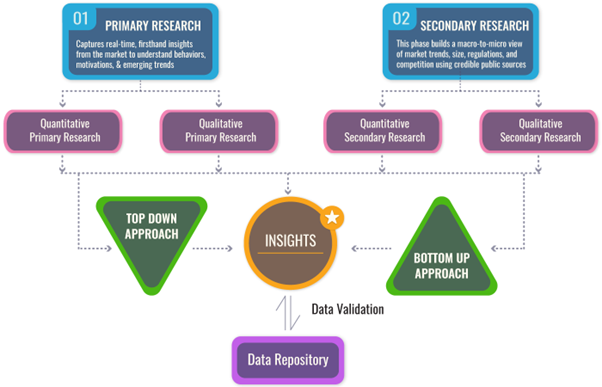
DUAL MODELING: TOP-DOWN + BOTTOM-UP
To ensure robust market estimation, we apply two complementary sizing approaches:
Top-Down Modeling:- Start with broader industry value (e.g., global or regional TAM)
- Apply filters by segment, geography, end-user, or use case
- Adjust with primary insights and validation benchmarks
- Ideal for investor-grade market scans and opportunity mapping
- Aggregate from the ground up using sales volumes, pricing, and unit economics
- Use internal modeling templates aligned with stakeholder data
- Incorporate distributor-level or region-specific inputs
- Most accurate for emerging segments and granular sub-markets
DATA VALIDATION: IN-HOUSE REPOSITORY
We close the loop with proprietary data intelligence built from ongoing projects, industry monitoring, and historical benchmarking. This repository includes:
- Multi-sector market and pricing models
- Key trendlines from past interviews and forecasts
- Benchmarked adoption rates, churn patterns, and ROI indicators
- Industry-specific deviation flags and cross-check logic
- Catches inconsistencies early
- Aligns projections across studies
- Enables consistent, high-trust deliverables