

Telestroke Market Size and Forecast (2025 – 2033), Global and Regional Growth, Trend, Share and Industry Analysis Report Coverage: By Type (Ischemic Stroke, Hemorrhagic Stroke, Transient Ischemic Attack); By Application (Counseling, Diagnosis, Monitoring, Emergency Services, Others); By End Use (Hospital, Specialty Clinic, Others); and Geography
2025-12-17
Healthcare
Swetal (Research Analyst)
Description
Telestroke
Market Overview
The Global Telestroke Market Size
is experiencing robust growth, driven by rising stroke incidences,
technological advancements in telemedicine, and expanding digital healthcare
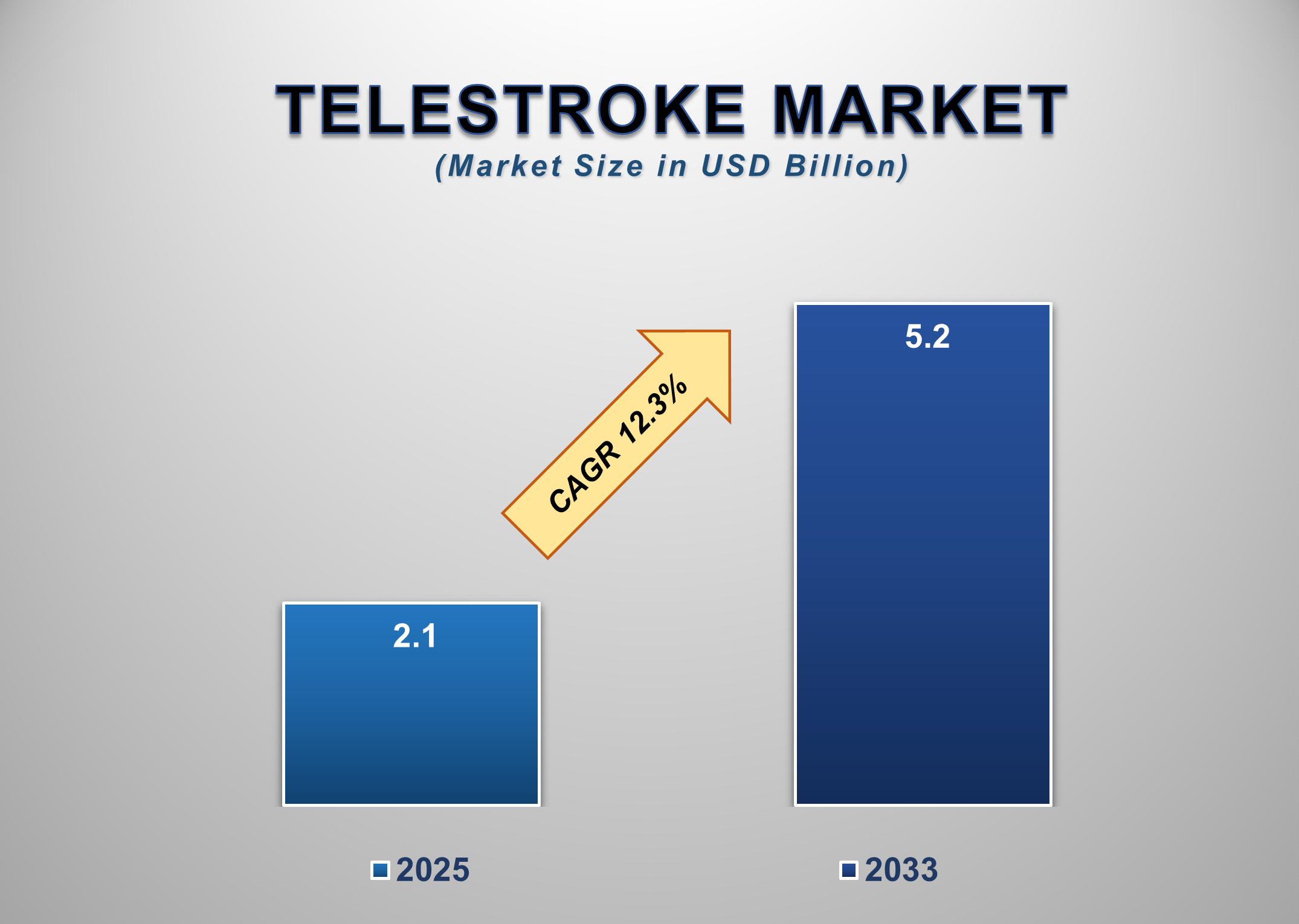
infrastructure worldwide. Valued at USD 2.1 billion in 2025, the market is projected
to reach USD 5.2 billion by 2033, growing at a CAGR of 12.3% during the
forecast period. Telestroke refers to the remote diagnosis and treatment of
stroke patients using telecommunication technologies, connecting neurologists
and emergency departments to ensure rapid evaluation and intervention,
especially in rural or underserved areas.
The increasing global prevalence
of ischemic and hemorrhagic strokes, coupled with the rising geriatric
population, is fueling the demand for efficient remote stroke management
solutions. Timely intervention through telestroke programs significantly reduces
disability rates and mortality by enabling faster treatment decisions.
Furthermore, the integration of artificial intelligence (AI) in stroke imaging,
real-time video consultations, and advanced data-sharing platforms enhances
diagnosis accuracy and treatment efficiency.
Telestroke
Market Drivers and Opportunities
Rising Stroke Incidence and
Growing Geriatric Population Are Accelerating Telestroke Market Growth
The increasing prevalence of
stroke, particularly among the aging population, is a major driver of the
telestroke market. Stroke remains one of the leading causes of mortality and
long-term disability worldwide, creating an urgent need for faster and more
accessible treatment options. Telestroke technology enables immediate access to
expert neurologists, ensuring accurate diagnosis and timely administration of
thrombolytic therapy. With the global elderly population expanding rapidly, the
number of stroke cases is expected to rise correspondingly. Moreover, the
growing awareness of the “golden hour” in stroke management, the critical
window for effective intervention, has encouraged healthcare facilities to
implement remote stroke care programs. Advancements in mobile communication, 5G
networks, and real-time data transmission are further supporting rapid response
systems. In rural and underserved regions where specialist availability is
limited, telestroke programs bridge the care gap, improving treatment access
and patient survival rates. Additionally, the shift toward value-based
healthcare models emphasizing outcome-driven care continues to encourage
hospitals to invest in telemedicine-enabled stroke management systems.
Technological Advancements in
Telecommunication and AI Integration Are Driving Market Expansion
Continuous technological
innovation in telecommunication and medical imaging is transforming the
efficiency of telestroke services. The integration of artificial intelligence
(AI) and machine learning (ML) algorithms enables faster stroke detection, automated
image interpretation, and improved triage decisions. AI-powered diagnostic
platforms, such as Viz.ai and RapidAI, can quickly analyze brain scans and
alert neurologists to potential strokes, drastically reducing diagnosis time.
In addition, the proliferation of
high-speed internet connectivity and mobile health applications has made remote
stroke management feasible even in remote areas. The incorporation of
cloud-based solutions ensures real-time collaboration between emergency
responders and neurologists, while advanced videoconferencing platforms enable
virtual consultations and immediate treatment guidance. Hospitals are
increasingly adopting hybrid models that combine AI-driven analytics with
teleconsultations to improve workflow efficiency and reduce time to treatment.
Governments and healthcare organizations worldwide are also investing in
digital health infrastructure, promoting interoperability, and expanding
reimbursement frameworks for telemedicine. These technological and policy
developments are expected to further propel the telestroke market over the
coming decade.
Expansion of Telestroke
Networks in Developing Economies Offers Significant Growth Potential
The expansion of telestroke
networks into developing economies presents a major growth opportunity for the
global market. Many emerging nations face challenges such as limited access to
specialized neurologists, delayed diagnosis, and inadequate emergency care
infrastructure. Telestroke systems provide an effective solution by enabling
remote access to expert care through digital platforms. As healthcare
digitization advances, countries in the Asia Pacific, Latin America, and Africa
are increasingly adopting telemedicine initiatives to address rural healthcare
disparities.
Public-private partnerships and
government-funded telehealth programs are driving the deployment of regional
telestroke networks. International collaborations, supported by organizations
such as the World Health Organization (WHO), are helping standardize protocols
and train healthcare professionals in remote stroke management. Furthermore,
the growing adoption of smartphones and telecommunication technologies is
facilitating the integration of mobile stroke units and portable diagnostic
systems. As broadband connectivity expands and healthcare reforms prioritize
digital transformation, emerging economies represent untapped markets for
telestroke service providers. These regions offer strong long-term growth
potential for technology developers, healthcare institutions, and telemedicine
startups seeking to enhance stroke care accessibility worldwide.
Telestroke Market Scope
|
Report Attributes |
Description |
|
Market Size in 2025 |
USD 2.1 Billion |
|
Market Forecast in 2033 |
USD 5.2 Billion |
|
CAGR % 2025-2033 |
12.3% |
|
Base Year |
2024 |
|
Historic Data |
2020-2024 |
|
Forecast Period |
2025-2033 |
|
Report USP |
Production, Consumption, Company
Share, Company Heatmap, Company Production Capacity, Growth Factors, and more |
|
Segments Covered |
●
By Type, By
Application, By End Use |
|
Regional Scope |
●
North America ●
Europe ●
APAC ●
Latin America ●
Middle East and
Africa |
|
Country Scope |
1)
U.S. 2)
Canada 3)
Germany 4)
UK 5)
France 6)
Spain 7)
Italy 8)
Switzerland 9)
China 10)
Japan 11)
India 12)
Australia 13)
South Korea 14)
Brazil 15)
Mexico 16)
Argentina 17)
South Africa 18)
Saudi Arabia 19)
UAE |
Telestroke Market Report Segmentation Analysis
The global Telestroke Market
industry analysis is segmented by Type, by Application, by End Use, and by
Region.
The Ischemic Stroke Segment
Accounted for the Largest Market Share in the Global Telestroke Market
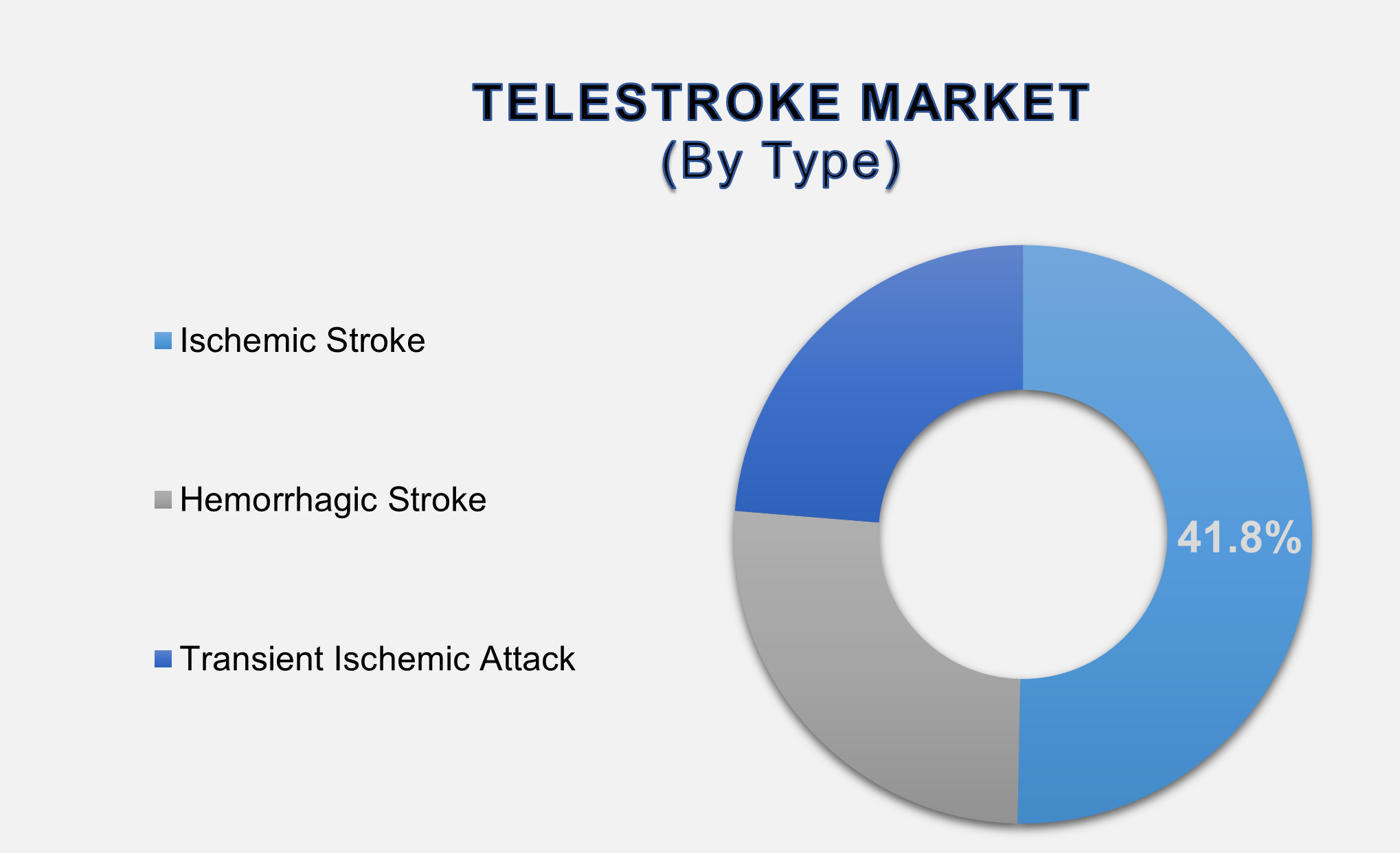
By type, the market is segmented into Ischemic Stroke, Hemorrhagic Stroke, and Transient Ischemic Attack. The Ischemic Stroke segment dominated the market in 2025, accounting for 41.8% of global revenue. This dominance is primarily due to the high prevalence of ischemic stroke cases, which represent nearly 85% of all stroke incidents globally. Telestroke systems play a critical role in providing timely treatment for ischemic stroke patients, where rapid diagnosis and administration of thrombolytics are crucial. The increasing burden of risk factors such as hypertension, diabetes, and obesity has led to a growing need for efficient management solutions. The segment benefits from widespread hospital adoption of AI-enabled diagnostic tools and integrated teleconsultation services, which improve outcomes and reduce hospital stay durations. As healthcare systems prioritize early stroke detection and treatment, the ischemic stroke segment is expected to maintain its leadership position throughout the forecast period.
Counseling Segment Leads the
Market by Application in the Global Telestroke Market
By application, the market is
divided into Counseling, Diagnosis, Monitoring, Emergency Services, and Others.
In 2025, the Counseling segment held the largest market share, driven by
increasing demand for remote neurological consultations and post-stroke
management programs. Telecounseling enables continuous follow-up,
rehabilitation, and patient education, helping reduce readmission rates and
improve quality of life. Healthcare providers use secure communication
platforms to offer emotional and medical support to patients and caregivers.
Furthermore, AI-driven virtual assistants and chatbots are being integrated
into telestroke systems to facilitate communication between doctors and
patients. As stroke survivors often require long-term care and guidance, digital
counseling services have become essential in maintaining patient compliance and
enhancing treatment outcomes. The growing acceptance of telehealth solutions
among both physicians and patients further fuels this segment’s expansion.
The Hospital Segment Accounted
for the Largest Market Share in the Global Telestroke Market
By end use, the market is
segmented into Hospital, Specialty Clinic, and Others.
The Hospital segment dominated the global market in 2025, owing to the
widespread adoption of telemedicine systems in emergency departments and stroke
units. Hospitals are increasingly partnering with telehealth service providers
to implement real-time consultation platforms and AI-based diagnostic tools.
These collaborations enable faster clinical decision-making, especially in
time-sensitive ischemic stroke cases. Moreover, hospitals benefit from the
integration of telestroke networks that connect urban stroke centers with rural
healthcare facilities, expanding access to specialized care. Government
funding, favorable reimbursement policies, and technological advancements in
hospital IT systems further support this segment’s growth. As demand for
advanced acute care continues to rise, hospitals are expected to remain the
primary users of telestroke technologies.
The following segments are
part of an in-depth analysis of the global Telestroke Market:
|
Market
Segments |
|
|
By Type |
●
Ischemic Stroke ●
Hemorrhagic Stroke ●
Transient Ischemic
Attack |
|
By Application |
●
Counseling ●
Diagnosis ●
Monitoring ●
Emergency Services ●
Others |
|
By End Use |
●
Hospital ●
Speciality Clinic ●
Others |
Telestroke
Market Share Analysis by Region
The North America region is
projected to hold the largest share of the global Telestroke Market over the
forecast period.
North America held the largest
share of the global telestroke market, accounting for 41.2% in 2025. The
region’s leadership is driven by advanced healthcare infrastructure, a high
prevalence of stroke cases, and the rapid adoption of telemedicine solutions.
The United States, in particular, has well-established telehealth frameworks
and reimbursement policies that encourage the deployment of telestroke programs
across hospitals and clinics. Key players such as Teladoc Health, GE
Healthcare, Philips, and Medtronic are continuously developing AI-integrated
stroke detection and management solutions. Widespread smartphone penetration,
strong network connectivity, and the increasing emphasis on value-based
healthcare are further enhancing the region’s market potential.
Meanwhile, the Asia Pacific
region is projected to record the fastest CAGR during the forecast period. The
growing incidence of cardiovascular diseases, increasing healthcare
expenditure, and rising digital health adoption are key drivers in countries
such as China, Japan, and India. Governments in the region are investing in
telehealth infrastructure and encouraging public-private collaborations to
improve rural healthcare access. The growing awareness of stroke symptoms and
the importance of timely intervention are also propelling telestroke service
adoption. Additionally, advancements in 5G networks and mobile diagnostics are
enabling remote stroke evaluation and real-time communication between
specialists and patients, positioning the Asia Pacific as a high-growth region
in the coming decade.
Telestroke
Market Competition Landscape Analysis
The global
telestroke market is moderately consolidated, with leading players focusing on
technological innovation, partnerships, and geographic expansion. Key companies
include Philips, Medtronic, GE Healthcare, Siemens Healthineers, Teladoc
Health, American Well, MDLive, Viz.ai, and RapidAI.
Global Telestroke Market Recent Developments News:
- In September 2025,
TeleSpecialists, LLC launched an Integrated Outpatient Teleneurology
Service that pairs on-site advanced practice providers with remote
neurologists using AI-enhanced workflows. The service addresses gaps in
follow-up care and aims to significantly reduce patient wait times for
neurological consultations.
- In February 2025,
Oneida Health Hospital joined the Upstate Telestroke Network, led by
Upstate University Hospital’s Comprehensive Stroke Center in Syracuse.
This partnership enables Oneida’s clinical team to conduct immediate
televideo consultations with remote stroke specialists when patients
present with potential stroke symptoms, improving access to timely
expertise.
- In May 2024, Centra partnered
with Sevaro to implement the Sevaro OneCall telestroke workflow across its
emergency and inpatient units. The system provides rapid connection to
neurologists, guaranteeing a response
in 45 seconds or less for efficient stroke evaluation and treatment
guidance.
The Global Telestroke Market is dominated by a few
large companies, such as
●
Philips
●
Medtronic
●
GE Healthcare
●
Siemens Healthineers
●
Cerner
●
Teladoc Health
●
American Well
●
Doctor on Demand
●
MDLive
●
iSchemaView
●
Viz.ai
●
RapidAI
●
Brainomix
●
Cercare Medical
●
Stryker
●
Neuronics
●
InTouch Health
●
GlobalMed
●
SnapMD
●
Cisco
● Other Prominent Players
Frequently Asked Questions
Swetal (Research Analyst)
Swetal is a Research Analyst with 4+ years of experience specializing in healthcare market research, medical devices, healthcare IT, and medical technology industry analysis. Her expertise includes competitive intelligence, secondary research, market trend forecasting, and healthcare business insights across global healthcare ecosystems.
She contributes to advanced market research reports by analyzing regulatory frameworks, emerging healthcare technologies, competitive landscapes, and innovation trends shaping the medical industry. With a strong focus on accurate market intelligence, strategic insights, and healthcare industry trends, Swetal supports businesses in making informed, data-backed decisions in a rapidly transforming healthcare environment.
1. Global Telestroke Market
Introduction and Market Overview
1.1.
Objectives
of the Study
1.2.
Global
Telestroke Market Scope and Market Estimation
1.2.1.Global Telestroke Market Overall
Market Size (US$ Bn), Market CAGR (%), Market forecast (2025 - 2033)
1.2.2.Global Telestroke Market
Revenue Share (%) and Growth Rate (Y-o-Y) from 2020 - 2033
1.3.
Market
Segmentation
1.3.1.Type of Global Telestroke
Market
1.3.2.Application of Global Telestroke
Market
1.3.3.End Use of Global Telestroke
Market
1.3.4.Region of Global Telestroke
Market
2. Executive
Summary
2.1.
Demand
Side Trends
2.2.
Key
Market Trends
2.3.
Market
Demand (US$ Bn) Analysis 2020 – 2024 and Forecast, 2025 – 2033
2.4.
Demand
and Opportunity Assessment
2.5.
Demand
Supply Scenario
2.6.
Market
Dynamics
2.6.1.Drivers
2.6.2.Limitations
2.6.3.Opportunities
2.6.4.Impact Analysis of Drivers
and Restraints
2.7.
Emerging
Trends for Telestroke Market
2.8.
Porter’s
Five Forces Analysis
2.9.
PEST
Analysis
2.10.
Key
Regulation
3. Global
Telestroke Market Estimates
& Historical Trend Analysis (2020 - 2024)
4.
Global Telestroke Market Estimates & Forecast Trend Analysis, by
Type
4.1.
Global
Telestroke Market Revenue (US$ Bn) Estimates and Forecasts, by Type, 2020 - 2033
4.1.1.Ischemic Stroke
4.1.2.Hemorrhagic Stroke
4.1.3.Transient Ischemic Attack
5.
Global Telestroke Market Estimates & Forecast Trend Analysis, by
Application
5.1.
Global
Telestroke Market Revenue (US$ Bn) Estimates and Forecasts, by Application, 2020
- 2033
5.1.1.Counseling
5.1.2.Diagnosis
5.1.3.Monitoring
5.1.4.Emergency Services
5.1.5.Others
6.
Global Telestroke Market Estimates & Forecast Trend Analysis, by
End Use
6.1.
Global
Telestroke Market Revenue (US$ Bn) Estimates and Forecasts, by End Use, 2020 - 2033
6.1.1.Hospital
6.1.2.Speciality Clinic
6.1.3.Others
7. Global
Telestroke Market Estimates
& Forecast Trend Analysis, by region
1.1.
Global
Telestroke Market Revenue (US$ Bn) Estimates and Forecasts, by region, 2020 - 2033
1.1.1.North America
1.1.2.Europe
1.1.3.Asia Pacific
1.1.4.Middle East & Africa
1.1.5.Latin America
8. North America Telestroke
Market: Estimates & Forecast Trend
Analysis
8.1.
North
America Telestroke Market Assessments & Key Findings
8.1.1.North America Telestroke
Market Introduction
8.1.2.North America Telestroke
Market Size Estimates and Forecast (US$ Billion) (2020 - 2033)
8.1.2.1. By Type
8.1.2.2. By Application
8.1.2.3. By End Use
8.1.2.4.
By
Country
8.1.2.4.1.
The
U.S.
8.1.2.4.2.
Canada
9. Europe Telestroke
Market: Estimates & Forecast Trend
Analysis
9.1.
Europe
Telestroke Market Assessments & Key Findings
9.1.1.Europe Telestroke Market
Introduction
9.1.2.Europe Telestroke Market
Size Estimates and Forecast (US$ Billion) (2020 - 2033)
9.1.2.1. By Type
9.1.2.2. By Application
9.1.2.3. By End Use
9.1.2.4.
By
Country
9.1.2.4.1. Germany
9.1.2.4.2. Italy
9.1.2.4.3. U.K.
9.1.2.4.4. France
9.1.2.4.5. Spain
9.1.2.4.6. Switzerland
9.1.2.4.7.
Rest of Europe
10. Asia Pacific Telestroke
Market: Estimates & Forecast Trend
Analysis
10.1.
Asia
Pacific Market Assessments & Key Findings
10.1.1.
Asia
Pacific Telestroke Market Introduction
10.1.2.
Asia
Pacific Telestroke Market Size Estimates and Forecast (US$ Billion) (2020 - 2033)
10.1.2.1. By Type
10.1.2.2. By Application
10.1.2.3. By End Use
10.1.2.4.
By
Country
10.1.2.4.1. China
10.1.2.4.2. Japan
10.1.2.4.3. India
10.1.2.4.4. Australia
10.1.2.4.5. South Korea
10.1.2.4.6.
Rest
of Asia Pacific
11. Middle East & Africa Telestroke
Market: Estimates & Forecast Trend
Analysis
11.1.
Middle
East & Africa Market Assessments & Key Findings
11.1.1.
Middle East & Africa Telestroke Market Introduction
11.1.2.
Middle East & Africa Telestroke Market Size Estimates and
Forecast (US$ Billion) (2020 - 2033)
11.1.2.1. By Type
11.1.2.2. By Application
11.1.2.3. By End Use
11.1.2.4.
By
Country
11.1.2.4.1. South
Africa
11.1.2.4.2. UAE
11.1.2.4.3. Saudi
Arabia
11.1.2.4.4.
Rest of MEA
12. Latin America
Telestroke Market: Estimates &
Forecast Trend Analysis
12.1.
Latin
America Market Assessments & Key Findings
12.1.1.
Latin
America Telestroke Market Introduction
12.1.2.
Latin
America Telestroke Market Size Estimates and Forecast (US$ Billion) (2020 - 2033)
12.1.2.1. By Type
12.1.2.2. By Application
12.1.2.3. By End Use
12.1.2.4.
By
Country
12.1.2.4.1. Brazil
12.1.2.4.2. Mexico
12.1.2.4.3. Argentina
12.1.2.4.4.
Rest of LATAM
13. Country Wise Market:
Introduction
14.
Competition
Landscape
14.1.
Global
Telestroke Market Product Mapping
14.2.
Global
Telestroke Market Concentration Analysis, by Leading Players / Innovators /
Emerging Players / New Entrants
14.3.
Global
Telestroke Market Tier Structure Analysis
14.4.
Global
Telestroke Market Concentration & Company Market Shares (%) Analysis, 2023
15.
Company
Profiles
15.1. Philips
15.1.1.
Company
Overview & Key Stats
15.1.2.
Financial
Performance & KPIs
15.1.3.
Product
Portfolio
15.1.4.
SWOT
Analysis
15.1.5.
Business
Strategy & Recent Developments
* Similar details would be provided for all
the players mentioned below
15.2. Medtronic
15.3. GE Healthcare
15.4. Siemens
Healthineers
15.5. Cerner
15.6. Teladoc
Health
15.7. American Well
15.8. Doctor on
Demand
15.9. MDLive
15.10. iSchemaView
15.11. Viz.ai
15.12. RapidAI
15.13. Brainomix
15.14. Cercare
Medical
15.15. Stryker
15.16. Neuronics
15.17. InTouch
Health
15.18. GlobalMed
15.19. SnapMD
15.20. Cisco
15.21. Other
Prominent Players
16. Research
Methodology
16.1.
External
Transportations / Databases
16.2.
Internal
Proprietary Database
16.3.
Primary
Research
16.4.
Secondary
Research
16.5.
Assumptions
16.6.
Limitations
16.7.
Report
FAQs
17. Research
Findings & Conclusion
Our Research Methodology
"Insight without rigor is just noise."
We follow a comprehensive, multi-phase research framework designed to deliver accurate, strategic, and decision-ready intelligence. Our process integrates primary and secondary research , both quantitative and qualitative , along with dual modeling techniques ( top-down and bottom-up) and a final layer of validation through our proprietary in-house repository.
PRIMARY RESEARCH
Primary research captures real-time, firsthand insights from the market to understand behaviors, motivations, and emerging trends.
1. Quantitative Primary Research
Objective: Generate statistically significant data directly from market participants.
Approaches:- Structured surveys with customers, distributors, and field agents
- Mobile-based data collection for point-of-sale audits and usage behavior
- Phone-based interviews (CATI) for market sizing and product feedback
- Online polling around industry events and digital campaigns
- Purchase frequency by customer type
- Channel performance across geographies
- Feature demand by application or demographic
2. Qualitative Primary Research
Objective: Explore decision-making drivers, pain points, and market readiness.
Approaches:- In-depth interviews (IDIs) with executives, product managers, and key decision-makers
- Focus groups among end users and early adopters
- Site visits and observational research for consumer products
- Informal field-level discussions for regional and cultural nuances
SECONDARY RESEARCH
This phase helps establish a macro-to-micro understanding of market trends, size, regulation, and competitive dynamics, sourced from credible and public domain information.
1. Quantitative Secondary Research
Objective: Model market value and segment-level forecasts based on published data.
Sources include:- Financial reports and investor summaries
- Government trade data, customs records, and regulatory statistics
- Industry association publications and economic databases
- Channel performance and pricing data from marketplace listings
- Revenue splits, pricing trends, and CAGR estimates
- Supply-side capacity and volume tracking
- Investment analysis and funding benchmarks
2. Qualitative Secondary Research
Objective: Capture strategic direction, innovation signals, and behavioral trends.
Sources include:- Company announcements, roadmaps, and product pipelines
- Publicly available whitepapers, conference abstracts, and academic research
- Regulatory body publications and policy briefs
- Social and media sentiment scanning for early-stage shifts
- Strategic shifts in market positioning
- Unmet needs and white spaces
- Regulatory triggers and compliance impact
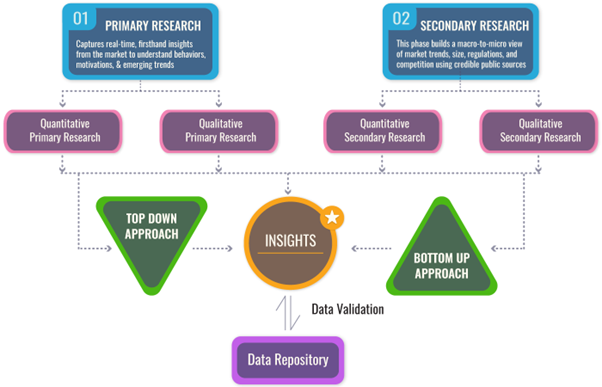
DUAL MODELING: TOP-DOWN + BOTTOM-UP
To ensure robust market estimation, we apply two complementary sizing approaches:
Top-Down Modeling:- Start with broader industry value (e.g., global or regional TAM)
- Apply filters by segment, geography, end-user, or use case
- Adjust with primary insights and validation benchmarks
- Ideal for investor-grade market scans and opportunity mapping
- Aggregate from the ground up using sales volumes, pricing, and unit economics
- Use internal modeling templates aligned with stakeholder data
- Incorporate distributor-level or region-specific inputs
- Most accurate for emerging segments and granular sub-markets
DATA VALIDATION: IN-HOUSE REPOSITORY
We close the loop with proprietary data intelligence built from ongoing projects, industry monitoring, and historical benchmarking. This repository includes:
- Multi-sector market and pricing models
- Key trendlines from past interviews and forecasts
- Benchmarked adoption rates, churn patterns, and ROI indicators
- Industry-specific deviation flags and cross-check logic
- Catches inconsistencies early
- Aligns projections across studies
- Enables consistent, high-trust deliverables