

Textile Colorant Market Size and Forecast (2025–2033), Global and Regional Growth, Trend, Share, and Industry Analysis Report Coverage: By Source (Natural, Synthetic), By Type (Azoic Dyes, Direct Dyes, Basic Dyes, Disperse Dyes, Reactive Dyes, Sulfur Dyes, VAT Dyes, Others), By Application (Clothing, Technical Textiles, Home Textiles & Carpets, Automotive Textiles), and Geography
2026-02-02
Chemicals & Materials
Jaya Bundele (Research Analyst)
Description
Textile Colorant Market Overview
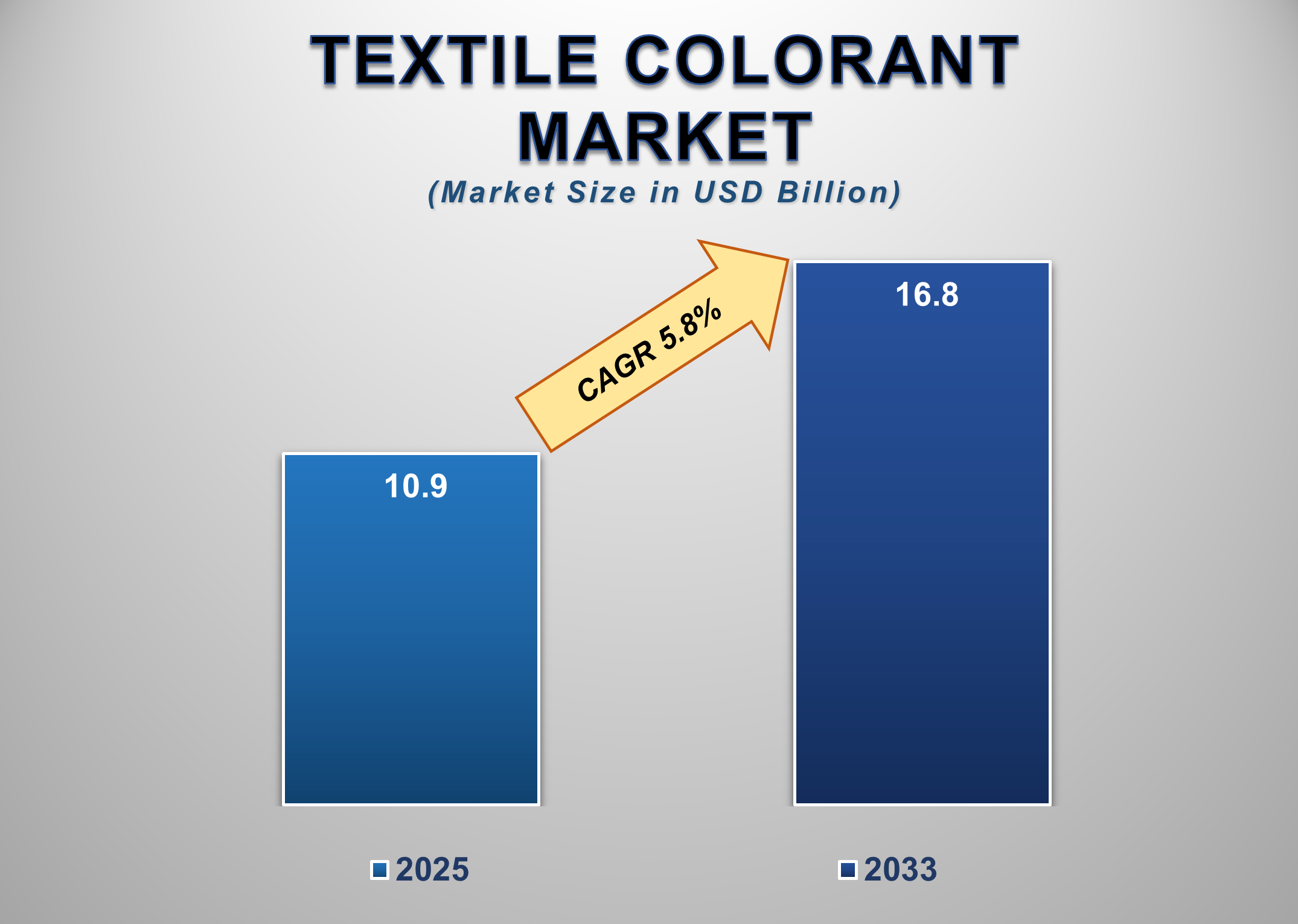
The global Textile Colorant Market was valued at USD 10.9 billion in 2025 and is projected to reach USD 16.8 billion by 2033, expanding at a CAGR of 5.8% during the forecast period. Textile colorants, including dyes and pigments, play a foundational role in defining the visual appeal, branding, and functional performance of textile products across apparel, home furnishings, industrial fabrics, and automotive interiors. As global textile and apparel production continues to expand, particularly in Asia-Pacific manufacturing hubs, demand for reliable, high-performance, and sustainable colorants is increasing steadily.
The market is undergoing a
structural transition driven by environmental regulations, consumer preference
for eco-friendly fabrics, and the fashion industry’s push toward sustainable
sourcing. Natural colorants are gaining significant traction, accounting for
34.8% of total market share, as brands shift away from petroleum-based dyes
toward biodegradable, non-toxic alternatives. Meanwhile, technological
advancements in synthetic dyes, such as reactive and disperse dyes, are
improving colorfastness, wash resistance, and compatibility with modern fibers
like polyester and blended textiles.
Textile Colorant Market
Drivers and Opportunities
Rising
Global Textile and Apparel Production Is Driving Textile Colorant Demand
Expanding global demand for apparel, home furnishings, and
technical textiles is a key driver of the textile colorant market. Rapid
urbanization, rising disposable income, and fast-fashion business models are
driving higher volumes of textile production, particularly in emerging
economies. Every garment, upholstery fabric, or industrial textile requires
multiple stages of dyeing and finishing, making colorants an indispensable
component of the textile value chain. Asia-Pacific continues to lead global textile
manufacturing, with countries such as China, India, Bangladesh, and Vietnam
serving as major suppliers to international fashion brands. As production
volumes increase, so does the consumption of dyes and pigments across spinning,
weaving, knitting, and finishing processes. Additionally, the growth of
technical textiles used in automotive, construction, medical, and industrial
applications is expanding the market for high-performance colorants that
deliver durability, chemical resistance, and UV stability.
Moreover, fashion cycles are becoming shorter, driving higher
color variety and faster dyeing throughput. This is boosting demand for
versatile dye systems such as reactive, disperse, and direct dyes that can
deliver consistent shades across large production runs. As global textile
exports continue to grow, the need for advanced, cost-effective, and scalable
colorant solutions is accelerating market expansion.
Shift Toward Sustainable and Eco-Friendly Dyeing Is Reshaping
the Market
Environmental concerns and regulatory pressure are transforming
the textile colorant industry. Conventional synthetic dyes often generate
wastewater containing toxic chemicals, heavy metals, and non-biodegradable
compounds, creating major environmental and compliance challenges for textile
producers. Governments across Europe, North America, and increasingly Asia are
enforcing stricter effluent treatment and chemical usage standards, pushing
manufacturers to adopt greener dyeing solutions.
This regulatory shift is driving strong growth in natural
colorants derived from plants, minerals, and bio-based sources. With natural
colorants accounting for 34.8% of the market, fashion brands are increasingly
marketing naturally dyed garments as premium, sustainable, and skin-friendly
products. At the same time, chemical companies are investing in low-impact
synthetic dyes, including high-exhaust reactive dyes and water-saving dyeing
technologies that reduce chemical and water consumption. Large apparel brands
are also setting sustainability targets that require suppliers to use
certified, low-toxicity colorants. This is reshaping procurement strategies and
accelerating the adoption of eco-compliant dye portfolios. As environmental
compliance becomes a competitive requirement rather than an option, sustainable
colorant solutions are becoming a powerful growth driver for the industry.
Digital Textile Printing and Fiber Innovation Are Creating
High-Value Opportunities
The expansion of digital textile printing and advanced fiber
technologies presents a major growth opportunity for the textile colorant
market. Digital printing allows manufacturers to apply precise, high-resolution
colors directly onto fabrics, enabling customization, shorter production runs,
and reduced waste. This shift is creating strong demand for specialized inks
and dye formulations optimized for digital printing platforms. At the same
time, the textile industry is rapidly adopting new fibers such as recycled
polyester, bio-based fabrics, and high-performance technical textiles. These
materials require advanced colorants that offer strong bonding, color vibrancy,
and durability. Traditional dye systems are often incompatible with modern
fibers, creating opportunities for innovative dye chemistry and application
methods. As fashion brands move toward on-demand manufacturing and mass
customization, colorant suppliers that can deliver digitally compatible,
sustainable, and high-performance solutions will gain a competitive edge. This
evolution is expected to significantly increase the value per unit of textile
colorants, driving premiumization and profitability across the market.
Textile Colorant Market
Scope
|
Report Attributes |
Description |
|
Market Size in 2025 |
USD 10.9 Billion |
|
Market Forecast in 2033 |
USD 16.8 Billion |
|
CAGR % 2025-2033 |
5.8% |
|
Base Year |
2024 |
|
Historic Data |
2020-2024 |
|
Forecast Period |
2025-2033 |
|
Report USP |
Production, Consumption,
Company Share, Company Heatmap, Company Production Capacity, Growth factors,
and more |
|
Segments Covered |
●
Source, Type,
Application |
|
Regional Scope |
●
North America, ●
Europe, ●
APAC, ●
Latin America ●
Middle East and
Africa |
|
Country Scope |
1)
U.S. 2)
Canada 3)
Germany 4)
UK 5)
France 6)
Spain 7)
Italy 8)
Switzerland 9)
China 10)
Japan 11)
India 12)
Australia 13)
South Korea 14)
Brazil 15)
Mexico 16)
Argentina 17)
South Africa 18)
Saudi Arabia 19)
UAE |
Textile Colorant Market
Report Segmentation Analysis
The Global Textile Colorant
Market Industry Analysis is segmented by Source, Type, Application, and Region.
Natural Segment Accounted for Largest Market Share in the
Global Textile Colorant Market
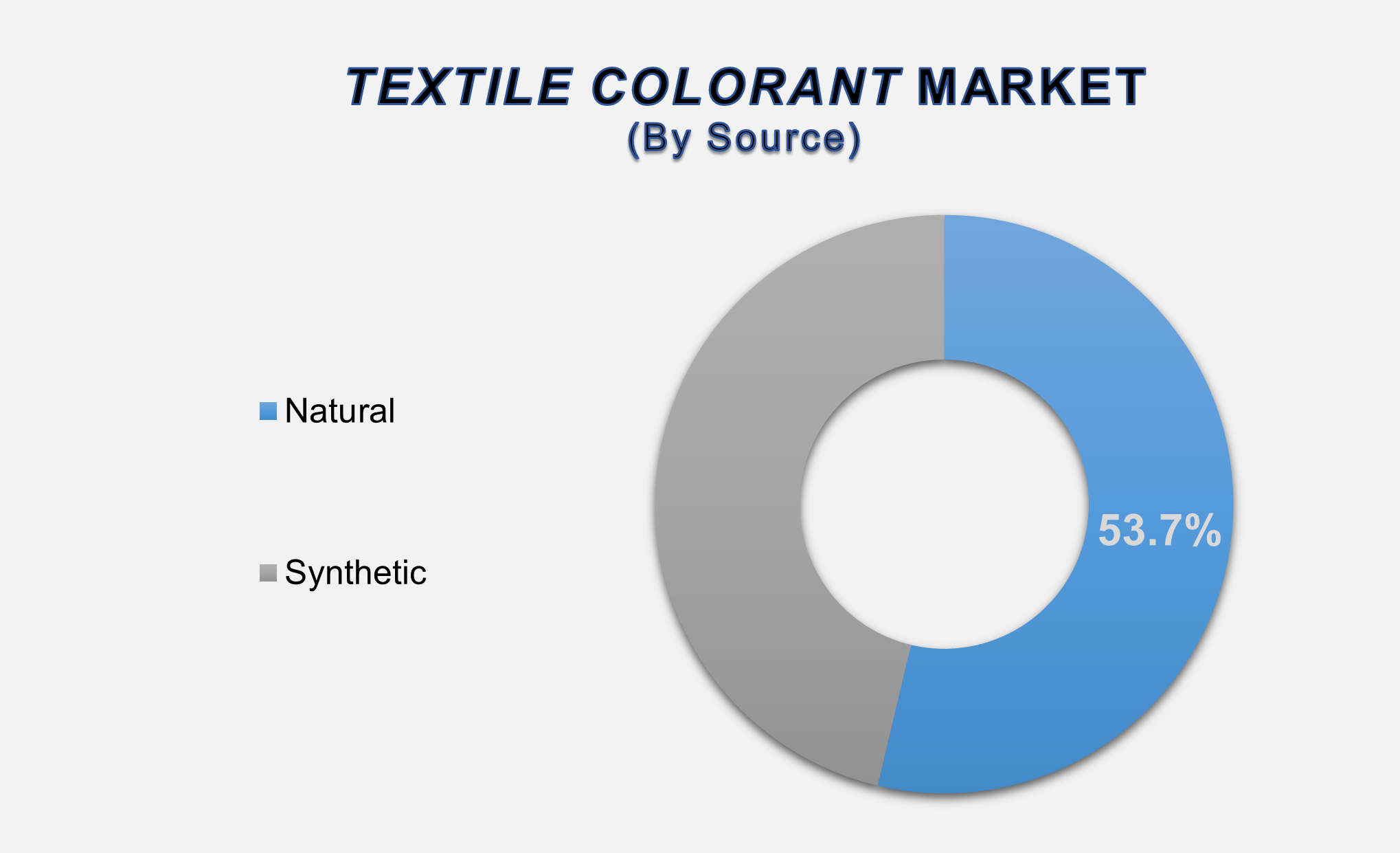
The natural segment accounted for the largest market share in the global textile colorant market, driven by rising sustainability awareness and increasing restrictions on synthetic dye chemicals. Natural dyes derived from plants, minerals, and organic sources are gaining popularity among apparel brands seeking eco-friendly and skin-safe products. These dyes are especially popular in premium clothing, organic apparel, and traditional textiles, where environmental credentials are becoming a key differentiator. Consumer demand for chemical-free and biodegradable fabrics is pushing brands to incorporate natural dyes into their collections. Additionally, natural colorants often offer softer shades and unique tonal variations that appeal to fashion designers and niche markets. While cost and scalability remain challenges, ongoing research into improved extraction and stabilization techniques is making natural dyes more commercially viable. As sustainability continues to shape textile procurement, the natural colorant segment is expected to maintain its leadership position.
Azoic
Dyes Segment Holds a Strong Position Across High-Volume Textile Applications
The
azoic dyes segment holds a strong share in the global textile colorant market
due to its cost-effectiveness and ability to deliver bright, vibrant shades,
particularly in cotton and cellulosic fibers. Azoic dyes are widely used in
mass-market clothing and home textiles because they offer good colorfastness and can be applied using relatively simple dyeing
processes. These dyes are especially popular in high-volume textile
manufacturing hubs in the Asia-Pacific region,
where efficiency, affordability, and consistent color output are critical.
Although environmental concerns are prompting gradual substitution in some
markets, azoic dyes remain essential for large-scale production of garments,
upholstery, and printed fabrics. Ongoing improvements in low-toxicity azo
formulations are helping this segment retain relevance in a more regulated
environment.
Clothing
Segment Represents the Largest Application Area for Textile Colorants
The
clothing segment accounted for the largest share of the textile colorant
market, reflecting the enormous global demand for dyed garments across fast
fashion, sportswear, luxury apparel, and traditional clothing. Every apparel
category, from T-shirts and denim to formal
wear and activewear, relies heavily on dyes
and pigments to create brand identity, visual appeal, and consumer
differentiation. Rapid fashion cycles and growing e-commerce penetration are
driving higher garment production volumes, which directly increase colorant
consumption. Additionally, trends such as custom designs, limited-edition
releases, and regional fashion preferences are increasing the number of colors
and shades used per production run. As the apparel industry continues to expand,
particularly in emerging markets, the clothing segment will remain the primary
revenue generator for textile colorant suppliers.
The following segments are
part of an in-depth analysis of the global Textile Colorant market:
|
Market Segments |
|
|
By Source |
●
Natural ●
Synthetic |
|
By Type |
●
Azoic Dyes ●
Direct Dyes ●
Basic Dyes ●
Disperse Dyes ●
Reactive Dyes ●
Sulfur Dyes ●
VAT Dyes ●
Others |
|
By Application |
●
Clothing ●
Technical Textiles ●
Home Textiles &
Carpets ●
Automotive Textiles |
Textile Colorant Market
Share Analysis by Region
North America is
anticipated to hold the biggest portion of the Textile Colorant Market globally
throughout the forecast period.
Asia-Pacific dominates the
textile colorant market with a 41.9% share, driven by the region’s position as
the global hub for textile and garment manufacturing. China, India, Bangladesh,
Vietnam, and Indonesia host thousands of dyeing and finishing facilities
supplying international fashion and home textile brands. Strong export demand,
low-cost labor, and expanding production capacity continue to reinforce
Asia-Pacific’s leadership.
North America is expected to grow
at the fastest CAGR, supported by increasing adoption of sustainable textiles,
reshoring of manufacturing, and growth in technical textiles for automotive,
medical, and industrial applications. Rising regulatory enforcement and
consumer demand for eco-friendly products are also boosting demand for advanced
and compliant colorant solutions in the region.
Textile Colorant Market
Competition Landscape Analysis
The textile colorant market is
highly competitive, with players focusing on sustainable dye portfolios,
digital printing inks, and compliance-ready formulations. Companies are
investing in R&D to meet environmental regulations while improving color performance
and application efficiency.
Global Textile Colorant
Market Recent Developments News:
- In June 2023,
Archroma entered a partnership with COLOURizd to focus on
eco-friendlier production of high-performance sustainable textiles, aiming
for maximum consumer appeal with minimal environmental impact.
- In February 2023,
Archroma completed the acquisition of the Textile Effects business
from Huntsman Corporation, integrating it with its
own Brand & Performance Textile Specialties business to form a new
division named Archroma Textile Effects.
The Global Textile Colorant Market
Is Dominated by a Few Large Companies, such as
●
Kapsch TrafficCom AG
●
Huntsman Corporation
●
Archroma
●
DyStar
●
Kiri Industries
●
BASF
●
Zhejiang Longsheng
Group
●
Jihua Group
●
Atul Ltd
●
Allied Industrial Corp
●
Yorkshire Group
●
Synthesia
●
Lanxess
●
Organic Dyes and
Pigments
●
Everlight Chemical
●
Kyung-In Synthetic
●
BEZEMA
●
Colourtex
●
Jay Chemicals
●
Apexical
●
Pidilite Industries
● Others
Frequently Asked Questions
Jaya Bundele (Research Analyst)
Jaya Bundele is a skilled Research Analyst with 4+ years of experience in market intelligence, consumer insights, competitive analysis, and industry forecasting across the consumer goods, agriculture, and food & beverage sectors. She specializes in market sizing, trend analysis, growth opportunity mapping, and strategic secondary research for global and regional markets.
Her expertise lies in transforming complex industry data into actionable business strategies that help organizations identify emerging trends, understand customer behavior, and gain a competitive edge. With a strong focus on data-driven insights, business intelligence, and future market trends, Jaya delivers high-quality research solutions aligned with evolving industry demands and market dynamics.
1. Global Textile Colorant
Market Introduction and Market Overview
1.1.
Objectives
of the Study
1.2.
Global
Textile Colorant Market Scope and Market Estimation
1.2.1.Global Textile Colorant Overall
Market Size (US$ Bn), Market CAGR (%), Market forecast (2025 - 2033)
1.2.2.Global Textile Colorant
Market Revenue Share (%) and Growth Rate (Y-o-Y) from 2020 - 2033
1.3.
Market
Segmentation
1.3.1.Type of Global Textile
Colorant Market
1.3.2.Source of Global Textile
Colorant Market
1.3.3.Application of Global Textile
Colorant Market
1.3.4.Region of Global Textile
Colorant Market
2. Executive
Summary
2.1.
Demand
Side Trends
2.2.
Key
Market Trends
2.3.
Market
Demand (US$ Bn) Analysis 2020 – 2024 and Forecast, 2025 – 2033
2.4.
Demand
and Opportunity Assessment
2.5.
Key
Developments
2.6.
Overview
of Tariff, Regulatory Landscape and Standards
2.7.
Market
Entry Strategies
2.8.
Market
Dynamics
2.8.1.Drivers
2.8.2.Limitations
2.8.3.Opportunities
2.8.4.Impact Analysis of Drivers
and Restraints
2.9.
Porter’s
Five Forces Analysis
2.10.
PEST
Analysis
3. Global
Textile Colorant Market Estimates
& Historical Trend Analysis (2020 - 2024)
4. Global
Textile Colorant Market Estimates
& Forecast Trend Analysis, by Type
4.1.
Global
Textile Colorant Market Revenue (US$ Bn) Estimates and Forecasts, by Type, 2020
- 2033
4.1.1.Azoic Dyes
4.1.2.Direct Dyes
4.1.3.Basic Dyes
4.1.4.Disperse Dyes
4.1.5.Reactive Dyes
4.1.6.Sulfur Dyes
4.1.7.VAT Dyes
4.1.8.Others
5. Global
Textile Colorant Market Estimates
& Forecast Trend Analysis, by Source
5.1.
Global
Textile Colorant Market Revenue (US$ Bn) Estimates and Forecasts, by Source,
2020 - 2033
5.1.1.Natural
5.1.2.Synthetic
6. Global
Textile Colorant Market Estimates
& Forecast Trend Analysis, by Application
6.1.
Global
Textile Colorant Market Revenue (US$ Bn) Estimates and Forecasts, by Application,
2020 - 2033
6.1.1.Clothing
6.1.2.Technical Textiles
6.1.3.Home Textiles &
Carpets
6.1.4.Automotive Textiles
7. Global
Textile Colorant Market Estimates
& Forecast Trend Analysis, by Region
7.1.
Global
Textile Colorant Market Revenue (US$ Bn) Estimates and Forecasts, by Region, 2020
- 2033
7.1.1.North America
7.1.2.Europe
7.1.3.Asia Pacific
7.1.4.Middle East & Africa
7.1.5.Latin America
8. North America Textile
Colorant Market: Estimates &
Forecast Trend Analysis
8.1.
North
America Textile Colorant Market Assessments & Key Findings
8.1.1.North America Textile
Colorant Market Introduction
8.1.2.North America Textile
Colorant Market Size Estimates and Forecast (US$ Billion) (2020 - 2033)
8.1.2.1. By Type
8.1.2.2. By Source
8.1.2.3. By Application
8.1.2.4.
By
Country
8.1.2.4.1. The U.S.
8.1.2.4.2. Canada
9. Europe Textile
Colorant Market: Estimates &
Forecast Trend Analysis
9.1.
Europe
Textile Colorant Market Assessments & Key Findings
9.1.1.Europe Textile Colorant
Market Introduction
9.1.2.Europe Textile Colorant
Market Size Estimates and Forecast (US$ Billion) (2020 - 2033)
9.1.2.1. By Type
9.1.2.2. By Source
9.1.2.3. By Application
9.1.2.4.
By
Country
9.1.2.4.1.
Germany
9.1.2.4.2.
Italy
9.1.2.4.3.
U.K.
9.1.2.4.4.
France
9.1.2.4.5.
Spain
9.1.2.4.6.
Switzerland
9.1.2.4.7. Rest
of Europe
10. Asia Pacific Textile
Colorant Market: Estimates &
Forecast Trend Analysis
10.1.
Asia
Pacific Market Assessments & Key Findings
10.1.1.
Asia
Pacific Textile Colorant Market Introduction
10.1.2.
Asia
Pacific Textile Colorant Market Size Estimates and Forecast (US$ Billion) (2020
- 2033)
10.1.2.1. By Type
10.1.2.2. By Source
10.1.2.3. By Application
10.1.2.4.
By
Country
10.1.2.4.1. China
10.1.2.4.2. Japan
10.1.2.4.3. India
10.1.2.4.4. Australia
10.1.2.4.5. South Korea
10.1.2.4.6. Rest of Asia Pacific
11. Middle East & Africa Textile
Colorant Market: Estimates &
Forecast Trend Analysis
11.1.
Middle
East & Africa Market Assessments & Key Findings
11.1.1.
Middle East & Africa Textile Colorant Market Introduction
11.1.2.
Middle East & Africa Textile Colorant Market Size Estimates
and Forecast (US$ Billion) (2020 - 2033)
11.1.2.1. By Type
11.1.2.2. By Source
11.1.2.3. By Application
11.1.2.4.
By
Country
11.1.2.4.1. UAE
11.1.2.4.2. Saudi
Arabia
11.1.2.4.3. South
Africa
11.1.2.4.4. Rest
of MEA
12. Latin America
Textile Colorant Market: Estimates
& Forecast Trend Analysis
12.1.
Latin
America Market Assessments & Key Findings
12.1.1.
Latin
America Textile Colorant Market Introduction
12.1.2.
Latin
America Textile Colorant Market Size Estimates and Forecast (US$ Billion) (2020
- 2033)
12.1.2.1. By Type
12.1.2.2. By Source
12.1.2.3. By Application
12.1.2.4.
By
Country
12.1.2.4.1. Brazil
12.1.2.4.2. Argentina
12.1.2.4.3. Mexico
12.1.2.4.4. Rest
of LATAM
13. Country Wise Market:
Introduction
14.
Competition
Landscape
14.1.
Global
Textile Colorant Market Product Mapping
14.2.
Global
Textile Colorant Market Concentration Analysis, by Leading Players / Innovators
/ Emerging Players / New Entrants
14.3.
Global
Textile Colorant Market Tier Structure Analysis
14.4.
Global
Textile Colorant Market Concentration & Company Market Shares (%) Analysis,
2024
15.
Company
Profiles
15.1.
Huntsman Corporation
15.1.1.
Company
Overview & Key Stats
15.1.2.
Financial
Performance & KPIs
15.1.3.
Product
Portfolio
15.1.4.
SWOT
Analysis
15.1.5.
Business
Strategy & Recent Developments
* Similar details would be provided for all the players
mentioned below
15.2. Archroma
15.3. DyStar
15.4. Kiri
Industries
15.5. BASF
15.6. Zhejiang
Longsheng Group
15.7. Jihua
Group
15.8. Atul Ltd
15.9. Allied
Industrial Corp
15.10. Yorkshire
Group
15.11. Synthesia
15.12. Lanxess
15.13. Organic
Dyes and Pigments
15.14. Everlight
Chemical
15.15. Kyung-In
Synthetic
15.16. BEZEMA
15.17. Colourtex
15.18. Jay
Chemicals
15.19. Apexical
15.20. Pidilite
Industries
15.21. Others
16. Research
Methodology
16.1.
External
Transportations / Databases
16.2.
Internal
Proprietary Database
16.3.
Primary
Research
16.4.
Secondary
Research
16.5.
Assumptions
16.6.
Limitations
16.7.
Report
FAQs
17. Research
Findings & Conclusion
Our Research Methodology
"Insight without rigor is just noise."
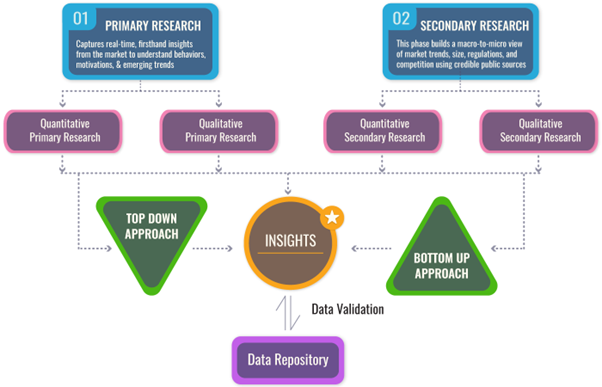
We follow a comprehensive, multi-phase research framework designed to deliver accurate, strategic, and decision-ready intelligence. Our process integrates primary and secondary research , both quantitative and qualitative , along with dual modeling techniques ( top-down and bottom-up) and a final layer of validation through our proprietary in-house repository.
PRIMARY RESEARCH
Primary research captures real-time, firsthand insights from the market to understand behaviors, motivations, and emerging trends.
1. Quantitative Primary Research
Objective: Generate statistically significant data directly from market participants.
Approaches:- Structured surveys with customers, distributors, and field agents
- Mobile-based data collection for point-of-sale audits and usage behavior
- Phone-based interviews (CATI) for market sizing and product feedback
- Online polling around industry events and digital campaigns
- Purchase frequency by customer type
- Channel performance across geographies
- Feature demand by application or demographic
2. Qualitative Primary Research
Objective: Explore decision-making drivers, pain points, and market readiness.
Approaches:- In-depth interviews (IDIs) with executives, product managers, and key decision-makers
- Focus groups among end users and early adopters
- Site visits and observational research for consumer products
- Informal field-level discussions for regional and cultural nuances
SECONDARY RESEARCH
This phase helps establish a macro-to-micro understanding of market trends, size, regulation, and competitive dynamics, sourced from credible and public domain information.
1. Quantitative Secondary Research
Objective: Model market value and segment-level forecasts based on published data.
Sources include:- Financial reports and investor summaries
- Government trade data, customs records, and regulatory statistics
- Industry association publications and economic databases
- Channel performance and pricing data from marketplace listings
- Revenue splits, pricing trends, and CAGR estimates
- Supply-side capacity and volume tracking
- Investment analysis and funding benchmarks
2. Qualitative Secondary Research
Objective: Capture strategic direction, innovation signals, and behavioral trends.
Sources include:- Company announcements, roadmaps, and product pipelines
- Publicly available whitepapers, conference abstracts, and academic research
- Regulatory body publications and policy briefs
- Social and media sentiment scanning for early-stage shifts
- Strategic shifts in market positioning
- Unmet needs and white spaces
- Regulatory triggers and compliance impact
DUAL MODELING: TOP-DOWN + BOTTOM-UP
To ensure robust market estimation, we apply two complementary sizing approaches:
Top-Down Modeling:- Start with broader industry value (e.g., global or regional TAM)
- Apply filters by segment, geography, end-user, or use case
- Adjust with primary insights and validation benchmarks
- Ideal for investor-grade market scans and opportunity mapping
- Aggregate from the ground up using sales volumes, pricing, and unit economics
- Use internal modeling templates aligned with stakeholder data
- Incorporate distributor-level or region-specific inputs
- Most accurate for emerging segments and granular sub-markets
DATA VALIDATION: IN-HOUSE REPOSITORY
We close the loop with proprietary data intelligence built from ongoing projects, industry monitoring, and historical benchmarking. This repository includes:
- Multi-sector market and pricing models
- Key trendlines from past interviews and forecasts
- Benchmarked adoption rates, churn patterns, and ROI indicators
- Industry-specific deviation flags and cross-check logic
- Catches inconsistencies early
- Aligns projections across studies
- Enables consistent, high-trust deliverables