

Thin Film Solar Cells Market Size and Forecast (2020 - 2033), Global and Regional Growth, Trend, Share, and Industry Analysis Report Coverage: By Type (Cadmium Telluride (CdTe), Copper Indium Gallium Selenide (CIGS), Amorphous Silicon (a-Si), Perovskite), By Application (Utility-Scale, Commercial, Residential, Off-Grid), By End-User (Energy, Industrial, Automotive, Construction) And Geography
2025-12-17
Energy & Power
Ekta Chaurasia (Team Lead)
Description
Thin Film
Solar Cells Market Overview
The Thin Film Solar Cells Market is poised for robust growth from 2025 to 2033, driven by the global push for renewable energy, rising demand for cost-effective and versatile solar solutions, and continuous technological advancements. The market is projected to be valued at approximately USD 18.8 billion in 2025 and is forecasted to reach nearly USD 37.0 billion by 2033, exhibiting a compound annual growth rate (CAGR) of 9.1% during this period.
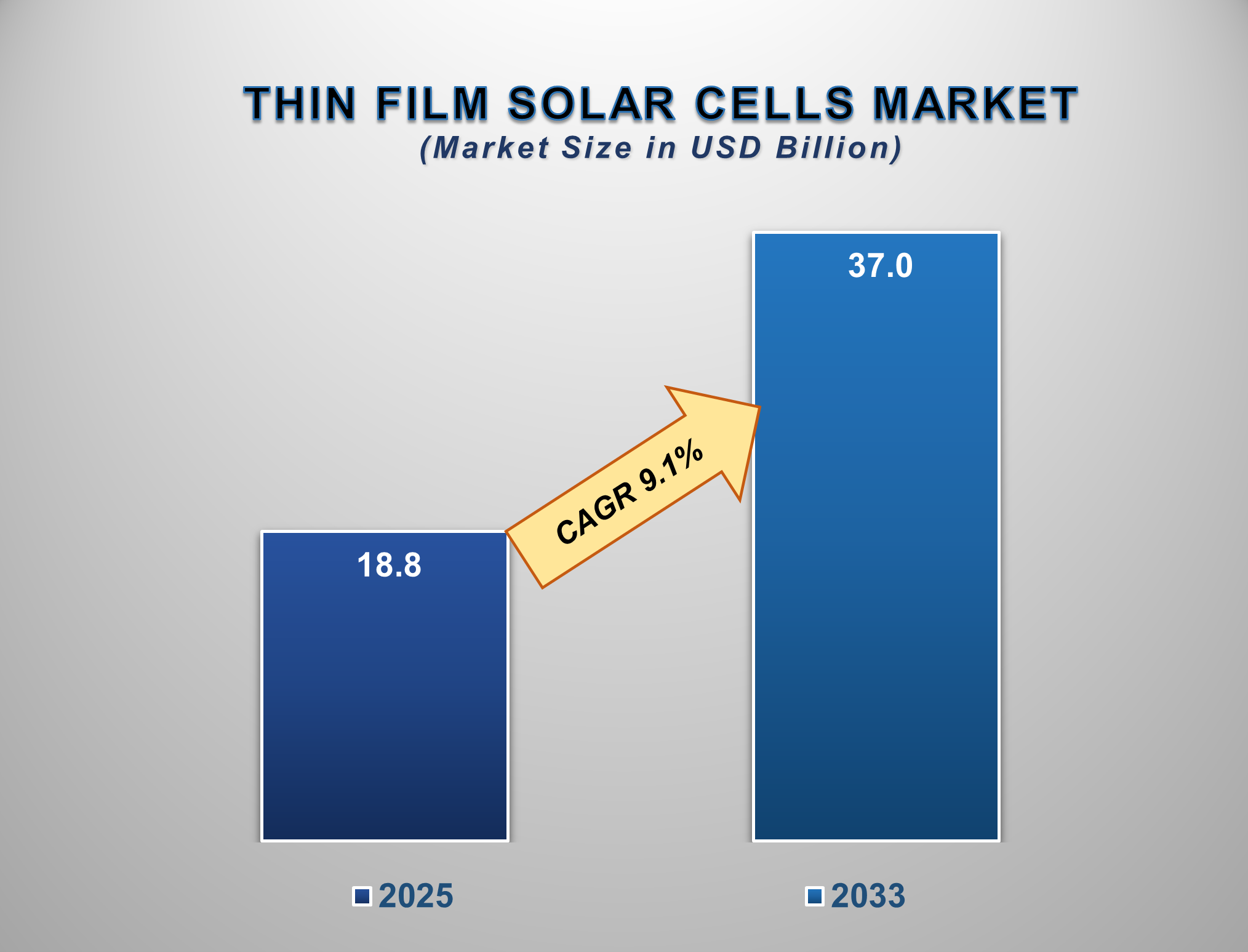
Thin-film solar cells are lightweight, flexible,
and semi-transparent photovoltaic devices that convert sunlight into
electricity. Unlike traditional silicon-wafer-based panels, they are created by
depositing one or more thin layers of photovoltaic material onto a substrate
like glass, plastic, or metal. The market's expansion is primarily fuelled by
their lower manufacturing costs, superior performance in low-light conditions,
and minimal material usage.
The versatility of thin film technology enables
its integration into building-integrated photovoltaics (BIPV),
vehicle-integrated photovoltaics (VIPV), and portable electronics, opening up
new application avenues. Government incentives, favorable policies promoting solar energy, and the declining cost of
raw materials are also significant contributors. Asia Pacific holds the largest
market share, driven by massive solar installations and a strong manufacturing
base, while North America and Europe are key regions for technological
innovation and BIPV adoption.
Thin Film Solar Cells Market Drivers and
Opportunities
Global Renewable Energy Transition and Cost Competitiveness
is the Primary Market Driver
The global imperative to transition from fossil
fuels to renewable energy sources is the most powerful driver for the thin-film solar cells market. Governments worldwide are setting
ambitious carbon neutrality targets, implementing supportive policies, and
offering subsidies for solar power generation. Thin film technology has become
increasingly cost-competitive with conventional crystalline silicon (c-Si)
panels, particularly for large-scale utility projects. The Levelized Cost of
Energy (LCOE) for thin-film solar, especially Cadmium Telluride (CdTe), is
among the lowest in the solar industry. This cost advantage, combined with
simpler and less energy-intensive manufacturing processes, makes thin film an
attractive option for developers aiming to maximize return on investment for
massive solar farms. The scalability of production and the ability to be
manufactured on flexible substrates further enhance its appeal for a diverse
range of applications beyond traditional solar farms, solidifying its role as a
cornerstone technology in the global energy transition.
Versatility and Emerging Application in Building-Integrated
Photovoltaics (BIPV) Are Driving Market Evolution
The unique physical properties of thin film
solar cells, such as flexibility, lightweight, and semi-transparency, are
unlocking new markets beyond conventional solar panels. The most significant
growth frontier is Building-Integrated Photovoltaics (BIPV), where solar cells
are seamlessly incorporated into building materials like windows, facades, and
roofs. This transforms buildings from energy consumers to energy producers
without compromising aesthetics. Similarly, the automotive industry is
exploring vehicle-integrated photovoltaics (VIPV) to power auxiliary systems
and extend the range of electric vehicles. The ability to deploy thin film on
curved surfaces and for portable charging applications further diversifies its
potential. This trend towards integrated and aesthetically pleasing solar
solutions is a major catalyst for market expansion beyond the utility sector.
Technological Breakthroughs in Perovskite and Tandem Cells
Present Significant Opportunities
Continuous innovation in materials and cell
architecture presents substantial growth frontiers. The most promising
opportunity lies in the development of perovskite solar cells, which have
demonstrated remarkable efficiency gains in laboratory settings and offer the
potential for ultra-low-cost, printable solar panels. The emergence of tandem
cells, which combine a thin film layer (like perovskite) with a traditional
silicon cell to capture a broader spectrum of sunlight, represents a
significant leap forward. These multi-junction cells have the potential to
shatter efficiency records, making solar power even more productive and
cost-effective. For manufacturers, investing in R&D to scale up perovskite
production, improve the long-term stability of new materials, and develop
commercial-grade tandem modules are key strategies for capturing future market share and driving the next
wave of solar adoption.
Thin Film Solar Cells Market Scope
|
Report Attributes |
Description |
|
Market Size in 2025 |
USD 18.8 Billion |
|
Market Forecast in 2033 |
USD 37.0 Billion |
|
CAGR % 2025-2033 |
9.1% |
|
Base Year |
2024 |
|
Historic Data |
2020-2024 |
|
Forecast Period |
2025-2033 |
|
Report USP |
Product Portfolio,
Technological Analysis, Company Market Share, Company Heatmap, Pricing
Analysis, Growth Factors and more |
|
Segments Covered |
●
By Type ●
By Application ●
By End-user |
|
Regional Scope |
●
North America, ●
Europe, ●
APAC, ●
Latin America ●
Middle East and
Africa |
|
Country Scope |
1)
U.S. 2)
Canada 3)
Germany 4)
UK 5)
France 6)
Spain 7)
Italy 8)
Switzerland 9)
China 10)
Japan 11)
India 12)
Australia 13)
South Korea 14)
Brazil 15)
Mexico 16)
Argentina 17)
South Africa 18)
Saudi Arabia 19)
UAE |
Thin Film Solar Cells Market Report Segmentation
Analysis
The global Thin Film Solar Cells
Market industry analysis is segmented by Type, by Application, by End-User, and
by Region.
The Dominance of Cadmium
Telluride (CdTe)
The Cadmium Telluride (CdTe) segment is anticipated to command a dominant market share in 2025 due to its established position as the most commercially mature and cost-effective thin-film technology. Unlike its competitors, CdTe boasts a simplified and rapid manufacturing process, leading to the lowest production cost per watt, which is a critical factor for large-scale adoption. Its modules have demonstrated high and reliable efficiency in real-world, mass-produced settings, particularly excelling in hot and humid climates and under diffuse light conditions. This proven performance and durability in massive utility-scale projects have built strong trust among developers and investors. Furthermore, the supply chain for CdTe materials is well-developed and robust, minimizing production bottlenecks. As a result, CdTe's combination of economic advantage, proven field performance, and manufacturing scalability solidifies its leadership over newer and more niche thin-film alternatives like CIGS and the still-developing perovskite cells.

The Leadership of the
Utility-Scale Application
The
Utility-Scale segment is projected to be the largest application area for
thin-film solar cells because it directly leverages the technology's core
economic strengths. The primary driver for utility-scale solar farm developers
is minimizing the Levelized Cost of Energy (LCOE), and thin-film panels,
especially those based on Cadmium Telluride (CdTe), consistently offer one of
the lowest LCOEs in the entire solar industry. Their cost-effectiveness,
derived from cheaper manufacturing processes, makes them the preferred choice
for projects covering hundreds of acres and requiring hundreds of megawatts of
capacity. Additionally, thin films' superior
performance in high temperatures and low-light conditions ensures consistent
energy yield, which is crucial for the financial models of these large
installations. While commercial and residential segments are growing, the sheer
volume and scale of utility projects, driven by global renewable energy
targets, ensure this segment remains the dominant force in the thin-film
market.
The Energy Sector as the
Primary End-User
The
Energy sector is projected to exhibit the highest usage as an end-user because
it encompasses the primary function of thin-film solar cells: centralized and
distributed electricity generation. This segment directly includes
utility-scale solar farms, commercial power plants, and independent power
producers who are the largest volume purchasers of photovoltaic modules. The
energy sector's massive investments are driven by global decarbonization goals,
government incentives, and the declining cost of solar power, with thin-film
technology being a key beneficiary due to its cost-competitiveness. While the
Industrial, Automotive, and Construction sectors represent innovative and
high-growth application areas, their current volume of solar cell consumption does
not yet rival the gigawatt-scale deployments led by the energy sector. The
energy industry's fundamental role in procuring and operating power generation
assets cements its position as the dominant end-user, consuming the vast
majority of thin-film panels produced.
The following segments are
part of an in-depth analysis of the global Thin Film Solar Cells Market:
|
Market
Segments |
|
|
By Type |
●
Cadmium Telluride
(CdTe) ●
Copper Indium
Gallium Selenide (CIGS) ●
Amorphous Silicon
(a-Si) ●
Perovskite |
|
By
Application |
●
Utility-Scale ●
Commercial ●
Residential ●
Off-Grid |
|
By End-user |
●
Energy ●
Industrial ●
Automotive ●
Construction |
Thin Film Solar Cells Market Share Analysis by
Region
The Asia Pacific region
is anticipated to hold the largest portion of the Thin Film Solar Cells Market
globally throughout the forecast period.
Asia
Pacific's dominance is attributed to its massive investments in solar energy
infrastructure, strong government support for renewables, and the presence of
leading manufacturing hubs, particularly in China. The region has a high demand
for low-cost energy, driving the installation of large-scale solar farms where
thin film technology is highly competitive. Supportive policies, growing
industrial and residential electricity demand, and a robust supply chain
solidify Asia Pacific's position as the largest regional market. China is the
single largest market within Asia Pacific, driven by its national renewable
energy targets and its dominance in solar panel manufacturing. The country is a
global leader in both the production and deployment of thin film solar cells.
Its massive domestic market, coupled with strong government backing and a
complete industrial ecosystem for photovoltaic manufacturing, ensures its
continued leadership in the thin film segment.
Thin Film Solar Cells Market Competition
Landscape Analysis
The global thin film solar
cells market is moderately consolidated and features a mix of large,
specialized thin-film manufacturers and emerging players focusing on
next-generation technologies. Competition is based on conversion efficiency,
cost per watt, product durability, and technological innovation. Key strategies
include significant investment in R&D to improve cell efficiencies, scaling
up production to reduce costs, and forming strategic partnerships for
technology development and market entry.
Global Thin Film Solar
Cells Market Recent Developments News:
- In March 2025, First Solar, Inc. announced a breakthrough in its
Series 7 CdTe module, achieving a record conversion efficiency for
commercial production.
- In January 2025, a European consortium launched a pilot production
line for perovskite-on-silicon tandem cells, aiming for commercialization
by 2027.
- In October 2024, Hanergy Thin Film Power Group unveiled a new line of
flexible CIGS solar panels specifically designed for vehicle-integrated
photovoltaics (VIPV).
- In June 2024, Swift Solar secured significant funding to advance the
development and manufacturing of lightweight, high-performance perovskite
solar cells for aerospace and mobility applications.
The Global Thin Film
Solar Cells Market Is Dominated by a Few Large Companies, such as
●
First Solar, Inc.
●
Hanergy Thin Film
Power Group
●
Solar Frontier K.K.
(subsidiary of Idemitsu Kosan Co., Ltd.)
●
Ascent Solar
Technologies, Inc.
●
Kaneka Corporation
●
Oxford PV
●
Swift Solar
●
Flisom AG
●
Mitsubishi Electric
Corporation
●
Trony Solar Holdings
Co., Ltd.
● Other Prominent Players
Frequently Asked Questions
Ekta Chaurasia (Team Lead)
Ekta Chaurasia is a highly experienced Team Lead at M2Square Consultancy with over 7 years of expertise in market research, strategic consulting, competitive benchmarking, and business intelligence solutions. She specializes in ICT, semiconductors & electronics, automotive & transportation, and industrial machinery markets.
She leads end-to-end global research projects focused on market trends, industry analysis, growth forecasting, customer insights, and strategic decision-making. Known for her analytical leadership and industry expertise, Ekta helps businesses uncover growth opportunities, evaluate competitive landscapes, and stay ahead in rapidly evolving markets through accurate and insight-driven research.
1. Global Thin Film Solar
Cells Market Introduction and Market Overview
1.1.
Objectives
of the Study
1.2.
Global
Thin Film Solar Cells Market Scope and Market Estimation
1.2.1.Global Electronic Toll
Collection Overall Market Size (US$ Mn), Market CAGR (%), Market forecast (2025
- 2033)
1.2.2.Global Thin Film Solar
Cells Market Revenue Share (%) and Growth Rate (Y-o-Y) from 2020 - 2033
1.3.
Market
Segmentation
1.3.1.Type of Global Thin Film
Solar Cells Market
1.3.2.Application of Global Thin
Film Solar Cells Market
1.3.3.End-user of Global Thin
Film Solar Cells Market
1.3.4.Region of Global Thin Film
Solar Cells Market
2. Executive
Summary
2.1.
Demand
Side Trends
2.2.
Key
Market Trends
2.3.
Market
Demand (US$ Mn) Analysis 2020 – 2024 and forecast, 2025 – 2033
2.4.
Demand
and Opportunity Assessment
2.5.
Technological
Advancements
2.6.
Regulatory
Scenario by Region
2.7.
Key
Developments
2.8.
Market
Entry Strategies
2.9.
Market
Dynamics
2.9.1.Drivers
2.9.2.Limitations
2.9.3.Opportunities
2.9.4.Impact Analysis of Drivers
and Restraints
2.10.
Porter’s
Five Forces Analysis
2.11.
PEST
Analysis
3. Global
Thin Film Solar Cells Market Estimates
& Historical Trend Analysis (2020 - 2024)
4. Global
Thin Film Solar Cells Market Estimates
& Forecast Trend Analysis, by Type
4.1.
Global
Thin Film Solar Cells Market Revenue (US$ Mn) Estimates and Forecasts, by Type,
2020 - 2033
4.1.1.Cadmium Telluride (CdTe)
4.1.2.Copper Indium Gallium
Selenide (CIGS)
4.1.3.Amorphous Silicon (a-Si)
4.1.4.Perovskite
5. Global
Thin Film Solar Cells Market Estimates
& Forecast Trend Analysis, by Application
5.1.
Global
Thin Film Solar Cells Market Revenue (US$ Mn) Estimates and Forecasts, by Application,
2020 - 2033
5.1.1.Utility-Scale
5.1.2.Commercial
5.1.3.Residential
5.1.4.Off-Grid
6. Global
Thin Film Solar Cells Market Estimates
& Forecast Trend Analysis, by End-user
6.1.
Global
Thin Film Solar Cells Market Revenue (US$ Mn) Estimates and Forecasts, by End-user
2020 - 2033
6.1.1.Energy
6.1.2.Industrial
6.1.3.Automotive
6.1.4.Construction
7. Global
Thin Film Solar Cells Market Estimates
& Forecast Trend Analysis, by region
7.1.
Global
Thin Film Solar Cells Market Revenue (US$ Mn) Estimates and Forecasts, by region,
2020 - 2033
7.1.1.North America
7.1.2.Europe
7.1.3.Asia Pacific
7.1.4.Middle East & Africa
7.1.5.Latin America
8. North America Thin
Film Solar Cells Market: Estimates
& Forecast Trend Analysis
8.1.
North
America Thin Film Solar Cells Market Assessments & Key Findings
8.1.1.North America Thin Film
Solar Cells Market Introduction
8.1.2.North America Thin Film
Solar Cells Market Size Estimates and Forecast (US$ Billion) (2020 - 2033)
8.1.2.1. By Type
8.1.2.2. By Application
8.1.2.3. By End-user
8.1.2.4.
By
Country
8.1.2.4.1. The U.S.
8.1.2.4.2. Canada
9. Europe Thin
Film Solar Cells Market: Estimates
& Forecast Trend Analysis
9.1.
Europe
Thin Film Solar Cells Market Assessments & Key Findings
9.1.1.Europe Thin Film Solar
Cells Market Introduction
9.1.2.Europe Thin Film Solar
Cells Market Size Estimates and Forecast (US$ Billion) (2020 - 2033)
9.1.2.1. By Type
9.1.2.2. By Application
9.1.2.3. By End-user
9.1.2.4.
By
Country
9.1.2.4.1.
Germany
9.1.2.4.2.
Italy
9.1.2.4.3.
U.K.
9.1.2.4.4.
France
9.1.2.4.5.
Spain
9.1.2.4.6.
Switzerland
9.1.2.4.7. Rest
of Europe
10. Asia Pacific Thin
Film Solar Cells Market: Estimates
& Forecast Trend Analysis
10.1.
Asia
Pacific Market Assessments & Key Findings
10.1.1.
Asia
Pacific Thin Film Solar Cells Market Introduction
10.1.2.
Asia
Pacific Thin Film Solar Cells Market Size Estimates and Forecast (US$ Billion)
(2020 - 2033)
10.1.2.1. By Type
10.1.2.2. By Application
10.1.2.3. By End-user
10.1.2.4.
By
Country
10.1.2.4.1. China
10.1.2.4.2. Japan
10.1.2.4.3. India
10.1.2.4.4. Australia
10.1.2.4.5. South Korea
10.1.2.4.6. Rest of Asia Pacific
11. Middle East & Africa Thin
Film Solar Cells Market: Estimates
& Forecast Trend Analysis
11.1.
Middle
East & Africa Market Assessments & Key Findings
11.1.1.
Middle East & Africa Thin Film Solar Cells Market
Introduction
11.1.2.
Middle East & Africa Thin Film Solar Cells Market Size Estimates
and Forecast (US$ Billion) (2020 - 2033)
11.1.2.1. By Type
11.1.2.2. By Application
11.1.2.3. By End-user
11.1.2.4.
By
Country
11.1.2.4.1. UAE
11.1.2.4.2. Saudi
Arabia
11.1.2.4.3. South
Africa
11.1.2.4.4. Rest
of MEA
12. Latin America
Thin Film Solar Cells Market: Estimates
& Forecast Trend Analysis
12.1.
Latin
America Market Assessments & Key Findings
12.1.1.
Latin
America Thin Film Solar Cells Market Introduction
12.1.2.
Latin
America Thin Film Solar Cells Market Size Estimates and Forecast (US$ Billion)
(2020 - 2033)
12.1.2.1. By Type
12.1.2.2. By Application
12.1.2.3. By End-user
12.1.2.4.
By
Country
12.1.2.4.1. Brazil
12.1.2.4.2. Argentina
12.1.2.4.3. Mexico
12.1.2.4.4. Rest
of LATAM
13. Country Wise Market:
Introduction
14.
Competition
Landscape
14.1.
Global
Thin Film Solar Cells Market Product Mapping
14.2.
Global
Thin Film Solar Cells Market Concentration Analysis, by Leading Players /
Innovators / Emerging Players / New Entrants
14.3.
Global
Thin Film Solar Cells Market Tier Structure Analysis
14.4.
Global
Thin Film Solar Cells Market Concentration & Company Market Shares (%)
Analysis, 2024
15.
Company
Profiles
15.1.
First Solar, Inc.
15.1.1.
Company
Overview & Key Stats
15.1.2.
Financial
Performance & KPIs
15.1.3.
Product
Portfolio
15.1.4.
SWOT
Analysis
15.1.5.
Business
Strategy & Recent Developments
* Similar details would be provided for all the players
mentioned below
15.2. Hanergy Thin
Film Power Group
15.3. Solar
Frontier K.K. (subsidiary of Idemitsu Kosan Co., Ltd.)
15.4. Ascent Solar
Technologies, Inc.
15.5. Kaneka
Corporation
15.6. Oxford PV
15.7. Swift Solar
15.8. Flisom AG
15.9. Mitsubishi
Electric Corporation
15.10. Trony Solar
Holdings Co., Ltd.
15.11. Other
Prominent Players
16. Research
Methodology
16.1.
External
Transportations / Databases
16.2.
Internal
Proprietary Database
16.3.
Primary
Research
16.4.
Secondary
Research
16.5.
Assumptions
16.6.
Limitations
16.7.
Report
FAQs
17. Research
Findings & Conclusion
Our Research Methodology
"Insight without rigor is just noise."
We follow a comprehensive, multi-phase research framework designed to deliver accurate, strategic, and decision-ready intelligence. Our process integrates primary and secondary research , both quantitative and qualitative , along with dual modeling techniques ( top-down and bottom-up) and a final layer of validation through our proprietary in-house repository.
PRIMARY RESEARCH
Primary research captures real-time, firsthand insights from the market to understand behaviors, motivations, and emerging trends.
1. Quantitative Primary Research
Objective: Generate statistically significant data directly from market participants.
Approaches:- Structured surveys with customers, distributors, and field agents
- Mobile-based data collection for point-of-sale audits and usage behavior
- Phone-based interviews (CATI) for market sizing and product feedback
- Online polling around industry events and digital campaigns
- Purchase frequency by customer type
- Channel performance across geographies
- Feature demand by application or demographic
2. Qualitative Primary Research
Objective: Explore decision-making drivers, pain points, and market readiness.
Approaches:- In-depth interviews (IDIs) with executives, product managers, and key decision-makers
- Focus groups among end users and early adopters
- Site visits and observational research for consumer products
- Informal field-level discussions for regional and cultural nuances
SECONDARY RESEARCH
This phase helps establish a macro-to-micro understanding of market trends, size, regulation, and competitive dynamics, sourced from credible and public domain information.
1. Quantitative Secondary Research
Objective: Model market value and segment-level forecasts based on published data.
Sources include:- Financial reports and investor summaries
- Government trade data, customs records, and regulatory statistics
- Industry association publications and economic databases
- Channel performance and pricing data from marketplace listings
- Revenue splits, pricing trends, and CAGR estimates
- Supply-side capacity and volume tracking
- Investment analysis and funding benchmarks
2. Qualitative Secondary Research
Objective: Capture strategic direction, innovation signals, and behavioral trends.
Sources include:- Company announcements, roadmaps, and product pipelines
- Publicly available whitepapers, conference abstracts, and academic research
- Regulatory body publications and policy briefs
- Social and media sentiment scanning for early-stage shifts
- Strategic shifts in market positioning
- Unmet needs and white spaces
- Regulatory triggers and compliance impact
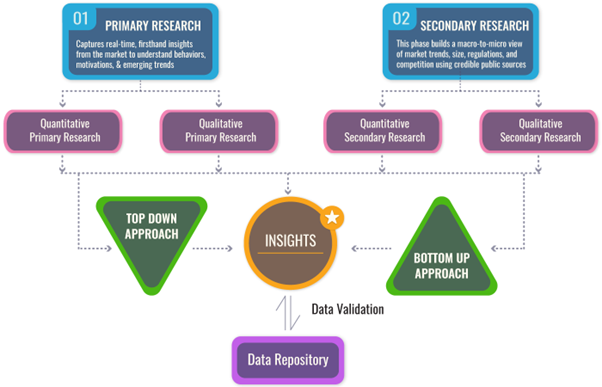
DUAL MODELING: TOP-DOWN + BOTTOM-UP
To ensure robust market estimation, we apply two complementary sizing approaches:
Top-Down Modeling:- Start with broader industry value (e.g., global or regional TAM)
- Apply filters by segment, geography, end-user, or use case
- Adjust with primary insights and validation benchmarks
- Ideal for investor-grade market scans and opportunity mapping
- Aggregate from the ground up using sales volumes, pricing, and unit economics
- Use internal modeling templates aligned with stakeholder data
- Incorporate distributor-level or region-specific inputs
- Most accurate for emerging segments and granular sub-markets
DATA VALIDATION: IN-HOUSE REPOSITORY
We close the loop with proprietary data intelligence built from ongoing projects, industry monitoring, and historical benchmarking. This repository includes:
- Multi-sector market and pricing models
- Key trendlines from past interviews and forecasts
- Benchmarked adoption rates, churn patterns, and ROI indicators
- Industry-specific deviation flags and cross-check logic
- Catches inconsistencies early
- Aligns projections across studies
- Enables consistent, high-trust deliverables