

Thoracic Surgery Devices Market Size and Forecast (2026–2034), Global and Regional Growth, Trend, Share and Industry Analysis Report Coverage: By Procedure Type (Open Thoracic Surgery, Video-Assisted Thoracoscopic Surgery, Robotic-Assisted Thoracic Surgery, Others (Thoracic Trauma Surgery, Pleural Procedures, Sympathectomy, etc.)), By Product Type (Surgical Instruments and Accessories, Endoscopes and Imaging Systems, Energy and Stapling Devices, Robotic Platforms, and Others (Retractors, Trocars, Suction & Irrigation Systems, Specimen Retrieval Bags, Chest Drainage Accessories, etc.)), By Indication (Lung Cancer, Esophageal Cancer, Pneumothorax, Mediastinal Tumors, Hyperhidrosis, and Others (Thoracic Trauma, Pleural Diseases, etc.)), By End User (Hospitals, Ambulatory Surgical Centers, Others (Specialty Clinics, Military Hospitals, Cancer Centers, etc.)), and Geography
2026-07-23
Healthcare
Swetal (Research Analyst)
Description
Thoracic Surgery Devices Market
Overview
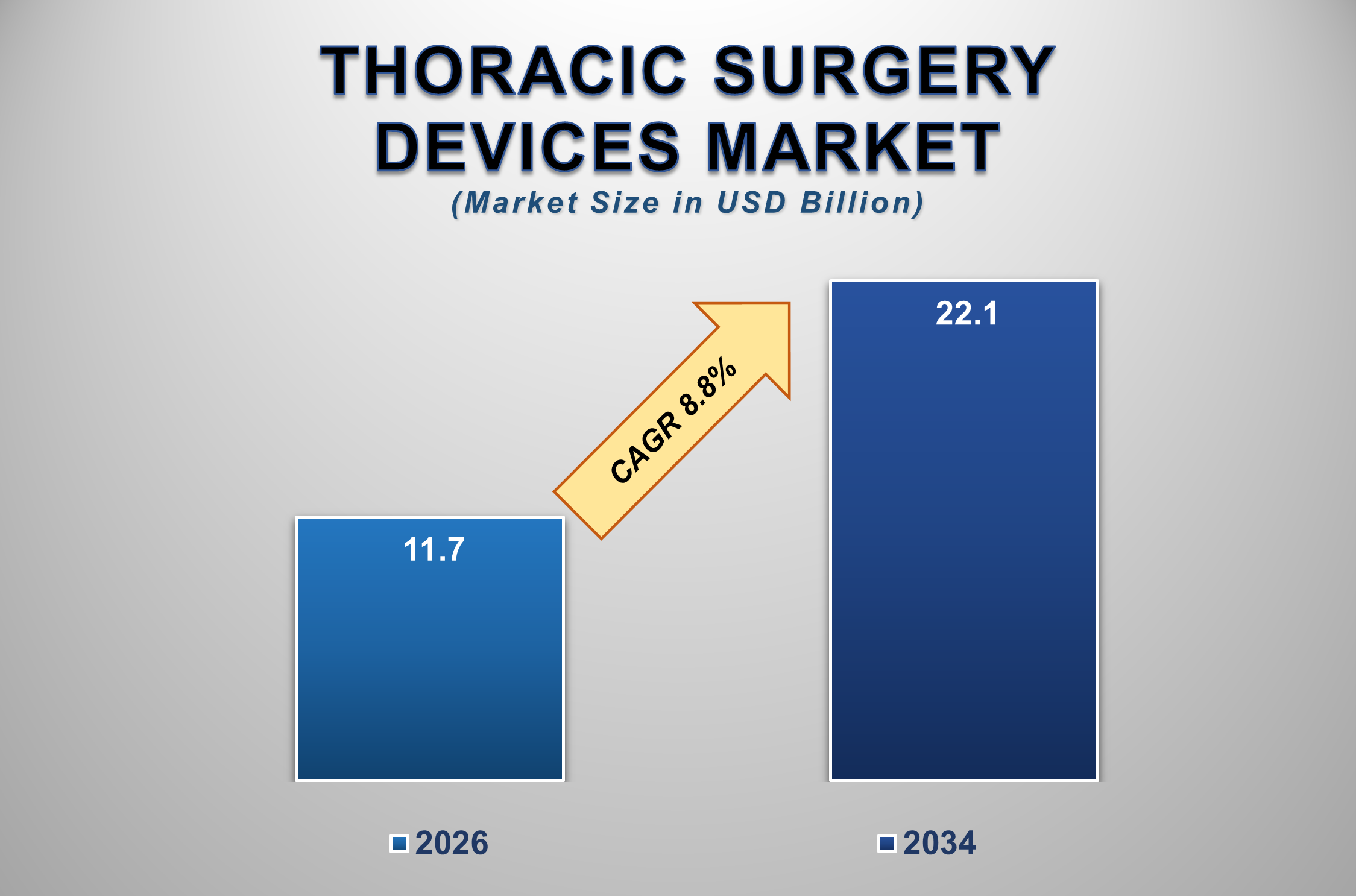
The global thoracic
surgery devices market was valued at USD 11.7 billion in 2026 and is projected
to reach USD 22.1 billion by 2034, expanding at a CAGR of 8.8% during the
forecast period. Demand for thoracic surgery devices is expected to grow faster
due to increases in lung cancer and diseases of the esophagus and other
thoracic organs. Demand is expected to grow with the number of thoracic
surgeries performed worldwide. More thoracic surgery devices are used with more
surgeries performed. Demand for devices is also expected to increase with the
adoption of less invasive surgeries, such as video-assisted thoracoscopic
surgery (VATS), robot-assisted thoracic surgery (RATS), and other procedures.
This translates into greater demand for advanced surgical staplers, endoscopic
imaging devices, energy devices, and other robot-assisted devices that make
surgery easier and faster for patients.
Thoracic Surgery Devices Market
Drivers and Opportunities
Rising
Prevalence of Thoracic Diseases is Driving Market Growth
The rising prevalence of lung cancer and other
thoracic diseases is expected to drive the thoracic surgery devices market.
Many patients diagnosed with lung cancer require multiple surgeries due to the
disease being one of the top cancer diagnoses and deaths worldwide. Projections
by the American Cancer Society predict an additional 229,410 lung cancer
diagnoses and an additional 124,990 deaths due to lung cancer in the United
States in 2026. These statistics emphasize the high burden of disease and the
high need for surgical interventions. The increased incidence of other
diseases, such as cancers of the esophagus, chronic obstructive pulmonary
disease (COPD), pulmonary infections, and other disorders of the mediastinum,
has increased the need for thoracic surgery worldwide. More surgeries are in
demand due to the increased incidence of thoracic diseases in the elderly.
Advances in low-dose CT scans and molecular diagnostics have improved the early
detection of thoracic diseases and the ability for curative surgical
procedures. These factors have increased the demand for better thoracic surgery
devices. Hospitals and specialty thoracic surgery centers are purchasing
surgery devices, such as powered staplers, energy-based vessel sealing devices,
and high-definition endoscopic imaging devices, to improve surgical outcomes.
Growing adoption
of minimally invasive and robotic-assisted surgery Fueling Market Expansion
The demand for
advanced thoracic surgery devices is growing very fast. VATS and RATS are the
best way to treat lung cancer, esophageal problems, and other thoracic
conditions because they're less invasive, have less blood loss, less pain,
shorter hospital stays, and faster recovery compared to open surgery. This has
led to a greater demand for specialized endoscopes, powered surgical staplers,
high-definition visualization systems, energy-based tissue sealing devices, and
robotic surgical platforms. Advancements in technology, including 3D imaging,
fluorescence-guided visualization, articulating instruments, and AI-assisted
surgical planning, are continuing to improve. Hospitals and healthcare systems
are also investing in new operating rooms and robotic surgery programs. As
surgeon expertise in minimally invasive techniques grows and patients prefer
less invasive surgeries, adoption of next-generation thoracic surgery devices
is expected to increase.
Expansion of
robotic and AI-enabled thoracic surgery in emerging markets Presents
Significant Opportunities
Developing
countries have great potential for the growth of the market for thoracic
surgery devices due to improvements in health care and investments in advanced
technologies. Governments and private hospitals are expanding centers for
specialized thoracic surgery and equipping hospitals with modern operating
rooms for minimally invasive and robotic surgeries. With more doctors realizing
the benefits of robotic surgery, such as being more precise, having better
vision, and having fewer complications, doctors and surgeons are looking
towards newer generations of robotic surgical systems. At the same time, the
use of artificial intelligence for surgical planning, during surgery, workflow
improvement, and predictive analysis is improving surgeries. Moreover, training
programs for surgeons and partnerships between device manufacturers and
hospitals are also increasing the number of surgeons who are skilled at
performing advanced thoracic procedures. With reimbursement policies changing
and access to advanced surgical technology becoming more common, companies have
the opportunity to create low-cost thoracic surgery machines.
Thoracic Surgery Devices Market Scope
|
Report Attributes |
Description |
|
Market Size in
2026 |
USD 11.7
Billion |
|
Market Forecast
in 2034 |
USD 22.1
Billion |
|
CAGR % 2026-2034 |
8.8% |
|
Base Year |
2025 |
|
Historic Data |
2021-2025 |
|
Forecast Period |
2026-2034 |
|
Report USP |
Pricing and
Cost Structure Analysis, Product Innovation Benchmarking, Whitespace
Assessment, Company Share, Company Heatmap, Growth Factors and more |
|
Segments Covered |
●
By
Procedure Type ●
By
Product Type ●
By
Indication ●
By End
User |
|
Regional Scope |
●
North
America ●
Europe ●
APAC ●
Latin
America ●
Middle East
and Africa |
|
Country Scope |
●
U.S. ●
Canada ●
U.K. ●
Germany ●
France ●
Italy ●
Spain ●
Russia ●
China ●
India ●
Japan ●
South
Korea ●
Australia
●
Mexico ●
Brazil ●
Saudi
Arabia ●
UAE ●
South
Africa
|
Thoracic Surgery Devices Market
Report Segmentation Analysis
The global thoracic
surgery devices market industry analysis is segmented by procedure type, by
product type, by indication, by end user, and by region.
Video-Assisted
Thoracoscopic Surgery Segment Is Expected to Dominate the Thoracic Surgery
Devices Market During the Forecast Period
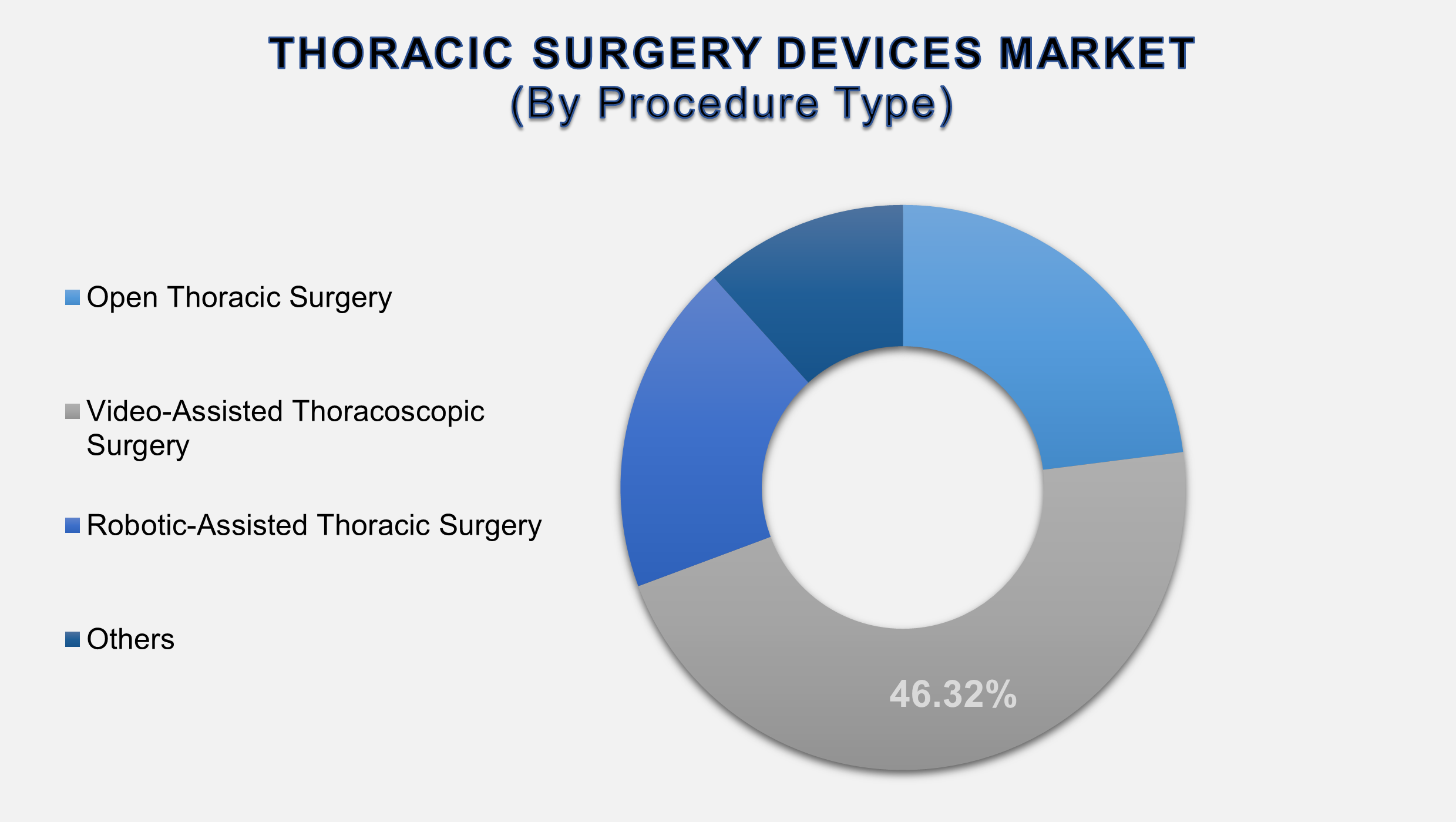
Video-Assisted
Thoracoscopic Surgery (VATS) is expected to be the dominant segment in the
global thoracic surgery devices market during the forecast period owing to the
increasing trend of minimally invasive surgeries resulting in fewer
complications, faster recovery, reduced postoperative pain, and shorter
hospital stays compared to traditional open thoracic surgery. Growing use of
VATS in lung cancer, pulmonary nodules, and other thoracic diseases is driving
demand for thoracic surgery devices such as endoscopic staplers, energy-based
sealing devices, thoracoscopes, and HD cameras. This trend was substantiated by
a meta-analysis conducted in September 2025, which revealed that the survival
rate among patients who underwent Video-Assisted Thoracoscopic Surgery (VATS)
for lobectomy was much better compared to the survival rate of those who
underwent open lobectomy. Such a favorable clinical outcome is encouraging
surgeons and other healthcare professionals to opt for VATS as the better
surgical procedure for such patients. In addition, continued advancements in
the field of thoracoscopic visualization, motorized surgical instruments, and
surgical education have led to the increasing acceptance of VATS across the
globe.
Robotic
Platforms Segment Is Expected to Lead the Thoracic Surgery Devices Market by
Product Type
The segment of
robotic platforms is expected to dominate the market in terms of product type
during the forecast period owing to the rising prevalence of robot-assisted
thoracic surgery (RATS), which is being used in complex pulmonary, mediastinal,
and esophageal surgeries. Robotic platforms offer enhanced three-dimensional
visualization, enhanced dexterity of the instruments, tremor filtration, and
precision to the surgeons, which enable them to dissect and suture accurately
within the thoracic cavity. This enables reduced blood loss, fewer
complications after the surgery, shorter hospital stays, and quicker recovery
of the patients than conventional open surgery while also expanding the scope
of minimally invasive procedures. The rising incidence of lung cancer and other
thoracic disorders, along with the increasing preference for minimally invasive
surgical procedures, has been driving the uptake of robotic-assisted surgery
procedures. Moreover, advancements like AI-assisted visualization,
fluorescence-guided visualization, improved robotic instruments, and enhanced
ergonomic surgeon consoles are contributing towards increased efficiency of the
procedure. The rising investment by hospitals in advanced surgical equipment,
increasing reimbursement in developed regions, and training of the surgeons
have been contributing to the dominance of the segment of robotic platforms.
Lung Cancer
Segment Is Expected to Dominate the Indication Segment
The lung cancer
segment will account for the largest share of the thoracic surgery devices
market by indication, owing to the high burden of the disease globally and
increasing use of surgery for the treatment of early-stage disease. Lung cancer
is expected to remain the dominant indication among thoracic procedures,
including lobectomy, segmentectomy, and wedge resection, requiring advanced
surgical devices. As per the data published by the American Cancer Society,
there are about 229,410 new lung cancer cases and 124,990 deaths caused by the
disease in 2026 in the US alone. Besides, the growing adoption of low-dose CT
screenings, increasing usage of minimally invasive approaches like VATS and
robotic thoracic surgery, and continuous developments in surgical device
technology are further reinforcing the dominant position of the lung cancer
segment in the thoracic surgery devices market.
Hospitals
Segment Is Expected to Dominate the End User Segment
The hospitals segment will hold a dominant position in the thoracic surgery devices market by end user in the coming years, owing to the high incidence of thoracic surgeries and the presence of highly sophisticated infrastructure for conducting such surgeries in hospitals. Hospitals form the main venues for the conduct of complicated surgeries, including those of lung cancer, esophageal cancer, and mediastinal surgeries. In addition, the increasing trend of minimally invasive thoracic and robot-assisted thoracic surgeries, along with the rising investment in high-resolution image system technology, robotic systems, and powered surgical instruments, will help drive the demand from hospitals. Apart from this, other factors such as a positive reimbursement policy, development of health care infrastructure, and a rising number of thoracic disease cases will continue to favor the growth of the hospital segment.
The following
segments are part of an in-depth analysis of the global thoracic surgery
devices market:
|
Market Segments |
|
|
By Procedure
Type |
●
Open
Thoracic Surgery ●
Video-Assisted
Thoracoscopic Surgery ●
Robotic-Assisted
Thoracic Surgery ●
Others
(Thoracic Trauma Surgery, Pleural Procedures, Sympathectomy, etc.) |
|
By
Product Type |
●
Surgical
Instruments and Accessories ●
Endoscopes
and Imaging Systems ●
Energy and
Stapling Devices ●
Robotic
Platforms ●
Others
(Retractors, Trocars, Suction & Irrigation Systems, Specimen Retrieval
Bags, Chest Drainage Accessories, etc.) |
|
By
Indication |
●
Lung Cancer ●
Esophageal
Cancer ●
Pneumothorax ●
Mediastinal
Tumors ●
Hyperhidrosis ●
Others
(Thoracic Trauma, Pleural Diseases, etc.) |
|
By End
User |
●
Hospitals ●
Ambulatory
Surgical Centers ●
Others
(Specialty Clinics, Military Hospitals, Cancer Centers, etc.) |
Thoracic Surgery Devices Market Share
Analysis by Region
North America is
projected to hold the largest share of the global thoracic surgery devices
market over the forecast period.
North America is
set to dominate the global market for thoracic surgery devices owing to the
presence of higher rates of thoracic diseases, an advanced healthcare
infrastructure, adoption of minimally invasive thoracic surgeries, and
prominent medical device makers in the region. A favorable reimbursement
landscape and increased spending on the healthcare sector are other factors
driving the regional market growth. As a testament to the region's performance,
in January 2026, Able Medical marked the milestone of completion of its 10,000th
procedure in the U.S. using its Valkyrie Thoracic Fixation System, which is
used for sternal closure and chest wall stabilization through advanced thoracic
fixation technologies. Rising incidences of lung cancer, proliferation of
thoracic surgery centers, and innovations in surgical devices will ensure North
America's dominance in the global thoracic surgery devices market during the
forecast period.
Thoracic Surgery
Devices Market Competition Landscape Analysis
The thoracic
surgery devices market features key medical device vendors focused on
innovation in minimally invasive and robotic-assisted surgical devices,
thoracoscopic devices, endoscopy devices, surgical staples, energy-based
devices, and thoracic fixation devices. The key players are leveraging their
competitive edge through innovation in their product portfolio, partnerships,
M&A activities, regulatory approvals, geographical expansions, and
investments in R&D. Moreover, the increasing use of video-assisted
thoracoscopic surgery (VATS), robotic-assisted thoracoscopic surgery (RATS),
advanced surgical imaging, enhanced recovery processes, and the rising
incidence of various thoracic ailments, including lung cancer and esophageal
ailments, represent substantial growth prospects for the worldwide thoracic
surgery devices market.
Global Thoracic
Surgery Devices Market Recent Developments News:
●
In January
2026, Johnson & Johnson announced that it had
submitted the OTTAVA Robotic Surgical System to the U.S. Food and Drug
Administration (FDA) for De Novo classification.
●
In March 2025 -
Olympus Corp., a global medical technology company committed to making people’s
lives healthier, safer, and more
fulfilling, announced the launch of its first
AI-powered clinical decision tool through a strategic partnership with software
firm Ziosoft. The first three applications being launched aim to revolutionize
liver, lung, and kidney procedures, thoracic surgery, liver surgery, and
urologic surgery.
●
In May 2025 -
Pulse Biosciences, Inc., a
company leveraging its novel and proprietary Nanosecond Pulsed Field Ablation
(nanosecond PFA or nsPFA) technology, announced that its Nanosecond PFA technology
was featured in a presentation and a preclinical
poster featuring the nsPFA Cardiac Surgical System at the American Association
for Thoracic Surgery (AATS) 2025 Annual Meeting, being held May 2-5 in Seattle,
Washington.
The global
thoracic surgery devices market is dominated by a few large companies, such as
●
B. Braun Melsungen AG
●
Boston Scientific Corporation
●
CONMED Corporation
●
CooperSurgical, Inc.
●
Delacroix-Chevalier
●
Fujifilm Holdings Corporation
●
Getinge AB
●
Intuitive Surgical
●
Johnson & Johnson (Ethicon)
●
Karl Storz SE & Co. KG
●
KLS Martin Group
●
Medtronic plc
●
MicroPort Scientific Corporation
●
Olympus Corporation
●
Richard Wolf GmbH
●
Scanlan International
●
Stryker Corporation
●
Teleflex Incorporated
●
XION GmbH
● Other Prominent Players
Frequently Asked Questions
Swetal (Research Analyst)
Swetal is a Research Analyst with 4+ years of experience specializing in healthcare market research, medical devices, healthcare IT, and medical technology industry analysis. Her expertise includes competitive intelligence, secondary research, market trend forecasting, and healthcare business insights across global healthcare ecosystems.
She contributes to advanced market research reports by analyzing regulatory frameworks, emerging healthcare technologies, competitive landscapes, and innovation trends shaping the medical industry. With a strong focus on accurate market intelligence, strategic insights, and healthcare industry trends, Swetal supports businesses in making informed, data-backed decisions in a rapidly transforming healthcare environment.
1.
Global
Thoracic Surgery Devices Market Introduction and Market Overview
1.1. Objectives of the Study
1.2. Market Segmentation
1.2.1.Procedure Type of the Global Thoracic
Surgery Devices Market
1.2.2.Product Type of the Global Thoracic
Surgery Devices Market
1.2.3.Indication of the Global Thoracic
Surgery Devices Market
1.2.4.End User of the Global Thoracic
Surgery Devices Market
1.2.5.Region of Global Thoracic
Surgery Devices Market
1.3. Competition Coverage List of
Market Participants
1.4. Market Definition: Thoracic
Surgery Devices Market
2.
Executive Summary
2.1. Global Thoracic Surgery Devices
Market Estimation & Forecast
2.1.1.Global Thoracic Surgery Devices
Market Size (US$ Million) Estimates & Historical Trend Analysis (2021 -
2025)
2.1.2.Global Thoracic Surgery Devices
Overall Market Size (US$ Million), Growth Rate (Y-o-Y), Market CAGR (%), Market
forecast (2026 - 2034)
2.2. Snapshot of Global Thoracic
Surgery Devices Market
2.3. Global Thoracic Surgery Devices
Market Revenue Share (%) 2025
2.4. REGIONAL OUTLINE: Revenue CAGR,
by Region
2.5. Key Competitors & Key
Insights
3.
Market Overview (Qualitative
Analysis)
3.1. Demand Side Trends
3.2. Supply Side Trends /
Manufacturing Trends
3.3. Demand and Opportunity
Assessment, 2026 - 2034
3.4. Market Dynamics
3.4.1.Drivers
3.4.2.Limitations
3.4.3.Opportunities
3.4.4.Impact Analysis of Drivers and
Restraints
3.5. Key Developments
3.6. Regulatory Landscape
3.7. Pricing Analysis
3.8. Supply Chain Analysis
3.9. Porter’s Five Forces Analysis
3.9.1.Bargaining Power of Suppliers
3.9.2.Bargaining Power of Buyers
3.9.3.Threat of Substitutes
3.9.4.Threat of New Entrants
3.9.5.Competitive Rivalry
3.10. PEST Analysis
3.10.1. Political Factors
3.10.2. Economic Factors
3.10.3. Social Factors
3.10.4. Technology Factors
4.
Global Thoracic Surgery Devices
Market Estimates & Forecast Trend Analysis, by Procedure Type
4.1. Global Thoracic Surgery Devices
Market Assessments & Key Findings, by Procedure Type
4.2. Global Thoracic Surgery Devices
Market Revenue (US$ Million) Estimates and Forecasts, by Procedure Type, 2021 -
2034
4.2.1.Open Thoracic Surgery
4.2.2.Video-Assisted Thoracoscopic
Surgery
4.2.3.Robotic-Assisted Thoracic
Surgery
4.2.4.Others (Thoracic Trauma Surgery,
Pleural Procedures, Sympathectomy, etc.)
5.
Global Thoracic Surgery Devices
Market Estimates & Forecast Trend Analysis, by Product Type
5.1. Global Thoracic Surgery Devices
Market Assessments & Key Findings, by Product Type
5.2. Global Thoracic Surgery Devices
Market Revenue (US$ Million) Estimates and Forecasts, by Product Type, 2021 -
2034
5.2.1.Surgical Instruments and
Accessories
5.2.2.Endoscopes and Imaging Systems
5.2.3.Energy and Stapling Devices
5.2.4.Robotic Platforms
5.2.5.Others (Retractors, Trocars,
Suction & Irrigation Systems, Specimen Retrieval Bags, Chest Drainage
Accessories, etc.)
6.
Global Thoracic Surgery Devices
Market Estimates & Forecast Trend Analysis, by Indication
6.1. Global Thoracic Surgery Devices
Market Assessments & Key Findings, by Indication
6.2. Global Thoracic Surgery Devices
Market Revenue (US$ Million) Estimates and Forecasts, by Indication, 2021 -
2034
6.2.1.Lung Cancer
6.2.2.Esophageal Cancer
6.2.3.Pneumothorax
6.2.4.Mediastinal Tumors
6.2.5.Hyperhidrosis
6.2.6.Others (Thoracic Trauma, Pleural
Diseases, etc.)
7.
Global Thoracic Surgery Devices
Market Estimates & Forecast Trend Analysis, by End User
7.1. Global Thoracic Surgery Devices
Market Assessments & Key Findings, by End User
7.2. Global Thoracic Surgery Devices
Market Revenue (US$ Million) Estimates and Forecasts, by End User, 2021 - 2034
7.2.1.Hospitals
7.2.2.Ambulatory Surgical Centers
7.2.3.Others (Others (Specialty
Clinics, Military Hospitals, Cancer Centers, etc.)
8.
Global Thoracic Surgery Devices
Market Estimates & Forecast Trend Analysis, by Region
8.1. Global Thoracic Surgery Devices
Market Assessments & Key Findings, by Region
8.2. Global Thoracic Surgery Devices
Market Revenue (US$ Million) Estimates and Forecasts, by Region, 2021 - 2034
8.2.1.North America
8.2.2.Europe
8.2.3.Asia Pacific
8.2.4.Middle East & Africa
8.2.5.Latin America
9.
North
America Thoracic Surgery Devices Market: Estimates & Forecast Trend Analysis
9.1.
North
America Thoracic Surgery Devices Market Assessments & Key Findings
9.1.1.North America Thoracic Surgery
Devices Market Introduction
9.1.2.North America Thoracic Surgery
Devices Market Size Estimates and Forecast (US$ Million) (2021 - 2034)
9.1.2.1. By Procedure Type
9.1.2.2. By Product Type
9.1.2.3. By Indication
9.1.2.4. By End User
9.1.2.5. By Country
9.1.2.5.1. The U.S.
9.1.2.5.2. Canada
10. Europe Thoracic
Surgery Devices Market: Estimates &
Forecast Trend Analysis
10.1. Europe Thoracic Surgery Devices
Market Assessments & Key Findings
10.1.1. Europe Thoracic Surgery Devices
Market Introduction
10.1.2. Europe Thoracic Surgery Devices
Market Size Estimates and Forecast (US$ Million) (2021 - 2034)
10.1.2.1. By Procedure Type
10.1.2.2. By Product Type
10.1.2.3. By Indication
10.1.2.4. By End User
10.1.2.4.1.
Germany
10.1.2.4.2.
Italy
10.1.2.4.3.
U.K.
10.1.2.4.4.
France
10.1.2.4.5.
Spain
10.1.2.4.6.
Switzerland
10.1.2.4.7. Rest
of Europe
11. Asia Pacific Thoracic
Surgery Devices Market: Estimates &
Forecast Trend Analysis
11.1. Asia Pacific Market Assessments
& Key Findings
11.1.1. Asia Pacific Thoracic Surgery
Devices Market Introduction
11.1.2. Asia Pacific Thoracic Surgery
Devices Market Size Estimates and Forecast (US$ Million) (2021 - 2034)
11.1.2.1. By Procedure Type
11.1.2.2. By Product Type
11.1.2.3. By Indication
11.1.2.4. By End User
11.1.2.5. By Country
11.1.2.5.1. China
11.1.2.5.2. Japan
11.1.2.5.3. India
11.1.2.5.4. Australia
11.1.2.5.5. South Korea
11.1.2.5.6. Rest of Asia Pacific
12. Middle East & Africa Thoracic
Surgery Devices Market: Estimates &
Forecast Trend Analysis
12.1. Middle East & Africa Market
Assessments & Key Findings
12.1.1. Middle
East & Africa Thoracic
Surgery Devices Market Introduction
12.1.2. Middle
East & Africa Thoracic
Surgery Devices Market Size Estimates and Forecast (US$ Million) (2021 - 2034)
12.1.2.1. By Procedure Type
12.1.2.2. By Product Type
12.1.2.3. By Indication
12.1.2.4. By End User
12.1.2.5. By Country
12.1.2.5.1. South Africa
12.1.2.5.2. UAE
12.1.2.5.3. Saudi Arabia
12.1.2.5.4. Rest of MEA
13. Latin America
Thoracic Surgery Devices Market: Estimates
& Forecast Trend Analysis
13.1. Latin America Market Assessments
& Key Findings
13.1.1. Latin America Thoracic Surgery
Devices Market Introduction
13.1.2. Latin America Thoracic Surgery
Devices Market Size Estimates and Forecast (US$ Million) (2021 - 2034)
13.1.2.1. By Procedure Type
13.1.2.2. By Product Type
13.1.2.3. By Indication
13.1.2.4. By End User
13.1.2.5. By Country
13.1.2.5.1. Brazil
13.1.2.5.2. Mexico
13.1.2.5.3. Argentina
13.1.2.5.4. Rest of LATAM
14. Competition Landscape
14.1. Global Thoracic Surgery Devices
Market Product Mapping
14.2. Global Thoracic Surgery Devices
Market Concentration Analysis, by Leading Players / Innovators / Emerging
Players / New Entrants
14.3. Global Thoracic Surgery Devices
Market Tier Structure Analysis
14.4. Global Thoracic Surgery Devices
Market Concentration & Company Market Shares (%) Analysis, 2025
15. Company Profiles
15.1. B. Braun Melsungen AG
15.1.1. Company Overview & Key Stats
15.1.2. Financial Performance & KPIs
15.1.3. Product Portfolio
15.1.4. SWOT Analysis
15.1.5. Business Strategy & Recent
Developments
* Similar details would be provided
for all the players mentioned below
15.2. Boston Scientific Corporation
15.3. CONMED Corporation
15.4. CooperSurgical, Inc.
15.5. Delacroix-Chevalier
15.6. Fujifilm Holdings Corporation
15.7. Getinge AB
15.8. Intuitive Surgical
15.9. Johnson & Johnson (Ethicon)
15.10. Karl Storz SE & Co. KG
15.11. KLS Martin Group
15.12. Medtronic plc
15.13. MicroPort Scientific Corporation
15.14. Olympus Corporation
15.15. Richard Wolf GmbH
15.16. Scanlan International
15.17. Stryker Corporation
15.18. Teleflex Incorporated
15.19. XION GmbH
15.20. Other Prominent Players
16. Research
Findings & Conclusion
17. Assumption & Acronyms Used
18. Research
Methodology
18.1. External Transportations /
Databases
18.2. Internal Proprietary Database
18.3. Primary Research
18.4. Secondary Research
18.5. Assumptions
18.6. Limitations
18.7. Report FAQs
Our Research Methodology
"Insight without rigor is just noise."
We follow a comprehensive, multi-phase research framework designed to deliver accurate, strategic, and decision-ready intelligence. Our process integrates primary and secondary research , both quantitative and qualitative , along with dual modeling techniques ( top-down and bottom-up) and a final layer of validation through our proprietary in-house repository.
PRIMARY RESEARCH
Primary research captures real-time, firsthand insights from the market to understand behaviors, motivations, and emerging trends.
1. Quantitative Primary Research
Objective: Generate statistically significant data directly from market participants.
Approaches:- Structured surveys with customers, distributors, and field agents
- Mobile-based data collection for point-of-sale audits and usage behavior
- Phone-based interviews (CATI) for market sizing and product feedback
- Online polling around industry events and digital campaigns
- Purchase frequency by customer type
- Channel performance across geographies
- Feature demand by application or demographic
2. Qualitative Primary Research
Objective: Explore decision-making drivers, pain points, and market readiness.
Approaches:- In-depth interviews (IDIs) with executives, product managers, and key decision-makers
- Focus groups among end users and early adopters
- Site visits and observational research for consumer products
- Informal field-level discussions for regional and cultural nuances
SECONDARY RESEARCH
This phase helps establish a macro-to-micro understanding of market trends, size, regulation, and competitive dynamics, sourced from credible and public domain information.
1. Quantitative Secondary Research
Objective: Model market value and segment-level forecasts based on published data.
Sources include:- Financial reports and investor summaries
- Government trade data, customs records, and regulatory statistics
- Industry association publications and economic databases
- Channel performance and pricing data from marketplace listings
- Revenue splits, pricing trends, and CAGR estimates
- Supply-side capacity and volume tracking
- Investment analysis and funding benchmarks
2. Qualitative Secondary Research
Objective: Capture strategic direction, innovation signals, and behavioral trends.
Sources include:- Company announcements, roadmaps, and product pipelines
- Publicly available whitepapers, conference abstracts, and academic research
- Regulatory body publications and policy briefs
- Social and media sentiment scanning for early-stage shifts
- Strategic shifts in market positioning
- Unmet needs and white spaces
- Regulatory triggers and compliance impact
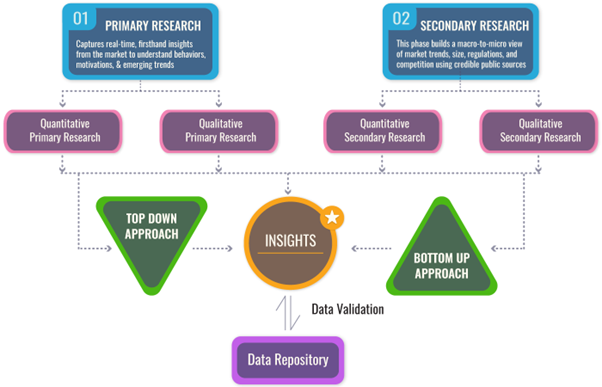
DUAL MODELING: TOP-DOWN + BOTTOM-UP
To ensure robust market estimation, we apply two complementary sizing approaches:
Top-Down Modeling:- Start with broader industry value (e.g., global or regional TAM)
- Apply filters by segment, geography, end-user, or use case
- Adjust with primary insights and validation benchmarks
- Ideal for investor-grade market scans and opportunity mapping
- Aggregate from the ground up using sales volumes, pricing, and unit economics
- Use internal modeling templates aligned with stakeholder data
- Incorporate distributor-level or region-specific inputs
- Most accurate for emerging segments and granular sub-markets
DATA VALIDATION: IN-HOUSE REPOSITORY
We close the loop with proprietary data intelligence built from ongoing projects, industry monitoring, and historical benchmarking. This repository includes:
- Multi-sector market and pricing models
- Key trendlines from past interviews and forecasts
- Benchmarked adoption rates, churn patterns, and ROI indicators
- Industry-specific deviation flags and cross-check logic
- Catches inconsistencies early
- Aligns projections across studies
- Enables consistent, high-trust deliverables