

Track and Trace Solutions Market Size and Forecast (2025–2033), Global and Regional Share, Growth Trends, and Industry Analysis Report Coverage: By Product (Hardware Systems, Software Solutions, Standalone Platforms, Consumables & Labels), By Technology (Barcode, RFID, Serialization, Aggregation), By Application (Serialization, Aggregation, Tracking, Tracing, Reporting & Verification), By End-use (Pharmaceutical & Biopharmaceutical Companies, Medical Device Manufacturers, Food & Beverage Companies, Cosmetics & Personal Care Brands, Logistics Providers), and Geography
2025-12-23
Healthcare
Swetal (Research Analyst)
Description
Track and Trace Solutions Market Overview
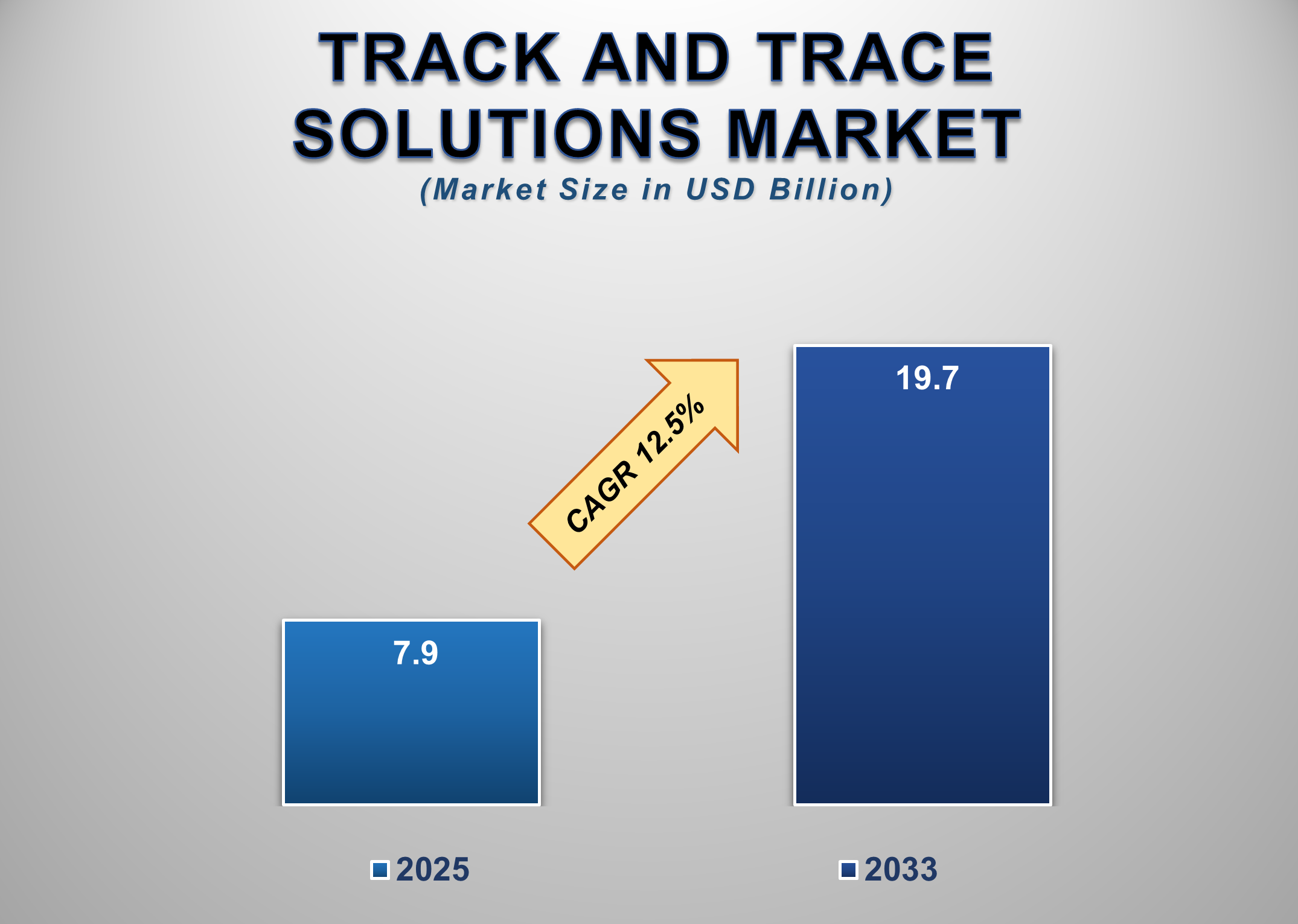
The Global Track and Trace Solutions Market is projected to grow significantly from USD 7.9 billion in 2025 to USD 19.7 billion by 2033, registering a strong CAGR of 12.5% during the forecast period. Demand for robust product authentication, regulatory compliance, and supply chain transparency is rising rapidly across high-risk industries such as pharmaceuticals, medical devices, food and beverages, and consumer packaged goods. Increasing incidents of counterfeiting, product diversion, unauthorized distribution, and quality deviations have compelled organizations worldwide to implement advanced traceability frameworks based on serialization, aggregation, and real-time tracking technologies. These solutions enable stakeholders to maintain product integrity from manufacturing to delivery, mitigate supply chain risks, and comply with strict mandates enforced by regulatory bodies such as the U.S. FDA, the EU FMD, and various national drug authorities.
Digitization of supply chain
operations, the rapid adoption of cloud-based platforms, and the integration of
technologies such as RFID, blockchain, and IoT are enhancing traceability
accuracy and end-to-end visibility. Pharmaceutical and biopharmaceutical
companies remain the dominant adopters, driven by stringent serialization
deadlines and anti-counterfeiting laws. Meanwhile, food & beverage
companies and logistics service providers are increasingly deploying track and
trace systems to streamline inventory, improve quality assurance, and prevent
product recalls. As industries transition toward fully digitized supply
networks, the market is expected to witness accelerating investment in
interoperable platforms, automated tracking tools, and data-driven traceability
ecosystems.
Track and Trace Solutions Market Drivers and
Opportunities
Rising Serialization
Mandates and Regulatory Compliance Requirements Are Driving the Track and Trace
Solutions Market Growth
Stringent global regulations aimed at enhancing patient safety,
combating counterfeit products, and maintaining authenticity across the supply
chain are among the strongest drivers of the track and trace solutions market.
Regulatory agencies such as the U.S. FDA (DSCSA), European Medicines Agency
(FMD), China NMPA, India CDSCO, and Brazil ANVISA mandate serialization,
aggregation, and end-to-end traceability for pharmaceutical products. These
requirements push manufacturers, packagers, and distributors to adopt advanced
serialization equipment, barcode printing technologies, and centralized
traceability software to ensure compliance. Beyond pharmaceuticals, the food
& beverage sector faces increasing regulatory scrutiny related to food
safety recalls, contamination prevention, and farm-to-fork traceability.
These regulations stimulate the widespread deployment of track and
trace systems capable of generating unique product identifiers, recording
product movement across all supply chain nodes, and enabling authorities to
verify product authenticity. As counterfeit goods account for billions in
losses annually, particularly in medicines, medical devices, and consumer
goods, companies are compelled to protect their brand value and safeguard
end-users. Regulatory timelines, global harmonization efforts, and industry-wide
digitalization programs are further encouraging organizations to upgrade legacy
systems and transition toward smart traceability technologies, significantly
expanding market demand across both developed and emerging nations.
Expanding
Counterfeit and Illicit Supply Chains Worldwide Are Boosting the Need for
Advanced Traceability Technologies
The rapid rise in counterfeit pharmaceuticals, medical devices,
luxury items, packaged foods, and cosmetics poses a major global challenge,
driving strong adoption of track and trace solutions worldwide. According to
industry estimates, counterfeit medicines alone account for over USD 200
billion in global losses each year and represent a major threat to patient
safety in low- and middle-income countries. Illicit trade networks have become
increasingly sophisticated, employing advanced replication techniques that
bypass traditional security measures. As a result, manufacturers and
distributors require highly secure, technology-driven traceability systems
capable of distinguishing genuine products, monitoring distribution channels,
and intercepting diversion activities. Track and trace technologies such as
RFID tags, serialized codes, tamper-evident labels, blockchain-based
verification, and IoT-enabled monitoring devices enable organizations to track
every unit throughout production, packaging, shipment, and delivery. These
systems proactively identify discrepancies such as unauthorized rerouting,
repackaging, or illegal imports. Manufacturers also benefit from improved
inventory visibility, fewer recalls, and enhanced consumer trust. The surge in
global e-commerce and cross-border trade further amplifies the need for
identification technologies that authenticate goods in real time. As
counterfeiters become more advanced, industries increasingly rely on integrated
track and trace ecosystems, driving strong long-term growth in the market.
Rising
Industrial Digitalization and Adoption of RFID, Blockchain, and IoT Are
Expected to Create Significant Opportunities in the Track and Trace Solutions
Market Worldwide
As industries accelerate digital transformation programs, the
adoption of next-generation technologies such as RFID, blockchain, IoT sensors,
cloud platforms, and AI-driven analytics presents a major growth opportunity
for the track and trace solutions market. Traditional barcode-based
traceability solutions are being increasingly complemented and, in some cases,
replaced by RFID tagging systems capable of storing more data, enabling
long-range scanning, and supporting real-time inventory management. IoT-enabled
trackers and connected packaging solutions provide continuous monitoring of
product conditions, enabling companies to track temperature, humidity, shock,
and location in real time.
Blockchain-based track and trace platforms are gaining traction in
pharmaceuticals, food, luxury goods, and logistics as they offer tamper-proof
data integrity, secure multi-stakeholder collaboration, and transparent product
histories. Cloud-based serialization and aggregation systems improve
scalability, reduce upfront infrastructure investments, and enable seamless
integration across global supply networks. AI algorithms further enhance
traceability by predicting supply chain risks, detecting anomalies, and
supporting automated documentation. The rapid shift toward digital supply chain
ecosystems, combined with increasing investments in Industry 4.0
infrastructure, is expected to create long-term opportunities for solution
providers, particularly in fast-growing markets across Asia-Pacific, Latin
America, and the Middle East.
Track and Trace Solutions
Market Scope
|
Report Attributes |
Description |
|
Market Size in 2025 |
USD 7.9 Billion |
|
Market Forecast in 2033 |
USD 19.7 Billion |
|
CAGR % 2025-2033 |
12.5% |
|
Base Year |
2024 |
|
Historic Data |
2020-2024 |
|
Forecast Period |
2025-2033 |
|
Report USP |
Production, Consumption,
Company Share, Company Heatmap, Company Production Capacity, Growth Factors,
and more |
|
Segments Covered |
●
by Product, Technology, Application, and
End-use |
|
Regional Scope |
●
North America, ●
Europe, ●
APAC, ●
Latin America ●
Middle East and Africa |
|
Country Scope |
1)
U.S. 2)
Canada 3)
Germany 4)
UK 5)
France 6)
Spain 7)
Italy 8)
Switzerland 9)
China 10)
Japan 11)
India 12)
Australia 13)
South Korea 14)
Brazil 15)
Mexico 16)
Argentina 17)
South Africa 18)
Saudi Arabia 19)
UAE |
Track and Trace Solutions
Market Report Segmentation Analysis
The global Track and Trace Solutions Market is segmented by
Product, Technology, Application, End-use, and by Region.
Hardware Systems Segment
Accounted for the Largest Market Share in the Global Track and Trace Solutions
Market
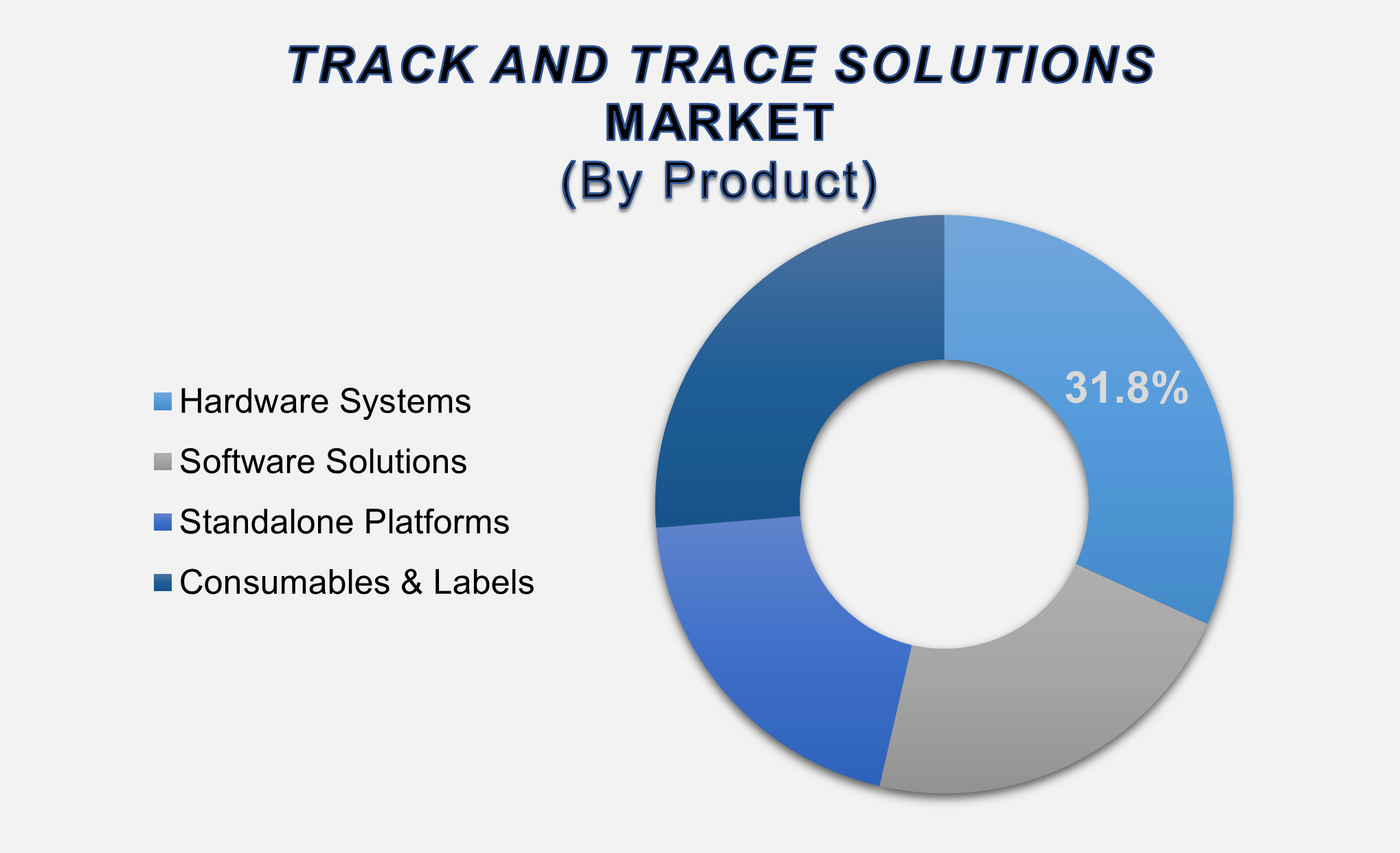
The hardware systems segment, including barcode scanners, RFID readers, label printers, verification systems, and aggregation equipment, holds the largest share of the track and trace market. This dominance is driven by global serialization mandates in the pharmaceutical and medical device industries, which require high-performance hardware capable of printing, scanning, encoding, and verifying unique identifiers at high production speeds. End-users across the food, cosmetics, and logistics sectors increasingly invest in automation-ready equipment to streamline packaging operations and reduce compliance errors. RFID hardware is witnessing rapid growth as companies shift toward contactless, high-speed tracking to improve supply chain visibility. With the expansion of e-commerce and global trade, warehouses, fulfillment centers, and distribution hubs are deploying advanced scanning and coding systems integrated with cloud software to enable real-time inventory management. As counterfeit risks and regulatory pressures rise, hardware systems remain essential for enabling accurate identification, authentication, and monitoring of products across all supply chain nodes.
Serialization Application
Segment Accounted for the Largest Market Share in the Global Track and Trace
Solutions Market
Serialization remains the most
widely adopted application due to regulatory requirements mandating unique
identification for pharmaceutical and medical device products. Governments in
the U.S., Europe, China, India, Brazil, and numerous emerging nations enforce
serialization rules to combat counterfeiting, ensure patient safety, and
enhance product traceability. Serialization systems enable manufacturers to
assign unique serial numbers that can be verified throughout production,
packaging, distribution, and dispensing. This allows regulators and
stakeholders to detect fake products, track product recalls, and prevent supply
chain diversion. Beyond pharmaceuticals, serialization adoption is increasing
in the food and cosmetics industries to support traceability audits and quality
control. As industries transition toward fully digitized supply chains,
serialization platforms integrated with blockchain, cloud, and RFID
technologies are gaining strong traction. Continuous regulatory expansions and
industry digitalization are expected to keep serialization the largest and most
critical application segment over the forecast period.
Pharmaceutical &
Biopharmaceutical Companies Segment Accounted for the Largest Market Share in
the Global Track and Trace Solutions Market
Pharmaceutical and
biopharmaceutical companies dominate market adoption due to stringent
regulatory frameworks governing product serialization, anti-counterfeiting
measures, and supply chain transparency. The rise in counterfeit drug
circulation, increasing drug recalls, and the need to maintain product
integrity from manufacturing to dispensing compel companies to deploy
comprehensive traceability systems. Serialization and aggregation solutions are
widely implemented in packaging lines, manufacturing plants, and distribution
networks to ensure compliance with DSCSA, EU FMD, and other international
mandates. Biopharma companies also rely on advanced RFID and IoT-enabled
solutions to monitor temperature-sensitive biologics, vaccines, and gene
therapies throughout cold chain logistics. Cloud-based platforms are
increasingly adopted for enterprise-wide visibility and compliance
documentation. As personalized medicine, complex biologics, and global
distribution networks expand, this segment will continue to lead the market,
supported by high investments, strict regulatory standards, and widespread
modernization of supply chain operations.
The following segments are
part of an in-depth analysis of the global Track and Trace Solutions market:
|
Market Segments |
|
|
By Product |
●
Hardware
Systems ●
Software
Solutions ●
Standalone
Platforms ●
Consumables
& Labels |
|
By Technology |
●
Barcode
Technology ●
RFID
Technology ●
Serialization
Technology ●
Aggregation
Technology |
|
By Application |
●
Serialization ●
Aggregation ●
Tracking ●
Tracing ●
Reporting
& Verification |
|
By End-use |
●
Pharmaceutical
& Biopharmaceutical Companies ●
Medical
Device Manufacturers ●
Food
& Beverage Companies ●
Cosmetics
& Personal Care Manufacturers ●
Logistics
& Transportation Providers ●
Other
Industries |
Track and Trace Solutions
Market Share Analysis by Region
North America is anticipated to hold the biggest
portion of the Track and Trace Solutions Market globally throughout the
forecast period.
North America holds the largest
share in the Global Track and Trace Solutions Market, driven by early
regulatory enforcement, strong technological adoption, and a large presence of
pharmaceutical, biotechnology, and medical device manufacturers. The implementation
of the U.S. Drug Supply Chain Security Act (DSCSA) and advanced serialization
infrastructure across the region significantly boosts the demand for hardware,
software, and integrated tracking platforms. The region is also a key hub for
logistics and e-commerce distribution, further increasing the need for supply
chain transparency and digital traceability. Europe follows closely with its
mandatory Falsified Medicines Directive (FMD), rising food traceability
requirements, and stringent product authenticity laws across major economies
such as Germany, France, and the U.K.
Asia-Pacific is expected to
register the highest CAGR through 2033, supported by the expansion of
manufacturing activities, growing pharmaceutical production, and increasing
investment in digital supply chain systems. Nations such as China, India, South
Korea, and Japan are strengthening anti-counterfeiting regulations and IT
infrastructure, accelerating the deployment of serialization and RFID-based
tracking tools. Latin America and the Middle East & Africa are also
witnessing increasing adoption, driven by improving regulatory frameworks, the
rise of organized retail, and growth in cross-border supply chain networks.
Track and Trace Solutions
Market Competition Landscape Analysis
The Track and Trace Solutions
Market is moderately competitive with a mix of global technology providers,
serialization platform developers, pharmaceutical solution vendors, and supply
chain automation companies. Key players focus on expanding integrated
hardware–software portfolios, enhancing cloud- and SaaS-based traceability
platforms, and forming strategic partnerships with pharmaceutical manufacturers
and logistics providers. Market leaders include Siemens, Zebra Technologies,
OPTEL Group, Systech International, SEA Vision, Antares Vision, TraceLink,
Adents, Körber AG, Avery Dennison, Cognex Corporation, and Wipotec-OCS.
Global Track and Trace Solutions Market Recent
Developments News:
- February
2024 –TrinaTracker launched an updated version of its Vanguard 1P Smart
Tracking Solution in global markets. This updated version includes recent
enhancements to the Smart Control System, denoting a major development in
solar tracking technology.
- February
2023 – Chemours Company, thermal and specialty solutions and advanced
performance materials, today announced that it offers customers Ti-Pure™
Flex and Connect track & Trace innovative order tracking technology.
It helps to know the location and status of your orders directly through
your e-commerce portal.
- February
2023 – DispatchTrack, a provider of last-mile delivery solutions,
integrated a new track and trace feature into its last-mile platform. This
feature has been designed to capture large amounts of data, organize it,
and display it so that end-users can access the exact data that is
required.
The Global Track and Trace Solutions Market Is
Dominated by a Few Large Companies, such as
●
Antares Vision
●
Systech
●
Optel Vision
●
TraceLink
●
Adents
●
Siemens
●
METTLER TOLEDO
●
Sea Vision
●
Robert Bosch
●
ACG Worldwide
●
Werum IT Solutions
●
Kezzler
●
rfxcel
●
Axway
●
Laetus
●
SATO Holdings
●
Zebra Technologies
●
Domino Printing Sciences
●
Videojet Technologies
●
Atlantic Zeiser
● Others
Frequently Asked Questions
Swetal (Research Analyst)
Swetal is a Research Analyst with 4+ years of experience specializing in healthcare market research, medical devices, healthcare IT, and medical technology industry analysis. Her expertise includes competitive intelligence, secondary research, market trend forecasting, and healthcare business insights across global healthcare ecosystems.
She contributes to advanced market research reports by analyzing regulatory frameworks, emerging healthcare technologies, competitive landscapes, and innovation trends shaping the medical industry. With a strong focus on accurate market intelligence, strategic insights, and healthcare industry trends, Swetal supports businesses in making informed, data-backed decisions in a rapidly transforming healthcare environment.
1. Global Track and Trace
Solutions Market Introduction and Market Overview
1.1.
Objectives
of the Study
1.2.
Global
Track and Trace Solutions Market Scope and Market Estimation
1.2.1.Global Track and Trace
Solutions Overall Market Size (US$ Bn), Market CAGR (%), Market forecast (2025
- 2033)
1.2.2.Global Track and Trace
Solutions Market Revenue Share (%) and Growth Rate (Y-o-Y) from 2020 - 2033
1.3.
Market
Segmentation
1.3.1.Product of Global Track
and Trace Solutions Market
1.3.2.Technology of Global Track
and Trace Solutions Market
1.3.3.Application of Global Track
and Trace Solutions Market
1.3.4.End-use of Global Track
and Trace Solutions Market
1.3.5.Region of Global Track and
Trace Solutions Market
2. Executive
Summary
2.1.
Demand
Side Trends
2.2.
Key
Market Trends
2.3.
Market
Demand (US$ Bn) Analysis 2020 – 2024 and Forecast, 2025 – 2033
2.4.
Demand
and Opportunity Assessment
2.5.
Key
Developments
2.6.
Overview
of Tariff, Regulatory Landscape and Standards
2.7.
Market
Entry Strategies
2.8.
Market
Dynamics
2.8.1.Drivers
2.8.2.Limitations
2.8.3.Opportunities
2.8.4.Impact Analysis of Drivers
and Restraints
2.9.
Porter’s
Five Forces Analysis
2.10.
PEST
Analysis
3. Global
Track and Trace Solutions Market Estimates
& Historical Trend Analysis (2020 - 2024)
4. Global
Track and Trace Solutions Market Estimates
& Forecast Trend Analysis, by Product
4.1.
Global
Track and Trace Solutions Market Revenue (US$ Bn) Estimates and Forecasts, by Product,
2020 - 2033
4.1.1.Hardware Systems
4.1.2.Software Solutions
4.1.3.Standalone Platforms
4.1.4.Consumables & Labels
5. Global
Track and Trace Solutions Market Estimates
& Forecast Trend Analysis, by Technology
5.1.
Global
Track and Trace Solutions Market Revenue (US$ Bn) Estimates and Forecasts, by Technology,
2020 - 2033
5.1.1.Barcode Technology
5.1.2.RFID Technology
5.1.3.Serialization Technology
5.1.4.Aggregation Technology
6. Global
Track and Trace Solutions Market Estimates
& Forecast Trend Analysis, by Application
6.1.
Global
Track and Trace Solutions Market Revenue (US$ Bn) Estimates and Forecasts, by Application,
2020 - 2033
6.1.1.Serialization
6.1.2.Aggregation
6.1.3.Tracking
6.1.4.Tracing
6.1.5.Reporting &
Verification
7. Global
Track and Trace Solutions Market Estimates
& Forecast Trend Analysis, by End-use
7.1.
Global
Track and Trace Solutions Market Revenue (US$ Bn) Estimates and Forecasts, by End-use,
2020 - 2033
7.1.1.Pharmaceutical &
Biopharmaceutical Companies
7.1.2.Medical Device
Manufacturers
7.1.3.Food & Beverage
Companies
7.1.4.Cosmetics & Personal
Care Manufacturers
7.1.5.Logistics &
Transportation Providers
7.1.6.Other Industries
8. Global
Track and Trace Solutions Market Estimates
& Forecast Trend Analysis, by Region
8.1.
Global
Track and Trace Solutions Market Revenue (US$ Bn) Estimates and Forecasts, by Region,
2020 - 2033
8.1.1.North America
8.1.2.Europe
8.1.3.Asia Pacific
8.1.4.Middle East & Africa
8.1.5.Latin America
9. North America Track
and Trace Solutions Market: Estimates
& Forecast Trend Analysis
9.1.
North
America Track and Trace Solutions Market Assessments & Key Findings
9.1.1.North America Track and
Trace Solutions Market Introduction
9.1.2.North America Track and
Trace Solutions Market Size Estimates and Forecast (US$ Billion) (2020 - 2033)
9.1.2.1. By Product
9.1.2.2. By Technology
9.1.2.3. By Application
9.1.2.4. By End-use
9.1.2.5.
By
Country
9.1.2.5.1. The U.S.
9.1.2.5.2. Canada
10. Europe Track
and Trace Solutions Market: Estimates
& Forecast Trend Analysis
10.1.
Europe
Track and Trace Solutions Market Assessments & Key Findings
10.1.1.
Europe
Track and Trace Solutions Market Introduction
10.1.2.
Europe
Track and Trace Solutions Market Size Estimates and Forecast (US$ Billion) (2020
- 2033)
10.1.2.1. By Product
10.1.2.2. By Technology
10.1.2.3. By Application
10.1.2.4. By End-use
10.1.2.5.
By
Country
10.1.2.5.1.
Germany
10.1.2.5.2.
Italy
10.1.2.5.3.
U.K.
10.1.2.5.4.
France
10.1.2.5.5.
Spain
10.1.2.5.6.
Switzerland
10.1.2.5.7. Rest
of Europe
11. Asia Pacific Track
and Trace Solutions Market: Estimates
& Forecast Trend Analysis
11.1.
Asia
Pacific Market Assessments & Key Findings
11.1.1.
Asia
Pacific Track and Trace Solutions Market Introduction
11.1.2.
Asia
Pacific Track and Trace Solutions Market Size Estimates and Forecast (US$ Billion)
(2020 - 2033)
11.1.2.1. By Product
11.1.2.2. By Technology
11.1.2.3. By Application
11.1.2.4. By End-use
11.1.2.5.
By
Country
11.1.2.5.1. China
11.1.2.5.2. Japan
11.1.2.5.3. India
11.1.2.5.4. Australia
11.1.2.5.5. South Korea
11.1.2.5.6. Rest of Asia Pacific
12. Middle East & Africa Track
and Trace Solutions Market: Estimates
& Forecast Trend Analysis
12.1.
Middle
East & Africa Market Assessments & Key Findings
12.1.1.
Middle East & Africa Track and Trace Solutions Market
Introduction
12.1.2.
Middle East & Africa Track and Trace Solutions Market
Size Estimates and Forecast (US$ Billion) (2020 - 2033)
12.1.2.1. By Product
12.1.2.2. By Technology
12.1.2.3. By Application
12.1.2.4. By End-use
12.1.2.5.
By
Country
12.1.2.5.1. UAE
12.1.2.5.2. Saudi
Arabia
12.1.2.5.3. South
Africa
12.1.2.5.4. Rest
of MEA
13. Latin America
Track and Trace Solutions Market:
Estimates & Forecast Trend Analysis
13.1.
Latin
America Market Assessments & Key Findings
13.1.1.
Latin
America Track and Trace Solutions Market Introduction
13.1.2.
Latin
America Track and Trace Solutions Market Size Estimates and Forecast (US$ Billion)
(2020 - 2033)
13.1.2.1. By Product
13.1.2.2. By Technology
13.1.2.3. By Application
13.1.2.4. By End-use
13.1.2.5.
By
Country
13.1.2.5.1. Brazil
13.1.2.5.2. Argentina
13.1.2.5.3. Mexico
13.1.2.5.4. Rest
of LATAM
14. Country Wise Market:
Introduction
15.
Competition
Landscape
15.1.
Global
Track and Trace Solutions Market Product Mapping
15.2.
Global
Track and Trace Solutions Market Concentration Analysis, by Leading Players /
Innovators / Emerging Players / New Entrants
15.3.
Global
Track and Trace Solutions Market Tier Structure Analysis
15.4.
Global
Track and Trace Solutions Market Concentration & Company Market Shares (%)
Analysis, 2024
16.
Company
Profiles
16.1.
Antares Vision
16.1.1.
Company
Overview & Key Stats
16.1.2.
Financial
Performance & KPIs
16.1.3.
Product
Portfolio
16.1.4.
SWOT
Analysis
16.1.5.
Business
Strategy & Recent Developments
* Similar details would be provided for all the players
mentioned below
16.2. Systech
16.3. Optel
Vision
16.4. TraceLink
16.5. Adents
16.6. Siemens
16.7. METTLER
TOLEDO
16.8. Sea
Vision
16.9. Robert
Bosch
16.10. ACG
Worldwide
16.11. Werum IT
Solutions
16.12. Kezzler
16.13. rfxcel
16.14. Axway
16.15. Laetus
16.16. SATO
Holdings
16.17. Zebra
Technologies
16.18. Domino
Printing Sciences
16.19. Videojet
Technologies
16.20. Atlantic
Zeiser
16.21. Others
17. Research
Methodology
17.1.
External
Transportations / Databases
17.2.
Internal
Proprietary Database
17.3.
Primary
Research
17.4.
Secondary
Research
17.5.
Assumptions
17.6.
Limitations
17.7.
Report
FAQs
18. Research
Findings & Conclusion
Our Research Methodology
"Insight without rigor is just noise."
We follow a comprehensive, multi-phase research framework designed to deliver accurate, strategic, and decision-ready intelligence. Our process integrates primary and secondary research , both quantitative and qualitative , along with dual modeling techniques ( top-down and bottom-up) and a final layer of validation through our proprietary in-house repository.
PRIMARY RESEARCH
Primary research captures real-time, firsthand insights from the market to understand behaviors, motivations, and emerging trends.
1. Quantitative Primary Research
Objective: Generate statistically significant data directly from market participants.
Approaches:- Structured surveys with customers, distributors, and field agents
- Mobile-based data collection for point-of-sale audits and usage behavior
- Phone-based interviews (CATI) for market sizing and product feedback
- Online polling around industry events and digital campaigns
- Purchase frequency by customer type
- Channel performance across geographies
- Feature demand by application or demographic
2. Qualitative Primary Research
Objective: Explore decision-making drivers, pain points, and market readiness.
Approaches:- In-depth interviews (IDIs) with executives, product managers, and key decision-makers
- Focus groups among end users and early adopters
- Site visits and observational research for consumer products
- Informal field-level discussions for regional and cultural nuances
SECONDARY RESEARCH
This phase helps establish a macro-to-micro understanding of market trends, size, regulation, and competitive dynamics, sourced from credible and public domain information.
1. Quantitative Secondary Research
Objective: Model market value and segment-level forecasts based on published data.
Sources include:- Financial reports and investor summaries
- Government trade data, customs records, and regulatory statistics
- Industry association publications and economic databases
- Channel performance and pricing data from marketplace listings
- Revenue splits, pricing trends, and CAGR estimates
- Supply-side capacity and volume tracking
- Investment analysis and funding benchmarks
2. Qualitative Secondary Research
Objective: Capture strategic direction, innovation signals, and behavioral trends.
Sources include:- Company announcements, roadmaps, and product pipelines
- Publicly available whitepapers, conference abstracts, and academic research
- Regulatory body publications and policy briefs
- Social and media sentiment scanning for early-stage shifts
- Strategic shifts in market positioning
- Unmet needs and white spaces
- Regulatory triggers and compliance impact
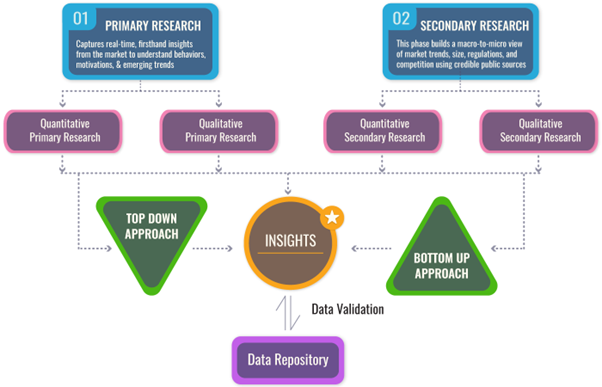
DUAL MODELING: TOP-DOWN + BOTTOM-UP
To ensure robust market estimation, we apply two complementary sizing approaches:
Top-Down Modeling:- Start with broader industry value (e.g., global or regional TAM)
- Apply filters by segment, geography, end-user, or use case
- Adjust with primary insights and validation benchmarks
- Ideal for investor-grade market scans and opportunity mapping
- Aggregate from the ground up using sales volumes, pricing, and unit economics
- Use internal modeling templates aligned with stakeholder data
- Incorporate distributor-level or region-specific inputs
- Most accurate for emerging segments and granular sub-markets
DATA VALIDATION: IN-HOUSE REPOSITORY
We close the loop with proprietary data intelligence built from ongoing projects, industry monitoring, and historical benchmarking. This repository includes:
- Multi-sector market and pricing models
- Key trendlines from past interviews and forecasts
- Benchmarked adoption rates, churn patterns, and ROI indicators
- Industry-specific deviation flags and cross-check logic
- Catches inconsistencies early
- Aligns projections across studies
- Enables consistent, high-trust deliverables