

Transdermal Drug Delivery Systems Market Size and Forecast (2026–2034), Global and Regional Growth, Trend, Share and Industry Analysis Report Coverage: By Type (Transdermal Patches, Semisolid Formulations (Gels, Ointments), Transdermal Sprays, and Others), By Application (Pain Management, Central Nervous System Disorders, Cardiovascular Diseases, Hormone Replacement Therapy, Smoking Cessation, and Others), By End User (Hospitals, Clinics, Home Care Settings, and Others) and Geography
2026-08-11
Healthcare
Swetal (Research Analyst)
Description
Transdermal Drug Delivery Systems
Market Overview
The global
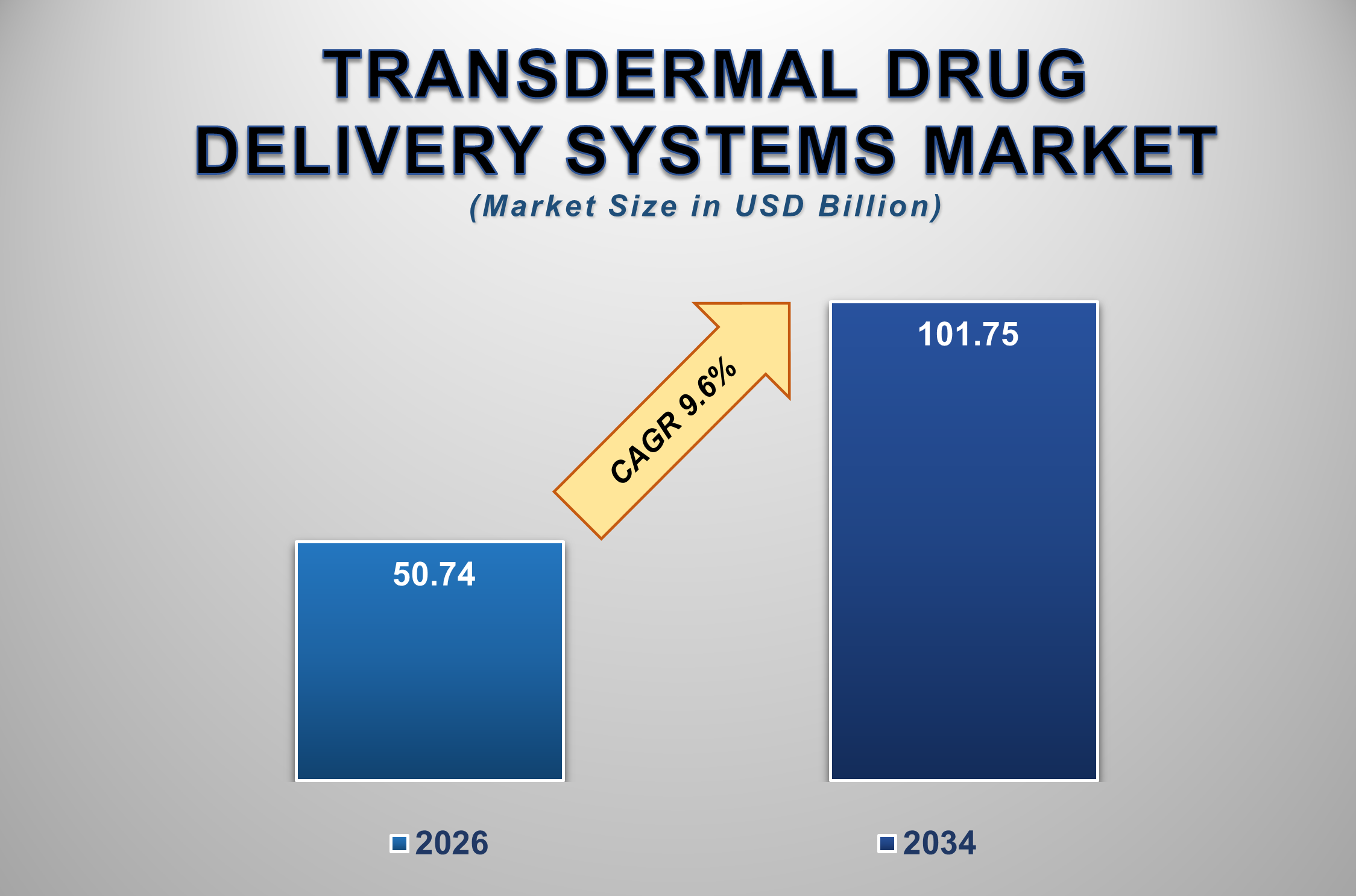
transdermal drug delivery systems market was valued at USD 50.74 billion in
2026 and is projected to reach USD 101.75 billion by 2034, expanding at a CAGR
of 9.6% during the forecast period. The market for transdermal drug delivery
systems (TDDS) is experiencing gradual growth due to the rising need for
painless drug delivery methods that enhance patient compliance, enable
sustained medication delivery, and reduce side effects associated with oral
medications. TDDS, such as transdermal patches, creams, gels, sprays, and new
microneedle techniques, are widely used to manage chronic pain, heart disease,
hormone replacement, neurological conditions, and smoking cessation. Advances
in drug penetration technology, drug delivery systems, and skin penetration
enhancers have enabled TDDS to deliver a range of drugs, including biological
agents and vaccines, through the skin. The increasing incidence of chronic
diseases, an aging population requiring continuous treatment, and the growing
trend toward self-administration of medications are driving market expansion.
Moreover, investments in research and development, regulatory support for new
drug delivery methods, and the launch of TDDS products are likely to contribute
to the growth of the global TDDS market.
Transdermal Drug Delivery Systems
Market Drivers and Opportunities
Rising Prevalence of
Chronic Diseases Driving Market Growth
The rising
incidence of chronic illnesses has greatly contributed to the growth of
transdermal delivery systems (TDDS). Referencing the statistics presented by
the American Journal of Public Health (AJPH) in June 2026, 51.1% of U.S. adults
had at least one of the ten selected chronic diseases diagnosed in 2024,
whereas 26.4 % were suffering from multiple chronic diseases. The increasing
number of patients demands prolonged and constant treatment, which causes the
need for methods of administering medications that ensure the lessening of the
frequency of taking medications, consequently leading to higher compliance and
better therapeutic results. TDDS provides controlled and continuous drug
release, less frequent administration of medications, avoids first-pass
metabolism, and decreases gastrointestinal side effects, which is the reason
that it is widely used in the treatment of chronic pain, cardiovascular
diseases, neurological conditions, and hormone replacement therapy. Given the
worldwide increase in chronic disease cases, the demand for satisfactory
non-invasive and patient-friendly TDDS-based therapies is expected to grow.
Growing
Preference for Non-Invasive Drug Delivery Fueling Market Expansion
The transdermal
drug delivery systems market is growing due to the increasing interest in
non-invasive drug delivery methods. Transdermal systems use patches and topical
treatments that allow for administering medication without pain or complicated
procedures. They also eliminate the need for going through the digestive tract,
thereby improving the effectiveness of medications and eliminating the side
effects arising from digestion. Additionally, these methods for drug delivery
make drug treatment more effective and simplify the administration of
medications in case of persistent problems of a chronic nature. The trends of
home healthcare growth and its aging population also contribute to the growth
of this market. Technology developments such as microneedle patches expand
opportunities for transdermal drug delivery, thus creating the scope for the
TDDS market development.
Expansion of
Microneedle-Based Drug Delivery Creates Significant Growth Opportunities
The growth of
microneedle delivery systems activities offers a unique chance for growth in
the Transdermal Drug Delivery Systems (TDDS) Market. The microneedle patch is
an approach that is more comfortable for patients and hence makes the process
of drug delivery simple through the production of tiny passage openings in the
human skin for drug delivery of vaccines, peptides, biologics, insulin, and
high-molecular-weight medications that were previously impossible to deliver
using traditional transdermal. The use of these microneedle patches has
increased the comfort of patients feeling as if they are being medicated more
painlessly, hastening the process of drug delivery and using fewer health
facility services. With more and more investment being made into microneedle
technology and an increasing number of patients requiring home care services,
more research activities into the development of advanced transdermal systems
have been ongoing. By expanding their application in managing chronic diseases,
vaccinations, and biologic therapies, pharmaceutical companies are able to open
new opportunities in using microneedle technologies.
Transdermal Drug Delivery Systems
Market Scope
|
Report Attributes |
Description |
|
Market Size in 2026 |
USD 50.74 Billion |
|
Market Forecast in 2034 |
USD 101.75 Billion |
|
CAGR % 2026-2034 |
9.6% |
|
Base Year |
2025 |
|
Historic Data |
2021-2025 |
|
Forecast Period |
2026-2034 |
|
Report USP |
Pricing and Cost Structure Analysis, Product
Innovation Benchmarking, Whitespace Assessment, Company Share, Company
Heatmap, Growth Factors, and more |
|
Segments Covered |
●
By Type ●
By
Application ●
By End
User |
|
Regional Scope |
●
North
America ●
Europe ●
APAC ●
Latin
America ●
Middle
East and Africa |
|
Country Scope |
●
U.S. ●
Canada ●
U.K. ●
Germany ●
France ●
Italy ●
Spain ●
Russia ●
China ●
India ●
Japan ●
South
Korea ●
Australia
●
Mexico ●
Brazil ●
Saudi
Arabia ●
UAE ●
South
Africa
|
Transdermal Drug Delivery Systems
Market Report Segmentation Analysis
The global
transdermal drug delivery systems market industry analysis is segmented by
type, by application, by end user, and by region.
Transdermal
Patches Segment Is Expected to Dominate the Transdermal Drug Delivery Systems
Market During the Forecast Period
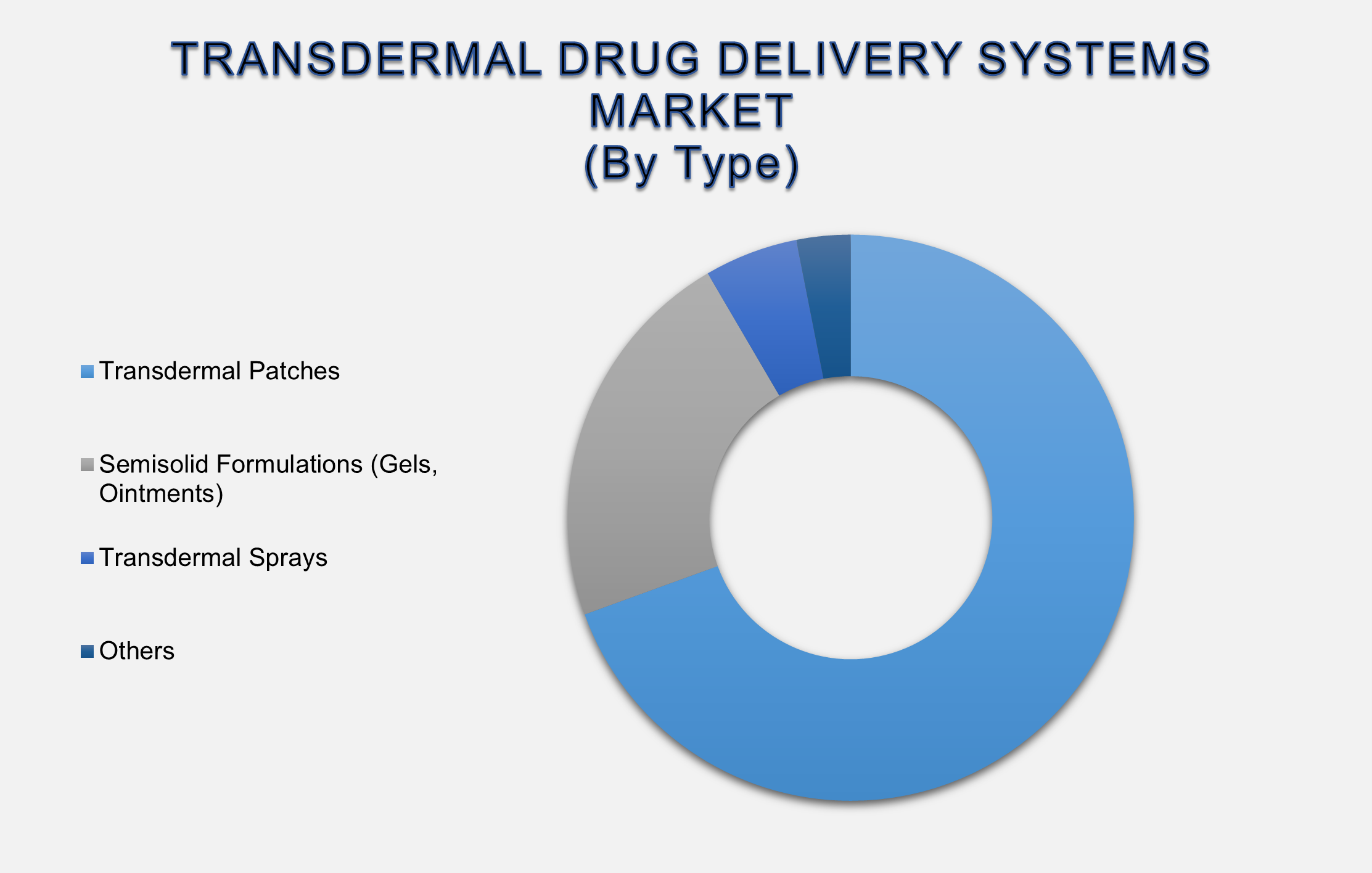
The transdermal
patches category is likely to hold the biggest share in the transdermal drug
delivery systems market, due to the capability of transdermal patches to permit
managed and slow drug dispensing, increase patient adherence to medication,
lessen the number of doses taken each day, and prevent first-pass metabolism.
These benefits make transdermal patches a preferred method of medication
delivery for long-term illnesses, pain relief, hormone replacement treatment,
as well as quitting smoking and contraceptives. Ongoing improvements in
technology, namely in adhesive systems employed in transdermal systems and
technology for skin permeability, expand the use of these medicines.
The collected facts
highlight further market potential, as one of the significant companies,
Viatris Inc., publicized in July 2026 that Gwyn Lo (norelgestromin and ethinyl
estradiol transdermal system) received approval from the U.S. FDA, which shows
that transdermal patches keep developing. The approval indicates that the
production of transdermal patches is aimed at creating safer and more usable
solutions with respect to human health concerns in the present-day conditions.
Pain Management
Segment Is Expected to Lead the Transdermal Drug Delivery Systems Market by
Application
The segment of pain
management is expected to dominate the market of Transdermal Drug Delivery
Systems (TDDS) throughout the forecast period because of the rise in the number
of chronic pain disease cases and preference for less invasive and long-lasting
drug delivery methods. Transdermal patches help in achieving controlled release
of drugs, simultaneously reducing the adverse effects of systemic drugs,
increasing the authority of the patient, and minimizing the need for prolonged
oral therapy. For instance, in March
2025, Aveva Drug Delivery Systems (DiffGen Company) got FDA approval for their
Lidocaine 1.8% Patch, which makes it a non-opioid topical treatment for
post-herpetic neuralgia (PHN). This approval enhances the availability of a
cost-effective and useful treatment for some forms of localized pain and
contributes to decreasing dependence on opioid medications. Such approvals make
the method more widespread in the field of pain therapy and more attractive for
the participants of the market.
Hospitals
Segment Is Expected to Lead the Transdermal Drug Delivery Systems Market by End
User
The hospital
segment is projected to hold the largest portion of the Transdermal Drug
Delivery Systems (TDDS) industry during the forecast period. This is due to the
high number of patients requiring pain therapy, cardiovascular treatment,
hormone therapy, and treatment after operations.
Hospitals are the
main healthcare facilities that offer drug treatments, as using transdermal
solutions is growing in popularity owing to their ability to provide consistent
and controlled medicines, high patient satisfaction, lower dosing requirements,
and low chances of gastrointestinal side effects. In addition to that, the
rising number of surgeries, chronic diseases, and the use of non-invasive
medicine delivery systems will impact the growing usage of transdermal
medicines in hospitals. Moreover, hospitals have always been the pioneers in
utilizing new transdermal medications, as they are equipped with clinical
protocols and skilled workers, as well as a developed monitoring system for
patients. The growth of the number of transdermal drugs for pain relief
treatment, neurological diseases, cardiovascular disorders, and hormone therapy
facilitates the usage of these products in hospitals. Other than that, the
healthcare system has been giving preference to better therapeutic outcomes,
patient safety, and being less of a load on hospitals, and is expected to
remain firm in the global Transdermal Drug Delivery Systems market during the
period being analyzed.
The following
segments are part of an in-depth analysis of the global transdermal drug
delivery systems market:
|
Market Segments |
|
|
By Type |
●
Transdermal
Patches ●
Semisolid
Formulations (Gels, Ointments) ●
Transdermal
Sprays ●
Others |
|
By Application |
●
Pain
Management ●
Central
Nervous System Disorders ●
Cardiovascular
Diseases ●
Hormone
Replacement Therapy ●
Smoking
Cessation ●
Others |
|
By End User |
●
Hospitals ●
Clinics ●
Home Care
Settings ●
Others |
Transdermal Drug Delivery Systems
Market Share Analysis by Region
North America is
projected to hold the largest share of the global Transdermal Drug Delivery
Systems Market over the forecast period
North America is
projected to hold the maximum share of the global Transdermal Drug Delivery
Systems (TDDS) market over the review timeline, fueled by a developed
healthcare system, high prevalence of chronic diseases, established pharma
R&D base, and higher usage of new medicines. North America benefits from
the presence of numerous drug manufacturers, favorable reimbursement systems,
and well-established laws governing the commercialization of new transdermal
therapies. The need for patient-centric non-invasive solutions for managing
pain in the population, women’s health, neurological illnesses, and hormone
replacement therapy is also stimulating market growth. For instance, in June
2026, the FDA approved an updated labeled strength for TWIRLA® (levonorgestrel
and ethinyl estradiol transdermal system) by Exeltis USA. The formulation of
the product was not changed, but the new labeling was in line with the new FDA
regulations regarding transdermal and topical delivery systems, which
highlights regulatory practice in the area and improvements in transdermal
therapy. Due to such changes, confidence in products is improved, and the North
American market of transdermal drug delivery systems continues to develop.
Transdermal Drug
Delivery Systems Market Competition Landscape Analysis
In the transdermal
drug delivery systems (TDDS) market, companies involved in the pharmaceutical
industry, drug delivery technology providers, specialized transdermal patch
producers, contract development and manufacturing organizations (CDMOs), and
material science companies are all competing. Companies invariably seek to
develop innovative transdermal patches, microneedle technology, improved skin
permeability methods, long-acting drug delivery systems, and new adhesive
agents. Competition arises from product launches, approval of new drugs,
advances in technology, joining forces, geographical catching up, mergers, and
more R&D activity, thus enabling companies to consolidate their product
lines.
Global
Transdermal Drug Delivery Systems Market Recent Developments News:
●
In July 2026
– Praxis Precision Medicines, Inc. a fully
integrated central nervous system (CNS) precision neuroscience
biopharmaceutical company, and Remagine Labs, Inc., a developer of
electronically controlled transdermal drug delivery systems, announced a
research collaboration and license agreement to develop an iontophoretic
transdermal patch for the delivery of ulixacaltamide, Praxis's highly selective
T-type calcium channel inhibitor in development for essential tremor (ET).
●
In July 2026 -
The FDA approved norelgestromin and ethinyl estradiol transdermal system (Gwyn
Lo; Viatris Inc.) as a once-weekly combined hormonal contraceptive (CHC) patch
with a low dose of estrogen for women of childbearing potential with a body
mass index (BMI) below 30 kg/m², the company announced in a news release.
●
In March 2025
- The U.S. Food and Drug Administration (FDA) approved a generic version of
ZTlido. The first-of-its-kind generic lidocaine 1.8% patch is produced by Aveva
Drug Delivery Systems (a DifGen company), a leader in transdermal drug delivery
systems based out of Miramar, Florida.
The global
transdermal drug delivery systems market is dominated by a few large companies,
such as
●
AdhexPharma
●
Agile Therapeutics
●
Corium
●
Endo International
●
Hisamitsu Pharmaceutical
●
IntelGenx
●
Johnson & Johnson
●
Kindeva Drug Delivery
●
Lohmann Therapie-Systeme (LTS)
●
Luye Pharma
●
Medherant
●
Nitto Denko
●
Novartis
●
Noven Pharmaceuticals
●
Purdue Pharma
●
Solventum
●
Sparsha Pharma
●
Teva Pharmaceutical
●
UCB
●
Viatris
● Other Prominent Players
Frequently Asked Questions
Swetal (Research Analyst)
Swetal is a Research Analyst with 4+ years of experience specializing in healthcare market research, medical devices, healthcare IT, and medical technology industry analysis. Her expertise includes competitive intelligence, secondary research, market trend forecasting, and healthcare business insights across global healthcare ecosystems.
She contributes to advanced market research reports by analyzing regulatory frameworks, emerging healthcare technologies, competitive landscapes, and innovation trends shaping the medical industry. With a strong focus on accurate market intelligence, strategic insights, and healthcare industry trends, Swetal supports businesses in making informed, data-backed decisions in a rapidly transforming healthcare environment.
1.
Global
Transdermal Drug Delivery Systems Market Introduction and Market Overview
1.1. Objectives of the Study
1.2. Market Segmentation
1.2.1.Type of the Global Transdermal
Drug Delivery Systems Market
1.2.2.Application of the Global
Transdermal Drug Delivery Systems Market
1.2.3.End User of the Global
Transdermal Drug Delivery Systems Market
1.2.4.Region of the Global Transdermal
Drug Delivery Systems Market
1.3. Competition Coverage List of
Market Participants
1.4. Market Definition: Transdermal
Drug Delivery Systems Market
2.
Executive Summary
2.1. Global Transdermal Drug Delivery
Systems Market Estimation & Forecast
2.1.1.Global Transdermal Drug Delivery
Systems Market Size (US$ Million) Estimates & Historical Trend Analysis
(2021 - 2025)
2.1.2.Global Transdermal Drug Delivery
Systems Overall Market Size (US$ Million), Growth Rate (Y-o-Y), Market CAGR
(%), Market Forecast (2026 - 2034)
2.2. Snapshot of Global Transdermal
Drug Delivery Systems Market
2.3. Global Transdermal Drug Delivery
Systems Market Revenue Share (%) 2025
2.4. REGIONAL OUTLINE: Revenue CAGR,
by Region
2.5. Key Competitors & Key
Insights
3.
Market Overview (Qualitative
Analysis)
3.1. Demand Side Trends
3.2. Supply Side Trends /
Manufacturing Trends
3.3. Demand and Opportunity
Assessment, 2026 - 2034
3.4. Market Dynamics
3.4.1.Drivers
3.4.2.Limitations
3.4.3.Opportunities
3.4.4.Impact Analysis of Drivers and
Restraints
3.5. Key Developments
3.6. Regulatory Landscape
3.7. Pricing Analysis
3.8. Supply Chain Analysis
3.9. Porter’s Five Forces Analysis
3.9.1.Bargaining Power of Suppliers
3.9.2.Bargaining Power of Buyers
3.9.3.Threat of Substitutes
3.9.4.Threat of New Entrants
3.9.5.Competitive Rivalry
3.10. PEST Analysis
3.10.1. Political Factors
3.10.2. Economic Factors
3.10.3. Social Factors
3.10.4. Technology Factors
4.
Global Transdermal Drug Delivery
Systems Market Estimates & Forecast Trend Analysis, by Type
4.1. Global Transdermal Drug Delivery
Systems Market Assessments & Key Findings, by Type
4.2. Global Transdermal Drug Delivery
Systems Market Revenue (US$ Million) Estimates and Forecasts, by Type, 2021 -
2034
4.2.1.Transdermal Patches
4.2.2.Semisolid Formulations (Gels,
Ointments)
4.2.3.Transdermal Sprays
4.2.4.Others
5.
Global Transdermal Drug Delivery
Systems Market Estimates & Forecast Trend Analysis, by Application
5.1. Global Transdermal Drug Delivery
Systems Market Assessments & Key Findings, by Application
5.2. Global Transdermal Drug Delivery
Systems Market Revenue (US$ Million) Estimates and Forecasts, by Application,
2021 - 2034
5.2.1.Pain Management
5.2.2.Central Nervous System Disorders
5.2.3.Cardiovascular Diseases
5.2.4.Hormone Replacement Therapy
5.2.5.Smoking Cessation
5.2.6.Others
6.
Global Transdermal Drug Delivery
Systems Market Estimates & Forecast Trend Analysis, by End User
6.1. Global Transdermal Drug Delivery
Systems Market Assessments & Key Findings, by End User
6.2. Global Transdermal Drug Delivery
Systems Market Revenue (US$ Million) Estimates and Forecasts, by End User, 2021
- 2034
6.2.1.Hospitals
6.2.2.Clinics
6.2.3.Home Care Settings
6.2.4.Others
7.
Global Transdermal Drug Delivery
Systems Market Estimates & Forecast Trend Analysis, by Region
7.1.
Global
Transdermal Drug Delivery Systems Market Assessments & Key Findings, by
Region
7.2.
Global
Transdermal Drug Delivery Systems Market Revenue (US$ Million) Estimates and
Forecasts, by Region, 2021 - 2034
7.2.1.North America
7.2.2.Europe
7.2.3.Asia Pacific
7.2.4.Middle East & Africa
7.2.5.Latin America
8.
North
America Transdermal Drug Delivery Systems Market: Estimates & Forecast Trend Analysis
8.1. North America Transdermal Drug
Delivery Systems Market Assessments & Key Findings
8.1.1.North America Transdermal Drug
Delivery Systems Market Introduction
8.1.2.North America Transdermal Drug
Delivery Systems Market Size Estimates and Forecast (US$ Million) (2021 - 2034)
8.1.2.2. By Application
8.1.2.3. By End User
8.1.2.4. By Country
8.1.2.4.1. The U.S.
8.1.2.4.2. Canada
9.
Europe
Transdermal Drug Delivery Systems Market: Estimates & Forecast Trend Analysis
9.1. Europe Transdermal Drug Delivery
Systems Market Assessments & Key Findings
9.1.1.Europe Transdermal Drug Delivery
Systems Market Introduction
9.1.2.Europe Transdermal Drug Delivery
Systems Market Size Estimates and Forecast (US$ Million) (2021 - 2034)
9.1.2.1. By Type
9.1.2.2. By Application
9.1.2.3. By End User
9.1.2.4. By Country
9.1.2.4.1.
Germany
9.1.2.4.2.
Italy
9.1.2.4.3.
U.K.
9.1.2.4.4.
France
9.1.2.4.5.
Spain
9.1.2.4.6.
Switzerland
9.1.2.4.7. Rest
of Europe
10. Asia Pacific Transdermal
Drug Delivery Systems Market: Estimates
& Forecast Trend Analysis
10.1. Asia Pacific Market Assessments
& Key Findings
10.1.1. Asia Pacific Transdermal Drug
Delivery Systems Market Introduction
10.1.2. Asia Pacific Transdermal Drug
Delivery Systems Market Size Estimates and Forecast (US$ Million) (2021 - 2034)
10.1.2.1. By Type
10.1.2.2. By Application
10.1.2.3. By End User
10.1.2.4. By Country
10.1.2.4.1. China
10.1.2.4.2. Japan
10.1.2.4.3. India
10.1.2.4.4. Australia
10.1.2.4.5. South Korea
10.1.2.4.6. Rest of Asia Pacific
11. Middle East & Africa Transdermal
Drug Delivery Systems Market: Estimates
& Forecast Trend Analysis
11.1. Middle East & Africa Market
Assessments & Key Findings
11.1.1. Middle
East & Africa
Transdermal Drug Delivery Systems Market Introduction
11.1.2. Middle
East & Africa
Transdermal Drug Delivery Systems Market Size Estimates and Forecast (US$
Million) (2021 - 2034)
11.1.2.1. By Type
11.1.2.2. By Application
11.1.2.3. By End User
11.1.2.4. By Country
11.1.2.4.1. South Africa
11.1.2.4.2. UAE
11.1.2.4.3. Saudi Arabia
11.1.2.4.4. Rest of MEA
12. Latin America
Transdermal Drug Delivery Systems Market:
Estimates & Forecast Trend Analysis
12.1. Latin America Market Assessments
& Key Findings
12.1.1. Latin America Transdermal Drug
Delivery Systems Market Introduction
12.1.2. Latin America Transdermal Drug
Delivery Systems Market Size Estimates and Forecast (US$ Million) (2021 - 2034)
12.1.2.1. By Type
12.1.2.2. By Application
12.1.2.3. By End User
12.1.2.4. By Country
12.1.2.4.1. Brazil
12.1.2.4.2. Mexico
12.1.2.4.3. Argentina
12.1.2.4.4. Rest of LATAM
13. Competition Landscape
13.1. Global Transdermal Drug Delivery
Systems Market Product Mapping
13.2. Global Transdermal Drug Delivery
Systems Market Concentration Analysis, by Leading Players / Innovators /
Emerging Players / New Entrants
13.3. Global Transdermal Drug Delivery
Systems Market Tier Structure Analysis
13.4. Global Transdermal Drug Delivery
Systems Market Concentration & Company Market Shares (%) Analysis, 2025
14. Company Profiles
14.1. AdhexPharma
14.1.1. Company Overview & Key Stats
14.1.2. Financial Performance & KPIs
14.1.3. Product Portfolio
14.1.4. SWOT Analysis
14.1.5. Business Strategy & Recent
Developments
* Similar details would be provided
for all the players mentioned below
14.2. Agile Therapeutics
14.3. Corium
14.4. Endo International
14.5. Hisamitsu Pharmaceutical
14.6. IntelGenx
14.7. Johnson & Johnson
14.8. Kindeva Drug Delivery
14.9. Lohmann Therapie-Systeme (LTS)
14.10. Luye Pharma
14.11. Medherant
14.12. Nitto Denko
14.13. Novartis
14.14. Noven Pharmaceuticals
14.15. Purdue Pharma
14.16. Solventum
14.17. Sparsha Pharma
14.18. Teva Pharmaceutical
14.19. UCB
14.20. Viatris
14.21. Other Prominent Players
15. Research
Findings & Conclusion
16. Assumptions & Acronyms Used
17. Research
Methodology
17.1. External Transportation /
Databases
17.2. Internal Proprietary Database
17.3. Primary Research
17.4. Secondary Research
17.5. Assumptions
17.6. Limitations
17.7. Report FAQs
Our Research Methodology
"Insight without rigor is just noise."
We follow a comprehensive, multi-phase research framework designed to deliver accurate, strategic, and decision-ready intelligence. Our process integrates primary and secondary research , both quantitative and qualitative , along with dual modeling techniques ( top-down and bottom-up) and a final layer of validation through our proprietary in-house repository.
PRIMARY RESEARCH
Primary research captures real-time, firsthand insights from the market to understand behaviors, motivations, and emerging trends.
1. Quantitative Primary Research
Objective: Generate statistically significant data directly from market participants.
Approaches:- Structured surveys with customers, distributors, and field agents
- Mobile-based data collection for point-of-sale audits and usage behavior
- Phone-based interviews (CATI) for market sizing and product feedback
- Online polling around industry events and digital campaigns
- Purchase frequency by customer type
- Channel performance across geographies
- Feature demand by application or demographic
2. Qualitative Primary Research
Objective: Explore decision-making drivers, pain points, and market readiness.
Approaches:- In-depth interviews (IDIs) with executives, product managers, and key decision-makers
- Focus groups among end users and early adopters
- Site visits and observational research for consumer products
- Informal field-level discussions for regional and cultural nuances
SECONDARY RESEARCH
This phase helps establish a macro-to-micro understanding of market trends, size, regulation, and competitive dynamics, sourced from credible and public domain information.
1. Quantitative Secondary Research
Objective: Model market value and segment-level forecasts based on published data.
Sources include:- Financial reports and investor summaries
- Government trade data, customs records, and regulatory statistics
- Industry association publications and economic databases
- Channel performance and pricing data from marketplace listings
- Revenue splits, pricing trends, and CAGR estimates
- Supply-side capacity and volume tracking
- Investment analysis and funding benchmarks
2. Qualitative Secondary Research
Objective: Capture strategic direction, innovation signals, and behavioral trends.
Sources include:- Company announcements, roadmaps, and product pipelines
- Publicly available whitepapers, conference abstracts, and academic research
- Regulatory body publications and policy briefs
- Social and media sentiment scanning for early-stage shifts
- Strategic shifts in market positioning
- Unmet needs and white spaces
- Regulatory triggers and compliance impact
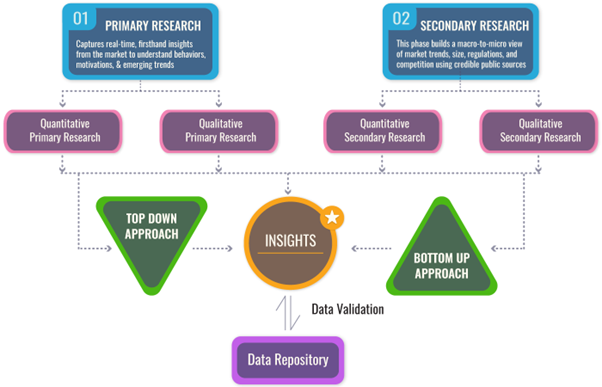
DUAL MODELING: TOP-DOWN + BOTTOM-UP
To ensure robust market estimation, we apply two complementary sizing approaches:
Top-Down Modeling:- Start with broader industry value (e.g., global or regional TAM)
- Apply filters by segment, geography, end-user, or use case
- Adjust with primary insights and validation benchmarks
- Ideal for investor-grade market scans and opportunity mapping
- Aggregate from the ground up using sales volumes, pricing, and unit economics
- Use internal modeling templates aligned with stakeholder data
- Incorporate distributor-level or region-specific inputs
- Most accurate for emerging segments and granular sub-markets
DATA VALIDATION: IN-HOUSE REPOSITORY
We close the loop with proprietary data intelligence built from ongoing projects, industry monitoring, and historical benchmarking. This repository includes:
- Multi-sector market and pricing models
- Key trendlines from past interviews and forecasts
- Benchmarked adoption rates, churn patterns, and ROI indicators
- Industry-specific deviation flags and cross-check logic
- Catches inconsistencies early
- Aligns projections across studies
- Enables consistent, high-trust deliverables