
United Kingdom Antiepileptic Drugs Market Size and Forecast (2026–2034), Regional Growth, Trend, Share and Industry Analysis Report Coverage: By Drug Class (Sodium Channel Modulators, GABA-Enhancing Agents, Calcium Channel Modulators, and Others); By Route of Administration (Oral, Intravenous, Intramuscular, and Others); By Formulation (Tablets and Capsules, Oral Liquids and Suspensions, Injectable Formulations, and Others); By Distribution Channel (Hospital Pharmacies, Retail Pharmacies, and Online Pharmacies)
2026-11-12
Healthcare
Swetal (Research Analyst)
Description
United Kingdom Antiepileptic Drugs Market Overview
The United Kingdom antiepileptic drugs market is projected to expand from USD 0.86 billion in 2026 to USD 1.37 billion by 2034, registering a CAGR of 6.3% during 2026–2034. The United Kingdom antiepileptic drugs market is characterized by the constant need for the management of seizures, well-defined treatment paths under the NHS, and the presence of many antiseizure medicines that are both branded and generic. There is an appropriate selection of medicines based on seizure type, patient factors, and efficacy, thus leading to the demand for medicines like levetiracetam, lamotrigine, carbamazepine, and sodium valproate. The market has established pharmaceutical companies and generic medicine providers, which compete in terms of product availability, pricing, and variety of products. On the other hand, new medicines present a chance to treat those patients who have seizures that are not adequately controlled. Prescribing decisions will be greatly affected by NICE guidance and MHRA safety requirements, especially when it comes to medicines with pregnancy-specific risks. Consistency of supply is crucial since changing the manufacturer might mean reassessment of certain antiseizure medicines.

United Kingdom Antiepileptic Drugs Market Growth Drivers
Continued Need for Long-Term Epilepsy Management
The constant burden of epilepsy in the UK is maintaining the demand for anti-epileptic drugs, as many patients will need continuous medication to manage seizures and minimize the risk of developing complications. According to statistics reported by the Epilepsy Research Institute, there are about 630,000 people who have epilepsy in the UK, which is about one out of every hundred people in the country; moreover, 30% of these patients continue experiencing uncontrolled seizures even though they are receiving some sort of treatment. The large patient population will support a consistent demand for well-known anticonvulsant drugs and the need for alternatives for those who do not manage their seizures effectively with the help of existing drugs.
Established NHS Treatment Infrastructure
The UK’s existing National Health Service (NHS) offers a systematic approach to epilepsy diagnosis, treatment, and management, thus facilitating the demand for antiepileptic drugs. NICE offers evidence-based guidelines for the treatment of various seizures among children, young people, and adults and helps in making decisions about which medications should be prescribed by taking into account the specific needs of patients. Treatment is offered through general practitioners and through hospital neurology departments and specialist centers for epilepsy treatment. Referrals to tertiary services are offered in case of difficult or resistant cases. This ensures that patients will get access not only to existing but also to newer medications against seizures. The role of the NHS in organizing the treatment of epilepsy and prescribing medicines ensures constant demand for antiepileptics.
United Kingdom Antiepileptic Drugs Market Restraint
Medicine Supply Disruptions and Treatment-Switching Challenges
Intermittent shortage of antiepileptic drug products, as well as considerations around changing from one drug manufacturer to another, could act as potential constraints in the UK antiepileptic drugs market owing to issues around disruption of patient treatment plans and drug dispensing problems. On February 28, 2025, the Department of Health and Social Care, UK, stated that there were problems with the supply of carbamazepine, lamotrigine, oxcarbazepine, topiramate, and phenobarbital product presentations. Although alternative manufacturing companies would be able to resolve these shortage issues, a decision to switch from one antiepileptic medication manufacturer to another could have significant challenges, as some drugs have a high chance of having adverse effects on seizure management or tolerance after switching. However, according to the September 2025 NHS Specialist Pharmacy Service guidelines, carbamazepine, phenytoin, phenobarbital, and primidone should not be changed in terms of manufacturer unless there is a valid clinical reason for switching to other products.
United Kingdom Antiepileptic Drugs Market Opportunities
Development of Therapies for Drug-Resistant Epilepsy
The gap between the unmet need for drugs to treat patients who suffer from uncontrolled seizures even after taking available medications is one of the areas of growth in the UK Antiepileptic Drugs Market. According to research, about one-third of people suffering from epilepsy have seizures that cannot be controlled using available medications, resulting in the need for drugs with enhanced efficacy, tolerability, and novel mechanisms.
Pharmaceutical companies can take advantage of this area by developing new antiseizure drugs, add-on drugs, and drugs targeting difficult-to-treat forms of epilepsy. The UK National Institute for Health and Care Excellence (NICE) has recognized the need for additional studies into alternative and add-on therapies in case of failure or non-tolerance to first-line drugs.
Expansion of Patient-Friendly Formulations
Patient-friendly formulation is another opportunity within the UK Antiepileptic Drugs Market due to the different administration requirements of children, senior patients, and individuals suffering from problems taking the ordinary tablet form of drugs. The formulation could allow pharmaceutical companies to diversify their products through formulations such as oral liquids, dissolvable or orodispersible tablets, granules, and any other convenient formulation methods. Levetiracetam exists in the market within formulations of tablet, liquid, granule, and orodispersible tablets within the NHS.
Such formulations would allow pharmaceutical companies to differentiate their products and provide for individual patients' needs. But then the formulation should take into consideration issues like dose precision, bioavailability, and suitability of formulations.
United Kingdom Antiepileptic Drugs Market Scope
United Kingdom Antiepileptic Drugs Market Report Segmentation Analysis
The Sodium Channel Modulators Segment Is Expected to Dominate the United Kingdom Antiepileptic Drugs Market During the Forecast Period
Patient-friendly formulation is another opportunity within the UK Antiepileptic Drugs Market due to the different administration requirements of children, senior patients, and individuals suffering from problems taking the ordinary tablet form of drugs. The formulation could allow pharmaceutical companies to diversify their products through formulations such as oral liquids, dissolvable or orodispersible tablets, granules, and any other convenient formulation methods. Levetiracetam exists in the market within formulations of tablets, liquids, granules, and orodispersible tablets within the NHS.
Such formulations would allow pharmaceutical companies to differentiate their products and provide for individual patients' needs. But then the formulation should take into consideration issues like dose precision, bioavailability, and suitability of formulations.

Oral Segment Is Expected to Dominate the United Kingdom Antiepileptic Drugs Market During the Forecast Period
The oral format is predicted to hold a considerable market share of the UK Antiepileptic Drugs Market because of the prolonged course of the treatment for epilepsy and the ease of taking medicine at home. Some popular antiepileptic drugs such as levetiracetam, carbamazepine, and topiramate come in oral formats that include tablets, capsules, liquid, and granular formulations. Oral medications are also seen by the NHS as an essential part of the treatment program for epilepsy. The presence of several different oral formulations is helpful since they make it easier to administer the medicines to young patients and those who cannot swallow the tablets.
Tablets and Capsules Segment Is Expected to Dominate the United Kingdom Antiepileptic Drugs Market During the Forecast Period
Both the tablet and capsule dosage forms will constitute a major part of the UK Antiepileptic Drugs Market because of their ease of administration, long-term safety, and common usage in the routine management of epilepsy. Commonly prescribed drugs like levetiracetam, lamotrigine, and carbamazepine come in tablet or capsule forms. Immediate-release as well as modified-release drug forms will be available in branded and generic versions, thus giving patients the choice of the type of drug and its administration. The NHS formulary includes tablet and capsule forms of several antiepileptic drugs. Even though oral liquids and granules and even injection drugs have a place in the management of epilepsy, tablets and capsules are still expected to be the dominant dosage form in the UK market.
The Hospital Pharmacies Segment Is Expected to Dominate the United Kingdom Antiepileptic Drugs Market During the Forecast Period
Hospital pharmacies are anticipated to play an important part in the UK Antiepileptic Drugs Market owing to their participation in starting specialist-driven treatment, handling of complicated epilepsy cases, and dispensation of medications to patients who need hospitalization. They assist in specialist-prescribed treatments, injectable antiepileptic drugs in emergencies, and dose adjustment for patients suffering from uncontrolled seizures or complicated cases. Hospital pharmacists also help in medication review, patient counseling, and treatment after discharge. Nevertheless, many patients taking oral antiepileptic medications on a long-term basis get repeat prescriptions from community pharmacies. Thus, the anticipated market dominance of the hospital pharmacy sector needs to be verified with respect to UK channel-level sales and dispensing figures.
The following segments are part of an in-depth analysis of the United Kingdom Antiepileptic Drugs Market:
United Kingdom Antiepileptic Drugs Market Competition Landscape Analysis
The UK antiepileptic drugs market is defined by competition among the branded pharma companies and the generic drug manufacturers. Some of the leading companies are UCB Pharma, Eisai, Jazz Pharmaceuticals, Teva Pharmaceutical Industries, Viatris, and Sandoz. Competition is driven by the company’s portfolio, effectiveness, tolerance, price, and reliability of supply. The branded companies are focused on providing differentiated treatments and treatments for patients with hard-to-control epilepsy, while the generic companies rely on providing cost-efficient alternative drugs. Prescribing and procurement policies of the NHS determine access and prices in the market, while the guidelines from the MHRA regarding switching between the products of different manufacturers emphasize the importance of treatment continuity for some of the antiepileptic drugs.
United Kingdom Antiepileptic Drugs Market Recent Developments News:
In October 2026, the Epilepsy Research Institute announced the launch of the LIFETIME project, a UK and European research network focused on improving understanding of the long-term health and neurodevelopmental outcomes of children exposed to anti-seizure medications during pregnancy. The initiative will initially collect standardized data from up to 350 mothers and children, with a longer-term goal of involving approximately 2,000 families. By addressing gaps in evidence on medication safety during pregnancy, the project aims to support better-informed treatment decisions, strengthen clinical understanding of potential long-term risks, and improve the evidence base for the use of established and newer antiseizure therapies.
In August 2026, SK Biopharmaceuticals announced an agreement to in-license opakalim, an investigational antiseizure drug candidate, from Biohaven. The selective Kv7.2/7.3 potassium channel activator is being evaluated in Phase 2/3 clinical trials as an adjunctive treatment for adults with focal-onset seizures, including patients with treatment-resistant epilepsy. SK Biopharmaceuticals aims for a potential U.S. launch as early as 2029, subject to clinical progress and regulatory approval. The agreement, which includes upfront and milestone payments of up to US$795 million related to the Kv7 platform, highlights pharmaceutical companies’ use of licensing partnerships to expand their epilepsy portfolios and advance novel therapies for patients with unmet treatment needs.
The United Kingdom Antiepileptic Drugs Market is dominated by a few large companies, such as
UCB
Eisai
Jazz Pharmaceuticals
Teva Pharmaceutical Industries
Viatris
Aurobindo Pharma
Sun Pharmaceutical Industries
Dr. Reddy’s Laboratories
Sandoz
Zentiva
Accord Healthcare
Brown & Burk
Wockhardt
Neuraxpharm
Seacross Pharmaceuticals
Strides Pharma
Aspire Pharma
Crescent Pharma
Torrent Pharmaceuticals
Pfizer
Other Prominent Players
Frequently Asked Questions
Swetal (Research Analyst)
Swetal is a Research Analyst with 4+ years of experience specializing in healthcare market research, medical devices, healthcare IT, and medical technology industry analysis. Her expertise includes competitive intelligence, secondary research, market trend forecasting, and healthcare business insights across global healthcare ecosystems.
She contributes to advanced market research reports by analyzing regulatory frameworks, emerging healthcare technologies, competitive landscapes, and innovation trends shaping the medical industry. With a strong focus on accurate market intelligence, strategic insights, and healthcare industry trends, Swetal supports businesses in making informed, data-backed decisions in a rapidly transforming healthcare environment.
United Kingdom Antiepileptic Drugs Market Introduction and Market Overview
Objectives of the Study
Market Segmentation
Drug Class of the United Kingdom Antiepileptic Drugs Market
Route of Administration of the United Kingdom Antiepileptic Drugs Market
Formulation of United Kingdom Antiepileptic Drugs Market
Distribution Channel of the United Kingdom Antiepileptic Drugs Market
Competition Coverage List of Market Participants
Market Definition: Antiepileptic Drugs Market
Executive Summary
United Kingdom Antiepileptic Drugs Market Estimation & Forecast
United Kingdom Antiepileptic Drugs Market Size (US$ Million) Estimates & Historical Trend Analysis (2021 - 2025)
United Kingdom Peptide Cancer Vaccine Overall Market Size (US$ Million), Growth Rate (Y-o-Y), Market CAGR (%), Market Forecast (2026 - 2034)
Snapshot of United Kingdom Antiepileptic Drugs Market
United Kingdom Antiepileptic Drugs Market Revenue Share (%) 2025
Key Competitors & Key Insights
Market Overview (Qualitative Analysis)
Demand Side Trends
Supply Side Trends / Manufacturing Trends
Demand and Opportunity Assessment, 2026 - 2034
Market Dynamics
Drivers
Limitations
Opportunities
Impact Analysis of Drivers and Restraints
Key Developments
Regulatory Landscape
Pricing Analysis
Supply Chain Analysis
Porter’s Five Forces Analysis
Bargaining Power of Suppliers
Bargaining Power of Buyers
Threat of Substitutes
Threat of New Entrants
Competitive Rivalry
PEST Analysis
Political Factors
Economic Factors
Social Factors
Technology Factors
United Kingdom Antiepileptic Drugs Market Estimates & Forecast Trend Analysis, by Drug Class
United Kingdom Antiepileptic Drugs Market Assessments & Key Findings, by Drug Class
United Kingdom Antiepileptic Drugs Market Revenue (US$ Million) Estimates and Forecasts, by Drug Class, 2021 - 2034
Sodium Channel Modulators
GABA-Enhancing Agents
Calcium Channel Modulators
Others
United Kingdom Antiepileptic Drugs Market Estimates & Forecast Trend Analysis, by Route of Administration
United Kingdom Antiepileptic Drugs Market Assessments & Key Findings, by Route of Administration
United Kingdom Antiepileptic Drugs Market Revenue (US$ Million) Estimates and Forecasts, by Route of Administration, 2021 - 2034
Oral
Intravenous
Intramuscular
Others
United Kingdom Antiepileptic Drugs Market Estimates & Forecast Trend Analysis, by Formulation
United Kingdom Antiepileptic Drugs Market Assessments & Key Findings, by Formulation
United Kingdom Antiepileptic Drugs Market Revenue (US$ Million) Estimates and Forecasts, by Formulation, 2021 - 2034
Tablets and Capsules
Oral Liquids and Suspensions
Injectable Formulations
Others
United Kingdom Antiepileptic Drugs Market Estimates & Forecast Trend Analysis, by Distribution Channel
United Kingdom Antiepileptic Drugs Market Assessments & Key Findings, by Distribution Channel
United Kingdom Antiepileptic Drugs Market Revenue (US$ Million) Estimates and Forecasts, by Distribution Channel, 2021 - 2034
Hospital Pharmacies
Retail Pharmacies
Online Pharmacies
Competition Landscape
United Kingdom Antiepileptic Drugs Market Product Mapping
United Kingdom Antiepileptic Drugs Market Concentration Analysis, by Leading Players / Innovators / Emerging Players / New Entrants
United Kingdom Antiepileptic Drugs Market Tier Structure Analysis
United Kingdom Antiepileptic Drugs Market Concentration & Company Market Shares (%) Analysis, 2025
Company Profiles
UCB
Company Overview & Key Stats
Financial Performance & KPIs
Product Portfolio
SWOT Analysis
Business Strategy & Recent Developments
* Similar details would be provided for all the players mentioned below
Eisai
Jazz Pharmaceuticals
Teva Pharmaceutical Industries
Viatris
Aurobindo Pharma
Sun Pharmaceutical Industries
Dr. Reddy’s Laboratories
Sandoz
Zentiva
Accord Healthcare
Brown & Burk
Wockhardt
Neuraxpharm
Seacross Pharmaceuticals
Strides Pharma
Aspire Pharma
Crescent Pharma
Torrent Pharmaceuticals
Pfizer
Other Prominent Players
Research Findings & Conclusion
Assumption & Acronyms Used
Research Methodology
External Transportations / Databases
Internal Proprietary Database
Primary Research
Secondary Research
Assumptions
Limitations
Report FAQs
Our Research Methodology
"Insight without rigor is just noise."
We follow a comprehensive, multi-phase research framework designed to deliver accurate, strategic, and decision-ready intelligence. Our process integrates primary and secondary research , both quantitative and qualitative , along with dual modeling techniques ( top-down and bottom-up) and a final layer of validation through our proprietary in-house repository.
PRIMARY RESEARCH
Primary research captures real-time, firsthand insights from the market to understand behaviors, motivations, and emerging trends.
1. Quantitative Primary Research
Objective: Generate statistically significant data directly from market participants.
Approaches:- Structured surveys with customers, distributors, and field agents
- Mobile-based data collection for point-of-sale audits and usage behavior
- Phone-based interviews (CATI) for market sizing and product feedback
- Online polling around industry events and digital campaigns
- Purchase frequency by customer type
- Channel performance across geographies
- Feature demand by application or demographic
2. Qualitative Primary Research
Objective: Explore decision-making drivers, pain points, and market readiness.
Approaches:- In-depth interviews (IDIs) with executives, product managers, and key decision-makers
- Focus groups among end users and early adopters
- Site visits and observational research for consumer products
- Informal field-level discussions for regional and cultural nuances
SECONDARY RESEARCH
This phase helps establish a macro-to-micro understanding of market trends, size, regulation, and competitive dynamics, sourced from credible and public domain information.
1. Quantitative Secondary Research
Objective: Model market value and segment-level forecasts based on published data.
Sources include:- Financial reports and investor summaries
- Government trade data, customs records, and regulatory statistics
- Industry association publications and economic databases
- Channel performance and pricing data from marketplace listings
- Revenue splits, pricing trends, and CAGR estimates
- Supply-side capacity and volume tracking
- Investment analysis and funding benchmarks
2. Qualitative Secondary Research
Objective: Capture strategic direction, innovation signals, and behavioral trends.
Sources include:- Company announcements, roadmaps, and product pipelines
- Publicly available whitepapers, conference abstracts, and academic research
- Regulatory body publications and policy briefs
- Social and media sentiment scanning for early-stage shifts
- Strategic shifts in market positioning
- Unmet needs and white spaces
- Regulatory triggers and compliance impact
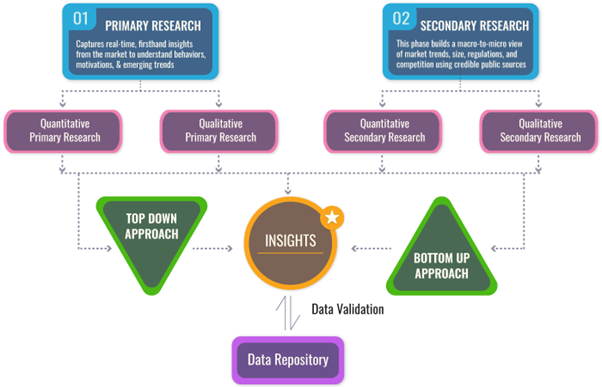
DUAL MODELING: TOP-DOWN + BOTTOM-UP
To ensure robust market estimation, we apply two complementary sizing approaches:
Top-Down Modeling:- Start with broader industry value (e.g., global or regional TAM)
- Apply filters by segment, geography, end-user, or use case
- Adjust with primary insights and validation benchmarks
- Ideal for investor-grade market scans and opportunity mapping
- Aggregate from the ground up using sales volumes, pricing, and unit economics
- Use internal modeling templates aligned with stakeholder data
- Incorporate distributor-level or region-specific inputs
- Most accurate for emerging segments and granular sub-markets
DATA VALIDATION: IN-HOUSE REPOSITORY
We close the loop with proprietary data intelligence built from ongoing projects, industry monitoring, and historical benchmarking. This repository includes:
- Multi-sector market and pricing models
- Key trendlines from past interviews and forecasts
- Benchmarked adoption rates, churn patterns, and ROI indicators
- Industry-specific deviation flags and cross-check logic
- Catches inconsistencies early
- Aligns projections across studies
- Enables consistent, high-trust deliverables