

United Kingdom Food Robotics Market Size and Forecast (2026–2034), Regional Growth, Trend, Share and Industry Analysis Report Coverage: By Type (Articulated Robots, SCARA Robots, Delta Robots, and Collaborative Robots); By Application (Food Processing, Packaging, Palletizing, Sorting & Grading, and Others); By End User (Food Manufacturers, Food Service Providers, Beverage Industry, and Others)
2026-09-16
ICT
Ekta Chaurasia (Team Lead)
Description
United
Kingdom Food Robotics Market Overview
The United Kingdom
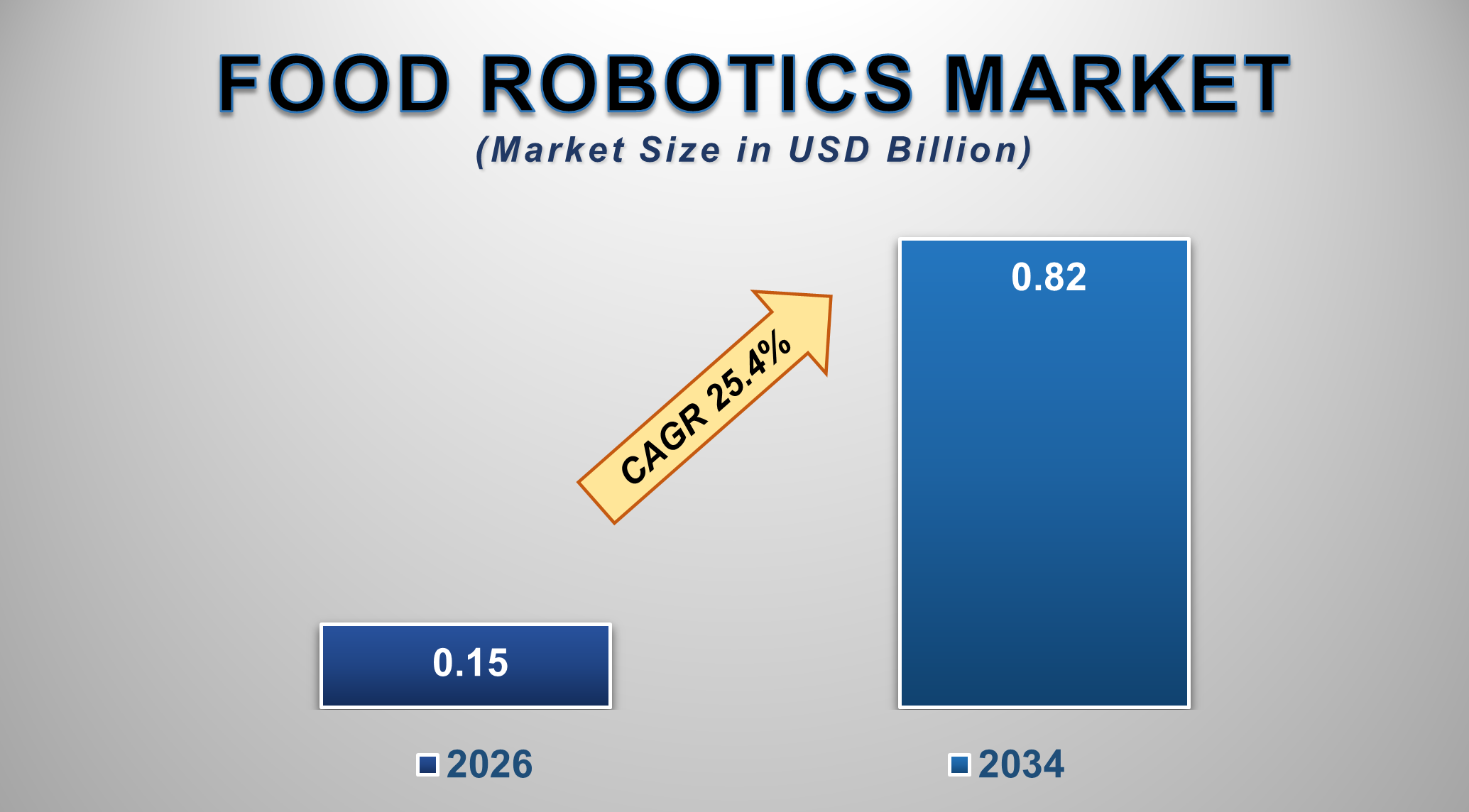
food robotics market is projected to expand from USD 0.15 billion in 2026 to
USD 0.82 billion by 2034, registering a CAGR of 25.4% during 2026–2034. Market
trends for food robotics in the United Kingdom include a shift towards automation
by food producers, which has become more common as companies seek to overcome
challenges such as labor availability through automation. This has led to
increasing use in areas such as processing, picking, handling, packing,
palletizing, and inspection. Increasing adoption is facilitated by an increased
ability of robots to handle delicate food items, which is possible due to
developments such as artificial intelligence, machine vision, and advanced
gripper capabilities. Also, government and industry efforts to encourage
automation in the food sector are leading to increased adoption in food
manufacturing, especially in areas where labor availability and productivity
challenges exist persistently. Furthermore, food manufacturers are shifting
towards the use of flexible, collaborative, and compact robots, which can be
incorporated into the existing manufacturing environment rather than relying on
traditional automation cells.
United
Kingdom Food Robotics Market Growth Drivers
Persistent Labor
Shortages in Food Manufacturing
Labor shortages in
the manufacturing industry are making robotics more popular in the UK food
manufacturing sector because of the need to perform tasks that are repetitive
in nature and involve physical labour, such as handling, packing, palletizing,
and processing. The inability to recruit people for production makes it more
challenging for manufacturers to keep the process going, which makes them rely
heavily on automation to increase production efficiency and decrease labor
availability risk. According to the UK Government's United Kingdom Food
Security Digest 2025, published on December 11, 2025, labor shortages remained
more prevalent in the food manufacturing industry compared to the rest of the
economy, and as stated by the Food and Drink Federation, almost three-quarters
of food and drink manufacturers had unfilled vacancies in Q3 2025. This problem
has translated directly into robotics demand, with Food Manufacture reporting
on May 22, 2026, that OAL has secured a £5 million Innovate UK loan for the commercialization
of fenceless robots for United Kingdom production lines due to the difficulty
that food manufacturers have in recruiting and retaining people for their
manual-handling tasks.
Growing Need for
Productivity, Hygiene, and Consistent Output
Increased pressure
to improve productivity without compromising on hygiene and quality has made
robotics more attractive among UK food industry manufacturers. Food
manufacturers are required to work in high-speed manufacturing environments
where activities such as handling, picking, packing, inspecting, and
palletizing are done at high speeds and with consistency, yet human
intervention could create hygiene risks as well as inconsistency in the
manufacturing process. Based on the information contained in the report Total
Factor Productivity of the United Kingdom Food Chain 2024, published by the UK
Government on June 18, 2026, there was an estimated 0.5 percent drop in food
and drinks manufacturing productivity in 2024. Consequently, the need for
technologies that improve productivity without requiring a proportional
increase in the labor force has become critical. According to the information
contained in an announcement by Siemens dated July 16, 2026, Siemens announced
the launch of a modular robot system that is geared towards improving
productivity for UK food manufacturers.
United Kingdom Food Robotics Market
Restraints
High Investment
and Integration Complexity
The need for high
up-front investment and integration is one of the main challenges facing food
robotics implementation in the UK, especially for small and medium enterprises
(SMEs) with narrow profit margins and tight budgets. The installation of food robotics
requires not only the robotics system itself but also the development of custom
grippers, machine vision, safety systems, software, modifications in the
production line, and integration with the old production machinery, thus
increasing the cost of implementing robots and making it more difficult.
According to the data provided by the Food & Drink Federation (FDF) in
November 2025, UK food producers have problems with costly and complicated
integration since their production lines feature a lot of old machinery, which
was not originally intended to be integrated with the digital systems, and
since tight profit margins and increased energy, labor, and input costs reduce
the amount of available budget for investments. This problem is also confirmed
in the industrial feedback: Food Manufacture published on April 15, 2024, that
the biggest barrier to automation among food producers is the investment cost
(72.63%), and the biggest challenge for food robotics adoption is the
technology integration (73.08%).
United Kingdom Food Robotics Market
Opportunities
AI-, Vision-,
and Flexible Robotics
AI, vision, and
flexible robots are key areas of opportunity for UK food robotics, as they will
be able to handle variability, fragility, and changes in the formats of food
products. Robots with machine vision and advanced gripper technologies will be
able to determine characteristics of the product, adjust their motions, as well
as perform inspection and quality control with higher precision, whereas
flexible robots can be used in several operations and formats of products.
According to the report published by the Science Council of the UK Food
Standards Agency on June 25, 2026, the adoption of artificial intelligence is
growing in the UK food industry, as machine learning, computer vision, and
robots can bring productivity benefits to food manufacturing. The report also
suggests some new ways of learning that would enable robots to perform more
complicated handling and inspection procedures. Therefore, there is an
opportunity for robotics companies to change from conventional automation to
flexible and adaptive systems for handling different food products and smaller
production batches.
Expansion into
SMEs, Foodservice, and Compact Production Lines
The emergence of
robotics in SMEs, foodservice companies, and small production lines is an
excellent growth prospect for the UK food robotics industry. Small food
producers and foodservice companies are looking for automation technologies
that require less factory space, less capital expenditure, and easier
integration compared with standard large-scale robotics. The rise of modular
and collaborative robots will enable the automation process of facilities with
less production space and different production needs. Such robots can be used
for picking, portioning, packing, palletizing, preparation, and handling of
foods, providing flexibility for multiple products and short-run production. As
automation technology becomes more and more attractive for manufacturers, who
prefer scalable automation to large manufacturing systems, the target market
will expand beyond big food-processing plants to SMEs, small production, and
foodservice companies.
United Kingdom Food Robotics Market
Scope
|
Report Attributes |
Description |
|
Market Size in 2026 |
USD 0.15 Billion |
|
Market Forecast in 2034 |
USD 0.82 Billion |
|
CAGR % 2026-2034 |
25.4% |
|
Market Concentration |
Moderately Concentrated |
|
Base Year |
2025 |
|
Historic Data |
2021-2025 |
|
Forecast Period |
2026-2034 |
|
Report USP |
Production, company share, company
heatmap, company production capacity, growth factors, and more |
|
Geography |
United Kingdom |
|
Segments Covered |
●
By Type ●
By Application ●
By End
User |
|
Key Demand Side Trends |
●
Increasing
demand for flexible automation ●
Growing
demand for labor-saving
automation ●
Rising
adoption in fresh produce and packhouses |
|
Key Supply Side Trends |
●
Shift toward
AI-enabled and vision-guided robotics ●
Growth of
hygienic and food-grade robot designs ●
Development
of compact and collaborative systems |
|
Major Players |
●
FANUC
Corporation ●
ABB Ltd. ●
KUKA AG ●
Yaskawa
Electric Corporation ●
OMRON
Corporation ●
Stäubli
International AG |
United Kingdom Food Robotics Market
Report Segmentation Analysis
The Articulated
Robots Segment Is Expected to Dominate the United Kingdom Food Robotics Market
During the Forecast Period
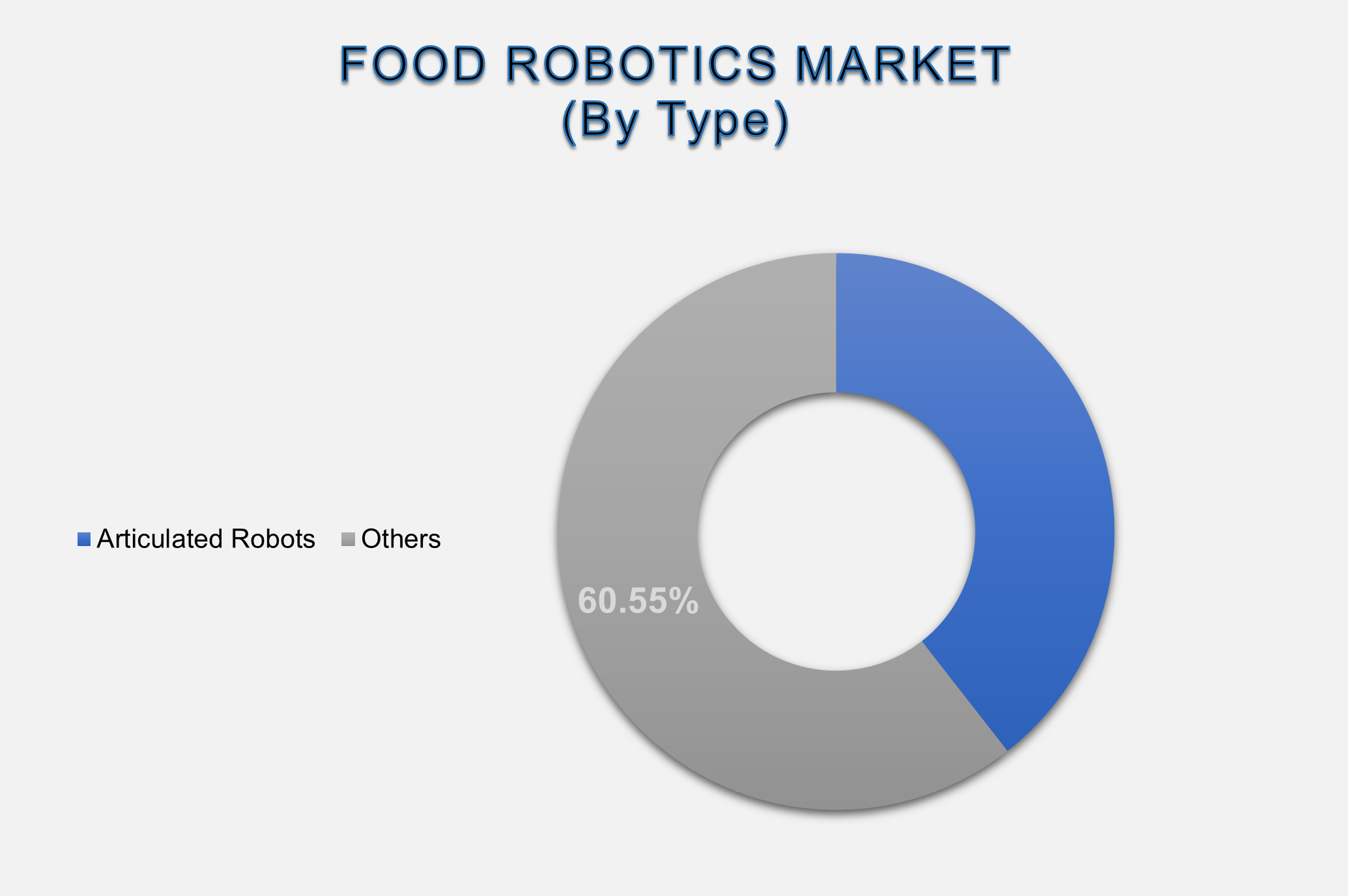
Articulated robots are projected to dominate the food robotics market in the UK during the forecast period owing to benefits such as flexibility, multi-axis movement capability, and their ability to undertake various kinds of food-processing and packaging operations through the use of different end-of-arm tools. Compared to application-specific types of robotics, articulated robots have greater versatility since they can be used in operations such as picking, handling, sorting, packing, palletizing, processing, and inspection. Articulated robots also offer the advantage of operating in a compact production environment while being able to handle different payloads. From industry analysis, it has been seen that articulated robots are the dominant type of robots in the food robotics market, mainly because of the versatility and suitability of these robots for difficult food handling applications. With the rise in the availability of hygienic design robots that include food-grade lubricants, washdown-capable robots, and direct food contact robots, the applicability of articulated robots in the food processing environment is rising in the UK.
Packaging
Segment Is Expected to Dominate the United Kingdom Food Robotics Market During
the Forecast Period
The packaging
segment will be the dominant player in the United Kingdom food robotics market
over the forecast period due to the large number of repetitive tasks requiring
high speed and precision performed in food packaging. Automation of tasks such
as pick-and-place, packing, case packing, wrapping, labeling, and palletizing
is increasingly performed using robotic systems due to the benefits that they
offer in terms of increasing productivity, improving product consistency and
accuracy, as well as minimizing labor costs. Moreover, packaging tends to offer
a more structured production process compared to food processing upstream
activities. Based on industry analysis of the UK food robotics market,
packaging and repackaging emerge as one of the main application areas alongside
palletizing, pick-and-place, and processing.
The Food
Manufacturers Segment Is Expected to Dominate the United Kingdom Food Robotics
Market During the Forecast Period
The segment of food
manufacturers is estimated to occupy the largest share of the United Kingdom
food robotics market through the forecast period owing to the broadest need for
automation among food manufacturers regarding processing, handling, picking,
sorting, packaging, palletizing, and quality inspection. Unlike other end
users, food manufacturers can use robotics at different stages of the
production line so that they can not only overcome labor-intensive processes
but also enhance production throughput and flexibility. At the same time, the
segment experiences growth due to the growing trend toward integrating robotics
with machine vision, hygienic design, and flexible end-of-line systems, thereby
allowing automation of various food handling processes, including complex ones.
As per the analysis of the UK market, food processing and manufacturing is one
of the main end-user segments of food robotics due to its broad range of
applications.
The following
segments are part of an in-depth analysis of the United Kingdom Food Robotics
Market:
|
Market Segments |
|
|
By
Type |
●
Articulated
Robots ●
SCARA Robots ●
Delta Robots ●
Collaborative
Robots |
|
By
Application |
●
Food
Processing ●
Packaging ●
Palletizing ●
Sorting
& Grading ●
Others |
|
By End
User |
●
Food
Manufacturers ●
Food Service
Providers ●
Beverage
Industry ●
Others |
United Kingdom Food Robotics Market
Competition Landscape Analysis
Competition in the
food robotics market of the United Kingdom is moderate to strong and
technology-based, characterized by competition among existing world-leading
robotics suppliers such as FANUC, ABB, KUKA, Yaskawa, OMRON, Stäubli, Kawasaki
and DENSO, and specialists in food process automation such as GEA, JBT and
Krones. In addition to traditional competition on basic robotics, current
trends suggest increasing competition on specific application capabilities,
machine vision enabled by artificial intelligence, hygienic design, fast motion
control, collaborative robotics, and easy integration capabilities.
International suppliers have advantages because of their existing UK sales
service organization, comprehensive automation offerings, and engineering capabilities,
whereas specialists rely on food processing competence and custom automation
systems for packaging, picking, palletizing, and handling. Nevertheless, the
market is also relatively receptive towards niche and emerging players
developing flexible, compact, and intelligent robotic systems, especially for
SMEs, foodservice operations, and food processes, which include products that
require delicate treatment. Increasing competitiveness is likely to follow as
suppliers compete to simplify integration and offer more complete robotics
solutions comprising robot hardware, vision, software, end-of-arm tooling, and
automation controls, rather than just robotics.
United Kingdom Food Robotics Market Recent
Developments News:
●
In July 2026,
Siemens unveiled a new open, modular robotics platform in Manchester, developed
with Wymbs Engineering and HMK Automation & Drives, to simplify robot
integration, operation, and
maintenance for UK food manufacturers. The platform supports applications
including pick-and-place, product depositing, customization, decorating, and packing, while its modular and recipe-driven design
enables faster product changeovers and greater production flexibility. Siemens
also highlighted the integration of industrial AI for contextual image
recognition, fault analysis, and operator
support, helping reduce the reliance on specialist programming expertise.
●
In November
2025, Starship Technologies and Uber Eats announced a global autonomous
delivery partnership, with the UK selected as the initial deployment market.
Autonomous robot deliveries were scheduled to launch in Leeds in December 2025,
with Starship's Level 4 autonomous robots capable of completing food deliveries
of up to two miles in under 30 minutes. The partnership highlights the
increasing application of robotics beyond food manufacturing into last-mile
food delivery and restaurant-to-consumer logistics.
The United
Kingdom Food Robotics Market is dominated by a few large companies, such as
●
ABB Ltd.
●
FANUC
Corporation
●
KUKA AG
●
Yaskawa
Electric Corporation
●
Mitsubishi
Electric Corporation
●
Kawasaki Heavy
Industries, Ltd.
●
OMRON
Corporation
●
Stäubli
International AG
●
DENSO
Corporation
●
Seiko Epson
Corporation
●
Universal
Robots A/S
●
JBT Marel
●
GEA Group AG
●
Ishida Co.,
Ltd.
●
Syntegon
Technology GmbH
●
Gerhard
Schubert GmbH
●
Cama Group
●
MULTIVAC Group
●
Doosan
Robotics Inc.
●
Moley Robotics
● Other Prominent Players
Frequently Asked Questions
Ekta Chaurasia (Team Lead)
Ekta Chaurasia is a highly experienced Team Lead at M2Square Consultancy with over 7 years of expertise in market research, strategic consulting, competitive benchmarking, and business intelligence solutions. She specializes in ICT, semiconductors & electronics, automotive & transportation, and industrial machinery markets.
She leads end-to-end global research projects focused on market trends, industry analysis, growth forecasting, customer insights, and strategic decision-making. Known for her analytical leadership and industry expertise, Ekta helps businesses uncover growth opportunities, evaluate competitive landscapes, and stay ahead in rapidly evolving markets through accurate and insight-driven research.
1.
United
Kingdom Food Robotics Market Introduction and Market Overview
1.1. Objectives of the Study
1.2. Market Segmentation
1.2.1.Type of the United Kingdom Food
Robotics Market
1.2.2.Application of the United
Kingdom Food Robotics Market
1.2.3.End Users of the United Kingdom Food
Robotics Market
1.3. Competition Coverage List of
Market Participants
1.4. Market Definition: Food Robotics
Market
2.
Executive Summary
2.1. United Kingdom Food Robotics
Market Estimation & Forecast
2.1.1.United Kingdom Food Robotics
Market Size (US$ Million) Estimates & Historical Trend Analysis (2021 -
2025)
2.1.2.United Kingdom Food Robotics
Overall Market Size (US$ Million), Growth Rate (Y-o-Y), Market CAGR (%), Market
forecast (2026 - 2034)
2.2. Snapshot of United Kingdom Food
Robotics Market
2.3. United Kingdom Food Robotics
Market Revenue Share (%) 2025
2.4. Key Competitors & Key
Insights
3.
Market Overview (Qualitative
Analysis)
3.1. Demand Side Trends
3.2. Supply Side Trends /
Manufacturing Trends
3.3. Demand and Opportunity
Assessment, 2026 - 2034
3.4. Market Dynamics
3.4.1.Drivers
3.4.2.Limitations
3.4.3.Opportunities
3.4.4.Impact Analysis of Drivers and
Restraints
3.5. Key Developments
3.6. Regulatory Landscape
3.7. Pricing Analysis
3.8. Supply Chain Analysis
3.9. Porter’s Five Forces Analysis
3.9.1.Bargaining Power of Suppliers
3.9.2.Bargaining Power of Buyers
3.9.3.Threat of Substitutes
3.9.4.Threat of New Entrants
3.9.5.Competitive Rivalry
3.10. PEST Analysis
3.10.1. Political Factors
3.10.2. Economic Factors
3.10.3. Social Factors
3.10.4. Technology Factors
4.
United Kingdom Food Robotics
Market Estimates & Forecast Trend Analysis, by Type
4.1. United Kingdom Food Robotics
Market Assessments & Key Findings, by Type
4.2. United Kingdom Food Robotics
Market Revenue (US$ Million) Estimates and Forecasts, by Type, 2021 - 2034
4.2.1. Articulated Robots
4.2.2.SCARA Robots
4.2.3.Delta Robots
4.2.4.Collaborative Robots
5.
United Kingdom Food Robotics
Market Estimates & Forecast Trend Analysis, by Application
5.1. United Kingdom Food Robotics
Market Assessments & Key Findings, by Application
5.2. United Kingdom Food Robotics
Market Revenue (US$ Million) Estimates and Forecasts, by Application, 2021 -
2034
5.2.1.Food Processing
5.2.2.Packaging
5.2.3.Palletizing
5.2.4.Sorting & Grading
5.2.5.Others
6.
United Kingdom Food Robotics
Market Estimates & Forecast Trend Analysis, by End User
6.1. United Kingdom Food Robotics
Market Assessments & Key Findings, by End User
6.2. United Kingdom Food Robotics
Market Revenue (US$ Million) Estimates and Forecasts, by End User, 2021 - 2034
6.2.1.Food Manufacturers
6.2.2.Food Service Providers
6.2.3.Beverage Industry
6.2.4.Others
7. Competition Landscape
7.1. United Kingdom Food Robotics
Market Product Mapping
7.2. United Kingdom Food Robotics
Market Concentration Analysis, by Leading Players / Innovators / Emerging
Players / New Entrants
7.3. United Kingdom Food Robotics
Market Tier Structure Analysis
7.4. United Kingdom Food Robotics
Market Concentration & Company Market Shares (%) Analysis, 2025
8. Company Profiles
8.1. ABB Ltd.
8.1.1.Company Overview & Key Stats
8.1.2.Financial Performance & KPIs
8.1.3.Product Portfolio
8.1.4.SWOT Analysis
8.1.5.Business Strategy & Recent
Developments
* Similar details would be provided
for all the players mentioned below
8.2.
FANUC Corporation
8.3.
KUKA AG
8.4.
Yaskawa Electric Corporation
8.5.
Mitsubishi Electric Corporation
8.6.
Kawasaki Heavy Industries, Ltd.
8.7.
OMRON Corporation
8.8.
Stäubli International AG
8.9.
DENSO Corporation
8.10.
Seiko Epson Corporation
8.11.
Universal Robots A/S
8.12.
JBT Marel
8.13.
GEA Group AG
8.14.
Ishida Co., Ltd.
8.15.
Syntegon Technology GmbH
8.16.
Gerhard Schubert GmbH
8.17.
Cama Group
8.18.
MULTIVAC Group
8.19.
Doosan Robotics Inc.
8.20.
Moley Robotics
8.21. Other Prominent Players
9.
Research Findings &
Conclusion
10. Assumptions & Acronyms Used
11. Research
Methodology
11.1. External Transportation /
Databases
11.2. Internal Proprietary Database
11.3. Primary Research
11.4. Secondary Research
11.5. Assumptions
11.6. Limitations
11.7. Report FAQs
Our Research Methodology
"Insight without rigor is just noise."
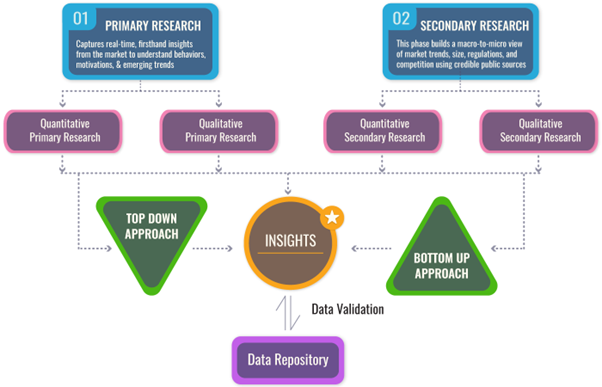
We follow a comprehensive, multi-phase research framework designed to deliver accurate, strategic, and decision-ready intelligence. Our process integrates primary and secondary research , both quantitative and qualitative , along with dual modeling techniques ( top-down and bottom-up) and a final layer of validation through our proprietary in-house repository.
PRIMARY RESEARCH
Primary research captures real-time, firsthand insights from the market to understand behaviors, motivations, and emerging trends.
1. Quantitative Primary Research
Objective: Generate statistically significant data directly from market participants.
Approaches:- Structured surveys with customers, distributors, and field agents
- Mobile-based data collection for point-of-sale audits and usage behavior
- Phone-based interviews (CATI) for market sizing and product feedback
- Online polling around industry events and digital campaigns
- Purchase frequency by customer type
- Channel performance across geographies
- Feature demand by application or demographic
2. Qualitative Primary Research
Objective: Explore decision-making drivers, pain points, and market readiness.
Approaches:- In-depth interviews (IDIs) with executives, product managers, and key decision-makers
- Focus groups among end users and early adopters
- Site visits and observational research for consumer products
- Informal field-level discussions for regional and cultural nuances
SECONDARY RESEARCH
This phase helps establish a macro-to-micro understanding of market trends, size, regulation, and competitive dynamics, sourced from credible and public domain information.
1. Quantitative Secondary Research
Objective: Model market value and segment-level forecasts based on published data.
Sources include:- Financial reports and investor summaries
- Government trade data, customs records, and regulatory statistics
- Industry association publications and economic databases
- Channel performance and pricing data from marketplace listings
- Revenue splits, pricing trends, and CAGR estimates
- Supply-side capacity and volume tracking
- Investment analysis and funding benchmarks
2. Qualitative Secondary Research
Objective: Capture strategic direction, innovation signals, and behavioral trends.
Sources include:- Company announcements, roadmaps, and product pipelines
- Publicly available whitepapers, conference abstracts, and academic research
- Regulatory body publications and policy briefs
- Social and media sentiment scanning for early-stage shifts
- Strategic shifts in market positioning
- Unmet needs and white spaces
- Regulatory triggers and compliance impact
DUAL MODELING: TOP-DOWN + BOTTOM-UP
To ensure robust market estimation, we apply two complementary sizing approaches:
Top-Down Modeling:- Start with broader industry value (e.g., global or regional TAM)
- Apply filters by segment, geography, end-user, or use case
- Adjust with primary insights and validation benchmarks
- Ideal for investor-grade market scans and opportunity mapping
- Aggregate from the ground up using sales volumes, pricing, and unit economics
- Use internal modeling templates aligned with stakeholder data
- Incorporate distributor-level or region-specific inputs
- Most accurate for emerging segments and granular sub-markets
DATA VALIDATION: IN-HOUSE REPOSITORY
We close the loop with proprietary data intelligence built from ongoing projects, industry monitoring, and historical benchmarking. This repository includes:
- Multi-sector market and pricing models
- Key trendlines from past interviews and forecasts
- Benchmarked adoption rates, churn patterns, and ROI indicators
- Industry-specific deviation flags and cross-check logic
- Catches inconsistencies early
- Aligns projections across studies
- Enables consistent, high-trust deliverables