

United Kingdom Peptide Cancer Vaccine Market Size and Forecast (2026–2034), Regional Growth, Trend, Share and Industry Analysis Report Coverage: By Type (Personalized Peptide Vaccines, Multivalent Peptide Vaccines, and Others); By Application (Melanoma, Lung Cancer, Breast Cancer, Prostate Cancer, and Others); By End User (Hospitals, Cancer Research Institutes, Specialty Clinics, and Others)
2026-11-13
Healthcare
Swetal (Research Analyst)
Description
United Kingdom Peptide Cancer Vaccine Market Overview
The United Kingdom peptide cancer vaccine market is projected to expand from USD 0.43 billion in 2026 to USD 2.83 billion by 2034, registering a CAGR of 28.1% during 2026–2034. The peptide cancer vaccine sector in the UK is an underdeveloped niche within the cancer immunotherapy industry, with innovation focused on tumor antigen discovery, peptide engineering, and personalized medicine. There is strong potential for growth in the peptide cancer vaccine segment in the UK due to its highly developed scientific infrastructure in oncology. The UK market for peptide cancer vaccines is fueled by institutions such as the NHS, Cancer Research UK, and universities, as well as biotech companies working on vaccine-related research and development. In the future, the peptide vaccine market will likely mature with neoantigen vaccines based on tumor analysis developed on an individual patient basis, as well as off-the-shelf vaccines for universal cancer antigens. The economic constraints to the use of this technology include the high cost of producing customized vaccines, difficulties in vaccine development, and insufficient testing and demonstration of efficacy against complex cancer types.

United Kingdom Peptide Cancer Vaccine Market Growth Drivers
Growth in personalized cancer immunotherapy
Increased acceptance of personalized cancer therapy through immunotherapy is one of the significant factors driving the market for the development of peptide-based cancer vaccines within the UK. Indeed, tumor profiling and identification of neoantigens, as well as immune profiling, have been advancing, thereby facilitating vaccine formulation based on specific molecular aspects of a certain person's tumor. This becomes important for the creation of personalized peptide cancer vaccines, as such tumors' neoantigens may be identified and used for the production of vaccines stimulating a specific T-cell reaction. In May 2024, according to the journal Immunotherapy of Cancer, a clinical trial of the drug EVX-01 indicated the viability of a personalized cancer vaccine of peptide-based type, where neoantigens produced in a tumor were selected with the assistance of an AI platform, resulting in EVX-01-specific T-cells generated in patients with metastatic melanoma. At the same time, England has been developing infrastructure for practical use of such a strategy: In May 2024, NHS England mentioned that the first patient in England received a personalized cancer vaccine during a clinical trial; the NHS Cancer Vaccine Launch Pad uses patients' tumor tissue as well as blood samples to select patients for personalized treatment.
Strong NHS clinical-trial infrastructure and government support
The United Kingdom has a well-established clinical-trial system in the NHS, a wide network of cancer research organizations, advanced genome technologies, and government support for precision oncology technology. With access to a large patient population, unique cancer centers, high-quality tumor analysis, and established clinical trial networks, it becomes easier to identify patients, prove them in real-life settings, and generate evidence of the effectiveness of the treatment under investigation. Moreover, government-sponsored initiatives for cancer vaccine development and partnerships with biotechs enhance the whole community of cancer immunotherapies, promoting R&D funding and investment.
United Kingdom Peptide Cancer Vaccine Market Restraint
Limited clinical validation and manufacturing complexity
One of the most significant restraints to the growth of the UK market for peptide cancer vaccines is the limited clinical validation of products, as many of them are still being tested in the early stages of clinical trials and require more evidence of their efficacy, patient selection, and survival rates to be accepted by the market. The manufacturing process itself is also associated with its peculiarities; in the case of personalized peptide vaccines, there may appear additional challenges connected with identifying unique antigens, producing peptides, testing their quality, and manufacturing them in small batches according to GMP standards.
United Kingdom Peptide Cancer Vaccine Market Opportunities
The increasing emphasis on personalized cancer therapy presents an opportunity for the developers of peptide cancer vaccines in the UK to formulate vaccines that target patient-specific tumor antigens and genetics. Peptide vaccines can also be used in combination with immune checkpoint inhibitors and other immunotherapeutic drugs in order to enhance anti-tumor immune response and overcome resistance to single-drug therapies. The infrastructure available in the UK for precision oncology, genomics, and clinical trials by the NHS can help in identifying suitable patients for such therapies. This provides opportunities for pharmaceutical and biotech companies to differentiate their peptide vaccines, forge clinical collaborations, and enter the cancer segment where immunotherapy has its limitations.
United Kingdom Peptide Cancer Vaccine Market Scope
United Kingdom Peptide Cancer Vaccine Market Report Segmentation Analysis
The Personalized Peptide Vaccines Segment Is Expected to Dominate the United Kingdom Peptide Cancer Vaccine Market During the Forecast Period
The personalized peptide vaccines segment is projected to continue dominating the market in the UK due to the growing uptake of precision oncology and developments in tumor genomics. Personalized vaccines can be developed to target neoantigens unique to each patient, in contrast to other conventional vaccines based on shared antigens. The UK's existing genomic testing capabilities, the infrastructure of NHS cancer research, and increasing clinical trial activities in personalized cancer vaccines are all propelling this sector. Growing interest from pharmaceutical and biotechnology companies in individualized immunotherapies is also pushing clinical development and partnerships, thereby establishing personalized peptide vaccines as a prominent trend in the UK peptide cancer vaccine market.
Melanoma Segment Is Expected to Dominate the United Kingdom Peptide Cancer Vaccine Market During the Forecast Period
The melanoma segment is positioned to remain a leading application area in the UK peptide cancer vaccine market, supported by melanoma’s strong immunogenicity and established responsiveness to immunotherapy. The presence of tumor-associated and melanoma-specific antigens provides opportunities for peptide vaccines to stimulate targeted anti-tumor immune responses. Growing research into peptide vaccines in combination with immune checkpoint inhibitors is also expanding clinical-development opportunities, particularly for patients with advanced or treatment-resistant melanoma. The UK’s strong oncology research base and NHS clinical-trial infrastructure further support the evaluation of novel melanoma vaccines, strengthening the segment’s potential during the forecast period.
The Hospital Segment Is Expected to Dominate the United Kingdom Peptide Cancer Vaccine Market During the Forecast Period
The hospital sector is projected to occupy a dominant market share in the United Kingdom peptide cancer vaccine market owing to the presence of cancer diagnosis, specialized oncology care, clinical research, and immunotherapy delivery in hospital settings. Peptide cancer vaccines are primarily used in clinical trials, investigational treatments, and specialized cancer treatments. Therefore, the hospital is the main venue for patient selection, biomarker testing, delivery of vaccines, and treatment response and adverse effects monitoring. The existing network of NHS hospitals and specialist cancer centers in the UK, which includes hospitals conducting clinical research on immunotherapy, offers the necessary platform for these treatments to develop from clinical studies to wider applications. Moreover, hospitals can combine peptide vaccines with other treatment options like chemotherapy, radiotherapy, immune checkpoint inhibitors, and targeted drugs, which increases their application in combination treatments. Thus, hospitals are expected to be the main application site of peptide cancer vaccines in the coming years.
The following segments are part of an in-depth analysis of the United Kingdom Peptide Cancer Vaccine Market:
United Kingdom Peptide Cancer Vaccine Market Competition Landscape Analysis
The UK peptide cancer vaccine market is still immature and research-oriented, with competition based more on clinical development, antigen/peptide technology, manufacturing capacity, and access to oncology trial networks rather than on commercial sales of products. The UK cancer vaccine industry comprises pharmaceutical companies, biotechnology firms, spinouts from universities, and NHS-based research programs. Though most of the leading programs employ mRNA and other non-peptide technologies, peptide-based companies play an important role in the industry, especially when it comes to therapeutic vaccines against tumor-associated antigens. The UK's clinical infrastructure of the UK is also becoming an important factor in competition, as NHS England's Cancer Vaccine Launch Pad is aimed at speeding up recruitment to cancer vaccine and immunotherapy trials, and Oxford has its own cancer vaccine hub covering antigen discovery, vaccine development, clinical manufacturing, and clinical trials.
United Kingdom Peptide Cancer Vaccine Market Recent Developments News:
In June 2026, Talentmark highlighted the UK’s growing focus on personalized cancer vaccines, noting that Moderna’s personalized mRNA cancer vaccines for melanoma and other solid tumors were being fast-tracked through UK clinical trials. The development reflects increasing NHS, government, and biotech support for precision cancer vaccines and reinforces the UK’s role as an early clinical-development and potential launch market for next-generation cancer immunotherapies.
In August 2025, researchers reported promising early results for ELI-002 2P, an off-the-shelf peptide cancer vaccine targeting common KRAS mutations associated with pancreatic and colorectal cancers. In a 25-patient study, the vaccine generated strong immune responses in 17 patients, with this group showing longer periods before recurrence and better overall survival than patients with weaker immune responses. Although the study was small and non-randomized, the findings support further development of scalable peptide-based cancer vaccines that could offer faster and potentially lower-cost access than personalized vaccines.
The United Kingdom Peptide Cancer Vaccine Market is dominated by a few large companies, such as
Scancell Holdings plc
TREOS Bio Ltd.
Oxford Vacmedix UK Ltd.
Greenwich LifeSciences, Inc.
IO Biotech, Inc.
OncoTherapy Science, Inc.
Shionogi & Co., Ltd.
BrightPath Biotherapeutics Co., Ltd.
Elicio Therapeutics, Inc.
SELLAS Life Sciences Group, Inc.
ISA Pharmaceuticals B.V.
Imugene Limited
VAXON Biotech
OncoPep, Inc.
Marker Therapeutics, Inc.
Other Prominent Players
Frequently Asked Questions
Swetal (Research Analyst)
Swetal is a Research Analyst with 4+ years of experience specializing in healthcare market research, medical devices, healthcare IT, and medical technology industry analysis. Her expertise includes competitive intelligence, secondary research, market trend forecasting, and healthcare business insights across global healthcare ecosystems.
She contributes to advanced market research reports by analyzing regulatory frameworks, emerging healthcare technologies, competitive landscapes, and innovation trends shaping the medical industry. With a strong focus on accurate market intelligence, strategic insights, and healthcare industry trends, Swetal supports businesses in making informed, data-backed decisions in a rapidly transforming healthcare environment.
United Kingdom Peptide Cancer Vaccine Market Introduction and Market Overview
Objectives of the Study
Market Segmentation
Type of the United Kingdom Peptide Cancer Vaccine Market
Application of the United Kingdom Peptide Cancer Vaccine Market
End User of United Kingdom Peptide Cancer Vaccine Market
Competition Coverage List of Market Participants
Market Definition: Peptide Cancer Vaccine Market
Executive Summary
United Kingdom Peptide Cancer Vaccine Market Estimation & Forecast
United Kingdom Peptide Cancer Vaccine Market Size (US$ Million) Estimates & Historical Trend Analysis (2021 - 2025)
United Kingdom Peptide Cancer Vaccine Overall Market Size (US$ Million), Growth Rate (Y-o-Y), Market CAGR (%), Market Forecast (2026 - 2034)
Snapshot of United Kingdom Peptide Cancer Vaccine Market
United Kingdom Peptide Cancer Vaccine Market Revenue Share (%) 2025
Key Competitors & Key Insights
Market Overview (Qualitative Analysis)
Demand Side Trends
Supply Side Trends / Manufacturing Trends
Demand and Opportunity Assessment, 2026 - 2034
Market Dynamics
Drivers
Limitations
Opportunities
Impact Analysis of Drivers and Restraints
Key Developments
Regulatory Landscape
Pricing Analysis
Supply Chain Analysis
Porter’s Five Forces Analysis
Bargaining Power of Suppliers
Bargaining Power of Buyers
Threat of Substitutes
Threat of New Entrants
Competitive Rivalry
PEST Analysis
Political Factors
Economic Factors
Social Factors
Technology Factors
United Kingdom Peptide Cancer Vaccine Market Estimates & Forecast Trend Analysis, by Type
United Kingdom Peptide Cancer Vaccine Market Assessments & Key Findings, by Type
United Kingdom Peptide Cancer Vaccine Market Revenue (US$ Million) Estimates and Forecasts, by Type, 2021 - 2034
Personalized Peptide Vaccines
Multivalent Peptide Vaccines
Others
United Kingdom Peptide Cancer Vaccine Market Estimates & Forecast Trend Analysis, by Application
United Kingdom Peptide Cancer Vaccine Market Assessments & Key Findings, by Application
United Kingdom Peptide Cancer Vaccine Market Revenue (US$ Million) Estimates and Forecasts, by Application, 2021 - 2034
Melanoma
Lung Cancer
Breast Cancer
Prostate Cancer
Others
United Kingdom Peptide Cancer Vaccine Market Estimates & Forecast Trend Analysis, by End User
United Kingdom Peptide Cancer Vaccine Market Assessments & Key Findings, by End User
United Kingdom Peptide Cancer Vaccine Market Revenue (US$ Million) Estimates and Forecasts, by End User, 2021 - 2034
Hospitals
Cancer Research Institutes
Specialty Clinics
Others
Competition Landscape
United Kingdom Peptide Cancer Vaccine Market Product Mapping
United Kingdom Peptide Cancer Vaccine Market Concentration Analysis, by Leading Players / Innovators / Emerging Players / New Entrants
United Kingdom Peptide Cancer Vaccine Market Tier Structure Analysis
United Kingdom Peptide Cancer Vaccine Market Concentration & Company Market Shares (%) Analysis, 2025
Company Profiles
Scancell Holdings plc
Company Overview & Key Stats
Financial Performance & KPIs
Product Portfolio
SWOT Analysis
Business Strategy & Recent Developments
* Similar details would be provided for all the players mentioned below
TREOS Bio Ltd.
Oxford Vacmedix UK Ltd.
Greenwich LifeSciences, Inc.
IO Biotech, Inc.
OncoTherapy Science, Inc.
Shionogi & Co., Ltd.
BrightPath Biotherapeutics Co., Ltd.
Elicio Therapeutics, Inc.
SELLAS Life Sciences Group, Inc.
ISA Pharmaceuticals B.V.
Imugene Limited
VAXON Biotech
OncoPep, Inc.
Marker Therapeutics, Inc.
Other Prominent Players
Research Findings & Conclusion
Assumption & Acronyms Used
Research Methodology
External Transportation / Databases
Internal Proprietary Database
Primary Research
Secondary Research
Assumptions
Limitations
Report FAQs
Our Research Methodology
"Insight without rigor is just noise."
We follow a comprehensive, multi-phase research framework designed to deliver accurate, strategic, and decision-ready intelligence. Our process integrates primary and secondary research , both quantitative and qualitative , along with dual modeling techniques ( top-down and bottom-up) and a final layer of validation through our proprietary in-house repository.
PRIMARY RESEARCH
Primary research captures real-time, firsthand insights from the market to understand behaviors, motivations, and emerging trends.
1. Quantitative Primary Research
Objective: Generate statistically significant data directly from market participants.
Approaches:- Structured surveys with customers, distributors, and field agents
- Mobile-based data collection for point-of-sale audits and usage behavior
- Phone-based interviews (CATI) for market sizing and product feedback
- Online polling around industry events and digital campaigns
- Purchase frequency by customer type
- Channel performance across geographies
- Feature demand by application or demographic
2. Qualitative Primary Research
Objective: Explore decision-making drivers, pain points, and market readiness.
Approaches:- In-depth interviews (IDIs) with executives, product managers, and key decision-makers
- Focus groups among end users and early adopters
- Site visits and observational research for consumer products
- Informal field-level discussions for regional and cultural nuances
SECONDARY RESEARCH
This phase helps establish a macro-to-micro understanding of market trends, size, regulation, and competitive dynamics, sourced from credible and public domain information.
1. Quantitative Secondary Research
Objective: Model market value and segment-level forecasts based on published data.
Sources include:- Financial reports and investor summaries
- Government trade data, customs records, and regulatory statistics
- Industry association publications and economic databases
- Channel performance and pricing data from marketplace listings
- Revenue splits, pricing trends, and CAGR estimates
- Supply-side capacity and volume tracking
- Investment analysis and funding benchmarks
2. Qualitative Secondary Research
Objective: Capture strategic direction, innovation signals, and behavioral trends.
Sources include:- Company announcements, roadmaps, and product pipelines
- Publicly available whitepapers, conference abstracts, and academic research
- Regulatory body publications and policy briefs
- Social and media sentiment scanning for early-stage shifts
- Strategic shifts in market positioning
- Unmet needs and white spaces
- Regulatory triggers and compliance impact
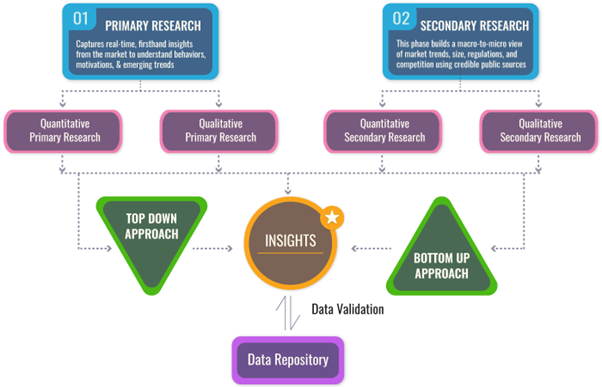
DUAL MODELING: TOP-DOWN + BOTTOM-UP
To ensure robust market estimation, we apply two complementary sizing approaches:
Top-Down Modeling:- Start with broader industry value (e.g., global or regional TAM)
- Apply filters by segment, geography, end-user, or use case
- Adjust with primary insights and validation benchmarks
- Ideal for investor-grade market scans and opportunity mapping
- Aggregate from the ground up using sales volumes, pricing, and unit economics
- Use internal modeling templates aligned with stakeholder data
- Incorporate distributor-level or region-specific inputs
- Most accurate for emerging segments and granular sub-markets
DATA VALIDATION: IN-HOUSE REPOSITORY
We close the loop with proprietary data intelligence built from ongoing projects, industry monitoring, and historical benchmarking. This repository includes:
- Multi-sector market and pricing models
- Key trendlines from past interviews and forecasts
- Benchmarked adoption rates, churn patterns, and ROI indicators
- Industry-specific deviation flags and cross-check logic
- Catches inconsistencies early
- Aligns projections across studies
- Enables consistent, high-trust deliverables