

United Kingdom Telemedicine Market Size and Forecast (2026–2034), Regional Growth, Trend, Share and Industry Analysis Report Coverage: By Components (Product {Hardware, Software, and Others}, and Services {Tele-consulting, Tele-monitoring, Tele-education}), By Modality (Store and forward, Real-time, and Others); By Application (Teleradiology, Telepsychiatry, Telepathology, Teledermatology, Telecardiology, and Others) and By End User (Hospitals & Health Systems, Clinics & Physician Practices, Patients/Homecare, Payers, and Others)
2026-09-18
Healthcare
Swetal (Research Analyst)
Description
United
Kingdom Telemedicine Market Overview
The United Kingdom
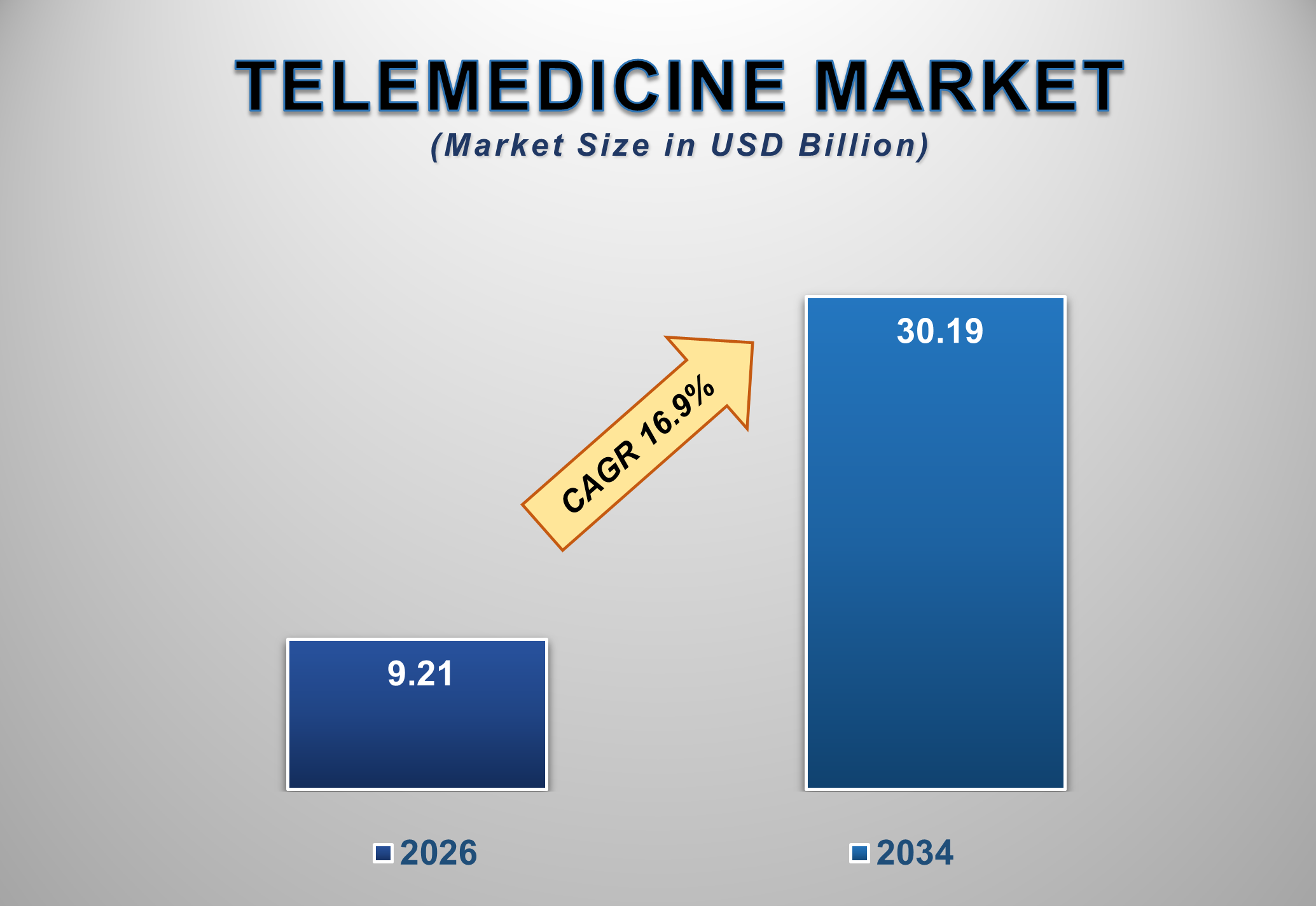
telemedicine market is projected to expand from USD 9.21 billion in 2026 to USD
30.19 billion by 2034, registering a CAGR of 16.9% during 2026–2034. The
telemedicine industry in the UK is becoming a more integrated part of the
healthcare delivery system in the country, which is driven by the rise in the
adoption of digital healthcare solutions, the transformation of patients'
preferences, the pressure on healthcare capacity, and the requirements for
better access to care. It should also be noted that the market dynamics are
influenced by the process of moving from traditional face-to-face care to
patient-centric, digitally enabled care and hybrid care models like remote
care, virtual consultation, digital triage, and technology-enabled follow-up
care. The increasing interest in telemedicine from the operation of the public
healthcare system and the growing number of private healthcare providers
positively impacts investments in telemedicine platforms, connected devices,
digital health infrastructure, and interoperable healthcare technologies. In
addition, the growing interest in the use of digital channels for communication
between patients and healthcare providers is positively influencing the level
of familiarity and acceptance of virtual care. Concurrently, the expansion of
market operations is driven by regulations, the issues related to privacy and
cybersecurity, the problems of interoperability, the challenges of digital
inclusion, the acceptance of clinical practices, the methods of reimbursement,
and the necessity to prove the clinical and financial efficiency of services
offered. All in all, the situation in the UK is such that the market is in the
process of forming a more integrated digital health system in which
telemedicine is not an isolated type of service but a supplementing component
of the healthcare transformation process, which will depend on the capacity of
technology to be integrated into the healthcare system, preparedness of
healthcare providers for the use of technologies, willingness of patients to
use technologies, and the capacity of technologies to be employed for digital
patient therapies.
United
Kingdom Telemedicine Market Drivers and Impact Analysis
|
Key
Drivers |
Impact |
|
Rising Patient Preference for Convenient
& Accessible Care |
Encourages adoption of virtual consultations
by reducing travel requirements, waiting times, and geographical barriers
while providing patients with greater flexibility in accessing healthcare
services. |
|
Increasing Chronic Disease & Long-Term
Care Demand |
Expands demand for telemedicine-enabled
follow-ups, ongoing disease management, medication reviews, and remote
monitoring, particularly for patients requiring regular clinical
interactions. |
|
NHS Focus on Digital & Integrated
Healthcare Delivery |
Accelerates incorporation of telemedicine
into routine healthcare pathways and supports the transition toward digitally
enabled, hybrid models of care across primary, secondary, and community
healthcare settings. |
|
Healthcare Workforce & Specialist
Capacity Constraints |
Increases the need for remote consultations
and digitally enabled specialist access, allowing healthcare providers to
utilize clinical expertise across geographical boundaries and improve service
capacity. |
|
Expansion of Remote Patient Monitoring &
Connected Medical Devices |
Broadens telemedicine beyond episodic
consultations by enabling continuous collection and transmission of patient
data, supporting earlier intervention and more proactive management of
patients. |
|
Advancement of Digital Health &
Healthcare IT Infrastructure |
Strengthens telemedicine scalability through
improved connectivity, cloud-based platforms, electronic health records,
interoperability, and integration of digital tools into existing clinical
workflows. |
|
Growing Demand for Home-Based &
Community-Based Care |
Supports the shift of appropriate healthcare
services away from hospitals and toward patients’ homes and community
settings, increasing the role of telemedicine in decentralized care delivery. |
Rising Patient
Preference for Convenient & Accessible Care
The rising
inclination towards convenient and easily available health care services
encourages the use of telemedicine in the UK. Nowadays, patients always prefer
those health services that do not require much traveling, help reduce waiting
times, allow flexibility in planning appointments, and ensure access to
appropriate specialists regardless of the location of the patients. As a
result, health care establishments are starting to introduce virtual features
in their work together with traditional healthcare institutions, thus making it
more accessible and convenient for patients.
This trend is also
promoted by the implementation of the NHS Online model by the NHS, revealed in
September 2025, as it is going to be a considerable change in the
digitalization of health service delivery in England. The model is going to
offer its services without any need for creating any physical hospital.
However, the services are going to be provided in a digital format with the
help of specialists situated all over England. The first patients are supposed
to start using this service in 2027, as they will gain access to it by means of
the NHS App, which will assist them in making appointments for necessary
diagnostic tests at their nearest Community Diagnostic Centers. In conclusion,
the growing importance of convenience, quick access, adaptable scheduling, and
location-free healthcare access is likely to enhance patients’ receptiveness to
telehealth in the UK. As technology is increasingly embedded in health
pathways, patients’ expectations will likely drive providers to continue to
broaden virtual and hybrid care models and contribute to the advancement of
telehealth services in the UK.
Healthcare
Workforce & Specialist Capacity Constraints
The UK continues to adopt telemedicine because of significant shortages of healthcare personnel and specialists in the sector. Thus, the NHS has to continue meeting requests to provide timely access to its clinical operations at a time when doctors, nurses, and medical specialists are not available everywhere. According to the NHS Long Term Workforce Plan, shortages in healthcare personnel mean that the NHS cannot provide the amounts and quality of services it needs to provide in the future and imply that more flexibility in the NHS workforce, capable of performing general and specialty duties, is a necessity. The NHS staff may not lack in numbers; however, the sector has to cope with shortages in specialist staff, which causes patients to wait a long time or drive long distances in search of healthcare. According to statistics, the NHS has an adequate number of doctors and specialists, who are the backbone of the service system. Under these unfavorable conditions, telemedicine appears to be the answer, as it provides an opportunity to attract specialists at one’s disposal so that patients can receive consultations, specialist evaluations, stay in touch with their doctors, and undergo tele-radiology and tele-psychiatry. One further way in which telemedicine can prove useful is by allowing the NHS to deploy its medical workforce more efficiently, enabling specialists to treat patients remotely from different locations rather than travelling to see them physically, thus improving access in areas lacking in services or in rural areas. In view of the increasing demand for medical services in combination with constraints on human resources, telemedicine is poised to expand not only the ability to use scarce medical expertise more efficiently but also speed up the process of obtaining specialist services in the United Kingdom.
United Kingdom Telemedicine Market
Restraint and Impact Analysis
|
Key Restraints |
Impact |
|
Digital Inequality Across Patient
Populations |
Creates uneven adoption of telemedicine by
limiting access among digitally excluded and less digitally confident
populations, potentially restricting the addressable patient base. |
|
Complex NHS IT & Interoperability
Environment |
Raises implementation complexity and
integration costs for telemedicine providers due to the need to connect with
diverse electronic health records and healthcare IT systems. |
|
Cybersecurity & Health Data Protection
Requirements |
Increases technology, compliance, and
operational requirements for providers, potentially extending implementation
timelines and raising the cost of deploying telemedicine platforms. |
|
Limited Suitability for Certain Clinical
Services |
Prevents complete substitution of
face-to-face care, particularly where physical examinations, diagnostic
testing, procedures, or direct clinical intervention are required, resulting
in continued reliance on hybrid delivery models. |
Digital
Inequality Across Patient Populations
The issue of
digital inequality in patient populations is one of the main impediments to the
expansion of telemedicine in the UK, as disadvantaged individuals and certain
patient groups may not be able to enjoy virtual access to various services due
to their limited access to equipment, reliable internet connection, digital
skills, and willingness to learn how to use platforms. According to NHS
England, different vulnerable groups, including seniors, low-income families,
marginalized groups, and disabled people, may experience the highest risk of
digital exclusion. Moreover, this may hinder patients' ability to book a video
consultation, use remote monitoring technology, access electronic health
records, and contact doctors through electronic means. Moreover, disparities in
terms of digital literacy, accessibility needs, health literacy, and confidence
in digital technologies could hinder the uptake of telemedicine among
vulnerable groups. Therefore, the shift towards telemedicine could create a
divide between patients who are capable of accessing digital services and
patients who are not, as patients who are digitally capable would benefit from
telemedicine and get faster treatment than their non-digital peers, relying on
the telephone and in-person healthcare. Hence, to prevent telemedicine
development from worsening the existing inequalities in the healthcare sector,
NHS England states that it is important to promote different types of care
through various channels, combining digital, telephone, and in-person care
services.
Complex NHS IT
& Interoperability Environment
The NHS IT and
interoperability ecosystem is complicated and disjointed, which acts as a
limitation for the growth of the telemedicine sector in the UK, as telemedicine
software needs to connect with different electronic health records, clinical
applications, application programming interfaces (APIs), data protocols, and
legacy systems in primary, secondary, and social care facilities. As per the
British NHS, healthcare providers do not use just one system. In addition,
various systems and types of technologies are used by healthcare organizations,
such as REST, SOAP, FHIR, and HL7 V3, which complicates the way data is
exchanged. Even though the NHS is moving towards the implementation of
FHIR-based APIs and open data standards, there is still a gap when it comes to
exchanging data between entities, as parts of the system are not working
properly. Thus, in order to ensure that telemedicine companies are able to
implement virtual consultation systems, remote monitoring devices, diagnostic
systems, appointment scheduling systems, and patient records in the UK,
significant technology investments will be required. Moreover, digital health
technologies that link with the services of the NHS should meet the assurance
requirements, which include clinical safety, data governance, and
interoperability. This may be more time-consuming and costly. It adds
complexity to the digital ecosystem of the NHS, making deployment and scaling
of telemedicine solutions longer and more costly and putting smaller technology
providers at a disadvantage.
United Kingdom Telemedicine Market
Opportunities and Impact Analysis
|
Key
Opportunities |
Impact |
|
AI-Enabled Telemedicine & Clinical
Decision Support |
Creates opportunities to enhance digital
triage, clinical decision support, patient prioritization, automated
documentation, and care personalization, while improving clinician
productivity and supporting more efficient utilization of NHS capacity. |
|
Integration of Telemedicine with Remote
Patient Monitoring & Virtual Diagnostics |
Enables continuous monitoring and digitally
supported diagnosis outside traditional healthcare facilities, expanding
telemedicine from episodic consultations toward longitudinal disease
management and earlier clinical intervention. |
|
Expansion of Hybrid & Hospital-at-Home
Care Models |
Supports the shift of appropriate care from
hospitals to patients’ homes by combining virtual consultations, remote
monitoring, and in-person services, creating opportunities for telemedicine
across higher-acuity, post-acute, and long-term care pathways. |
|
Expansion into Specialty & Underserved
Care Segments |
Creates opportunities to extend specialist
expertise across geographical boundaries and improve access to care in areas
facing capacity or specialist availability constraints, supporting broader
adoption across secondary and specialist healthcare services. |
AI-Enabled
Telemedicine & Clinical Decision Support
AI-powered
telemedicine and clinical decision support serve as a true boon for the
telemedicine industry in the UK. It has the potential to improve the processes
of obtaining health care in remote settings. With the help of AI technologies,
telemedicine systems can offer automated solutions for symptom assessment and
triage, prediction of clinical risks, and diagnostics. Innovative tools can
help doctors make quick clinical decisions in virtual consultations. NHS
England acknowledges the importance of clinical decision support tools in
providing information regarding patients in different locations and
institutions at the right time. It is worth mentioning that the UK is carrying
out numerous initiatives aimed at widening the deployment of AI-based solutions.
By applying artificial intelligence technologies in telemedicine, it is
possible to ensure ongoing monitoring of patient health data, thereby
addressing the concerns of those who are usually applying only reactive care
models. In addition to that, AI can also help automate administrative processes
like documentation and communication with patients, thus freeing up the time of
physicians and allowing them to pay more attention to the patients. While
telemedicine becomes more mainstream and moves beyond the usual use of video
conferencing to more intelligent, responsive platforms aimed at providing
continuous care, the increasing implementation of AI and clinical decision
support features in telemedicine systems is expected to afford developers new
ways to stand out in the industry, streamline workflows, increase remote care
possibilities, and enhance the delivery of healthcare services throughout the
UK.
Integration of
Telemedicine with Remote Patient Monitoring & Virtual Diagnostics
The combination of
telemedicine with remote patient monitoring and virtual diagnosis creates
important prospects for the telemedicine market of the UK since it helps
medical professionals to go beyond single-time virtual consultations and
provide continuous customer support based on the data received. Connected
devices, wearables, and in-home monitoring devices, as well as point-of-care
diagnostic tools, allow doctors to carry out remote monitoring of blood
pressure, blood oxygen levels, heart rate, weight, and other relevant
indicators of the patient’s health; in addition, diagnostic devices assist in
carrying out ECHO, ultrasound procedures, pathology, visual diagnostics, etc.
Currently, NHS England has recognized remote monitoring and remote access to diagnostics
as one of the most crucial issues for implementing the technology-based virtual
wards. By integrating these capabilities with telemedicine systems, it may be
possible to detect deterioration in the patient's condition sooner, take
preventive action, provide tailored follow-ups, reduce unnecessary visits to
the hospital, and manage chronic and acute illnesses better. Furthermore, the
NHS plans to bolster its digital specialist care capabilities and NHS Online,
which will enhance the use of remote monitoring and digital routes in addition
to conventional diagnostics. As interoperability improves between the
monitoring, diagnostics, electronic health records, and telemedicine systems,
healthcare providers will be able to establish a more complete virtual model
for care, allowing technology firms to offer integrated systems, remote
diagnostics, and data analytics services.
United Kingdom Telemedicine Market
Scope
|
Report Attributes |
Description |
|
Market Size in 2026 |
USD 9.21 Billion |
|
Market Forecast in 2034 |
USD 30.19 Billion |
|
CAGR % 2026-2034 |
16.9% |
|
Market Concentration |
Moderately Fragmented |
|
Base Year |
2025 |
|
Historic Data |
2021-2025 |
|
Forecast Period |
2026-2034 |
|
Report USP |
Production, Consumption, company share,
company heatmap, company production capacity, growth factors, and more |
|
Geography |
United Kingdom |
|
Segments Covered |
●
By
Component ●
By
Modality ●
By
Application ●
By End
User |
|
Key Demand-Side Trends |
●
Shift Toward
Convenient & Faster Healthcare Access ●
Growing
Demand for Home-Based & Continuous Care ●
Increasing
Demand for Digitally Enabled Specialist Care |
|
Key Supply-Side Trends |
●
Expansion
from Virtual Consultations to Integrated Digital Care ●
Integration
of Telemedicine with RPM & Virtual Ward Technologies ●
Increasing
AI & Automation Integration |
|
Major Players |
●
Koninklijke
Philips N.V. ●
GE
HealthCare Technologies Inc. ●
Medtronic
plc ●
Abbott
Laboratories ●
Siemens Healthineers
AG ●
ResMed Inc. |
United Kingdom Telemedicine Market
Report Segmentation Analysis
Services Segment
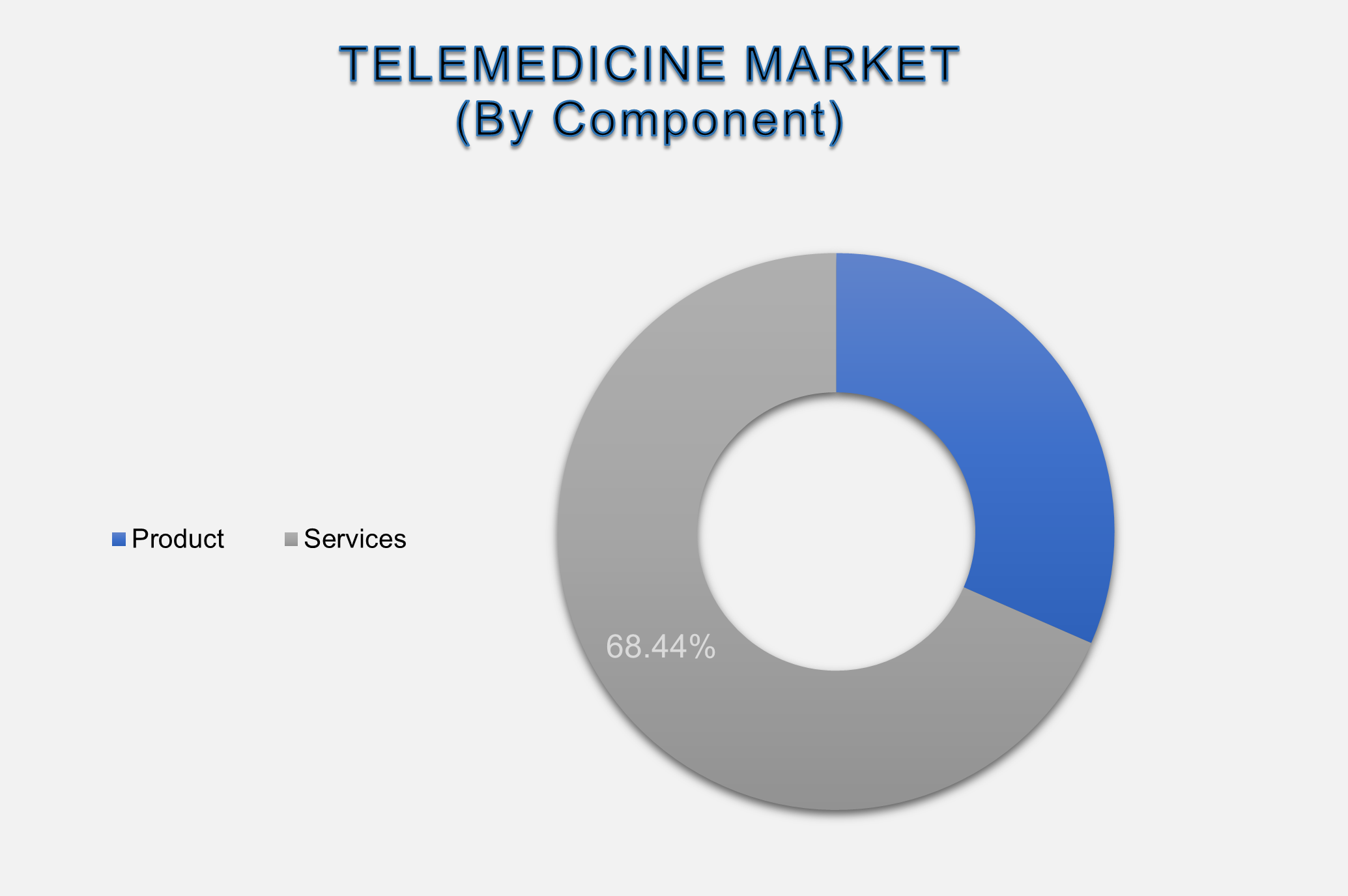
Is Expected to Dominate the United Kingdom Telemedicine Market During the
Forecast Period
By the end of the forecast period, it is anticipated that services will be the leading segment in the telemedicine market in the UK, as the importance of digital health services in providing healthcare and access to clinical specialists is growing. An announcement made by the NHS in January 2026 introduced the framework of the NHS Online Hospital for patients suffering from nine common diseases, who will be able to access healthcare facilities fast through digital healthcare services. This is indicative of the increasing need to provide patients with consultations and healthcare services online, thus lessening the necessity to visit hospitals personally. The growing popularity of these digital services is expected to positively influence the demand for teleconsultations, online medical appointments, and other internet-based medical services, thus contributing to the leading position of the services segment in the UK telemedicine market.
Store and
Forward Segment Is Expected to Grow in the United Kingdom Telemedicine Market
As the demand for
asynchronous medical services allowing for the collection, storage, and
subsequent electronic transmission of patient records grows, the
store-and-forward segment of telemedicine in the United Kingdom will expand. By
allowing patients to send their health documents to doctors without being
nearby, this method helps doctors to transfer medical records, images, results,
and even data provided by patients without direct communication in real-time.
Store-and-forward telemedicine can also help with referrals to specialists and
with assessment of patients from a distance when face-to-face consultation is
not necessary. Due to the possibility of avoiding unnecessary face-to-face
appointments, store-and-forward technologies are expected to be adopted widely
in the UK.
Teleradiology
Segment Is Expected to Witness Steady Growth in the United Kingdom Telemedicine
Market
The teleradiology
segment is projected to grow steadily within the United Kingdom telemedicine
market. This is primarily attributed to the rising utilization of remote
interpretation and digital transmission of medical images in different
healthcare settings. Teleradiology allows radiologists to review and interpret
diagnostic images securely. Thus, it aims to enable access to specialized
expertise faster, while also increasing efficiency in diagnostic workflows. The
segment is also becoming increasingly relevant as healthcare providers look for
ways to manage imaging workload, eliminate discrepancies in the availability of
radiology professionals, and ensure prompt reporting without having
radiologists be physically present at the imaging location. Increased
popularity of digital imaging technology, successful integration of
teleradiology with already established hospital information systems and picture
archiving and communication systems, and ever-increasing demand for flexible
radiology services will help teleradiology continue to develop within the UK
telemedicine market.
The Hospital and
Health System Segment Is Expected to Grow in the United Kingdom Telemedicine
Market
In the United
Kingdom, the segment of hospitals and health systems is likely to experience
growth in the telemedicine industry due to the growing use of new online health
technologies in traditional healthcare. To enhance access to specialists,
remote monitoring of patients, follow-up treatment, and streamlined healthcare
services in various environments, hospitals and health systems are embracing
telemedicine solutions. Additionally, telemedicine allows increased efficiency
of communication with patients and prevents unnecessary visits to doctors, thus
contributing to continuity of medical services. The use of online
consultations, remote diagnosis, and virtual health options by hospitals is
further expected to increase the demand for telemedicine solutions in that
particular sector.
The following
segments are part of an in-depth analysis of the United Kingdom telemedicine
market:
|
Market Segments |
|
|
By
Components |
●
Product o
Hardware o
Software o
Others ●
Services o
Tele-consulting o
Tele-monitoring o
Tele-education |
|
By
Modality |
●
Store and
forward ●
Real-time ●
Others |
|
By
Application |
●
Teleradiology ●
Telepsychiatry ●
Telepathology ●
Teledermatology ●
Telecardiology ●
Others |
|
By End
User |
●
Hospitals
& Health Systems ●
Clinics
& Physician Practices ●
Patients/Homecare ●
Payers ●
Others |
United Kingdom Telemedicine Market
Competition Landscape Analysis
Competition in the
United Kingdom telemedicine marketplace is fierce; companies seek to
distinguish themselves from their rivals by focusing on their virtual care
capabilities, quality of services, integration of technologies, patient
experience, and corporate capacity to deal with numerous healthcare delivery
models. Competition in this marketplace is characterized by the presence of
traditional healthcare technology companies, telemedicine service providers,
platforms for digital healthcare, and niche enterprises engaged in providing
remote-care solutions. The market is quite fragmented in terms of the services
offered, which include virtual consultations and telemedicine monitoring and
receiving services, digital diagnosis, and other telemedicine-based services.
Market players are beginning to emphasize their plans for receiving software
products based on AI technologies, ensuring interoperability, monitoring
patients at home, offering digital security services for clients, and
implementing telemedicine technologies into the existing healthcare system.
Other methods of competition include forming alliances with technology
companies, developing advanced technologies, and modifying the service offering
of the company.
United Kingdom Telemedicine Market Recent
Developments News:
●
In January
2025, Huma Therapeutics partnered with Wheel to deliver a digital healthcare
platform incorporating telehealth, diagnostics, remote monitoring, digital
front-door services, and prescription capabilities.
●
In January
2025, National Friendly launched Friendly Doctor+, a 24/7 virtual GP service
providing UK residents with access to qualified GPs through phone or video
consultations.
The United
Kingdom Telemedicine Market is dominated by a few large companies, such as
●
Koninklijke
Philips N.V.
●
GE HealthCare
Technologies Inc.
●
Medtronic plc
●
Abbott
Laboratories
●
Siemens
Healthineers AG
●
Boston
Scientific Corporation
●
Masimo
Corporation
●
ResMed Inc.
●
OMRON
Healthcare Co., Ltd.
●
Nihon Kohden
Corporation
●
Baxter
International Inc.
●
Drägerwerk AG
& Co. KGaA
●
BIOTRONIK SE
& Co. KG
●
Shenzhen
Mindray Bio-Medical Electronics Co., Ltd.
●
Dexcom, Inc.
●
Aerotel
Medical Systems
●
VitalConnect,
Inc.
●
VivaLNK, Inc.
●
Tunstall
Healthcare
●
Whzan Digital
Health
● Other Prominent Players
Frequently Asked Questions
Swetal (Research Analyst)
Swetal is a Research Analyst with 4+ years of experience specializing in healthcare market research, medical devices, healthcare IT, and medical technology industry analysis. Her expertise includes competitive intelligence, secondary research, market trend forecasting, and healthcare business insights across global healthcare ecosystems.
She contributes to advanced market research reports by analyzing regulatory frameworks, emerging healthcare technologies, competitive landscapes, and innovation trends shaping the medical industry. With a strong focus on accurate market intelligence, strategic insights, and healthcare industry trends, Swetal supports businesses in making informed, data-backed decisions in a rapidly transforming healthcare environment.
1.
United
Kingdom Telemedicine Market Introduction and Market Overview
1.1. Objectives of the Study
1.2. Market Segmentation
1.2.1.Components of the United Kingdom
Telemedicine Market
1.2.2.Modality of the United Kingdom
Telemedicine Market
1.2.3.Application of the United Kingdom
Telemedicine Market
1.2.4.End User of United Kingdom
Telemedicine Market
1.3. Competition Coverage List of
Market Participants
1.4. Market Definition: Telemedicine Market
2.
Executive Summary
2.1. United Kingdom Telemedicine
Market Estimation & Forecast
2.1.1.United Kingdom Telemedicine
Market Size (US$ Million) Estimates & Historical Trend Analysis (2021 -
2025)
2.1.2.United Kingdom Telemedicine
Overall Market Size (US$ Million), Growth Rate (Y-o-Y), Market CAGR (%), Market
forecast (2026 - 2034)
2.2. Snapshot of United Kingdom
Telemedicine Market
2.3. United Kingdom Telemedicine
Market Revenue Share (%) 2025
2.4. Key Competitors & Key
Insights
3.
Market Overview (Qualitative
Analysis)
3.1. Demand Side Trends
3.2. Supply Side Trends /
Manufacturing Trends
3.3. Demand and Opportunity Assessment,
2026 - 2034
3.4. Market Dynamics
3.4.1.Drivers
3.4.2.Limitations
3.4.3.Opportunities
3.4.4.Impact Analysis of Drivers and
Restraints
3.5. Key Developments
3.6. Regulatory Landscape
3.7. Pricing Analysis
3.8. Supply Chain Analysis
3.9. Porter’s Five Forces Analysis
3.9.1.Bargaining Power of Suppliers
3.9.2.Bargaining Power of Buyers
3.9.3.Threat of Substitutes
3.9.4.Threat of New Entrants
3.9.5.Competitive Rivalry
3.10. PEST Analysis
3.10.1. Political Factors
3.10.2. Economic Factors
3.10.3. Social Factors
3.10.4. Technology Factors
4.
United Kingdom Telemedicine
Market Estimates & Forecast Trend Analysis, by Components
4.1. United Kingdom Telemedicine
Market Assessments & Key Findings, by Components
4.2. United Kingdom Telemedicine
Market Revenue (US$ Million) Estimates and Forecasts, by Components, 2021 -
2034
4.2.1. Product
4.2.1.1.
Hardware
4.2.1.2.
Software
4.2.1.3.
Others
4.2.2. Services
4.2.2.1.
Tele-consulting
4.2.2.2.
Tele-monitoring
4.2.2.3.
Tele-education
5.
United Kingdom Telemedicine
Market Estimates & Forecast Trend Analysis, by Modality
5.1. United Kingdom Telemedicine
Market Assessments & Key Findings, by Modality
5.2. United Kingdom Telemedicine
Market Revenue (US$ Million) Estimates and Forecasts, by Modality, 2021 - 2034
5.2.1.Store and forward
5.2.2.Real-time
5.2.3.Others
6.
United Kingdom Telemedicine
Market Estimates & Forecast Trend Analysis, by Application
6.1. United Kingdom Telemedicine
Market Assessments & Key Findings, by Application
6.2. United Kingdom Telemedicine
Market Revenue (US$ Million) Estimates and Forecasts, by Application, 2021 -
2034
6.2.1.Teleradiology
6.2.2.Telepsychiatry
6.2.3.Telepathology
6.2.4.Teledermatology
6.2.5.Telecardiology
6.2.6.Others
7.
United Kingdom Telemedicine
Market Estimates & Forecast Trend Analysis, by End User
7.1. United Kingdom Telemedicine
Market Assessments & Key Findings, by End User
7.2. United Kingdom Telemedicine
Market Revenue (US$ Million) Estimates and Forecasts, by End User, 2021 - 2034
7.2.1.Hospitals & Health Systems
7.2.2.Clinics & Physician
Practices
7.2.3.Patients/Homecare
7.2.4.Payers
7.2.5.Others
8. Competition Landscape
8.1. United Kingdom Telemedicine
Market Product Mapping
8.2. United Kingdom Telemedicine
Market Concentration Analysis, by Leading Players / Innovators / Emerging
Players / New Entrants
8.3. United Kingdom Telemedicine
Market Tier Structure Analysis
8.4. United Kingdom Telemedicine
Market Concentration & Company Market Shares (%) Analysis, 2025
9. Company Profiles
9.1. Koninklijke Philips N.V.
9.1.1.Company Overview & Key Stats
9.1.2.Financial Performance & KPIs
9.1.3.Product Portfolio
9.1.4.SWOT Analysis
9.1.5.Business Strategy & Recent
Developments
* Similar details would be provided
for all the players mentioned below
9.2.
GE HealthCare Technologies Inc.
9.3.
Medtronic plc
9.4.
Abbott Laboratories
9.5.
Siemens Healthineers AG
9.6.
Boston Scientific Corporation
9.7.
Masimo Corporation
9.8.
ResMed Inc.
9.9.
OMRON Healthcare Co., Ltd.
9.10.
Nihon Kohden Corporation
9.11.
Baxter International Inc.
9.12.
Drägerwerk AG & Co. KGaA
9.13.
BIOTRONIK SE & Co. KG
9.14.
Shenzhen Mindray Bio-Medical
Electronics Co., Ltd.
9.15.
Dexcom, Inc.
9.16.
Aerotel Medical Systems
9.17.
VitalConnect, Inc.
9.18.
VivaLNK, Inc.
9.19.
Tunstall Healthcare
9.20.
Whzan Digital Health
9.21.
Other Prominent Players
10. Research
Findings & Conclusion
11. Assumption & Acronyms Used
12. Research
Methodology
12.1. External Transportations /
Databases
12.2. Internal Proprietary Database
12.3. Primary Research
12.4. Secondary Research
12.5. Assumptions
12.6. Limitations
12.7. Report FAQs
Our Research Methodology
"Insight without rigor is just noise."
We follow a comprehensive, multi-phase research framework designed to deliver accurate, strategic, and decision-ready intelligence. Our process integrates primary and secondary research , both quantitative and qualitative , along with dual modeling techniques ( top-down and bottom-up) and a final layer of validation through our proprietary in-house repository.
PRIMARY RESEARCH
Primary research captures real-time, firsthand insights from the market to understand behaviors, motivations, and emerging trends.
1. Quantitative Primary Research
Objective: Generate statistically significant data directly from market participants.
Approaches:- Structured surveys with customers, distributors, and field agents
- Mobile-based data collection for point-of-sale audits and usage behavior
- Phone-based interviews (CATI) for market sizing and product feedback
- Online polling around industry events and digital campaigns
- Purchase frequency by customer type
- Channel performance across geographies
- Feature demand by application or demographic
2. Qualitative Primary Research
Objective: Explore decision-making drivers, pain points, and market readiness.
Approaches:- In-depth interviews (IDIs) with executives, product managers, and key decision-makers
- Focus groups among end users and early adopters
- Site visits and observational research for consumer products
- Informal field-level discussions for regional and cultural nuances
SECONDARY RESEARCH
This phase helps establish a macro-to-micro understanding of market trends, size, regulation, and competitive dynamics, sourced from credible and public domain information.
1. Quantitative Secondary Research
Objective: Model market value and segment-level forecasts based on published data.
Sources include:- Financial reports and investor summaries
- Government trade data, customs records, and regulatory statistics
- Industry association publications and economic databases
- Channel performance and pricing data from marketplace listings
- Revenue splits, pricing trends, and CAGR estimates
- Supply-side capacity and volume tracking
- Investment analysis and funding benchmarks
2. Qualitative Secondary Research
Objective: Capture strategic direction, innovation signals, and behavioral trends.
Sources include:- Company announcements, roadmaps, and product pipelines
- Publicly available whitepapers, conference abstracts, and academic research
- Regulatory body publications and policy briefs
- Social and media sentiment scanning for early-stage shifts
- Strategic shifts in market positioning
- Unmet needs and white spaces
- Regulatory triggers and compliance impact
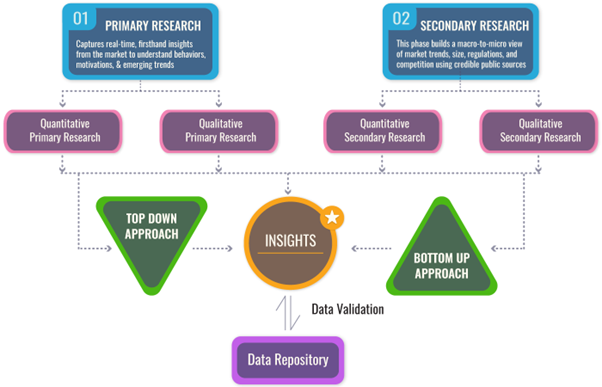
DUAL MODELING: TOP-DOWN + BOTTOM-UP
To ensure robust market estimation, we apply two complementary sizing approaches:
Top-Down Modeling:- Start with broader industry value (e.g., global or regional TAM)
- Apply filters by segment, geography, end-user, or use case
- Adjust with primary insights and validation benchmarks
- Ideal for investor-grade market scans and opportunity mapping
- Aggregate from the ground up using sales volumes, pricing, and unit economics
- Use internal modeling templates aligned with stakeholder data
- Incorporate distributor-level or region-specific inputs
- Most accurate for emerging segments and granular sub-markets
DATA VALIDATION: IN-HOUSE REPOSITORY
We close the loop with proprietary data intelligence built from ongoing projects, industry monitoring, and historical benchmarking. This repository includes:
- Multi-sector market and pricing models
- Key trendlines from past interviews and forecasts
- Benchmarked adoption rates, churn patterns, and ROI indicators
- Industry-specific deviation flags and cross-check logic
- Catches inconsistencies early
- Aligns projections across studies
- Enables consistent, high-trust deliverables