United States Antiepileptic Drugs Market Size and Forecast (2026–2034), Regional Growth, Trend, Share and Industry Analysis Report Coverage: By Drug Class (Sodium Channel Modulators, GABA-Enhancing Agents, Calcium Channel Modulators, and Others); By Route of Administration (Oral, Intravenous, Intramuscular, and Others); By Formulation (Tablets and Capsules, Oral Liquids and Suspensions, Injectable Formulations, and Others); By Distribution Channel (Hospital Pharmacies, Retail Pharmacies, and Online Pharmacies)
2026-11-12
Healthcare
Swetal (Research Analyst)
Description
United States Antiepileptic Drugs Market Overview
The United States antiepileptic drugs market is projected to expand from USD 4.91 billion in 2026 to USD 7.59 billion by 2034, registering a CAGR of 5.9% during 2026–2034. The global antiepileptic drugs market is propelled by an increasing demand for management of epilepsy and other seizures, increased awareness of neurologic disorders, and advancements in diagnosis and treatment. Antiepileptic drugs aid in reducing the frequency and intensity of seizures in various ways, such as modulation of sodium and calcium channels, inhibition of excitatory neurotransmitter release, and enhancement of inhibitory neurotransmission. There is an increase in options for treatment due to the introduction of new-generation antiepileptic drugs, which have better tolerability, various formulations, and therapeutic properties. Access to neurological treatment facilities, availability of generic medicines, and research on the development of new treatments are some of the factors impacting the growth of this market. Some of the factors hampering the growth of this market include the occurrence of side effects, resistance to treatment in certain cases, and lack of adherence to medication regimens.

United States Antiepileptic Drugs Market Growth Drivers
Rising Prevalence of Epilepsy and Seizure Disorders
The increasing burden of epilepsy is spurring the demand for anti-epileptic drugs since patients need long-term pharmacological therapy to treat their condition. According to the information provided by the World Health Organization (WHO), more than 50 million people around the world suffer from epilepsy, with almost 80% living in low- and middle-income countries. WHO also believes that about 70% of people with epilepsy can become seizure-free if diagnosed and treated properly. In the United States, there are roughly 3 million adults and 456,000 children who have active epilepsy, according to the statistics presented by SingleCare in January 2026 and based on the U.S. Centers for Disease Control and Prevention. The large number of patients will fuel the demand for both existing and new antiseizure medicines. Efforts to diagnose epilepsy better and provide treatment for the disease in underdeveloped regions will further contribute to the adoption of medicines and provide new market opportunities for pharmaceutical companies.
Advancements in Antiseizure Drug Development
Continued improvements in the field of pharmacological research and medicine development are driving the growth of the antiepileptic drugs market by adding to the range of treatment options for patients suffering from various types of seizures. Companies are working on drugs that would be better tolerated, have more selective mechanisms of action, have ease of use, and have fewer chances of drug-drug interactions. These innovations would help in providing better control over seizures and ensuring better compliance among patients who do not get enough benefit from currently available treatments. The ongoing research for new medicines and alternate drug delivery systems also provides an opportunity for product diversification.
United States Antiepileptic Drugs Market Restraint
Adverse Effects and Drug-Resistance Challenges
In the market of antiepileptic drugs, there exist certain limitations owing to the adverse side effects of antiseizure drugs and the challenge of ensuring proper control of seizures in certain patients. Issues related to the treatment process, such as drowsiness, dizziness, lack of cognitive function, and interactions of the drug, may influence the medication process and necessitate the use of different dosages and medications. Further, some patients have developed drug-resistant epilepsy whereby the seizures cannot be controlled by any drug. This complicates the treatment process further.
United States Antiepileptic Drugs Market Opportunities
Expanding Access to Treatment in Underserved Markets
The lack of affordable medicines, the weakness of health care infrastructure, the shortage of healthcare personnel, and insufficient diagnoses for epilepsy provide room for growth in the Antiepileptic Drugs Market, especially in the developing economies. Manufacturers of pharmaceuticals could solve these issues by making affordable generics available, enhancing logistics, and working together with health care providers as well as local stakeholders to make these drugs more accessible. The development of cheaper drugs, better supply chain management, and awareness programs might help more people to start and stay on treatment. This would allow for increasing the number of consumers and creating new opportunities for producers.
Development of Therapies for Drug-Resistant Epilepsy
The lack of efficacious treatment options for people suffering from drug-resistant epilepsy is a key opportunity that exists in the Antiepileptic Drugs Market. People who have failed to obtain satisfactory seizure control through currently available drugs need a different treatment option, thus creating an opportunity for drugs with a novel mechanism of action and greater efficacy. Pharmaceutical companies can take advantage of the above-mentioned opportunity by conducting research and development efforts, finding out new drug targets, and developing treatments aimed at improving seizure control without causing side effects and interactions. Clinical research efforts, targeted treatment, and advanced formulations might facilitate the development of differentiated products for patients with refractory seizures. The success in this field will enable pharmaceutical companies to diversify their product lines and create opportunities in the specialty epilepsy market segment.
United States Antiepileptic Drugs Market Scope
United States Antiepileptic Drugs Market Report Segmentation Analysis
The Sodium Channel Modulators Segment Is Expected to Dominate the United States Antiepileptic Drugs Market During the Forecast Period
Sodium channel modulators are expected to account for a significant share of the U.S. antiepileptic drugs market due to their established use in managing various seizure types, particularly focal-onset seizures. Medicines such as carbamazepine, oxcarbazepine, phenytoin, and lacosamide help control abnormal electrical activity in the brain by modulating voltage-gated sodium channels. Their established clinical use, availability in multiple formulations, and presence across branded and generic drug portfolios support demand. Continued use of these medicines in routine epilepsy management, alongside treatment options for patients requiring alternative therapies, is expected to sustain the segment's position during the forecast period.

Oral Segment Is Expected to Dominate the United States Antiepileptic Drugs Market During the Forecast Period
The oral segment is anticipated to lead the U.S. antiepileptic drugs market because of the prevalent use of oral drugs for managing seizures in the long run and easy administration in the case of home health care. Oral tablets, capsules, and liquids allow flexible dosing along with easy continuation of therapy in various age categories of patients. The wide availability of branded and generic oral drugs, as well as the adaptability for outpatient treatment, also supports the demand of this segment. As compared to injectables that are only used in emergencies and hospitals, oral drugs are better suited for routine epilepsy treatment.
Tablets and Capsules Segment Is Expected to Dominate the United States Antiepileptic Drugs Market During the Forecast Period
The tablets & capsules segment will hold the largest share in the U.S. antiepileptic drugs market because of the wide application of these drugs in the management of epilepsy, easy consumption, and availability in a wide range of anticonvulsants. Consistency in the dose and easy home treatment make this segment fit for patients who need treatment for their seizures. Moreover, there is easy availability of branded as well as generic drugs, which include immediate-release and extended-release formulations. The segment of tablets & capsules is already established through prescription practice and wide pharmacy networks.
The Hospital Pharmacies Segment Is Expected to Dominate the United States Antiepileptic Drugs Market During the Forecast Period
It can be predicted that the hospital pharmacies' share would be considerable in the U.S. antiepileptic drugs market owing to the role of hospitals in the diagnosis, treatment, and management of patients suffering from seizure attacks. Hospital pharmacies help in accessing the injectable antiepileptic drugs available during emergencies as well as the oral antiepileptic drugs used during hospitalization and upon discharge from the hospital. They are connected to neurological departments and emergency services, along with the inpatient services that would aid in procurement and dispensation of medicines. Clinical support, along with a wide array of antiepileptic drugs, is another factor fueling the hospital pharmacies market share during the forecast period.
The following segments are part of an in-depth analysis of the United States. Antiepileptic Drugs Market:
United States Antiepileptic Drugs Market Competition Landscape Analysis
In the market for U.S. antiepileptic drugs, there is competition among existing pharmaceutical companies with branded drug products and the suppliers of generic anticonvulsant medicines. The leading players include UCB, Eisai, Jazz Pharmaceuticals, SK Biopharmaceuticals, Supernus Pharmaceuticals, and Teva Pharmaceutical Industries. Competitive rivalry in the antiepileptic drugs market can be based on such factors as innovations, differentiation of the products on the basis of their mechanism of action and indications, diversification of portfolios, and market access. The branded drug manufacturers develop innovative antiseizure medicines with a different mechanism of action and good tolerability, which are used for treating refractory types of epilepsy. Meanwhile, generic producers mainly compete on the basis of prices, product availability, and manufacturing. Research into new therapies and innovative formulations helps meet the unmet medical needs of patients.
United States Antiepileptic Drugs Market Recent Developments News:
In September 2026, Reuters reported that the U.S. FDA had imposed a partial clinical hold on Biohaven’s experimental epilepsy drug BHV-7000, pausing enrollment of new patients following findings involving a drug metabolite in rodent testing. The relevance of the findings to human safety remained uncertain, while patients already enrolled could continue treatment. The development highlights the importance of regulatory safety assessments in advancing novel therapies for drug-resistant focal epilepsy and the potential for safety-related findings to affect clinical development timelines.
In September 2026, Xenon Pharmaceuticals announced the submission of a New Drug Application (NDA) to the U.S. FDA for azetukalner, an investigational treatment for focal seizures. The submission was supported by positive results from the Phase 2b X-TOLE and Phase 3 X-TOLE2 trials, which demonstrated statistically significant reductions in monthly seizure frequency compared with placebo. Azetukalner’s novel mechanism as a Kv7 potassium channel opener, once-daily dosing, and generally well-tolerated safety profile highlight ongoing innovation in antiseizure drug development and efforts to address unmet treatment needs among patients with focal epilepsy.
The United States Antiepileptic Drugs Market is dominated by a few large companies, such as
UCB
Eisai
Jazz Pharmaceuticals
SK Biopharmaceuticals
Neurelis
Supernus Pharmaceuticals
Teva Pharmaceutical Industries
Viatris
Sun Pharmaceutical Industries
Lupin
Dr. Reddy’s Laboratories
Amneal Pharmaceuticals
Aurobindo Pharma
Zydus Lifesciences
Torrent Pharmaceuticals
Glenmark Pharmaceuticals
Alembic Pharmaceuticals
Apotex
Cipla
Hikma Pharmaceuticals
Other Prominent Players
Frequently Asked Questions
Swetal (Research Analyst)
Swetal is a Research Analyst with 4+ years of experience specializing in healthcare market research, medical devices, healthcare IT, and medical technology industry analysis. Her expertise includes competitive intelligence, secondary research, market trend forecasting, and healthcare business insights across global healthcare ecosystems.
She contributes to advanced market research reports by analyzing regulatory frameworks, emerging healthcare technologies, competitive landscapes, and innovation trends shaping the medical industry. With a strong focus on accurate market intelligence, strategic insights, and healthcare industry trends, Swetal supports businesses in making informed, data-backed decisions in a rapidly transforming healthcare environment.
United States Antiepileptic Drugs Market Introduction and Market Overview
Objectives of the Study
Market Segmentation
Drug Class of the United States Antiepileptic Drugs Market
Route of Administration of the United States Antiepileptic Drugs Market
Formulation of United States Antiepileptic Drugs Market
Distribution Channel of the United States Antiepileptic Drugs Market
Competition Coverage List of Market Participants
Market Definition: Antiepileptic Drugs Market
Executive Summary
United States Antiepileptic Drugs Market Estimation & Forecast
United States Antiepileptic Drugs Market Size (US$ Million) Estimates & Historical Trend Analysis (2021 - 2025)
United States Peptide Cancer Vaccine Overall Market Size (US$ Million), Growth Rate (Y-o-Y), Market CAGR (%), Market Forecast (2026 - 2034)
Snapshot of United States Antiepileptic Drugs Market
United States Antiepileptic Drugs Market Revenue Share (%) 2025
Key Competitors & Key Insights
Market Overview (Qualitative Analysis)
Demand Side Trends
Supply Side Trends / Manufacturing Trends
Demand and Opportunity Assessment, 2026 - 2034
Market Dynamics
Drivers
Limitations
Opportunities
Impact Analysis of Drivers and Restraints
Key Developments
Regulatory Landscape
Pricing Analysis
Supply Chain Analysis
Porter’s Five Forces Analysis
Bargaining Power of Suppliers
Bargaining Power of Buyers
Threat of Substitutes
Threat of New Entrants
Competitive Rivalry
PEST Analysis
Political Factors
Economic Factors
Social Factors
Technology Factors
United States Antiepileptic Drugs Market Estimates & Forecast Trend Analysis, by Drug Class
United States Antiepileptic Drugs Market Assessments & Key Findings, by Drug Class
United States Antiepileptic Drugs Market Revenue (US$ Million) Estimates and Forecasts, by Drug Class, 2021 - 2034
Sodium Channel Modulators
GABA-Enhancing Agents
Calcium Channel Modulators
Others
United States Antiepileptic Drugs Market Estimates & Forecast Trend Analysis, by Route of Administration
United States Antiepileptic Drugs Market Assessments & Key Findings, by Route of Administration
United States Antiepileptic Drugs Market Revenue (US$ Million) Estimates and Forecasts, by Route of Administration, 2021 - 2034
Oral
Intravenous
Intramuscular
Others
United States Antiepileptic Drugs Market Estimates & Forecast Trend Analysis, by Formulation
United States Antiepileptic Drugs Market Assessments & Key Findings, by Formulation
United States Antiepileptic Drugs Market Revenue (US$ Million) Estimates and Forecasts, by Formulation, 2021 - 2034
Tablets and Capsules
Oral Liquids and Suspensions
Injectable Formulations
Others
United States Antiepileptic Drugs Market Estimates & Forecast Trend Analysis, by Distribution Channel
United States Antiepileptic Drugs Market Assessments & Key Findings, by Distribution Channel
United States Antiepileptic Drugs Market Revenue (US$ Million) Estimates and Forecasts, by Distribution Channel, 2021 - 2034
Hospital Pharmacies
Retail Pharmacies
Online Pharmacies
Competition Landscape
United States Antiepileptic Drugs Market Product Mapping
United States Antiepileptic Drugs Market Concentration Analysis, by Leading Players / Innovators / Emerging Players / New Entrants
United States Antiepileptic Drugs Market Tier Structure Analysis
United States Antiepileptic Drugs Market Concentration & Company Market Shares (%) Analysis, 2025
Company Profiles
UCB
Company Overview & Key Stats
Financial Performance & KPIs
Product Portfolio
SWOT Analysis
Business Strategy & Recent Developments
* Similar details would be provided for all the players mentioned below
Eisai
Jazz Pharmaceuticals
SK Biopharmaceuticals
Neurelis
Supernus Pharmaceuticals
Teva Pharmaceutical Industries
Viatris
Sun Pharmaceutical Industries
Lupin
Dr. Reddy’s Laboratories
Amneal Pharmaceuticals
Aurobindo Pharma
Zydus Lifesciences
Torrent Pharmaceuticals
Glenmark Pharmaceuticals
Alembic Pharmaceuticals
Apotex
Cipla
Hikma Pharmaceuticals
Other Prominent Players
Research Findings & Conclusion
Assumption & Acronyms Used
Research Methodology
External Transportations / Databases
Internal Proprietary Database
Primary Research
Secondary Research
Assumptions
Limitations
Report FAQs
Our Research Methodology
"Insight without rigor is just noise."
We follow a comprehensive, multi-phase research framework designed to deliver accurate, strategic, and decision-ready intelligence. Our process integrates primary and secondary research , both quantitative and qualitative , along with dual modeling techniques ( top-down and bottom-up) and a final layer of validation through our proprietary in-house repository.
PRIMARY RESEARCH
Primary research captures real-time, firsthand insights from the market to understand behaviors, motivations, and emerging trends.
1. Quantitative Primary Research
Objective: Generate statistically significant data directly from market participants.
Approaches:- Structured surveys with customers, distributors, and field agents
- Mobile-based data collection for point-of-sale audits and usage behavior
- Phone-based interviews (CATI) for market sizing and product feedback
- Online polling around industry events and digital campaigns
- Purchase frequency by customer type
- Channel performance across geographies
- Feature demand by application or demographic
2. Qualitative Primary Research
Objective: Explore decision-making drivers, pain points, and market readiness.
Approaches:- In-depth interviews (IDIs) with executives, product managers, and key decision-makers
- Focus groups among end users and early adopters
- Site visits and observational research for consumer products
- Informal field-level discussions for regional and cultural nuances
SECONDARY RESEARCH
This phase helps establish a macro-to-micro understanding of market trends, size, regulation, and competitive dynamics, sourced from credible and public domain information.
1. Quantitative Secondary Research
Objective: Model market value and segment-level forecasts based on published data.
Sources include:- Financial reports and investor summaries
- Government trade data, customs records, and regulatory statistics
- Industry association publications and economic databases
- Channel performance and pricing data from marketplace listings
- Revenue splits, pricing trends, and CAGR estimates
- Supply-side capacity and volume tracking
- Investment analysis and funding benchmarks
2. Qualitative Secondary Research
Objective: Capture strategic direction, innovation signals, and behavioral trends.
Sources include:- Company announcements, roadmaps, and product pipelines
- Publicly available whitepapers, conference abstracts, and academic research
- Regulatory body publications and policy briefs
- Social and media sentiment scanning for early-stage shifts
- Strategic shifts in market positioning
- Unmet needs and white spaces
- Regulatory triggers and compliance impact
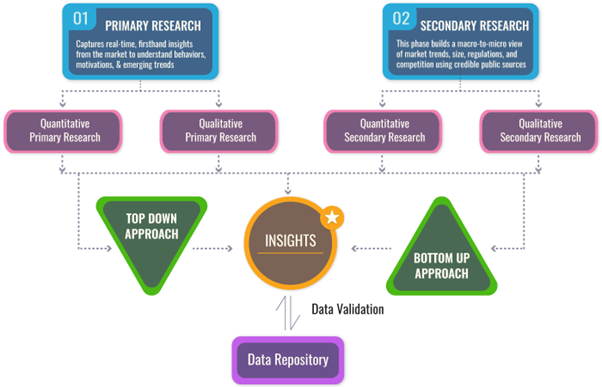
DUAL MODELING: TOP-DOWN + BOTTOM-UP
To ensure robust market estimation, we apply two complementary sizing approaches:
Top-Down Modeling:- Start with broader industry value (e.g., global or regional TAM)
- Apply filters by segment, geography, end-user, or use case
- Adjust with primary insights and validation benchmarks
- Ideal for investor-grade market scans and opportunity mapping
- Aggregate from the ground up using sales volumes, pricing, and unit economics
- Use internal modeling templates aligned with stakeholder data
- Incorporate distributor-level or region-specific inputs
- Most accurate for emerging segments and granular sub-markets
DATA VALIDATION: IN-HOUSE REPOSITORY
We close the loop with proprietary data intelligence built from ongoing projects, industry monitoring, and historical benchmarking. This repository includes:
- Multi-sector market and pricing models
- Key trendlines from past interviews and forecasts
- Benchmarked adoption rates, churn patterns, and ROI indicators
- Industry-specific deviation flags and cross-check logic
- Catches inconsistencies early
- Aligns projections across studies
- Enables consistent, high-trust deliverables