

United States Food Robotics Market Size and Forecast (2026–2034), Regional Growth, Trend, Share and Industry Analysis Report Coverage: By Type (Articulated Robots, SCARA Robots, Delta Robots, and Collaborative Robots); By Application (Food Processing, Packaging, Palletizing, Sorting & Grading, and Others); By End User (Food Manufacturers, Food Service Providers, Beverage Industry, and Others)
2026-09-16
ICT
Ekta Chaurasia (Team Lead)
Description
United
States Food Robotics Market Overview
The United States
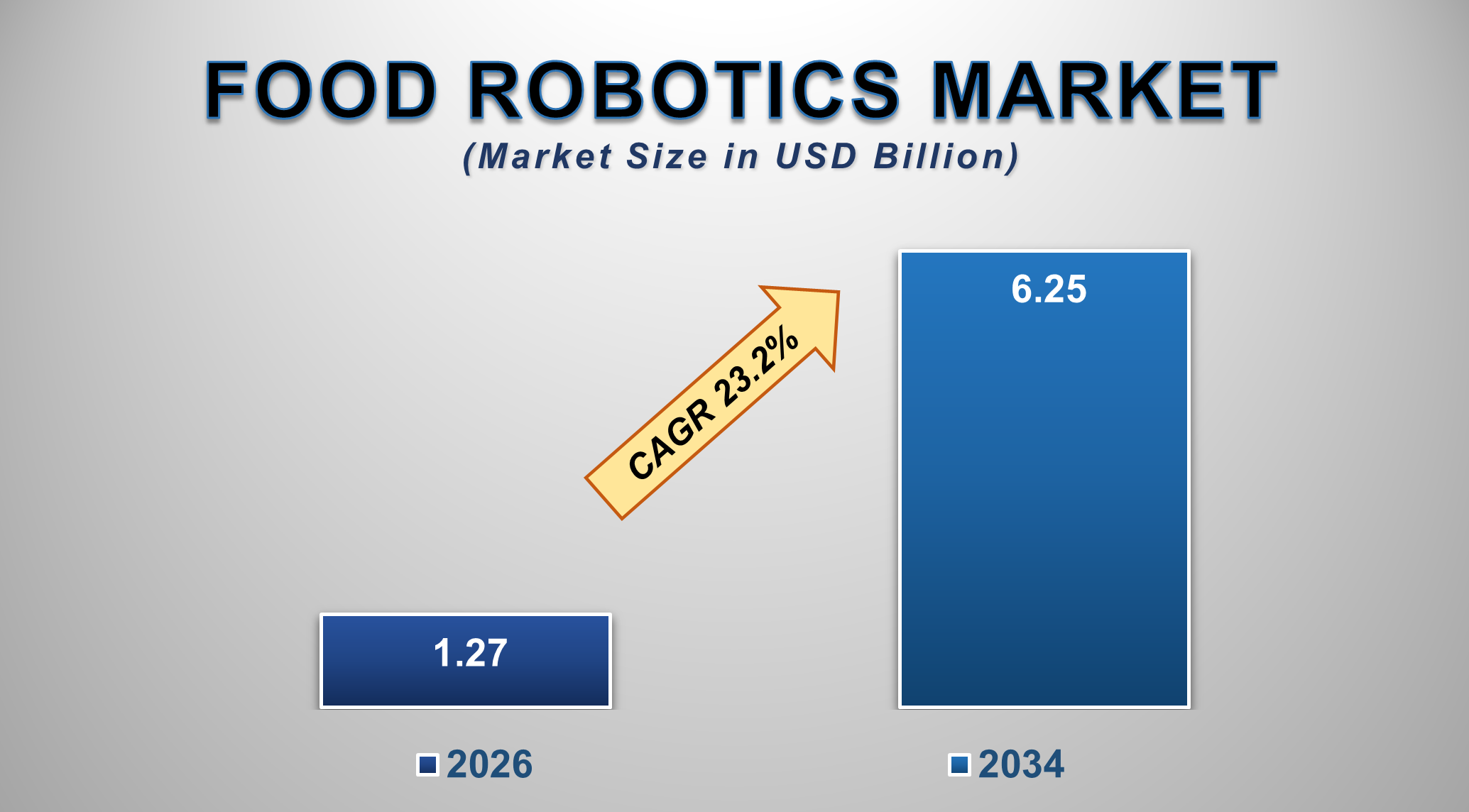
food robotics market is projected to expand from USD 1.27 billion in 2026 to
USD 6.25 billion by 2034, registering a CAGR of 23.2% during 2026–2034. The
United States food robotics industry is developing against the backdrop of the
food industry's growing need to boost productivity, resolve ongoing
labor-related problems, and ensure continuous food safety and quality standards
at high-volume plants. The areas driving demand are processing, packaging,
picking, palletizing, inspection, and material handling, which are highly
suitable for articulated and delta/parallel robots due to their repetitive
nature and high-speed requirements. Meanwhile, the market is evolving beyond
traditional large processors as technology costs fall and robots become
increasingly flexible, making automation applicable to medium-size processors.
From the technological perspective, automation is growing more sophisticated
thanks to such technologies as artificial intelligence, machine vision,
collaborative robots, and food-grade designs of robots, allowing companies to
automate the processes involving variable or fragile products. Hygiene
requirements in food robotics are promoting the development of sealed robots
and robots capable of washdown operation. In terms of demand drivers, growing
consumption of packaged and ready-to-eat products is pushing scalability, while
high labor costs and safety needs support the business case for automation. The
competitive landscape of the market includes robotics suppliers such as ABB,
FANUC, KUKA, Yaskawa, Mitsubishi Electric, and Kawasaki, together with
food-specific automation providers.
United
States Food Robotics Market Growth Drivers
Persistent Labor
Shortages and Rising Labor Costs
The increasing
workforce shortage is reinforcing the economic viability of robots within
food-processing companies in the United States, especially for tasks that are
repetitive, physical, and shift-oriented, including picking, loading, packing,
palletizing, and processing. According to the BLS's figures released on July 8,
2026, food-processing equipment workers were estimated to number 297,000 in
2025, with about 36,600 jobs expected to open up each year until 2035, mostly
due to replacements for people who either move occupations or stop working. In
addition, the BLS reported that food-processing equipment workers made a median
salary of USD 41,230 per annum in May 2025, while those directly employed in
food manufacturing earned a greater salary of USD 42,740 annually, hence making
it more economically favorable for processors to automate laborious processes.
The shortage problem is more visible at a plant level since the 2025
Manufacturing Outlook Survey conducted by Food Processing revealed in January
2025 that 37% of food and beverage processors were facing worker shortages that
were affecting production, compared to 32% in 2024. The problem is exacerbated
by the industry’s current automation trend, as per an analysis by the BLS
released in July 2026, which found that only around 6.6% of the U.S. food
manufacturing establishments employed robots in 2022; moreover, there was a
227.5% increase in the stock of robots in food and beverage manufacturing from
2010 to 2020, showing significant potential for further automation to
compensate for labor problems without reducing efficiency. The message is clear
for suppliers of food robotics: labor availability makes robots shift from
being productivity-increasing investments to capacity preservation and
workforce substitution solutions.
Growing Need for
Food Safety, Consistency, and Production Efficiency
Due to the rising
importance of food safety, process uniformity, and efficiency, more food
manufacturing companies in the U.S. are beginning to rely on robotics during
food inspections, picking, handling, processing, packaging, and palletizing, as
these processes are prone to automation to decrease the extent of human
interaction, standardize repetitive procedures, and provide consistent
production. In addition, the regulatory environment encourages this trend
because, according to the U.S. Food and Drug Administration (FDA), the FSMA
program makes it necessary for food facilities to implement hazard analysis and
risk-based preventive controls instead of responding to contamination incidents
after they happen. For example, according to an article published by Reuters on
August 11, 2026, the FDA has issued new guidance regarding fresh-cut produce
due to the Cyclospora and Salmonella outbreaks that have occurred recently. In
addition, these demands place an increased emphasis on the use of automated
systems, which would allow for standard handling and inspection processes while
minimizing unwanted contact between humans and foods. Moreover, arguments about
efficiency continue to gain weight: according to data from the U.S. Bureau of
Labor Statistics, which was released in late August of 2026, food manufacturing
labor productivity fell by 2.1% in 2025, while unit labor costs rose 5.6%,
creating the need to manufacture more effectively with fewer labor hours. Thus,
automation becomes especially valuable because robotics allows not only
enhancing hygiene and process reproducibility but also improving efficiency of
production through increasing output and decreasing labor inputs. Furthermore,
FDA guidance specifically notes the significance of computer-based production
technologies.
United States Food Robotics Market
Restraints
High Upfront
Investment and Integration Costs
The high initial
cost required for implementing food robotics is a major factor discouraging
companies from adopting food robotics technologies, especially the smaller and
medium-sized American food processing plants. In addition to purchasing robotic
machines, companies also have to buy vision systems, end effectors, safety
devices, and software, thus increasing the overall cost involved and increasing
the period before they can recover their cost outlay. According to the Food
Industry Executive, April 7, 2025, 57% of the food producers cited budget
limitations as the most limiting factor for adoption of the technology.
United States Food Robotics Market
Opportunities
AI- and
vision-enabled adaptive robotics
The development of
AI-based machine vision presents the possibility to advance the application of
food robotics beyond simple, programmed manipulation and into adaptively
picking, sorting, inspecting, cutting, and handling variable food products.
Vision-enabled robotics is able to make adjustments based on differences in
product size, shape, position, and quality, unlike conventional automation.
According to the Food Engineering Reviews on May 18, 2026, the use of AI
applications in food processing is becoming popular in quality control,
inspection, process optimization, and robotics. A relevant example in the
United States is the USDA Agricultural Research Service project started on
September 1, 2025, where robots with AI machine vision are designed to detect
crop defects and contamination while executing laborious inspection and
handling operations. The evolution of such technologies means that food
processors can robotize applications that have been previously hard to do with
robots, enlarging the market potential for robotics and the need for AI-based
vision, sensors, and adaptive end-effectors.
Expansion of
robotics into foodservice and flexible production
With the growing
adoption of robotics technology not only in conventional food processing plants
but also in restaurants, commercial kitchens, convenience retail, and flexible
food production systems, there is emerging growth potential for the U.S. food robotics
market. Robotics technology is increasingly being used for cooking, food
preparation, service, material handling, and order fulfillment operations, thus
enabling operators to sustain production capacity using less manpower and
adjust production capacity to accommodate different menus or products. For
instance, SoftBank Robotics made an announcement on May 1, 2026, about the U.S.
launch of its STEAMA and FLAMA autonomous cooking robots, in which the FLAMA
robot would be able to automate ingredient dispensing, seasoning, stir-frying,
mixing, plating, and cleaning processes. Also, Murphy USA made an announcement
on August 20, 2026, on the launch of an autonomous foodservice platform in
collaboration with White Castle as a modular system to prepare and deliver hot
food without the need for a traditional commercial kitchen's labor and space.
United States Food Robotics Market
Scope
|
Report Attributes |
Description |
|
Market Size in 2026 |
USD 1.27 Billion |
|
Market Forecast in 2034 |
USD 6.25 Billion |
|
CAGR % 2026-2034 |
23.2% |
|
Market Concentration |
Moderately Concentrated |
|
Base Year |
2025 |
|
Historic Data |
2021-2025 |
|
Forecast Period |
2026-2034 |
|
Report USP |
Production, company share, company
heatmap, company production capacity, growth factors, and more |
|
Geography |
United States |
|
Segments Covered |
●
By Type ●
By
Application ●
By End
User |
|
Key Demand Side Trends |
●
Shift toward
flexible automation for labor-intensive operations ●
Growing
demand for AI- and vision-enabled robotics ●
Greater
emphasis on food safety and hygienic processing |
|
Key Supply Side Trends |
●
Integration
of AI, machine vision, and
advanced end-effectors ●
Rise of
collaborative and flexible robotic systems ●
Expansion
from packaging into processing and inspection |
|
Major Players |
●
ABB Ltd. ●
FANUC
Corporation ●
KUKA AG ●
Yaskawa
Electric Corporation ●
Mitsubishi
Electric Corporation ●
Kawasaki
Heavy Industries, Ltd. |
United States Food Robotics Market Report Segmentation Analysis
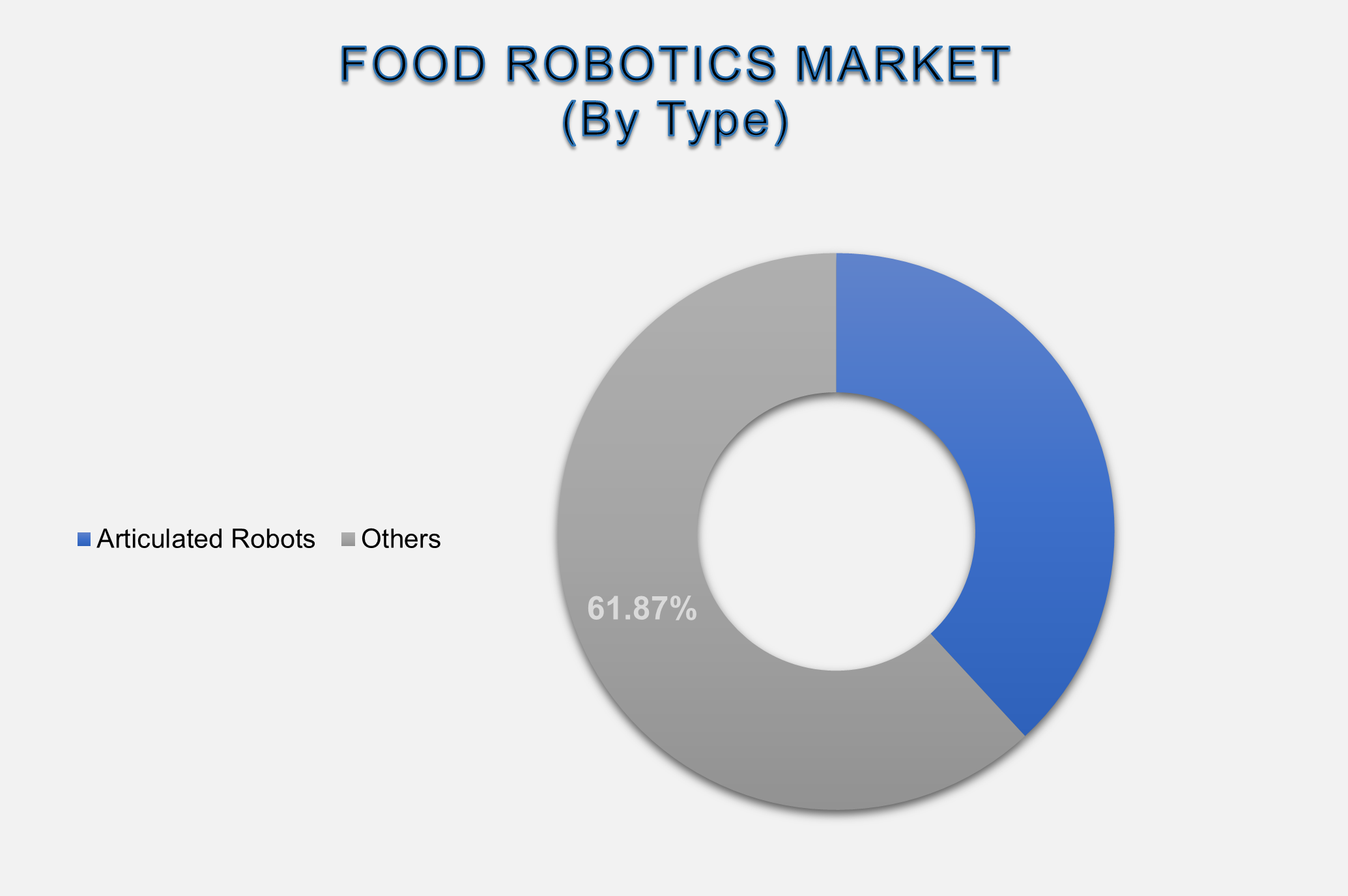
The Articulated
Robots Segment Is Expected to Dominate the United States Food Robotics Market
During the Forecast Period
The segment of articulated robots is anticipated to command a large share of the U.S. food robotics market owing to their high flexibility, multi-axis movement, wide range of payload capacity, and versatile use in several applications such as picking, processing, packaging, palletizing, and material handling. Rising use of food-grade articulated robots, along with machine vision and end effectors, is allowing automation in tough hygiene conditions and varying product applications. The capability of performing multiple tasks by articulated robots offers better value to United States food producers.
Packaging
Segment Is Expected to Dominate the United States Food Robotics Market During
the Forecast Period
The packaging
sub-segment is expected to lead the U.S. food robotics market owing to the
large volume of repetitive and labor-intensive tasks like pick-and-place
operations, packing, case packing, labeling, and palletizing. Growing demand
for processed, frozen, and ready-to-eat food items has led to an increased
requirement for efficient and high-speed packaging, along with the scarcity of
labor and requirements of throughput improvement, which is driving automation
in the segment. Packaging is also one of the easy-to-adapt segments compared
with the processes in food processing due to the standardized nature of the
products involved. According to industry sources, the packaging and repackaging
application has been identified as the dominant application in the United
States food robotics market.
The Food
Manufacturers Segment Is Expected to Dominate the United States Food Robotics
Market During the Forecast Period
Food manufacturing
companies will drive growth in the United States food robotics market since
these large-scale food processors use robots extensively in food processing,
packaging, palletizing, and inspection to solve labor shortage problems,
enhance efficiency, and maintain quality. Meat, poultry, seafood, dairy,
bakery, and packaged foods manufacturing companies are among those companies
that are suitable for automation due to the volume nature of production. The
presence of many food-processing facilities in the United States and increased
labor costs are expected to boost automation in the industry.
The following
segments are part of an in-depth analysis of the United States Food Robotics
Market:
|
Market Segments |
|
|
By
Type |
●
Articulated
Robots ●
SCARA Robots ●
Delta Robots ●
Collaborative
Robots |
|
By
Application |
●
Food
Processing ●
Packaging ●
Palletizing ●
Sorting
& Grading ●
Others |
|
By End
User |
●
Food
Manufacturers ●
Food Service
Providers ●
Beverage
Industry ●
Others |
United States Food Robotics Market Competition
Landscape Analysis
The market for food
robotics is moderately concentrated in terms of robot OEM manufacturers but
still fragmented due to the presence of specialized food-automation suppliers
and system integrators like ABB, FANUC, KUKA, Yaskawa, Mitsubishi Electric,
Kawasaki, OMRON, and Stäubli, with their competitive robot lineups, food-grade
models, machine vision, and automation. In addition, specialized vendors such
as JLS Automation, BluePrint Automation, and ProMach are intensifying
competition via application-specific solutions for packaging, palletizing,
picking, and processing. The competitive advantage in the field is increasingly
shifting from mere robotics hardware to machine vision powered by AI, hygienic
design, versatility, integration skills, and after-sales services because food
producers are looking for automation that can solve their labor problems.
United States Food Robotics Market Recent
Developments News:
●
In August
2026, Serve Robotics announced a partnership with Grubhub to expand autonomous
food delivery across Chicago, Los Angeles, and Alexandria, initially covering
more than 100 participating merchants in Chicago and nearly 200 in Los Angeles.
The company also announced expansion into San Jose and Washington, D.C.,
highlighting the growing deployment of robotics in restaurant delivery and
foodservice.
●
In August
2026, Sagtec Global officially launched its HALO AI food-serving robot and
secured a USD 3 million purchase order for 1,500 units, marking the transition
of its AI robotics platform from development and pilot deployments to
commercial-scale foodservice automation.
●
In September
2025, FANUC America showcased its food-grade robotics and automation portfolio
at PACK EXPO Las Vegas, featuring food-grade cobots, washdown-capable robots,
machine-vision systems, robotic picking, packaging, and palletizing solutions
designed to address labor shortages, improve sanitation, and increase
throughput in food manufacturing.
●
In May 2026,
Chef Robotics expanded its AI-driven robotics platform into component assembly
for CPG manufacturing, enabling robots to use AI-powered computer vision to
identify, orient, and place irregular items such as seasoning packets, sauce
sachets, and other components into bowls, trays, and packaging. The solution is
available in the U.S. and is offered under Chef Robotics’ Robotics-as-a-Service
model.
The United
States Food Robotics Market is dominated by a few large companies, such as
●
FANUC
Corporation
●
ABB Ltd.
●
KUKA AG
●
Yaskawa
Electric Corporation
●
Kawasaki Heavy
Industries, Ltd.
●
Mitsubishi
Electric Corporation
●
DENSO
Corporation
●
OMRON
Corporation
●
Stäubli
International AG
●
Seiko Epson
Corporation
●
JBT Marel
●
Middleby
Corporation
●
GEA Group AG
●
Krones AG
●
Mayekawa
Manufacturing Co., Ltd.
●
Bühler AG
●
JLS Automation
●
BluePrint
Automation (BPA)
●
Miso Robotics
●
Scott
Automation
● Other Prominent Players
Frequently Asked Questions
Ekta Chaurasia (Team Lead)
Ekta Chaurasia is a highly experienced Team Lead at M2Square Consultancy with over 7 years of expertise in market research, strategic consulting, competitive benchmarking, and business intelligence solutions. She specializes in ICT, semiconductors & electronics, automotive & transportation, and industrial machinery markets.
She leads end-to-end global research projects focused on market trends, industry analysis, growth forecasting, customer insights, and strategic decision-making. Known for her analytical leadership and industry expertise, Ekta helps businesses uncover growth opportunities, evaluate competitive landscapes, and stay ahead in rapidly evolving markets through accurate and insight-driven research.
1.
United
States Food Robotics Market Introduction and Market Overview
1.1. Objectives of the Study
1.2. Market Segmentation
1.2.1.Type of the United States Food
Robotics Market
1.2.2.Application of the United States
Food Robotics Market
1.2.3.End Users of the United States Food
Robotics Market
1.3. Competition Coverage List of
Market Participants
1.4. Market Definition: Food Robotics
Market
2.
Executive Summary
2.1. United States Food Robotics
Market Estimation & Forecast
2.1.1.United States Food Robotics
Market Size (US$ Million) Estimates & Historical Trend Analysis (2021 -
2025)
2.1.2.United States Food Robotics
Overall Market Size (US$ Million), Growth Rate (Y-o-Y), Market CAGR (%), Market
forecast (2026 - 2034)
2.2. Snapshot of United States Food
Robotics Market
2.3. United States Food Robotics
Market Revenue Share (%) 2025
2.4. Key Competitors & Key
Insights
3.
Market Overview (Qualitative
Analysis)
3.1. Demand Side Trends
3.2. Supply Side Trends /
Manufacturing Trends
3.3. Demand and Opportunity
Assessment, 2026 - 2034
3.4. Market Dynamics
3.4.1.Drivers
3.4.2.Limitations
3.4.3.Opportunities
3.4.4.Impact Analysis of Drivers and
Restraints
3.5. Key Developments
3.6. Regulatory Landscape
3.7. Pricing Analysis
3.8. Supply Chain Analysis
3.9. Porter’s Five Forces Analysis
3.9.1.Bargaining Power of Suppliers
3.9.2.Bargaining Power of Buyers
3.9.3.Threat of Substitutes
3.9.4.Threat of New Entrants
3.9.5.Competitive Rivalry
3.10. PEST Analysis
3.10.1. Political Factors
3.10.2. Economic Factors
3.10.3. Social Factors
3.10.4. Technology Factors
4.
United States Food Robotics
Market Estimates & Forecast Trend Analysis, by Type
4.1. United States Food Robotics
Market Assessments & Key Findings, by Type
4.2. United States Food Robotics
Market Revenue (US$ Million) Estimates and Forecasts, by Type, 2021 - 2034
4.2.1. Articulated Robots
4.2.2.SCARA Robots
4.2.3.Delta Robots
4.2.4.Collaborative Robots
5.
United States Food Robotics
Market Estimates & Forecast Trend Analysis, by Application
5.1. United States Food Robotics
Market Assessments & Key Findings, by Application
5.2. United States Food Robotics
Market Revenue (US$ Million) Estimates and Forecasts, by Application, 2021 -
2034
5.2.1.Food Processing
5.2.2.Packaging
5.2.3.Palletizing
5.2.4.Sorting & Grading
5.2.5.Others
6.
United States Food Robotics
Market Estimates & Forecast Trend Analysis, by End User
6.1. United States Food Robotics
Market Assessments & Key Findings, by End User
6.2. United States Food Robotics
Market Revenue (US$ Million) Estimates and Forecasts, by End User, 2021 - 2034
6.2.1.Food Manufacturers
6.2.2.Food Service Providers
6.2.3.Beverage Industry
6.2.4.Others
7. Competition Landscape
7.1. United States Food Robotics
Market Product Mapping
7.2. United States Food Robotics
Market Concentration Analysis, by Leading Players / Innovators / Emerging
Players / New Entrants
7.3. United States Food Robotics
Market Tier Structure Analysis
7.4. United States Food Robotics
Market Concentration & Company Market Shares (%) Analysis, 2025
8. Company Profiles
8.1. FANUC Corporation
8.1.1.Company Overview & Key Stats
8.1.2.Financial Performance & KPIs
8.1.3.Product Portfolio
8.1.4.SWOT Analysis
8.1.5.Business Strategy & Recent
Developments
* Similar details would be provided
for all the players mentioned below
8.2.
ABB Ltd.
8.3.
KUKA AG
8.4.
Yaskawa Electric Corporation
8.5.
Kawasaki Heavy Industries, Ltd.
8.6.
Mitsubishi Electric Corporation
8.7.
DENSO Corporation
8.8.
OMRON Corporation
8.9.
Stäubli International AG
8.10.
Seiko Epson Corporation
8.11.
JBT Marel
8.12.
Middleby Corporation
8.13.
GEA Group AG
8.14.
Krones AG
8.15.
Mayekawa Manufacturing Co.,
Ltd.
8.16.
Bühler AG
8.17.
JLS Automation
8.18.
BluePrint Automation (BPA)
8.19.
Miso Robotics
8.20.
Scott Automation
8.21. Other Prominent Players
9.
Research Findings &
Conclusion
10. Assumptions & Acronyms Used
11. Research
Methodology
11.1. External Transportation /
Databases
11.2. Internal Proprietary Database
11.3. Primary Research
11.4. Secondary Research
11.5. Assumptions
11.6. Limitations
11.7. Report FAQs
Our Research Methodology
"Insight without rigor is just noise."
We follow a comprehensive, multi-phase research framework designed to deliver accurate, strategic, and decision-ready intelligence. Our process integrates primary and secondary research , both quantitative and qualitative , along with dual modeling techniques ( top-down and bottom-up) and a final layer of validation through our proprietary in-house repository.
PRIMARY RESEARCH
Primary research captures real-time, firsthand insights from the market to understand behaviors, motivations, and emerging trends.
1. Quantitative Primary Research
Objective: Generate statistically significant data directly from market participants.
Approaches:- Structured surveys with customers, distributors, and field agents
- Mobile-based data collection for point-of-sale audits and usage behavior
- Phone-based interviews (CATI) for market sizing and product feedback
- Online polling around industry events and digital campaigns
- Purchase frequency by customer type
- Channel performance across geographies
- Feature demand by application or demographic
2. Qualitative Primary Research
Objective: Explore decision-making drivers, pain points, and market readiness.
Approaches:- In-depth interviews (IDIs) with executives, product managers, and key decision-makers
- Focus groups among end users and early adopters
- Site visits and observational research for consumer products
- Informal field-level discussions for regional and cultural nuances
SECONDARY RESEARCH
This phase helps establish a macro-to-micro understanding of market trends, size, regulation, and competitive dynamics, sourced from credible and public domain information.
1. Quantitative Secondary Research
Objective: Model market value and segment-level forecasts based on published data.
Sources include:- Financial reports and investor summaries
- Government trade data, customs records, and regulatory statistics
- Industry association publications and economic databases
- Channel performance and pricing data from marketplace listings
- Revenue splits, pricing trends, and CAGR estimates
- Supply-side capacity and volume tracking
- Investment analysis and funding benchmarks
2. Qualitative Secondary Research
Objective: Capture strategic direction, innovation signals, and behavioral trends.
Sources include:- Company announcements, roadmaps, and product pipelines
- Publicly available whitepapers, conference abstracts, and academic research
- Regulatory body publications and policy briefs
- Social and media sentiment scanning for early-stage shifts
- Strategic shifts in market positioning
- Unmet needs and white spaces
- Regulatory triggers and compliance impact
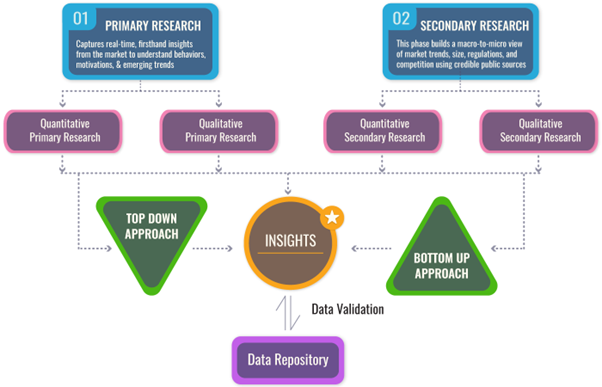
DUAL MODELING: TOP-DOWN + BOTTOM-UP
To ensure robust market estimation, we apply two complementary sizing approaches:
Top-Down Modeling:- Start with broader industry value (e.g., global or regional TAM)
- Apply filters by segment, geography, end-user, or use case
- Adjust with primary insights and validation benchmarks
- Ideal for investor-grade market scans and opportunity mapping
- Aggregate from the ground up using sales volumes, pricing, and unit economics
- Use internal modeling templates aligned with stakeholder data
- Incorporate distributor-level or region-specific inputs
- Most accurate for emerging segments and granular sub-markets
DATA VALIDATION: IN-HOUSE REPOSITORY
We close the loop with proprietary data intelligence built from ongoing projects, industry monitoring, and historical benchmarking. This repository includes:
- Multi-sector market and pricing models
- Key trendlines from past interviews and forecasts
- Benchmarked adoption rates, churn patterns, and ROI indicators
- Industry-specific deviation flags and cross-check logic
- Catches inconsistencies early
- Aligns projections across studies
- Enables consistent, high-trust deliverables