

Unmanned Traffic Management Market Size and Forecast (2026–2034), Global and Regional Growth, Trend, Share and Industry Analysis Report Coverage; By Type (Persistent, Non-Persistent); By Component (Hardware, Software, Services); By Solution (Communication Infrastructure, Navigation Infrastructure, Surveillance Infrastructure, Others); By End Use (Agriculture & Forestry, Logistics & Transportation, Surveillance & Monitoring, Others); and Geography
2026-10-28
Aerospace & Defense
Ekta Chaurasia (Team Lead)
Description
Unmanned Traffic Management Market Overview
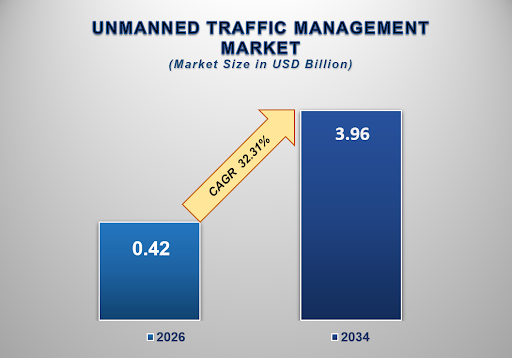
The global Unmanned Traffic Management Market is entering a high-growth phase as commercial drones, autonomous unmanned aircraft, and increasingly complex low-altitude operations require structured systems for flight authorization, airspace awareness, strategic deconfliction, surveillance, navigation, communication, and regulatory compliance. Based on a current 2026–2034 industry assessment, the market is valued at approximately USD 0.42216 billion in 2026 and is projected to reach USD 3.96473 billion by 2034, expanding at a CAGR of 32.31% during 2026–2034. The expansion is being supported by rising drone utilization, increasing beyond-visual-line-of-sight (BVLOS) activity, digitalization of low-altitude airspace, regulatory development, and the emergence of automated systems capable of coordinating multiple unmanned aircraft.
Unmanned Traffic Management (UTM) refers to a digital ecosystem designed to coordinate and manage unmanned aircraft operations, particularly in low-altitude airspace where large numbers of drones may operate simultaneously. Unlike conventional air traffic management, UTM relies extensively on automated data exchange between drone operators, UTM service suppliers, regulators, air navigation service providers, and other authorized stakeholders. The system can support flight planning, authorization, surveillance, conformance monitoring, airspace information, conflict management, and operational coordination. The U.S. Federal Aviation Administration describes UTM as a collaborative ecosystem intended to safely manage unmanned aircraft operations, especially BVLOS flights, through automated and interoperable services.
The market is closely connected to the expansion of commercial drone operations. Drones are increasingly being deployed for parcel delivery, infrastructure inspection, agricultural monitoring, emergency response, public safety, surveying, construction, environmental observation, energy-sector inspection, and defense-related missions. As the number of aircraft operating within the same geographical area rises, conventional manual authorization and coordination processes become increasingly difficult to scale. UTM platforms address this challenge by digitizing airspace access and automating several operational processes.
BVLOS operations represent a particularly important market catalyst. BVLOS flights allow drones to operate beyond the direct visual range of their pilots and are essential for applications such as long-distance delivery, pipeline inspection, railway monitoring, offshore infrastructure inspection, and large-scale agricultural operations. These missions require more sophisticated traffic coordination because operators cannot rely solely on visual observation to identify and avoid other aircraft.
The FAA's UTM framework emphasizes automated information exchange and strategic coordination between service providers and operators. Its operational evaluation work has focused on enabling multiple overlapping BVLOS operations while reducing the risk of drone-to-drone conflicts. The agency has also been developing processes through which third-party UTM service providers can receive safety recognition for services supporting drone operations.
Europe is developing a parallel regulatory and technological ecosystem through U-space. The European Union's regulatory framework establishes requirements for digital services that enable increasingly complex drone operations. EASA's June 2026 revision of its Easy Access Rules for unmanned aircraft incorporated updated guidance and acceptable means of compliance, including the SORA 2.5 framework for risk assessment of specific drone operations.
Technology development is also reshaping the market. Artificial intelligence and machine learning can support traffic prediction, route optimization, anomaly detection, weather analysis, and conflict identification. Cloud-based platforms allow UTM providers to manage geographically distributed operations while APIs enable data exchange between operators, regulators, air navigation systems, and third-party service providers.
Communication infrastructure is another fundamental element. UTM systems require reliable connectivity for exchanging flight intent, authorization information, surveillance data, operational alerts, and airspace constraints. Cellular networks, dedicated aviation communications, satellite connectivity, and emerging 5G infrastructure can collectively support these requirements.
Cybersecurity is becoming equally important as UTM systems increasingly control or influence access to shared airspace. Threats such as GNSS spoofing, GNSS jamming, unauthorized access, manipulated flight information, and attacks on communication networks can compromise the reliability of unmanned-aircraft operations. Consequently, modern UTM platforms are increasingly incorporating secure authentication, encrypted communication, anomaly detection, resilient positioning, and cybersecurity monitoring.
The market is also moving toward integration between unmanned and conventional air traffic management. At Airspace World 2026, Frequentis demonstrated an approach connecting drone traffic management with ATM automation, allowing information concerning crewed and uncrewed operations to be incorporated into a shared operational environment.
Unmanned Traffic Management Market Drivers and Opportunities
The Rapid Expansion of BVLOS Drone Operations Is Increasing the Need for Automated Airspace Coordination
The expansion of BVLOS operations is one of the strongest structural drivers for the UTM market. Traditional visual-line-of-sight drone missions can often be managed through relatively simple operating procedures because the pilot or observer can directly monitor the aircraft and its immediate surroundings. BVLOS operations remove this direct visual dependency and therefore require stronger digital mechanisms for authorization, tracking, conformance monitoring, and strategic deconfliction.
Commercial drone delivery is particularly dependent on scalable BVLOS capabilities. Delivery networks may involve numerous aircraft operating across the same metropolitan area, potentially following overlapping routes and interacting with controlled and uncontrolled airspace. A centralized or federated UTM ecosystem can distribute relevant airspace information and allow operators to coordinate flight plans before and during missions.
Infrastructure inspection creates another important use case. Energy companies, utilities, rail operators, telecommunications providers, and pipeline operators increasingly use drones to inspect assets extending over large geographical areas. BVLOS capabilities can allow one operator to supervise longer missions and cover greater distances, improving the economic feasibility of drone-based inspection.
Emergency services also require reliable traffic coordination. During wildfire response, disaster assessment, search and rescue, or medical logistics operations, multiple drones may be deployed simultaneously alongside helicopters or other aircraft. UTM systems can provide a digital layer for sharing flight intent, operational constraints, and airspace information.
The development of regulatory pathways for BVLOS operations is consequently closely linked to UTM adoption. The FAA continues to work on UTM services, strategic deconfliction, interoperability, and service-provider recognition, while European authorities are expanding U-space frameworks.
As more regulators establish predictable BVLOS pathways, UTM platforms can move from demonstration projects toward recurring operational infrastructure. This transition creates demand for scalable software, communication networks, surveillance systems, navigation services, and managed UTM operations.
The Increasing Density of Commercial Drones and Digitalization of Low-Altitude Airspace Are Driving UTM Adoption
The number and diversity of drone applications are expanding beyond recreational and small-scale commercial operations. Logistics companies, agricultural enterprises, infrastructure owners, public agencies, emergency responders, and security organizations are developing larger and more frequent drone missions.
As drone density rises, the operational environment becomes more complex. Several independent operators may need to access the same airspace at the same time. Each operation can have different aircraft capabilities, routes, risk profiles, priorities, and authorization requirements. UTM platforms provide a mechanism for collecting and exchanging this information digitally.
Modern UTM architectures can combine flight plans, airspace restrictions, weather information, terrain information, Remote ID data, surveillance feeds, navigation information, and operator credentials. This allows service providers to construct a continuously updated picture of unmanned operations.
The increasing use of AI and analytics can further automate these processes. Machine-learning models can identify traffic patterns, predict congestion, detect deviations from planned trajectories, and support route optimization. Automated systems can also flag potentially conflicting operations before they develop into safety-critical situations.
5G and satellite connectivity are creating additional opportunities. High-bandwidth, low-latency communications can improve the speed at which UTM platforms exchange operational data. Satellite communications can extend connectivity into remote locations where terrestrial infrastructure is limited, supporting long-distance inspection, agriculture, maritime operations, and emergency missions.
The combination of rising drone density, connected aircraft, automated authorization, and digital airspace information is therefore creating a structural need for UTM platforms rather than isolated drone-management tools.
Opportunity: AI-Enabled UTM, U-Space Expansion and Integration With Conventional Air Traffic Management Create New Growth Areas
The development of integrated, intelligent UTM ecosystems presents a substantial opportunity for technology providers. Future systems are expected to combine traffic-management software with AI, real-time surveillance, automated conflict resolution, digital twins, advanced communications, cybersecurity, and conventional ATM interfaces.
Integration with conventional air traffic management is particularly important because drone operations increasingly need to coexist with crewed aviation. UTM platforms can provide unmanned-aircraft information to air navigation stakeholders while allowing drone operators to receive relevant constraints and traffic information.
Europe's U-space development creates opportunities for standardized digital services across multiple countries. In July 2026, Unifly joined the SESAR Joint Undertaking, contributing UTM expertise to the broader Digital European Sky research and innovation ecosystem. The initiative brings together aviation stakeholders working toward interoperable and digitally enabled European airspace.
Cyber-resilient UTM represents another opportunity. In April 2026, Unifly and Nexova completed Phase I of the ESA NAVISP SecureUTM 2 project, focusing on cybersecurity foundations for U-space and UTM systems. The project specifically addressed threats including GNSS jamming and spoofing and validated several monitoring and mitigation mechanisms.
UTM providers can therefore expand beyond basic flight-planning platforms into complete operational ecosystems that include regulatory compliance, cybersecurity, traffic analytics, surveillance, fleet coordination, and integration with national airspace systems.
Unmanned Traffic Management Market Scope
Unmanned Traffic Management Market Report Segmentation Analysis
The global Unmanned Traffic Management Market industry analysis is segmented by type, by component, by solution, by end use, and by region. Type includes persistent and non-persistent UTM; component covers hardware, software, and services; solution encompasses communication infrastructure, navigation infrastructure, surveillance infrastructure, and others; while end use includes agriculture & forestry, logistics & transportation, surveillance & monitoring, and other applications.
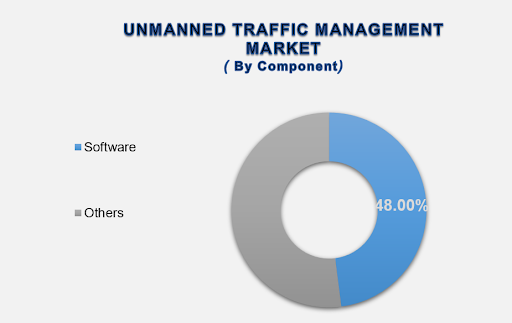
The software segment accounted for approximately 48% of the market in a recent industry assessment and represents an important value center because UTM platforms depend on software for flight planning, traffic coordination, airspace monitoring, authorization, strategic deconfliction, and data exchange.
The Software Segment Is Expected to Dominate the Market During the Forecast Period
UTM software forms the operational intelligence layer of the market. It collects information from aircraft, operators, regulators, navigation systems, surveillance infrastructure, weather services, and other data sources and converts that information into actionable airspace-management functions.
Software platforms can automate flight-plan submission, authorization workflows, airspace restriction checks, traffic visualization, conformance monitoring, strategic deconfliction, and alerts. As drone fleets become larger, automation becomes essential because manual coordination cannot efficiently manage thousands of simultaneous operations.
Cloud-based architectures are particularly valuable for commercial operators because they can provide scalable computing and centralized data access. At the same time, on-premises and sovereign deployments remain important for defense, critical infrastructure, government agencies, and organizations handling sensitive operational information.
The growing importance of software is also linked to interoperability. UTM systems must exchange data between multiple providers rather than operating as isolated platforms. APIs, standardized data formats, and federated architectures therefore represent important components of future UTM software development.
The Persistent UTM Segment Is Expected to Maintain Strong Market Importance
Persistent UTM systems support continuing or regularly recurring unmanned-aircraft operations in a defined operational environment. These systems are particularly relevant where drone activity is sustained over time rather than limited to an isolated mission.
Persistent operations can include recurring logistics routes, industrial inspections, agricultural monitoring, public-safety patrols, and long-duration surveillance programs. Such applications benefit from continuous traffic information, predefined operational areas, persistent surveillance, and repeatable authorization workflows.
As commercial drone networks become more established, persistent UTM capabilities can allow operators to maintain recurring flight corridors and operational procedures. This can reduce the administrative burden associated with repeatedly planning similar missions.
The persistent model is particularly relevant to high-density drone environments where continuous monitoring and coordination are necessary. Industry assessments also identify persistent UTM as an important growth segment as commercial drone operations become more routine.
The Surveillance & Monitoring Segment Is Expected to Dominate the Market by Application
Surveillance and monitoring represents a major UTM application because safe unmanned-aircraft operations require accurate awareness of aircraft positions, flight trajectories, airspace constraints, and potential conflicts.
UTM surveillance infrastructure can incorporate information from Remote ID, radar, ADS-B where appropriate, cellular positioning, GNSS-based tracking, optical systems, and other sensing technologies. Combining multiple data sources can improve the visibility of drone operations and help identify deviations from approved flight paths.
The need for surveillance is particularly important for BVLOS operations because the operator may not have direct visual awareness of the aircraft's surrounding environment. UTM systems can therefore provide a digital representation of relevant traffic and airspace conditions.
Surveillance also supports public safety and security applications. Authorities can use UTM platforms to identify unauthorized or non-conforming aircraft and coordinate responses with relevant agencies.
The following segments are part of an in-depth analysis of the global Unmanned Traffic Management Market:
Unmanned Traffic Management Market Share Analysis By Region
North America represented the largest regional market in the current 2025 assessment, accounting for approximately 37.97% of global UTM market revenue. The region benefits from a large commercial drone ecosystem, established aerospace and technology companies, regulatory initiatives supporting BVLOS development, and ongoing investment in UTM service-provider infrastructure.
North America
North America is a major center for UTM development due to the scale of the U.S. commercial drone market and the FAA's ongoing work on automated traffic-management services. The U.S. is developing a framework in which UTM service providers can support flight authorization, strategic deconfliction, conformance monitoring, and information exchange for increasingly complex drone operations.
The region also benefits from the presence of major aerospace and defense companies, specialized UTM developers, telecommunications providers, logistics companies, and autonomous-drone technology firms.
Canada is developing its own digital framework for remotely piloted aircraft. In May 2026, NAV CANADA selected Indra Group as its technology partner for the RPAS Flight Information Management System, a centralized digital platform intended to support Canada's evolving framework for safe drone integration into national airspace.
The combination of regulatory development, drone delivery, infrastructure inspection, emergency response, and defense applications is expected to maintain strong demand for UTM technologies across the region.
Europe
Europe is developing a comprehensive U-space ecosystem to enable safe and scalable integration of drones into increasingly complex airspace. U-space services are designed to provide digital infrastructure for drone identification, flight authorization, traffic information, strategic deconfliction, and other operational functions.
Germany, France, the U.K., Italy, Spain, Belgium, and other European markets are participating in the development of digital aviation and unmanned-aircraft frameworks.
Cybersecurity and interoperability are especially important in Europe because drone operations may increasingly cross national borders. UTM providers must therefore support common technical standards and regulatory requirements.
Unifly's 2026 participation in the SESAR Joint Undertaking reflects the region's emphasis on developing a Digital European Sky in which UTM and conventional ATM can increasingly operate within an interoperable environment.
Asia Pacific
Asia Pacific represents an important growth market as China, Japan, India, South Korea, Australia, and Southeast Asian countries expand drone operations across logistics, agriculture, infrastructure, public safety, and defense.
China has a large drone manufacturing ecosystem and extensive commercial applications, creating substantial requirements for digital airspace management. Japan and South Korea are developing advanced drone and autonomous-mobility applications, while Australia has significant requirements associated with remote-area operations, mining, agriculture, and infrastructure monitoring.
India is also progressing toward a national UTM framework. In September 2026, the Indian government issued a global expression of interest for technical proposals to implement a UAS Traffic Management System in India. The tender demonstrates the increasing institutional focus on establishing digital infrastructure for unmanned aircraft operations.
The region's combination of dense urban environments, large agricultural areas, logistics demand, infrastructure requirements, and rapidly developing drone regulations creates substantial opportunities for UTM service providers.
Latin America
Latin America is gradually increasing commercial drone adoption across agriculture, mining, energy, infrastructure inspection, public safety, and logistics. Brazil and Mexico represent important markets because of their large economies and extensive agricultural and industrial activities.
Agricultural monitoring is a particularly relevant application because drones can cover large areas for crop assessment, irrigation monitoring, pest detection, and field mapping. As drone operations become more frequent, UTM platforms can provide greater coordination and regulatory visibility.
Brazil is also developing digital aviation and ATM capabilities, while regional authorities continue to evaluate frameworks for commercial BVLOS operations. These developments can support the gradual expansion of UTM services.
Middle East & Africa
The Middle East & Africa market is developing through applications in infrastructure monitoring, security, agriculture, energy, logistics, and smart-city programs. Countries such as the UAE and Saudi Arabia are investing in advanced aviation technologies and autonomous mobility.
The region's large infrastructure projects and extensive energy assets create opportunities for drone-based inspection and monitoring. UTM systems can support these operations by coordinating recurring flights and providing authorities with improved visibility of unmanned-aircraft activity.
The UAE is also active in UTM research. Khalifa University's Secure UTM Systems Lab is developing research around secure unmanned traffic management, including cybersecurity and autonomous aviation applications.
Unmanned Traffic Management Market Competition Landscape Analysis
The global UTM market contains a combination of aerospace and defense companies, air traffic management specialists, drone technology providers, UTM software companies, and emerging digital-airspace businesses.
Large aerospace companies such as Airbus, Leonardo, Thales, Lockheed Martin, and L3Harris bring established capabilities in surveillance, command and control, air traffic management, communications, and defense systems. Specialized companies such as Unifly, Frequentis, Altitude Angel, OneSky Systems, and AirMap focus more directly on digital UTM and U-space services.
According to a 2026 Global Market Insights assessment, Airbus held the largest estimated market position in 2025, while Airbus, Leonardo, Thales, Lockheed Martin, and L3Harris collectively represented approximately 65% of the market.
Competition is increasingly centered on interoperability and regulatory integration rather than only standalone drone-management functionality. Providers must connect with aviation authorities, operators, air navigation service providers, surveillance systems, and other UTM service suppliers.
Software capability is becoming particularly important because UTM providers need to translate complex regulatory and operational requirements into automated workflows. Platforms that can support flight authorization, strategic deconfliction, conformance monitoring, Remote ID, airspace information, and data exchange can serve as foundational infrastructure for commercial BVLOS operations.
Cybersecurity is also becoming a competitive differentiator. UTM platforms handle sensitive information concerning aircraft locations, flight plans, operators, and airspace constraints. Providers therefore need to incorporate secure communications, identity management, intrusion detection, resilient positioning, and cybersecurity monitoring.
The industry is also moving toward integration with conventional ATM systems. Frequentis demonstrated at Airspace World 2026 how UTM information can be exchanged with ATM automation to create a shared operational picture of crewed and uncrewed traffic.
Global Unmanned Traffic Management Recent Developments News
September 2026 – India launches global EOI for UTM implementation: The Indian government published an Expression of Interest seeking technical proposals for implementation of a national Unmanned Aircraft Systems Traffic Management system. The initiative represents a significant step toward establishing digital infrastructure for the coordinated management of unmanned aircraft operations in India.
September 2026 – Indian Air Force demonstrates Vayu UTtaM: During Dronathon 2026, the Indian Air Force demonstrated Vayu UTtaM, an indigenous multi-mode system designed to facilitate coordinated drone management in congested airspace while supporting identification of rogue aircraft. The demonstration highlighted the growing importance of coordinated unmanned-aircraft management and airspace awareness.
July 2026 – Unifly joins SESAR Joint Undertaking: Unifly became a member of the SESAR Joint Undertaking, joining aviation stakeholders working on the Digital European Sky. The company is contributing UTM expertise and operational experience to research and innovation surrounding interoperable U-space and future European airspace systems.
May 2026 – NAV CANADA selects Indra for RPAS traffic-management platform: NAV CANADA selected Indra Group to deliver the RPAS Flight Information Management System, a centralized digital platform forming part of Canada's evolving framework for integrating remotely piloted aircraft into national airspace.
April 2026 – Unifly and Nexova advance SecureUTM cybersecurity: Unifly and Nexova completed Phase I of the ESA NAVISP SecureUTM 2 project, developing cybersecurity foundations for UTM and U-space operations. The project validated measures addressing GNSS jamming, spoofing, trajectory monitoring, message verification, and anomaly detection.
The Global Unmanned Traffic Management Market is Dominated by a Few Large Companies, Such As
Airbus SE
Leonardo S.p.A.
Thales Group
Lockheed Martin Corporation
L3Harris Technologies, Inc.
RTX Corporation
Frequentis AG
Unifly NV
Altitude Angel
OneSky Systems
AirMap, Inc.
ANRA Technologies
Terra Drone Corporation
Indra Sistemas, S.A.
Saab AB
Honeywell International Inc.
BAE Systems plc
General Atomics
PrecisionHawk
Nova Systems
Others
Frequently Asked Questions
Ekta Chaurasia (Team Lead)
Ekta Chaurasia is a highly experienced Team Lead at M2Square Consultancy with over 7 years of expertise in market research, strategic consulting, competitive benchmarking, and business intelligence solutions. She specializes in ICT, semiconductors & electronics, automotive & transportation, and industrial machinery markets.
She leads end-to-end global research projects focused on market trends, industry analysis, growth forecasting, customer insights, and strategic decision-making. Known for her analytical leadership and industry expertise, Ekta helps businesses uncover growth opportunities, evaluate competitive landscapes, and stay ahead in rapidly evolving markets through accurate and insight-driven research.
Global Unmanned Traffic Management Market Introduction and Market Overview
Objectives of the Study
Global Unmanned Traffic Management Market Scope and Market Estimation
Global Unmanned Traffic Management Market Size (US$ Million), Market CAGR (%), Market Forecast (2026 - 2034)
Global Unmanned Traffic Management Market Revenue Share (%) and Growth Rate (Y-o-Y) Analysis (2021 - 2034)
Market Segmentation
By Type of Global Unmanned Traffic Management Market
By Component of Global Unmanned Traffic Management Market
By Solution of Global Unmanned Traffic Management Market
By End Use of Global Unmanned Traffic Management Market
Region of Global Unmanned Traffic Management Market
Competition Coverage List of Market Participants
Market Definition: Unmanned Traffic Management Market
Executive Summary
Demand Side Trends
Key Market Trends
Market Demand (US$ Million) Analysis 2021 – 2025 and Forecast, 2026 – 2034
Demand and Opportunity Assessment
Key Developments
Overview of Regulatory Landscape, Compliance Framework, and Industry Standards
Market Entry Strategies
Market Dynamics
Drivers
Limitations
Opportunities
Impact Analysis of Drivers and Restraints
Porter's Five Forces Analysis
PEST Analysis
Global Unmanned Traffic Management Market Estimates & Historical Trend Analysis (2021 – 2025)
Global Unmanned Traffic Management Market Estimates & Forecast Trend Analysis, by Type
Global Unmanned Traffic Management Market Revenue (US$ Million) Estimates and Forecasts, by Type, 2021 - 2034
Persistent
Non-Persistent
Global Unmanned Traffic Management Market Estimates & Forecast Trend Analysis, by Component
Global Unmanned Traffic Management Market Revenue (US$ Million) Estimates and Forecasts, by Component, 2021 - 2034
Hardware
Software
Services
Global Unmanned Traffic Management Market Estimates & Forecast Trend Analysis, by Solution
Global Unmanned Traffic Management Market Revenue (US$ Million) Estimates and Forecasts, by Solution, 2021 - 2034
Communication Infrastructure
Navigation Infrastructure
Surveillance Infrastructure
Others
Global Unmanned Traffic Management Market Estimates & Forecast Trend Analysis, by End Use
Global Unmanned Traffic Management Market Revenue (US$ Million) Estimates and Forecasts, by End Use, 2021 - 2034
Agriculture & Forestry
Logistics & Transportation
Surveillance & Monitoring
Others
Global Unmanned Traffic Management Market Estimates & Forecast Trend Analysis, by Region
Global Unmanned Traffic Management Market Revenue (US$ Million) Estimates and Forecasts, by Region, 2021 - 2034
North America
Europe
Asia Pacific
Middle East & Africa
Latin America
North America Unmanned Traffic Management Market: Estimates & Forecast Trend Analysis
North America Unmanned Traffic Management Market Assessments & Key Findings
North America Unmanned Traffic Management Market Introduction
North America Unmanned Traffic Management Market Size Estimates and Forecast (US$ Million) (2021 - 2034)
By Type
By Component
By Solution
By End Use
By Country
The U.S.
Canada
Europe Unmanned Traffic Management Market: Estimates & Forecast Trend Analysis
Europe Unmanned Traffic Management Market Assessments & Key Findings
Europe Unmanned Traffic Management Market Introduction
Europe Unmanned Traffic Management Market Size Estimates and Forecast (US$ Million) (2021 - 2034)
By Type
By Component
By Solution
By End Use
By Country
Germany
Italy
The U.K.
France
Spain
Switzerland
Rest of Europe
Asia Pacific Unmanned Traffic Management Market: Estimates & Forecast Trend Analysis
Asia Pacific Unmanned Traffic Management Market Assessments & Key Findings
Asia Pacific Unmanned Traffic Management Market Introduction
Asia Pacific Unmanned Traffic Management Market Size Estimates and Forecast (US$ Million) (2021 - 2034)
By Type
By Component
By Solution
By End Use
By Country
China
Japan
India
Australia
South Korea
Rest of Asia Pacific
Middle East & Africa Unmanned Traffic Management Market: Estimates & Forecast Trend Analysis
Middle East & Africa Unmanned Traffic Management Market Assessments & Key Findings
Middle East & Africa Unmanned Traffic Management Market Introduction
Middle East & Africa Unmanned Traffic Management Market Size Estimates and Forecast (US$ Million) (2021 - 2034)
By Type
By Component
By Solution
By End Use
By Country
UAE
Saudi Arabia
South Africa
Rest of Middle East & Africa
Latin America Unmanned Traffic Management Market: Estimates & Forecast Trend Analysis
Latin America Unmanned Traffic Management Market Assessments & Key Findings
Latin America Unmanned Traffic Management Market Introduction
Latin America Unmanned Traffic Management Market Size Estimates and Forecast (US$ Million) (2021 - 2034)
By Type
By Component
By Solution
By End Use
By Country
Brazil
Mexico
Argentina
Rest of Latin America
Competition Landscape
Global Unmanned Traffic Management Market Product Mapping
Global Unmanned Traffic Management Market Concentration Analysis, by Leading Players / Innovators / Emerging Players / New Entrants
Global Unmanned Traffic Management Market Tier Structure Analysis
Global Unmanned Traffic Management Market Concentration & Company Market Shares (%) Analysis, 2026
Company Profiles
Airbus SE
Company Overview & Key Stats
Financial Performance & KPIs
Product Portfolio
SWOT Analysis
Business Strategy & Recent Developments
*Similar details would be provided for all the players mentioned below
Leonardo S.p.A.
Thales Group
Lockheed Martin Corporation
L3Harris Technologies, Inc.
RTX Corporation
Frequentis AG
Unifly NV
Altitude Angel
OneSky Systems
AirMap, Inc.
ANRA Technologies
Terra Drone Corporation
Indra Sistemas, S.A.
Saab AB
Honeywell International Inc.
BAE Systems plc
General Atomics
PrecisionHawk
Nova Systems
Other
Research Findings & Conclusion
Assumptions & Acronyms Used
Research Methodology
External Databases
Internal Proprietary Database
Primary Research
Secondary Research
Assumptions
Limitations
Report FAQ
Our Research Methodology
"Insight without rigor is just noise."
We follow a comprehensive, multi-phase research framework designed to deliver accurate, strategic, and decision-ready intelligence. Our process integrates primary and secondary research , both quantitative and qualitative , along with dual modeling techniques ( top-down and bottom-up) and a final layer of validation through our proprietary in-house repository.
PRIMARY RESEARCH
Primary research captures real-time, firsthand insights from the market to understand behaviors, motivations, and emerging trends.
1. Quantitative Primary Research
Objective: Generate statistically significant data directly from market participants.
Approaches:- Structured surveys with customers, distributors, and field agents
- Mobile-based data collection for point-of-sale audits and usage behavior
- Phone-based interviews (CATI) for market sizing and product feedback
- Online polling around industry events and digital campaigns
- Purchase frequency by customer type
- Channel performance across geographies
- Feature demand by application or demographic
2. Qualitative Primary Research
Objective: Explore decision-making drivers, pain points, and market readiness.
Approaches:- In-depth interviews (IDIs) with executives, product managers, and key decision-makers
- Focus groups among end users and early adopters
- Site visits and observational research for consumer products
- Informal field-level discussions for regional and cultural nuances
SECONDARY RESEARCH
This phase helps establish a macro-to-micro understanding of market trends, size, regulation, and competitive dynamics, sourced from credible and public domain information.
1. Quantitative Secondary Research
Objective: Model market value and segment-level forecasts based on published data.
Sources include:- Financial reports and investor summaries
- Government trade data, customs records, and regulatory statistics
- Industry association publications and economic databases
- Channel performance and pricing data from marketplace listings
- Revenue splits, pricing trends, and CAGR estimates
- Supply-side capacity and volume tracking
- Investment analysis and funding benchmarks
2. Qualitative Secondary Research
Objective: Capture strategic direction, innovation signals, and behavioral trends.
Sources include:- Company announcements, roadmaps, and product pipelines
- Publicly available whitepapers, conference abstracts, and academic research
- Regulatory body publications and policy briefs
- Social and media sentiment scanning for early-stage shifts
- Strategic shifts in market positioning
- Unmet needs and white spaces
- Regulatory triggers and compliance impact
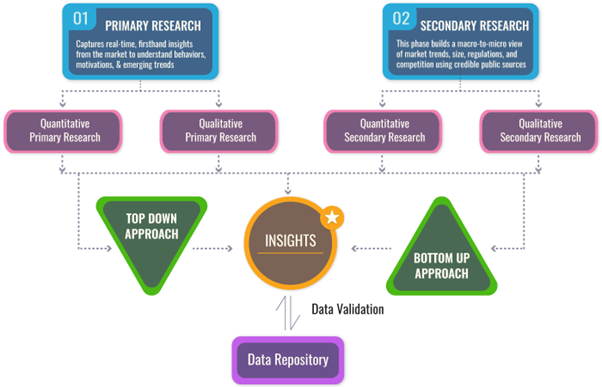
DUAL MODELING: TOP-DOWN + BOTTOM-UP
To ensure robust market estimation, we apply two complementary sizing approaches:
Top-Down Modeling:- Start with broader industry value (e.g., global or regional TAM)
- Apply filters by segment, geography, end-user, or use case
- Adjust with primary insights and validation benchmarks
- Ideal for investor-grade market scans and opportunity mapping
- Aggregate from the ground up using sales volumes, pricing, and unit economics
- Use internal modeling templates aligned with stakeholder data
- Incorporate distributor-level or region-specific inputs
- Most accurate for emerging segments and granular sub-markets
DATA VALIDATION: IN-HOUSE REPOSITORY
We close the loop with proprietary data intelligence built from ongoing projects, industry monitoring, and historical benchmarking. This repository includes:
- Multi-sector market and pricing models
- Key trendlines from past interviews and forecasts
- Benchmarked adoption rates, churn patterns, and ROI indicators
- Industry-specific deviation flags and cross-check logic
- Catches inconsistencies early
- Aligns projections across studies
- Enables consistent, high-trust deliverables