
Urinary Incontinence Therapeutics Market Size and Forecast (2026–2034), Global and Regional Growth, Trend, Share and Industry Analysis Report Coverage: By Type (Stress Incontinence, Urge Incontinence, Overflow Incontinence, Functional Incontinence, and Other Types), By Drug Class (Anticholinergics, β3-Adrenoceptor Agonists, Estrogen Therapy, Desmopressin, Tricyclic Antidepressants, Alpha Blockers, and Other Drug Classes), By Gender (Male and Female), By Distribution Channel (Hospital Pharmacies, Retail Pharmacies, and Online Pharmacies) and Geography
2026-08-11
Healthcare
Swetal (Research Analyst)
Description
Urinary Incontinence Therapeutics
Market Overview
The Global Urinary Incontinence
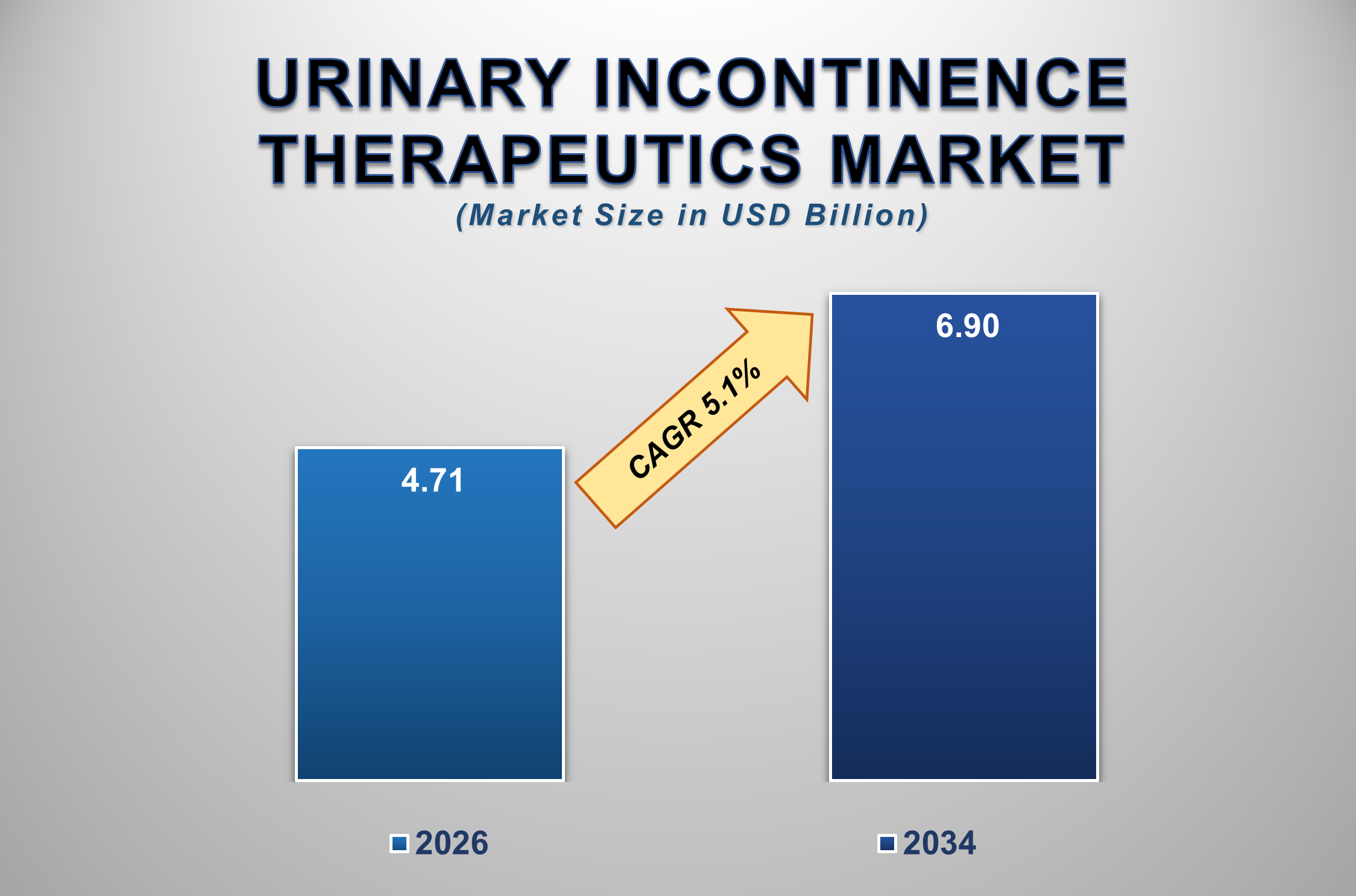
Therapeutics Market was valued at USD 4.71 Billion in 2026 and is projected to
reach USD 6.90 Billion by 2034, expanding at a CAGR of 5.1% during the forecast
period. The market for urinary incontinence treatment consists of drugs for the
treatment of various types of urinary incontinence, such as overflow, urge,
stress, and functional incontinence. The growth of the market is largely attributed
to the increasing occurrence of overactive bladder, the aging population, and
the rising number of the elderly suffering from neurological disorders and
benign prostatic hyperplasia (BPH), along with rising awareness, which causes
better diagnosis and treatment of the illness. The market consists of various
drug categories, such as anticholinergics, β3-adrenoceptor agonists,
desmopressin, topical estrogen, tricyclic antidepressants, and other supportive
medicines in order to combat the symptoms of this condition. The growth
prospects of the market will be enhanced by the developments in medicines,
appearance of new effective and safe therapies, better access to healthcare,
and introduction of generic medications on the market.
Urinary Incontinence Therapeutics
Market Drivers and Opportunities
Rising Prevalence of
Overactive Bladder and Urinary Incontinence Driving Market Growth
The growing number
of patients diagnosed with overactive bladder (OAB) and suffering from urinary
incontinence is a key reason for the growth of the market for urinary
incontinence therapeutics. As per The International Continence Society (ICS),
around 12% of the male and female population around the globe suffers from OAB.
As the population grows older, the incidence of OAB and its attendant
implications keep increasing, with approximately 70–80% of the patients facing
OAB reaching the age of 80. In addition to the predilection of the disease
affecting women, at least 33% of patients suffering from OAB report
experiencing urgency urinary incontinence, and 66% of patients report suffering
from OAB without the issue of urgency urinary incontinence. The growing elderly
population is coupled with the rising incidence of various medical conditions
such as neurological disorders, diabetes, and benign prostatic hyperplasia
(BPH), thus leading to an increased number of patients requiring long-term
treatment for OAB.
Growing Adoption
of Advanced Pharmacological Therapies Fueling Market Expansion
The rising adoption
of advanced pharmacological treatments is boosting the urinary incontinence
therapeutics market. Availability of new treatment options, particularly
β3-adrenoceptor agonists, has expanded the treatment options by providing
better symptom control with proven safety and tolerability when compared to
traditional anticholinergic therapies. In addition, new innovations, including
extended-release products and combination therapies, are contributing to better
compliance, patient comfort, and positive clinical results. Growing physician
inclination toward targeted therapies, increased awareness regarding urinary
incontinence treatment, and easy accessibility to modern drugs through evolving
healthcare systems are further supporting the adoption of advanced
pharmacological treatments, thereby leading to continuous growth of the market
globally.
Development of
Innovative Therapies with Improved Safety Profiles Creates Significant Growth
Opportunities
Opportunities
arising from the development of advanced therapies that have higher levels of
effectiveness and safety are some of the areas where growth potential for the
market is considerable. There is an increasing interest on the part of
pharmaceutical companies in developing next-generation therapies, selective
receptor-targeted drugs, and drug delivery formulations with reduced side
effects, and at the same time, providing continued relief from symptoms.
Moreover, innovations in combination therapies, long-acting drugs, and
customized therapeutic approaches may help in improving the compliance rates
amongst the patients. Increased demand for safe and more effective therapies,
especially amongst the geriatric population, will open up immense opportunities
for the market.
Urinary Incontinence Therapeutics
Market Scope
|
Report Attributes |
Description |
|
Market Size in 2026 |
USD 4.71 Billion |
|
Market Forecast in 2034 |
USD 6.90 Billion |
|
CAGR % 2026-2034 |
5.1% |
|
Base Year |
2025 |
|
Historic Data |
2021-2025 |
|
Forecast Period |
2026-2034 |
|
Report USP |
Pricing and Cost Structure Analysis, Product Innovation
Benchmarking, Whitespace Assessment, Company Share, Company Heatmap, Growth
Factors, and more |
|
Segments Covered |
●
By Type ●
By Drug
Class ●
By Gender ●
By
Distribution Channel |
|
Regional Scope |
●
North
America ●
Europe ●
APAC ●
Latin
America ●
Middle
East and Africa |
|
Country Scope |
●
U.S. ●
Canada ●
U.K. ●
Germany ●
France ●
Italy ●
Spain ●
Russia ●
China ●
India ●
Japan ●
South
Korea ●
Australia
●
Mexico ●
Brazil ●
Saudi
Arabia ●
UAE ●
South
Africa
|
Urinary Incontinence Therapeutics
Market Report Segmentation Analysis
The global urinary
incontinence therapeutics market industry analysis is segmented by type, by
drug class, by gender, by distribution channel, and by region.
Urge
Incontinence Segment Is Expected to Dominate the Urinary Incontinence
Therapeutics Market During the Forecast Period
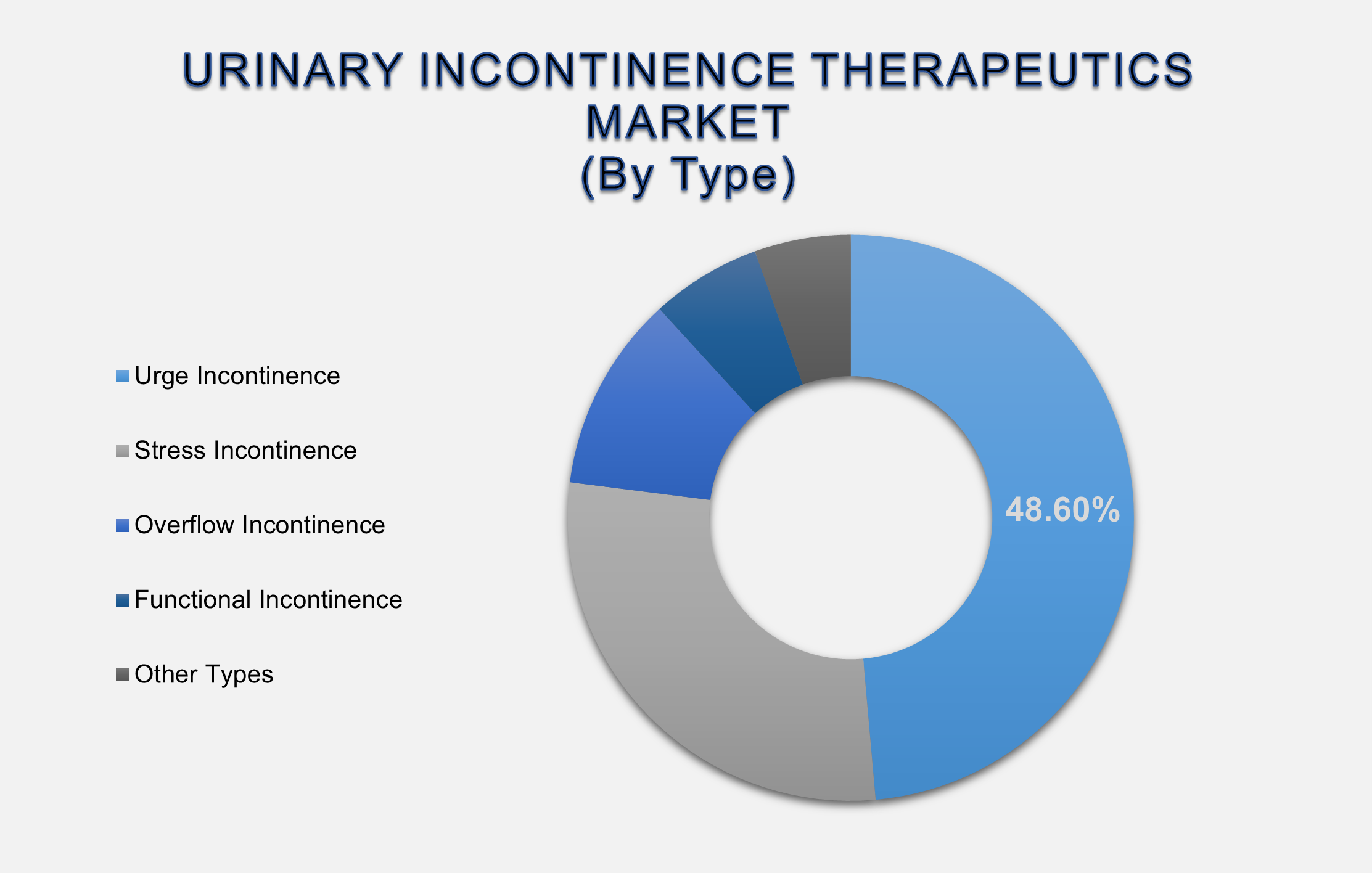
The urge
incontinence segment will capture the maximum share in the urinary incontinence
therapeutics market throughout the forecast period owing to the high prevalence
rate of overactive bladder (OAB) and wide availability of highly efficacious
drugs. As per an article published by the University of Texas Medical Branch in
March 2026, based on data provided by the National Health and Nutrition
Examination Survey (NHANES), 2021-2023, the crude prevalence rate of urinary
incontinence (UI) among women in the U.S. is 63%, which affects around 79.6
million women. Urgency incontinence is one of the most widely prevalent forms
of UI and is highly associated with OAB. Rising burden of the condition,
particularly among the geriatric population, coupled with increasing prevalence
rate and rising consumption of highly efficacious drugs such as β3-adrenoceptor
agonists and anticholinergics, is driving the growth in pharmacological
treatment of the condition. Moreover, product launches and increasing awareness
about OAB treatments will continue to drive the dominance of the urge
incontinence segment during the forecast period.
Anticholinergics
Segment Is Expected to Lead the Urinary Incontinence Therapeutics Market by
Drug Class
The
anticholinergics segment will hold the largest market share in the global
urinary incontinence therapeutics market during the forecast period. The
medicines are mainly used in the treatment of urge urinary incontinence with
OAB because they have the capability of reducing the action potential of
acetylcholine, and hence they are able to control urge and the leakage of
urine. Due to the wide array of treatments available for managing OAB, both
generic and branded anticholinergics are extensively used. Besides, the high
confidence that doctors have in these drugs, in addition to their efficacy in
clinical settings and their presence in treatment guidelines, will enhance the
growth of the segment. While beta 3-adrenergic agonists are increasingly
becoming the drug of choice for treating OAB due to increasing incidences of
the disease, their high costs and lesser acceptance compared to
anticholinergics will hinder their growth potential during the forecast period.
On the other hand, the popularity, availability, and low-cost aspects of
anticholinergics will boost their use, which in turn will fuel the market
growth during the forecast.
Female Segment
Is Expected to Lead the Urinary Incontinence Therapeutics Market by Gender
The female gender
is expected to continue dominating the urinary incontinence therapeutics
market, driven by the prevalence rate of urinary incontinence being higher in
females than males. Risk factors like pregnancy, childbirth, menopause,
weakening of the pelvic muscles, and changes in hormone levels are responsible
for increasing the vulnerability of stress and urge urinary incontinence in
women. Moreover, the increasing number of aged females and obesity and chronic
diseases that affect bladder function among women have been increasing the
number of patients requiring pharmacological treatment. Awareness about urinary
health and improved diagnosis and treatment rates of urinary incontinence among
women have been contributing to the growth of the market. There are various
drugs available for the treatment of the disorder, including anticholinergics,
β3 adrenergic agonists, topical estrogen treatment, and others.
Hospital
Pharmacies Segment Is Expected to Lead the Urinary Incontinence Therapeutics
Market by Distribution Channel
Hospital pharmacies
will represent the leading segment on the basis of distribution channel in the
urinary incontinence therapeutics market during the forecast period. The
primary reason for this is that hospitals and specialty departments such as
urology and gynecology are responsible for issuing a large number of
prescriptions because the patients at such facilities undergo a comprehensive
diagnosis and personalized treatment options. Hospital pharmacies are
responsible for distributing prescribed drugs for conditions such as overactive
bladder (OAB) and other types of urinary incontinence, especially for those
patients suffering from severe symptoms, multiple diseases, or those who
require specialized treatment. Moreover, the rising number of hospital visits
from the aging population and advanced treatment options are expected to propel
the segment's growth in the future. Positive reimbursement trends in most
developed countries and a wide range of branded and specialty drugs available
at hospitals are expected to contribute to the dominant position of the segment
during the forecast period.
The following
segments are part of an in-depth analysis of the global urinary incontinence
therapeutics market:
|
Market Segments |
|
|
By Type |
●
Stress
Incontinence ●
Urge
Incontinence ●
Overflow Incontinence ●
Functional
Incontinence ●
Other Types |
|
By Drug Class |
●
Anticholinergics ●
β3-Adrenoceptor
Agonists ●
Estrogen
Therapy ●
Desmopressin ●
Tricyclic
Antidepressants ●
Alpha
Blockers ●
Other Drug
Classes |
|
By Gender |
●
Male ●
Female |
|
By Distribution Channel |
●
Hospital
Pharmacies ●
Retail
Pharmacies ●
Online
Pharmacies |
Urinary Incontinence Therapeutics
Market Share Analysis by Region
North America is
projected to hold the largest share of the global urinary incontinence
therapeutics market over the forecast period
The largest share
of the global market for therapeutics used in urinary incontinence during the
forecast period will be held by North America. There are several reasons behind
the leading role of the region, including the high prevalence of urinary incontinence
and OAB, a solid healthcare infrastructure, positive reimbursement policies,
and the rapid penetration of novel drug therapies. The presence of leading
pharmaceutical companies, a variety of clinical studies, and efficient
regulatory machinery also play an important role in the growth of the market.
The growth is further stimulated by the introduction of new products that lead
to the expansion of therapeutic use among patients. For example, Sumitomo
Pharma America, Inc. announced in December 2024 that its drug GEMTESA was
approved by the U.S. Food and Drug Administration for the treatment of male OAB
patients experiencing UI, urgency, and frequency due to BPH treatment. This
opened the door for more widespread use of GEMTESA and contributed to making innovative
β3-adrenergic receptor agonist drugs more accessible on the market.
Urinary
Incontinence Therapeutics Market Competition Landscape Analysis
The urinary
incontinence therapeutics market is a highly competitive arena for players
across various categories. These include companies developing proprietary
pharmaceuticals, generics, and pharmaceutical innovators engaged in the
formulation of advanced treatment methodologies for urinary incontinence and
overactive bladder (OAB). Currently, all market players are striving to
increase their medication portfolios by advertising new pharmacological
preparations and innovative treatment modalities aimed at the further
improvement of medication efficacy, safety, and medication adherence.
Organizations are allocating funds to R&D initiatives related to developing
next-generation β3-adrenergic receptor agonists, advanced anticholinergic
therapies, mixed treatment options, and pipeline products aimed at satisfying
unmet market needs. Competition becomes even more intense with the introduction
of new products, approval of new medications by authorizing agencies, patent
expiry leading to the emergence of generics, as well as mergers, acquisitions,
licensing, and collaboration agreements which facilitate R&D investments to
update product portfolios and expand presence in the global urinary
incontinence therapeutics market.
Global Urinary
Incontinence Therapeutics Market Recent Developments News:
●
In May 2026 -
KYORIN Pharmaceutical Co., Ltd. reported advancement of KRP-114VP
(Beova/vibegron) into Phase III development in Japan for an additional
pediatric overactive bladder indication.
●
In July 2025 -
Eisai Co., Ltd. launched Beova (vibegron) in Thailand, marking the first
commercial launch under its ASEAN licensing agreement for overactive bladder
treatment.
The global
urinary incontinence therapeutics market is dominated by a few large companies,
such as
●
Pfizer Inc.
●
AbbVie Inc.
●
Amneal Pharmaceuticals, Inc.
●
Astellas Pharma Inc.
●
Bayer AG
●
Dr. Reddy's Laboratories Ltd.
●
Ferring Pharmaceuticals
●
Hikma Pharmaceuticals PLC
●
Lupin Limited
●
Sanofi S.A.
●
Sumitomo Pharma Co., Ltd.
●
Sun Pharmaceutical Industries Ltd.
●
Teva Pharmaceutical Industries Ltd.
●
Viatris Inc.
●
Zydus Lifesciences Ltd.
● Other Prominent Players
Frequently Asked Questions
Swetal (Research Analyst)
Swetal is a Research Analyst with 4+ years of experience specializing in healthcare market research, medical devices, healthcare IT, and medical technology industry analysis. Her expertise includes competitive intelligence, secondary research, market trend forecasting, and healthcare business insights across global healthcare ecosystems.
She contributes to advanced market research reports by analyzing regulatory frameworks, emerging healthcare technologies, competitive landscapes, and innovation trends shaping the medical industry. With a strong focus on accurate market intelligence, strategic insights, and healthcare industry trends, Swetal supports businesses in making informed, data-backed decisions in a rapidly transforming healthcare environment.
1.
Global
Urinary Incontinence Therapeutics Market Introduction and Market Overview
1.1. Objectives of the Study
1.2. Market Segmentation
1.2.1.Type of the Global Urinary
Incontinence Therapeutics Market
1.2.2.Drug Class of the Global Urinary
Incontinence Therapeutics Market
1.2.3.Gender of the Global Urinary
Incontinence Therapeutics Market
1.2.4.Distribution Channel of the
Global Urinary Incontinence Therapeutics Market
1.2.5.Region of the Global Urinary
Incontinence Therapeutics Market
1.3. Competition Coverage List of
Market Participants
1.4. Market Definition: Urinary
Incontinence Therapeutics Market
2.
Executive Summary
2.1. Global Urinary Incontinence
Therapeutics Market Estimation & Forecast
2.1.1.Global Urinary Incontinence
Therapeutics Market Size (US$ Million) Estimates & Historical Trend
Analysis (2021 - 2025)
2.1.2.Global Urinary Incontinence
Therapeutics Overall Market Size (US$ Million), Growth Rate (Y-o-Y), Market
CAGR (%), Market Forecast (2026 - 2034)
2.2. Snapshot of Global Urinary
Incontinence Therapeutics Market
2.3. Global Urinary Incontinence
Therapeutics Market Revenue Share (%) 2025
2.4. REGIONAL OUTLINE: Revenue CAGR,
by Region
2.5. Key Competitors & Key
Insights
3.
Market Overview (Qualitative
Analysis)
3.1. Demand Side Trends
3.2. Supply Side Trends /
Manufacturing Trends
3.3. Demand and Opportunity
Assessment, 2026 - 2034
3.4. Market Dynamics
3.4.1.Drivers
3.4.2.Limitations
3.4.3.Opportunities
3.4.4.Impact Analysis of Drivers and
Restraints
3.5. Key Developments
3.6. Regulatory Landscape
3.7. Pricing Analysis
3.8. Supply Chain Analysis
3.9. Porter’s Five Forces Analysis
3.9.1.Bargaining Power of Suppliers
3.9.2.Bargaining Power of Buyers
3.9.3.Threat of Substitutes
3.9.4.Threat of New Entrants
3.9.5.Competitive Rivalry
3.10. PEST Analysis
3.10.1. Political Factors
3.10.2. Economic Factors
3.10.3. Social Factors
3.10.4. Technology Factors
4.
Global Urinary Incontinence
Therapeutics Market Estimates & Forecast Trend Analysis, by Type
4.1. Global Urinary Incontinence
Therapeutics Market Assessments & Key Findings, by Type
4.2. Global Urinary Incontinence
Therapeutics Market Revenue (US$ Million) Estimates and Forecasts, by Type,
2021 - 2034
4.2.1.Stress Incontinence
4.2.2.Urge Incontinence
4.2.3.Overflow Incontinence
4.2.4.Functional Incontinence
4.2.5.Other Types
5.
Global Urinary Incontinence
Therapeutics Market Estimates & Forecast Trend Analysis, by Drug Class
5.1. Global Urinary Incontinence
Therapeutics Market Assessments & Key Findings, by Drug Class
5.2. Global Urinary Incontinence
Therapeutics Market Revenue (US$ Million) Estimates and Forecasts, by Drug
Class, 2021 - 2034
5.2.1.Anticholinergics
5.2.2.β3-Adrenoceptor Agonists
5.2.3.Estrogen Therapy
5.2.4.Desmopressin
5.2.5.Tricyclic Antidepressants
5.2.6.Alpha Blockers
5.2.7.Other Drug Classes
6.
Global Urinary Incontinence
Therapeutics Market Estimates & Forecast Trend Analysis, by Gender
6.1. Global Urinary Incontinence
Therapeutics Market Assessments & Key Findings, by Gender
6.2. Global Urinary Incontinence
Therapeutics Market Revenue (US$ Million) Estimates and Forecasts, by Gender,
2021 - 2034
6.2.1.Male
6.2.2.Female
7.
Global Urinary Incontinence
Therapeutics Market Estimates & Forecast Trend Analysis, by Distribution
Channel
7.1. Global Urinary Incontinence
Therapeutics Market Assessments & Key Findings, by Distribution Channel
7.2. Global Urinary Incontinence
Therapeutics Market Revenue (US$ Million) Estimates and Forecasts, by Distribution
Channel, 2021 - 2034
7.2.1.Hospital Pharmacies
7.2.2.Retail Pharmacies
7.2.3.Online Pharmacies
8.
Global Urinary Incontinence
Therapeutics Market Estimates & Forecast Trend Analysis, by Region
8.1.
Global
Urinary Incontinence Therapeutics Market Assessments & Key Findings, by
Region
8.2.
Global
Urinary Incontinence Therapeutics Market Revenue (US$ Million) Estimates and
Forecasts, by Region, 2021 - 2034
8.2.1.North America
8.2.2.Europe
8.2.3.Asia Pacific
8.2.4.Middle East & Africa
8.2.5.Latin America
9.
North
America Urinary Incontinence Therapeutics Market: Estimates & Forecast Trend Analysis
9.1. North America Urinary
Incontinence Therapeutics Market Assessments & Key Findings
9.1.1.North America Urinary
Incontinence Therapeutics Market Introduction
9.1.2.North America Urinary
Incontinence Therapeutics Market Size Estimates and Forecast (US$ Million)
(2021 - 2034)
9.1.2.2. By Drug Class
9.1.2.3. By Gender
9.1.2.4. By Distribution Channel
9.1.2.5. By Country
9.1.2.5.1. The U.S.
9.1.2.5.2. Canada
10. Europe Urinary
Incontinence Therapeutics Market:
Estimates & Forecast Trend Analysis
10.1. Europe Urinary Incontinence
Therapeutics Market Assessments & Key Findings
10.1.1. Europe Urinary Incontinence
Therapeutics Market Introduction
10.1.2. Europe Urinary Incontinence
Therapeutics Market Size Estimates and Forecast (US$ Million) (2021 - 2034)
10.1.2.1. By Type
10.1.2.2. By Drug Class
10.1.2.3. By Gender
10.1.2.4. By Distribution Channel
10.1.2.5. By Country
10.1.2.5.1.
Germany
10.1.2.5.2.
Italy
10.1.2.5.3.
U.K.
10.1.2.5.4.
France
10.1.2.5.5.
Spain
10.1.2.5.6.
Switzerland
10.1.2.5.7. Rest
of Europe
11. Asia Pacific Urinary
Incontinence Therapeutics Market:
Estimates & Forecast Trend Analysis
11.1. Asia Pacific Market Assessments
& Key Findings
11.1.1. Asia Pacific Urinary
Incontinence Therapeutics Market Introduction
11.1.2. Asia Pacific Urinary
Incontinence Therapeutics Market Size Estimates and Forecast (US$ Million)
(2021 - 2034)
11.1.2.1. By Type
11.1.2.2. By Drug Class
11.1.2.3. By Gender
11.1.2.4. By Distribution Channel
11.1.2.5. By Country
11.1.2.5.1. China
11.1.2.5.2. Japan
11.1.2.5.3. India
11.1.2.5.4. Australia
11.1.2.5.5. South Korea
11.1.2.5.6. Rest of Asia Pacific
12. Middle East & Africa Urinary
Incontinence Therapeutics Market: Estimates
& Forecast Trend Analysis
12.1. Middle East & Africa Market
Assessments & Key Findings
12.1.1. Middle
East & Africa Urinary
Incontinence Therapeutics Market Introduction
12.1.2. Middle
East & Africa Urinary
Incontinence Therapeutics Market Size Estimates and Forecast (US$ Million)
(2021 - 2034)
12.1.2.1. By Type
12.1.2.2. By Drug Class
12.1.2.3. By Gender
12.1.2.4. By Distribution Channel
12.1.2.5. By Country
12.1.2.5.1. South Africa
12.1.2.5.2. UAE
12.1.2.5.3. Saudi Arabia
12.1.2.5.4. Rest of MEA
13. Latin America
Urinary Incontinence Therapeutics Market:
Estimates & Forecast Trend Analysis
13.1. Latin America Market Assessments
& Key Findings
13.1.1. Latin America Urinary
Incontinence Therapeutics Market Introduction
13.1.2. Latin America Urinary
Incontinence Therapeutics Market Size Estimates and Forecast (US$ Million)
(2021 - 2034)
13.1.2.1. By Type
13.1.2.2. By Drug Class
13.1.2.3. By Gender
13.1.2.4. By Distribution Channel
13.1.2.5. By Country
13.1.2.5.1. Brazil
13.1.2.5.2. Mexico
13.1.2.5.3. Argentina
13.1.2.5.4. Rest of LATAM
14. Competition Landscape
14.1. Global Urinary Incontinence
Therapeutics Market Product Mapping
14.2. Global Urinary Incontinence
Therapeutics Market Concentration Analysis, by Leading Players / Innovators /
Emerging Players / New Entrants
14.3. Global Urinary Incontinence
Therapeutics Market Tier Structure Analysis
14.4. Global Urinary Incontinence
Therapeutics Market Concentration & Company Market Shares (%) Analysis,
2025
15. Company Profiles
15.1. Pfizer Inc.
15.1.1. Company Overview & Key Stats
15.1.2. Financial Performance & KPIs
15.1.3. Product Portfolio
15.1.4. SWOT Analysis
15.1.5. Business Strategy & Recent
Developments
* Similar details would be provided
for all the players mentioned below
15.2. AbbVie Inc.
15.3. Amneal Pharmaceuticals, Inc.
15.4. Astellas Pharma Inc.
15.5. Bayer AG
15.6. Dr. Reddy's Laboratories Ltd.
15.7. Ferring Pharmaceuticals
15.8. Hikma Pharmaceuticals PLC
15.9. Lupin Limited
15.10. Sanofi S.A.
15.11. Sumitomo Pharma Co., Ltd.
15.12. Sun Pharmaceutical Industries
Ltd.
15.13. Teva Pharmaceutical Industries
Ltd.
15.14. Viatris Inc.
15.15. Zydus Lifesciences Ltd.
15.16. Other Prominent Players
16. Research
Findings & Conclusion
17. Assumptions & Acronyms Used
18. Research
Methodology
18.1. External Transportation /
Databases
18.2. Internal Proprietary Database
18.3. Primary Research
18.4. Secondary Research
18.5. Assumptions
18.6. Limitations
18.7. Report FAQs
Our Research Methodology
"Insight without rigor is just noise."
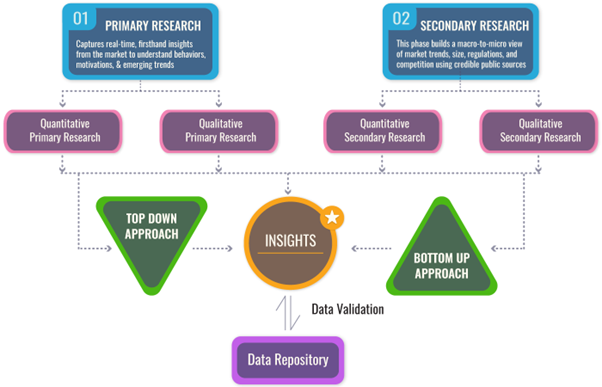
We follow a comprehensive, multi-phase research framework designed to deliver accurate, strategic, and decision-ready intelligence. Our process integrates primary and secondary research , both quantitative and qualitative , along with dual modeling techniques ( top-down and bottom-up) and a final layer of validation through our proprietary in-house repository.
PRIMARY RESEARCH
Primary research captures real-time, firsthand insights from the market to understand behaviors, motivations, and emerging trends.
1. Quantitative Primary Research
Objective: Generate statistically significant data directly from market participants.
Approaches:- Structured surveys with customers, distributors, and field agents
- Mobile-based data collection for point-of-sale audits and usage behavior
- Phone-based interviews (CATI) for market sizing and product feedback
- Online polling around industry events and digital campaigns
- Purchase frequency by customer type
- Channel performance across geographies
- Feature demand by application or demographic
2. Qualitative Primary Research
Objective: Explore decision-making drivers, pain points, and market readiness.
Approaches:- In-depth interviews (IDIs) with executives, product managers, and key decision-makers
- Focus groups among end users and early adopters
- Site visits and observational research for consumer products
- Informal field-level discussions for regional and cultural nuances
SECONDARY RESEARCH
This phase helps establish a macro-to-micro understanding of market trends, size, regulation, and competitive dynamics, sourced from credible and public domain information.
1. Quantitative Secondary Research
Objective: Model market value and segment-level forecasts based on published data.
Sources include:- Financial reports and investor summaries
- Government trade data, customs records, and regulatory statistics
- Industry association publications and economic databases
- Channel performance and pricing data from marketplace listings
- Revenue splits, pricing trends, and CAGR estimates
- Supply-side capacity and volume tracking
- Investment analysis and funding benchmarks
2. Qualitative Secondary Research
Objective: Capture strategic direction, innovation signals, and behavioral trends.
Sources include:- Company announcements, roadmaps, and product pipelines
- Publicly available whitepapers, conference abstracts, and academic research
- Regulatory body publications and policy briefs
- Social and media sentiment scanning for early-stage shifts
- Strategic shifts in market positioning
- Unmet needs and white spaces
- Regulatory triggers and compliance impact
DUAL MODELING: TOP-DOWN + BOTTOM-UP
To ensure robust market estimation, we apply two complementary sizing approaches:
Top-Down Modeling:- Start with broader industry value (e.g., global or regional TAM)
- Apply filters by segment, geography, end-user, or use case
- Adjust with primary insights and validation benchmarks
- Ideal for investor-grade market scans and opportunity mapping
- Aggregate from the ground up using sales volumes, pricing, and unit economics
- Use internal modeling templates aligned with stakeholder data
- Incorporate distributor-level or region-specific inputs
- Most accurate for emerging segments and granular sub-markets
DATA VALIDATION: IN-HOUSE REPOSITORY
We close the loop with proprietary data intelligence built from ongoing projects, industry monitoring, and historical benchmarking. This repository includes:
- Multi-sector market and pricing models
- Key trendlines from past interviews and forecasts
- Benchmarked adoption rates, churn patterns, and ROI indicators
- Industry-specific deviation flags and cross-check logic
- Catches inconsistencies early
- Aligns projections across studies
- Enables consistent, high-trust deliverables