

US Cloud Kitchen Market Size and Forecast (2026–2034), Regional Growth, Trend, Share and Industry Analysis Report Coverage: By Source of Order (Web and Mobile App), By Payment Method (Cash on Delivery, Mobile Wallet, Card Transaction and Others)
2026-09-09
ICT
Ekta Chaurasia (Team Lead)
Description
US Cloud Kitchen
Market Overview
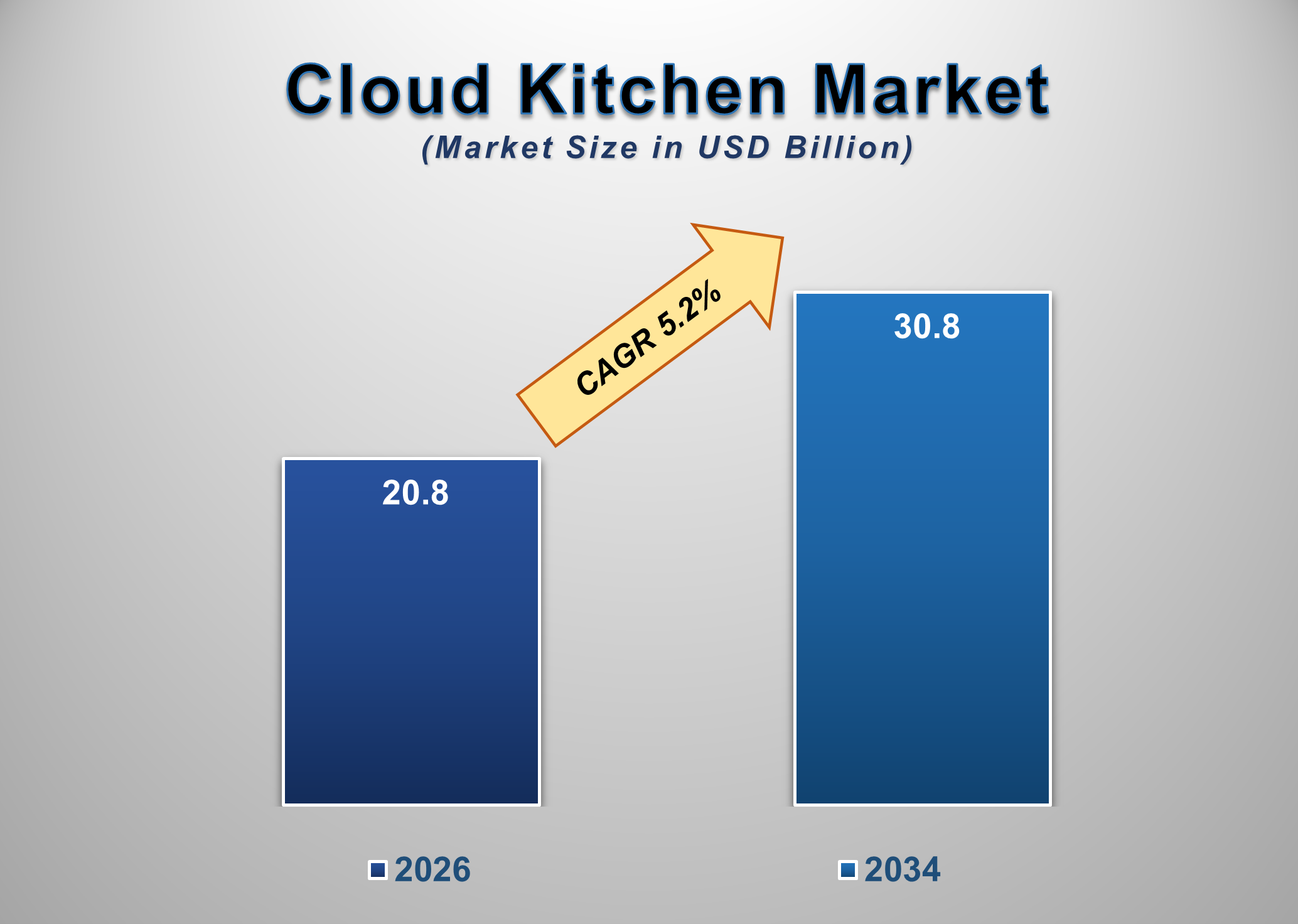
The US Cloud Kitchen Market Size is projected to Expand from USD 20.8 Billion in 2026 to USD 30.8 Billion by 2034, registering a CAGR of 5.2% during 2026–2034. The market is developing as the U.S. foodservice industry increasingly integrates digital ordering, third-party delivery platforms, virtual restaurant brands, delivery-only concepts, and technology-enabled kitchen infrastructure. Cloud kitchens, also referred to as ghost kitchens or virtual kitchens, operate without a conventional dine-in format and primarily prepare food for delivery, pickup, or digital ordering channels.
The U.S. market has evolved beyond the
early concept of shared commercial kitchens. The industry now includes multiple
business models, including dedicated delivery-only kitchens, multi-brand
kitchen facilities, virtual restaurant concepts, restaurant-as-a-service
platforms, and hybrid operators combining physical food preparation with
proprietary technology and digital ordering systems. Companies can use cloud
kitchen infrastructure to enter new geographic markets, test menu concepts,
launch virtual brands, and increase production capacity without investing in
traditional restaurant dining space. The growth of mobile food ordering remains
central to the market's development. Consumers increasingly expect convenient
access to restaurant meals through mobile applications and digital platforms,
creating a favorable environment for delivery-focused foodservice models.
Third-party delivery companies have also expanded their role beyond logistics,
increasingly participating in virtual restaurant ecosystems, merchant services,
order management, and digital customer acquisition. The U.S. cloud kitchen
market is also characterized by a transition toward more sustainable business
models. Early industry expansion was heavily influenced by rapid delivery
growth and aggressive investment in ghost kitchen infrastructure. However, operators
are increasingly focusing on kitchen utilization, unit economics, order
density, menu optimization, delivery radius, and profitability. As a result,
the future market is expected to favor operators with strong technology
capabilities, established restaurant relationships, high kitchen utilization,
and access to large digital customer bases.
US
Cloud Kitchen Market Growth Drivers
Rising Digital Food Ordering and
Mobile Application Usage Are Supporting Cloud Kitchen Expansion
The increasing use of digital
platforms for restaurant ordering is a major driver of the U.S. cloud kitchen
market. Consumers are increasingly using mobile applications and websites to
browse menus, compare restaurants, place orders, make digital payments, and
track deliveries. This transition has created a large addressable market for
foodservice operators that do not require traditional dine-in infrastructure.
Cloud kitchens are designed specifically to benefit from this digital ordering
environment. Unlike conventional restaurants, cloud kitchen operators can
concentrate investment on food preparation, packaging, kitchen operations,
technology, and delivery coordination. This reduces the need for expensive
dining areas and allows operators to focus on high-demand delivery locations.
Mobile applications are particularly
important because they enable customers to access multiple restaurant brands
through a single interface. Delivery platforms also provide cloud kitchens with
access to customer data, digital marketing tools, order-management systems, and
delivery networks. The growth of digital ordering is also encouraging
restaurants to develop virtual brands. An existing restaurant can use excess
kitchen capacity to operate additional digital-only concepts targeting
different customer segments. This model can improve kitchen utilization and
allow operators to experiment with new cuisines and menu formats without
establishing a separate physical restaurant.
Restaurant Operators Are Increasingly
Seeking Asset-Light Expansion and Lower-Cost Market Entry
The high cost of establishing and
operating traditional restaurants is creating demand for more asset-light
foodservice models. A conventional restaurant requires expenditure on real
estate, dining areas, furniture, customer-facing staff, utilities, interior
design, and other infrastructure. Cloud kitchens can reduce a portion of these
requirements by eliminating or minimizing dine-in facilities. This model can be
particularly attractive in major U.S. metropolitan areas where commercial real
estate costs are high. Restaurant brands can enter new delivery markets through
shared or dedicated kitchen facilities rather than investing in a complete
restaurant location. Cloud kitchens can also provide flexibility for food
entrepreneurs and emerging restaurant brands. Operators can test concepts,
evaluate customer demand, modify menus, and expand into new geographic markets
with lower initial investment. Multi-brand operators can further improve
economics by using centralized kitchen infrastructure to support multiple
virtual restaurant concepts.
As the restaurant industry
increasingly focuses on operational efficiency and profitability, cloud
kitchens are expected to remain relevant as an alternative expansion model.
However, successful deployment will increasingly depend on order density, efficient
delivery operations, strong brand recognition, and sustainable unit economics.
US Cloud Kitchen Market Restraint
High Dependence on Third-Party
Platforms and Delivery Economics Can Pressure Profitability
A major restraint facing the U.S.
cloud kitchen market is dependence on third-party delivery platforms. Cloud
kitchen operators frequently rely on digital marketplaces to acquire customers
and generate orders. Delivery commissions, promotional expenses, technology
fees, discounts, refunds, and customer-acquisition costs can reduce restaurant
margins.
Cloud kitchens also face intense
competition on digital platforms, where consumers can compare numerous restaurants
and virtual brands. Maintaining visibility may require promotional spending and
discounted offers. In addition, food quality can be affected by delivery time
and transportation conditions. Consequently, operators must carefully manage
menu design, packaging, kitchen efficiency, delivery distance, and platform
costs to maintain profitability.
US Cloud Kitchen Market Opportunities
Multi-Brand Virtual Restaurants Can
Improve Kitchen Utilization and Revenue Generation
Multi-brand operations represent an
important opportunity for the U.S. cloud kitchen market. A single kitchen can
prepare food for several restaurant brands, allowing operators to utilize the
same infrastructure, equipment, employees, and production capacity across
multiple concepts. This model enables companies to target different consumer
preferences without establishing separate physical restaurants. For example,
one facility can support concepts specializing in burgers, pizza, Asian
cuisine, healthy meals, desserts, and other categories.
Virtual brands can also be developed
using existing restaurant kitchens. This provides restaurant operators with an
opportunity to generate additional revenue from unused capacity while testing
new food concepts. Companies such as Nextbite, Franklin Junction, and Virtual
Dining Concepts have supported the development and expansion of virtual
restaurant brands and digital foodservice concepts. Going forward, data
analytics and artificial intelligence can further improve multi-brand
operations. Operators can analyze local ordering patterns, customer
preferences, peak ordering periods, and cuisine demand to optimize menus and
determine which brands should operate from specific kitchen locations.
Technology-Enabled Integrated
Foodservice Platforms Can Create New Growth Opportunities
The market is increasingly moving
toward integrated foodservice ecosystems combining kitchen infrastructure,
ordering technology, logistics, digital marketing, payments, and restaurant
operations. This creates opportunities for companies that can provide more than
physical kitchen space.
Cloud kitchen operators can
increasingly differentiate through technology platforms that optimize order
processing, inventory management, kitchen workflows, delivery coordination, and
customer engagement. Integration with mobile applications and digital payment
systems can further improve operational efficiency. Companies with established
technology and logistics capabilities may benefit from this transition.
DoorDash Kitchens and Uber Eats/Uber Direct's broader virtual kitchen
ecosystem, for example, represent the increasing connection between digital
ordering platforms and foodservice infrastructure.
The future opportunity may also
include hybrid concepts. Companies can combine cloud kitchens with pickup
locations, food halls, retail partnerships, and centralized production
facilities. This approach can diversify revenue sources while reducing dependence
on a single delivery-only business model.
US Cloud Kitchen Market Scope
|
Report Attributes |
Description |
|
Market Size in 2026 |
USD 20.8 Billion |
|
Market Forecast in 2034 |
USD 30.8
Billion |
|
CAGR % 2026-2034 |
5.2% |
|
Base Year |
2025 |
|
Historic Data |
2021-2025 |
|
Forecast Period |
2026-2034 |
|
Report USP |
Production, Consumption, company share, company
heatmap, company production capacity, growth factors and more |
|
Geography |
United
States |
|
By Source of Order |
Web, Mobile App |
|
By Payment Method |
Cash on
Delivery, Mobile Wallet, Card Transaction, Others |
|
Key Players |
CloudKitchens; Kitchen United; REEF Technology;
Nextbite; Ghost Kitchen Brands; C3 (Creating Culinary Communities); Wonder;
DoorDash Kitchens; Uber Eats / Uber Direct Virtual Kitchen Ecosystem;
Franklin Junction; Virtual Dining Concepts; Ghost Kitchen Orlando |
US Cloud Kitchen Market Report Segmentation
Analysis
Mobile App Segment Is Expected to
Dominate the U.S. Cloud Kitchen Market During the Forecast Period
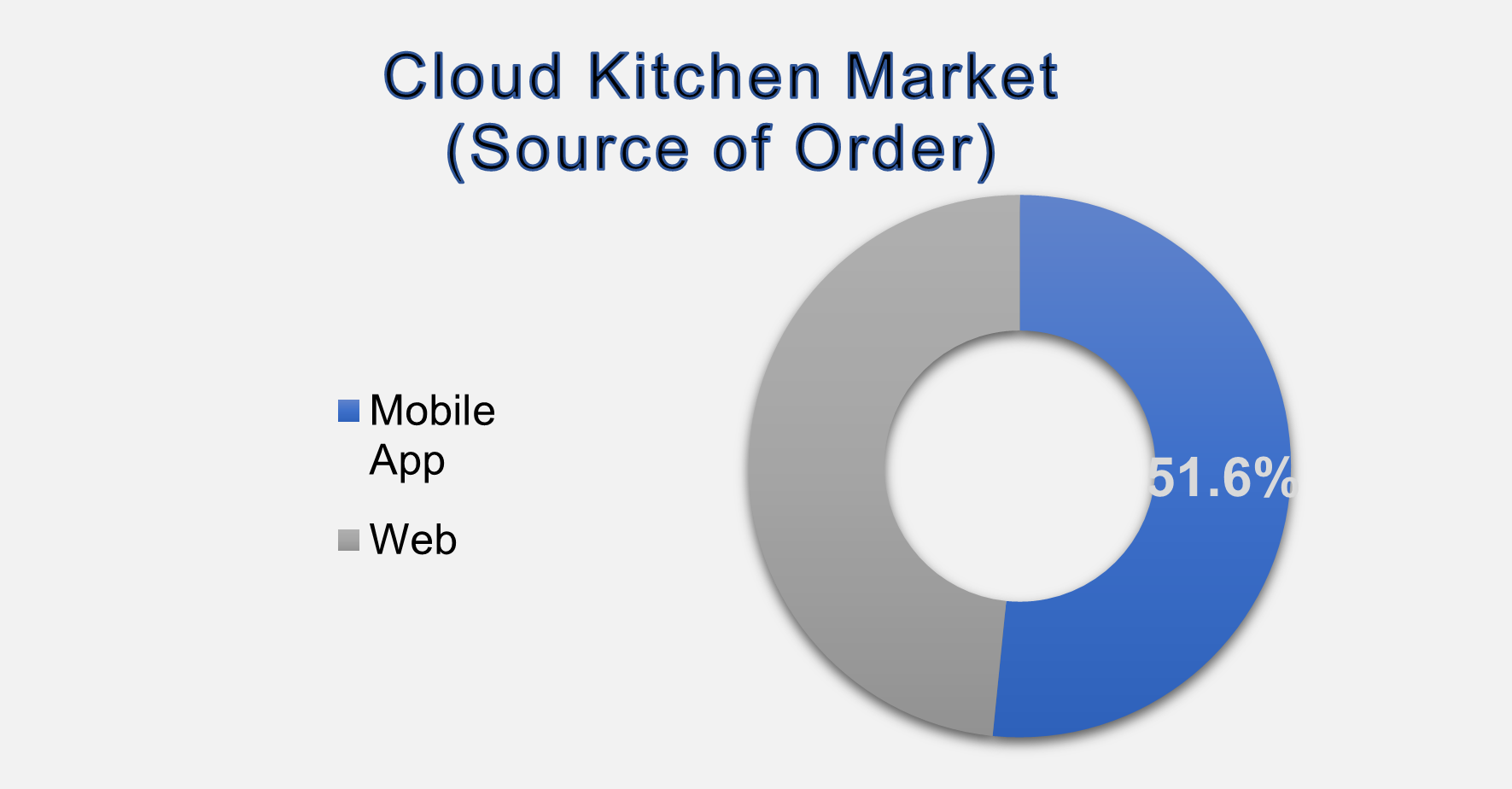
The U.S. Cloud Kitchen Market is segmented by source of order into Web and Mobile App. The Mobile App segment is expected to dominate the market during the forecast period, supported by the increasing use of smartphones for food discovery, restaurant selection, order placement, payment, and delivery tracking. Mobile applications provide customers with convenience and immediate access to multiple restaurant brands. Food delivery platforms also use applications to provide personalized recommendations, promotional offers, real-time delivery tracking, and digital payment options. These capabilities are expected to support the continued dominance of mobile application-based ordering.
The Web segment is expected to
maintain demand, particularly among customers placing orders through restaurant
websites and desktop-based platforms. Web ordering can also remain relevant for
corporate orders, group orders, and direct-to-consumer restaurant transactions.
However, mobile applications are expected to remain the primary growth engine
because of increasing smartphone penetration and consumer preference for
app-based convenience.
Card Transaction Segment Is Expected
to Dominate the U.S. Cloud Kitchen Market During the Forecast Period
The market is segmented by payment
method into Cash on Delivery, Mobile Wallet, Card Transaction, and Others. Card
Transaction is expected to dominate the U.S. market, supported by the
widespread use of credit and debit cards for online food ordering. Digital food
delivery platforms are primarily designed around cashless transactions, making
cards a highly convenient payment method for consumers. Card payments can be
integrated directly into mobile applications and websites, supporting fast and
secure transactions.
Mobile Wallet is expected to witness
increasing adoption as consumers increasingly use smartphone-based payment
systems. Digital wallets can provide faster checkout and greater integration
with mobile ordering applications. Cash on Delivery is expected to have
comparatively limited relevance in the U.S. digital food delivery ecosystem
because of the strong preference for electronic payments. Others include
alternative digital payment methods and emerging payment solutions.
The
following segments are part of an in-depth analysis of the U.S. Cloud Kitchen
Market:
|
Market Segments |
|
|
By
Source of Order |
· Web
· Mobile
App |
|
By
Payment Method |
· Cash
on Delivery · Mobile
Wallet · Card
Transaction · Others |
US Cloud Kitchen Market Competition Landscape Analysis
The U.S. Cloud Kitchen Market features
a diverse competitive landscape comprising dedicated ghost kitchen operators,
shared commercial kitchen providers, virtual restaurant companies,
delivery-platform ecosystems, restaurant technology providers, and integrated
foodservice companies. The identified competitive landscape includes
CloudKitchens, Kitchen United, REEF Technology, Nextbite, Ghost Kitchen Brands,
C3 (Creating Culinary Communities), Wonder, DoorDash Kitchens, Uber Eats/Uber
Direct Virtual Kitchen Ecosystem, Franklin Junction, Virtual Dining Concepts,
and Ghost Kitchen Orlando.
Competition is based on kitchen
location, access to restaurant brands, technology capabilities, order volume,
kitchen utilization, geographic coverage, delivery integration, operational
efficiency, and unit economics. CloudKitchens and Kitchen United represent
dedicated kitchen infrastructure models, while companies such as Nextbite,
Franklin Junction, and Virtual Dining Concepts have focused on virtual
restaurant and digital brand strategies.
The competitive environment is also evolving as delivery platforms expand their influence across the foodservice value chain. DoorDash and Uber provide access to large digital customer bases, making platform integration an important strategic consideration for cloud kitchen operators.
US Cloud
Kitchen Market Recent Developments News:
·
March 2024 – Sam Nazarian acquired selected
Kitchen United intellectual property and ghost-kitchen assets, combining them
with C3 and elements of Nextbite to support the formation of the asset-light
digital restaurant platform Everybody Eats.
·
2024 – Kitchen United shifted away from its
previous physical-unit strategy, selling or closing facilities and focusing
more heavily on software and technology, reflecting the U.S. industry's broader
movement toward capital-efficient operating models.
·
2024 – REEF Technology continued restructuring
its business model after the rapid expansion of its delivery-focused
infrastructure, highlighting the importance of profitability and sustainable
utilization in the U.S. ghost-kitchen industry.
·
May 2025 – DoorDash released its 2025 Delivery
Trends Report, highlighting the growing importance of digital food discovery,
personalized recommendations, and evolving consumer expectations in food
delivery.
·
2025 – Technology and operational efficiency
became increasingly important across the U.S. delivery ecosystem, with AI,
advanced fulfillment solutions, and strategically located production hubs
supporting improved order processing and delivery efficiency.
·
2025–2026 – The U.S. cloud-kitchen market
continued transitioning toward multi-brand, asset-light, technology-enabled,
and hybrid foodservice models, with operators increasingly focused on
sustainable unit economics rather than rapid physical expansion.
The
US Cloud Kitchen Market is dominated by a few large companies, such
as
·
CloudKitchens
·
Kitchen United
·
REEF Technology
·
Nextbite
·
Ghost Kitchen Brands
·
C3 (Creating Culinary Communities)
·
Wonder
·
DoorDash Kitchens
·
Uber Eats / Uber Direct Virtual Kitchen
Ecosystem
·
Franklin Junction
·
Virtual Dining Concepts
·
Ghost Kitchen Orlando
· Others
Frequently Asked Questions
Ekta Chaurasia (Team Lead)
Ekta Chaurasia is a highly experienced Team Lead at M2Square Consultancy with over 7 years of expertise in market research, strategic consulting, competitive benchmarking, and business intelligence solutions. She specializes in ICT, semiconductors & electronics, automotive & transportation, and industrial machinery markets.
She leads end-to-end global research projects focused on market trends, industry analysis, growth forecasting, customer insights, and strategic decision-making. Known for her analytical leadership and industry expertise, Ekta helps businesses uncover growth opportunities, evaluate competitive landscapes, and stay ahead in rapidly evolving markets through accurate and insight-driven research.
1.
U.S.
Cloud Kitchen Market Introduction and Market Overview
1.1. Objectives of the Study
1.2. Market Segmentation
1.2.1.Source of Order of U.S. Cloud
Kitchen Market
1.2.2.Payment Method of U.S. Cloud
Kitchen Market
1.3. Competition Coverage List of
Market Participants
1.4. Market Definition: Cloud Kitchen
Market
2.
Executive Summary
2.1. U.S. Cloud Kitchen Market
Estimation & Forecast
2.1.1.U.S. Cloud Kitchen Market Size (US$
Million) Estimates & Historical Trend Analysis (2021 - 2025)
2.1.2.U.S. Cloud Kitchen Overall
Market Size (US$ Million), Growth Rate (Y-o-Y), Market CAGR (%), Market
forecast (2026 - 2034)
2.2. Snapshot of U.S. Cloud Kitchen
Market
2.3. U.S. Cloud Kitchen Market
Revenue Share (%) 2025
2.4. Key Competitors & Key
Insights
3.
Market Overview (Qualitative
Analysis)
3.1. Demand Side Trends
3.2. Supply Side Trends /
Manufacturing Trends
3.3. Demand and Opportunity
Assessment, 2026 - 2034
3.4. Market Dynamics
3.4.1.Drivers
3.4.2.Limitations
3.4.3.Opportunities
3.4.4.Impact Analysis of Drivers and
Restraints
3.5. Market Entry Strategy
3.6. Key Developments
3.7. Regulatory Landscape
3.8. Pricing Analysis
3.9. Value Chain / Ecosystem Analysis
3.10. Porter’s Five Forces Analysis
3.10.1. Bargaining Power of Suppliers
3.10.2. Bargaining Power of Buyers
3.10.3. Threat of Substitutes
3.10.4. Threat of New Entrants
3.10.5. Competitive Rivalry
3.11. PEST Analysis
3.11.1. Political Factors
3.11.2. Economic Factors
3.11.3. Social Factors
3.11.4. Technology Factors
4.
U.S. Cloud Kitchen Market
Estimates & Forecast Trend Analysis, by Source of Order
4.1. U.S. Cloud Kitchen Market
Assessments & Key Findings, by Source of Order
4.2. U.S. Cloud Kitchen Market
Revenue (US$ Million) Estimates and Forecasts, by Source of Order, 2021 - 2034
4.2.1.Web
4.2.2.Mobile App
5.
U.S. Cloud Kitchen Market
Estimates & Forecast Trend Analysis, by Payment Method
5.1. U.S. Cloud Kitchen Market
Assessments & Key Findings, by Payment Method
5.2. U.S. Cloud Kitchen Market
Revenue (US$ Million) Estimates and Forecasts, by Payment Method, 2021 - 2034
5.2.1.Cash on Delivery
5.2.2.Mobile Wallet
5.2.3.Card Transaction
5.2.4.Others
6. Competition Landscape
6.1. U.S. Cloud Kitchen Market Product
Mapping
6.2. U.S. Cloud Kitchen Market
Concentration Analysis, by Leading Players / Innovators / Emerging Players /
New Entrants
6.3. U.S. Cloud Kitchen Market Tier
Structure Analysis
6.4. U.S. Cloud Kitchen Market
Concentration & Company Market Shares (%) Analysis, 2025
7. Company Profiles
7.1. CloudKitchens
7.1.1.Company Overview & Key Stats
7.1.2.Financial Performance & KPIs
7.1.3.Product Portfolio
7.1.4.SWOT Analysis
7.1.5.Business Strategy & Recent
Developments
* Similar details would be provided
for all the players mentioned below
7.2.
Kitchen United
7.3.
REEF Technology
7.4.
Nextbite
7.5.
Ghost Kitchen Brands
7.6.
C3 (Creating Culinary
Communities)
7.7.
Wonder
7.8.
DoorDash Kitchens
7.9.
Uber Eats / Uber Direct Virtual
Kitchen Ecosystem
7.10.
Franklin Junction
7.11.
Virtual Dining Concepts
7.12.
Ghost Kitchen Orlando
7.13.
Others
8.
Research Findings &
Conclusion
9.
Assumption
& Acronyms Used
10. Research
Methodology
10.1. External Transportations /
Databases
10.2. Internal Proprietary Database
10.3. Primary Research
10.4. Secondary Research
10.5. Assumptions
10.6. Limitations
10.7. Report FAQs
Our Research Methodology
"Insight without rigor is just noise."
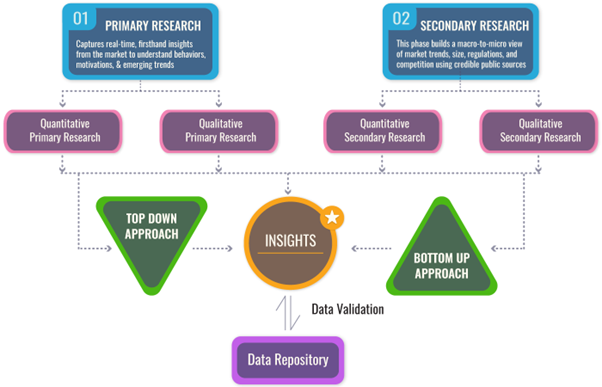
We follow a comprehensive, multi-phase research framework designed to deliver accurate, strategic, and decision-ready intelligence. Our process integrates primary and secondary research , both quantitative and qualitative , along with dual modeling techniques ( top-down and bottom-up) and a final layer of validation through our proprietary in-house repository.
PRIMARY RESEARCH
Primary research captures real-time, firsthand insights from the market to understand behaviors, motivations, and emerging trends.
1. Quantitative Primary Research
Objective: Generate statistically significant data directly from market participants.
Approaches:- Structured surveys with customers, distributors, and field agents
- Mobile-based data collection for point-of-sale audits and usage behavior
- Phone-based interviews (CATI) for market sizing and product feedback
- Online polling around industry events and digital campaigns
- Purchase frequency by customer type
- Channel performance across geographies
- Feature demand by application or demographic
2. Qualitative Primary Research
Objective: Explore decision-making drivers, pain points, and market readiness.
Approaches:- In-depth interviews (IDIs) with executives, product managers, and key decision-makers
- Focus groups among end users and early adopters
- Site visits and observational research for consumer products
- Informal field-level discussions for regional and cultural nuances
SECONDARY RESEARCH
This phase helps establish a macro-to-micro understanding of market trends, size, regulation, and competitive dynamics, sourced from credible and public domain information.
1. Quantitative Secondary Research
Objective: Model market value and segment-level forecasts based on published data.
Sources include:- Financial reports and investor summaries
- Government trade data, customs records, and regulatory statistics
- Industry association publications and economic databases
- Channel performance and pricing data from marketplace listings
- Revenue splits, pricing trends, and CAGR estimates
- Supply-side capacity and volume tracking
- Investment analysis and funding benchmarks
2. Qualitative Secondary Research
Objective: Capture strategic direction, innovation signals, and behavioral trends.
Sources include:- Company announcements, roadmaps, and product pipelines
- Publicly available whitepapers, conference abstracts, and academic research
- Regulatory body publications and policy briefs
- Social and media sentiment scanning for early-stage shifts
- Strategic shifts in market positioning
- Unmet needs and white spaces
- Regulatory triggers and compliance impact
DUAL MODELING: TOP-DOWN + BOTTOM-UP
To ensure robust market estimation, we apply two complementary sizing approaches:
Top-Down Modeling:- Start with broader industry value (e.g., global or regional TAM)
- Apply filters by segment, geography, end-user, or use case
- Adjust with primary insights and validation benchmarks
- Ideal for investor-grade market scans and opportunity mapping
- Aggregate from the ground up using sales volumes, pricing, and unit economics
- Use internal modeling templates aligned with stakeholder data
- Incorporate distributor-level or region-specific inputs
- Most accurate for emerging segments and granular sub-markets
DATA VALIDATION: IN-HOUSE REPOSITORY
We close the loop with proprietary data intelligence built from ongoing projects, industry monitoring, and historical benchmarking. This repository includes:
- Multi-sector market and pricing models
- Key trendlines from past interviews and forecasts
- Benchmarked adoption rates, churn patterns, and ROI indicators
- Industry-specific deviation flags and cross-check logic
- Catches inconsistencies early
- Aligns projections across studies
- Enables consistent, high-trust deliverables