

UV Nail Gel Market Size and Forecast (2025–2033), Global and Regional Growth, Trend, Share, and Industry Analysis Report Coverage: By Product Type (Color Gel/Gel Polish, Base Coat Gels, Top Coat Gels, Others), By Application (Nail Salons, Beauty Professionals, DIY Kits, Others), By Category (Mass/Economic, Premium, Luxury), By Distribution Channel (Supermarkets & Hypermarkets, Direct Sales to Salons, Online Retail, Others), and Geography
2026-02-17
Consumer Products
Jaya Bundele (Research Analyst)
Description
UV Nail Gel Market Overview
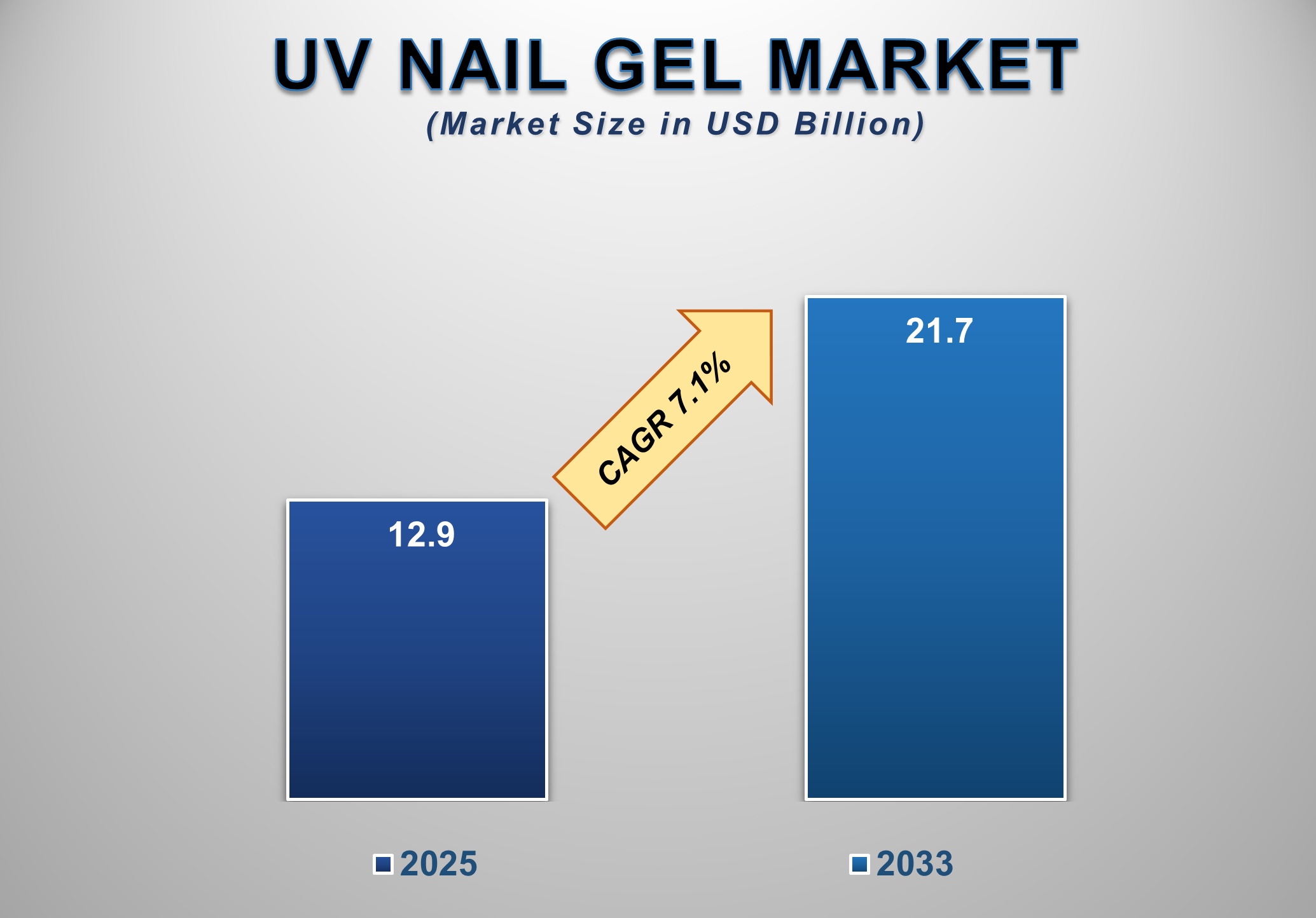
The global UV Nail Gel Market is experiencing robust growth, driven by rising beauty consciousness, increasing salon culture, and strong consumer preference for long-lasting and aesthetically superior nail care solutions. Valued at USD 12.9 Billion in 2025, the market is projected to reach USD 21.7 Billion by 2033, expanding at a CAGR of 7.1% during the forecast period. UV nail gels have become a mainstream component of professional and at-home nail care routines due to their durability, glossy finish, and extended wear compared to traditional nail polishes.
UV nail gels are widely used
across professional nail salons, beauty studios, and increasingly among DIY
consumers. Advancements in gel formulations, curing technologies, and color
pigmentation have significantly enhanced product performance and user experience.
Consumers are increasingly drawn toward chip-resistant, fast-curing, and
visually appealing nail gel products that support frequent styling without
compromising nail health.
UV Nail Gel Market
Drivers and Opportunities
The Expanding Nail Salon Industry and Professional Beauty
Services Are Driving Market Growth
The rapid expansion of nail salons and professional beauty service
establishments is one of the most significant drivers of growth in the global
UV nail gel market. Nail salons represent the largest application segment,
driven by increasing demand for professional-grade manicures, pedicures, and
nail art services. Consumers increasingly prefer UV nail gels in salon settings
due to their superior durability, long-lasting shine, and resistance to
chipping.
Urbanization, rising disposable incomes, and lifestyle changes
have contributed to frequent salon visits, particularly among young working
professionals and millennials. Nail salons are continuously expanding their
service offerings, incorporating advanced nail gel systems, seasonal color
collections, and customized nail art designs. This has significantly boosted
the demand for color gels, base coats, and top coats. Additionally, beauty
professionals increasingly rely on premium and luxury UV nail gel products to
differentiate their services and command higher pricing. Training programs,
certifications, and influencer-driven education further strengthen professional
adoption. As salon culture continues to expand globally, particularly in
emerging economies, demand for UV nail gel products is expected to grow
steadily.
Rising Popularity of Nail Art, Social Media Influence, and
DIY Trends Is Accelerating Adoption
The growing popularity of nail art and the strong influence of
social media platforms are accelerating the adoption of UV nail gel products
worldwide. Platforms such as Instagram, TikTok, and YouTube have transformed
nail styling into a prominent fashion statement, encouraging consumers to
experiment with bold colors, textures, and artistic designs. UV nail gels,
particularly color gels and gel polishes, are preferred due to their vibrant
pigmentation and compatibility with intricate nail art techniques. In parallel,
the rising popularity of DIY nail kits has expanded the consumer base beyond
professional salons. Consumers increasingly invest in UV lamps, starter kits,
and gel polish sets to achieve salon-quality results at home. This trend gained
momentum during periods of limited salon access and continues to grow due to
convenience and cost efficiency.
Manufacturers are responding by launching user-friendly
formulations, beginner kits, and educational content tailored to at-home users.
As digital influence and self-care trends continue to evolve, the combination
of professional and DIY demand is expected to sustain long-term market growth.
Premiumization and Product Innovation Are Creating
Significant Market Opportunities
The ongoing premiumization of beauty products presents a significant opportunity for the global UV nail gel market. Consumers increasingly associate premium and luxury nail gel products with superior quality, safety, and performance. High-end formulations offering low-odor chemistry, reduced nail damage, and enhanced wear time are gaining strong traction, particularly in developed markets. Innovation in gel formulations, including soak-off gels, vegan and cruelty-free options, and hypoallergenic products, is further expanding market opportunities. Brands are also introducing seasonal and limited-edition color ranges to drive repeat purchases and brand loyalty. Luxury salons and boutique beauty studios increasingly prefer premium UV nail gels to elevate service offerings and customer experience.
Emerging markets also present strong growth potential as rising incomes and beauty awareness support demand for premium nail care solutions. As innovation and premium positioning continue to reshape consumer preferences, this segment is expected to generate higher margins and sustained revenue growth
UV Nail Gel Market Scope
|
Report Attributes |
Description |
|
Market Size in 2025 |
USD 12.5 Billion |
|
Market Forecast in 2035 |
USD 21.7 Billion |
|
CAGR % 2025-2035 |
7.1% |
|
Base Year |
2024 |
|
Historic Data |
2020-2024 |
|
Forecast Period |
2025-2035 |
|
Report USP |
Production, Consumption,
Company Share, Company Heatmap, Company Production Capacity, Growth Factors,
and more |
|
Segments Covered |
●
Product Type,
Application, Category, Distribution Channel |
|
Regional Scope |
●
North America, ●
Europe, ●
APAC, ●
Latin America ●
Middle East and
Africa |
|
Country Scope |
1)
U.S. 2)
Canada 3)
Germany 4)
UK 5)
France 6)
Spain 7)
Italy 8)
Switzerland 9)
China 10)
Japan 11)
India 12)
Australia 13)
South Korea 14)
Brazil 15)
Mexico 16)
Argentina 17)
South Africa 18)
Saudi Arabia 19)
UAE |
UV Nail Gel Market Report
Segmentation Analysis
The Global UV Nail Gel Market
Industry Analysis Is Segmented by Product Type, Application, Category,
Distribution Channel, and by Region.
Color Gel/Gel Polish
Segment Accounted for the Largest Market Share in the Global UV Nail Gel Market
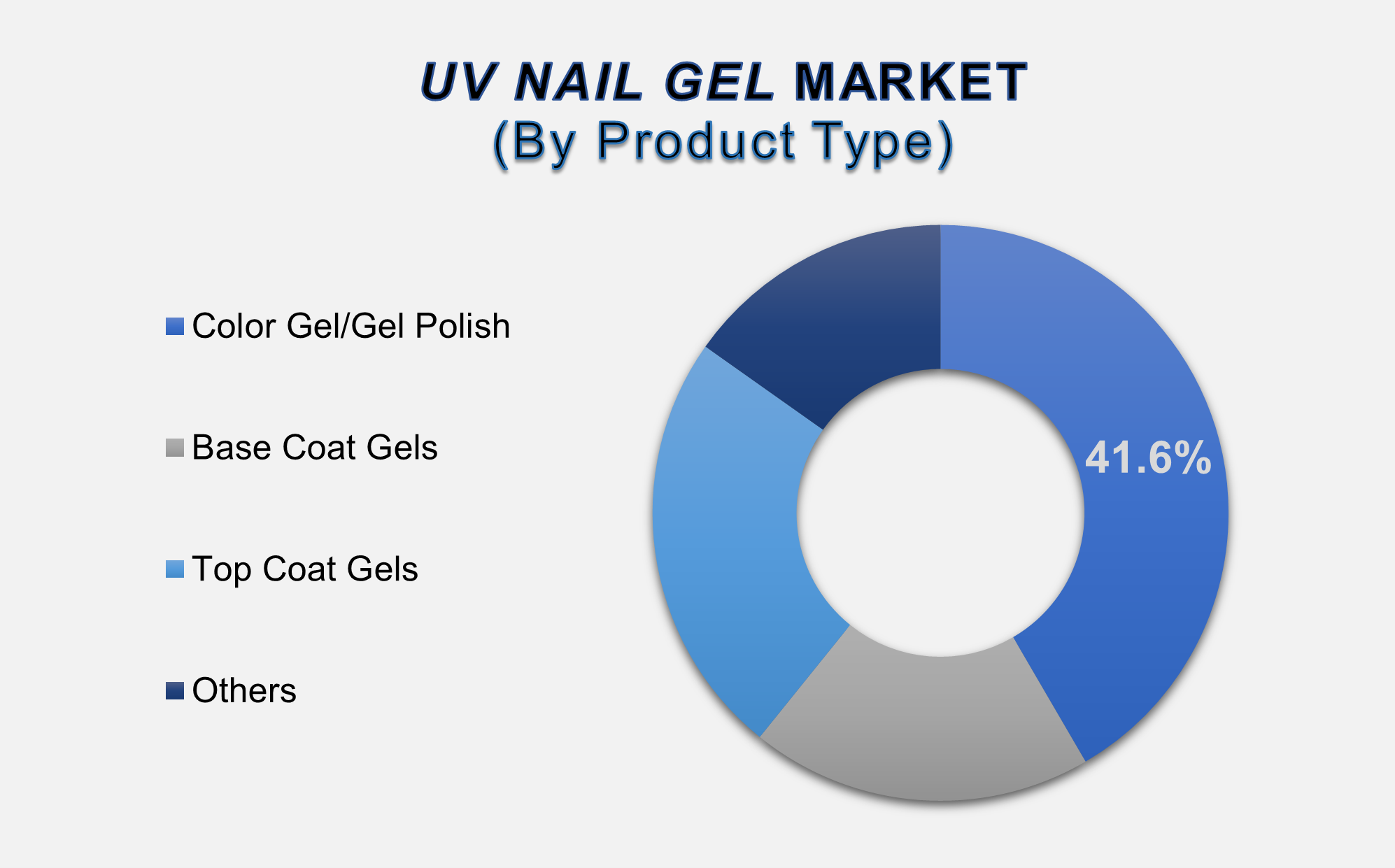
The color gel/gel polish segment accounted for the largest market share, contributing 41.6% of the global UV nail gel market. This dominance is driven by strong consumer demand for vibrant colors, long-lasting finishes, and compatibility with advanced nail art designs. Color gels are widely used across nail salons and DIY kits, making them the most frequently purchased product type. Manufacturers continuously introduce new shades, textures, and finishes to align with fashion trends and seasonal demand. The versatility and aesthetic appeal of color gels position this segment as the primary revenue contributor within the market.
Nail Salons Segment
Dominated the Market Share in the Global UV Nail Gel Market
The
nail salon segment dominated the global UV
nail gel market by application, supported by high service volumes and
consistent product consumption. Professional salons rely heavily on UV nail
gels for manicures, pedicures, and artistic nail designs, ensuring recurring
demand. Salon professionals prefer high-performance gels that deliver
durability, fast curing, and superior finish. As salon networks expand
globally, particularly in the
Asia Pacific, this segment continues to
reinforce market growth.
Mass/Economic Segment
Held the Largest Share in the Category Segment
The
mass/economic segment held the largest share in the category segmentation,
driven by affordability and broad consumer accessibility. Mass-market UV nail
gels are widely used by salons and DIY consumers seeking cost-effective
solutions without compromising quality. High-volume sales through supermarkets,
online platforms, and salon distributors support this segment’s dominance.
While premium and luxury categories are growing rapidly, mass/economic products
remain the foundation of market volume.
The following segments are
part of an in-depth analysis of the global UV Nail Gel market:
|
Market Segments |
|
|
By Product
Type |
●
Color Gel/Gel Polish ●
Base Coat Gels ●
Top Coat Gels ●
Others |
|
By Application |
●
Nail Salons ●
Beauty Professionals ●
DIY Kits |
|
By Category |
●
Mass/Economic ●
Premium ●
Luxury |
|
By
Distribution Channel |
●
Supermarkets &
Hypermarkets ●
Direct Sales to
Salons ●
Online Retail ●
Others |
UV Nail Gel Market Share
Analysis by Region
Asia Pacific is
anticipated to hold the biggest portion of the UV Nail Gel Market globally
throughout the forecast period.
Asia Pacific dominated the global
UV nail gel market, accounting for 43.2% of the total market share. The
region’s leadership is driven by a rapidly expanding beauty and personal care
industry, strong nail salon culture, and high consumer engagement with nail art
trends. Countries such as China, South Korea, and Japan serve as key innovation
and consumption hubs, supported by cost-efficient manufacturing and widespread
product availability.
North America is expected to
register the highest CAGR during the forecast period, supported by
premiumization trends, the strong influence of beauty influencers, and the
rising adoption of DIY nail kits. The region also benefits from
well-established distribution networks and strong online retail penetration,
enabling faster access to new and innovative UV nail gel products.
UV Nail Gel Market
Competition Landscape Analysis
The global UV nail gel market is
moderately fragmented, with the presence of international beauty brands and
specialized nail care companies. Market players compete on product quality,
formulation safety, color innovation, pricing, and distribution reach.
Branding, influencer collaborations, and professional endorsements play a
critical role in competitive differentiation.
Global UV Nail Gel Market
Recent Developments News:
- In April 2025 – Fiabila launched SPF50+ Base
and Top, a hybrid nail treatment formulated with marine plant extracts and
high UV protection designed to shield nails from environmental damage and
enhance color longevity.
- In April 2025 – Essie entered a partnership
to become the official nail polish partner of the New York Liberty WNBA
team. This collaboration aligns the brand with sports and lifestyle
culture, leveraging the team's fan base to reach new audiences.
- In December 2023 – Coty Inc. expanded its
operations in the Indian market by strengthening its local teams and
entering a strategic distribution and marketing partnership with House of
Beauty to support both its Prestige and Consumer Beauty divisions.
The Global UV Nail Gel Market Is
Dominated by a Few Large Companies, such as
●
CND
●
OPI
●
Gelish
●
IBD
●
Kiara Sky
●
SNS
●
DND
●
Gelaza
●
Madam Glam
●
The GelBottle Inc.
●
Light Elegance
●
Kupa Inc.
●
Young Nails
●
Naio Nails
●
Bluesky
●
Aimeili
●
TGB
●
Modelones
●
Beetles
●
Mylee
● Others
Frequently Asked Questions
Jaya Bundele (Research Analyst)
Jaya Bundele is a skilled Research Analyst with 4+ years of experience in market intelligence, consumer insights, competitive analysis, and industry forecasting across the consumer goods, agriculture, and food & beverage sectors. She specializes in market sizing, trend analysis, growth opportunity mapping, and strategic secondary research for global and regional markets.
Her expertise lies in transforming complex industry data into actionable business strategies that help organizations identify emerging trends, understand customer behavior, and gain a competitive edge. With a strong focus on data-driven insights, business intelligence, and future market trends, Jaya delivers high-quality research solutions aligned with evolving industry demands and market dynamics.
1. Global UV Nail Gel Market
Introduction and Market Overview
1.1.
Objectives
of the Study
1.2.
Global
UV Nail Gel Market Scope and Market Estimation
1.2.1.Global UV Nail Gel Overall
Market Size (US$ Bn), Market CAGR (%), Market forecast (2025 - 2033)
1.2.2.Global UV Nail Gel Market
Revenue Share (%) and Growth Rate (Y-o-Y) from 2020 - 2033
1.3.
Market
Segmentation
1.3.1.Product Type of Global UV
Nail Gel Market
1.3.2.Category of Global UV Nail
Gel Market
1.3.3.Distribution Channel of
Global UV Nail Gel Market
1.3.4.Application of Global UV
Nail Gel Market
1.3.5.Region of Global UV Nail
Gel Market
2. Executive
Summary
2.1.
Demand
Side Trends
2.2.
Key
Market Trends
2.3.
Market
Demand (US$ Bn) Analysis 2020 – 2024 and Forecast, 2025 – 2033
2.4.
Demand
and Opportunity Assessment
2.5.
Key
Developments
2.6.
Overview
of Tariff, Regulatory Landscape and Standards
2.7.
Market
Entry Strategies
2.8.
Market
Dynamics
2.8.1.Drivers
2.8.2.Limitations
2.8.3.Opportunities
2.8.4.Impact Analysis of Drivers
and Restraints
2.9.
Porter’s
Five Forces Analysis
2.10.
PEST
Analysis
3. Global
UV Nail Gel Market Estimates
& Historical Trend Analysis (2020 - 2024)
4. Global
UV Nail Gel Market Estimates
& Forecast Trend Analysis, by Product Type
4.1.
Global
UV Nail Gel Market Revenue (US$ Bn) Estimates and Forecasts, by Product Type, 2020
- 2033
4.1.1.Color Gel/Gel Polish
4.1.2.Base Coat Gels
4.1.3.Top Coat Gels
4.1.4.Others
5. Global
UV Nail Gel Market Estimates
& Forecast Trend Analysis, by Category
5.1.
Global
UV Nail Gel Market Revenue (US$ Bn) Estimates and Forecasts, by Category, 2020
- 2033
5.1.1.Mass/Economic
5.1.2.Premium
5.1.3.Luxury
6. Global
UV Nail Gel Market Estimates
& Forecast Trend Analysis, by Distribution Channel
6.1.
Global
UV Nail Gel Market Revenue (US$ Bn) Estimates and Forecasts, by Distribution
Channel, 2020 - 2033
6.1.1.Supermarkets &
Hypermarkets
6.1.2.Direct Sales to Salons
6.1.3.Online Retail
6.1.4.Others
7. Global
UV Nail Gel Market Estimates
& Forecast Trend Analysis, by Application
7.1.
Global
UV Nail Gel Market Revenue (US$ Bn) Estimates and Forecasts, by Application,
2020 - 2033
7.1.1.Nail Salons
7.1.2.Beauty Professionals
7.1.3.DIY Kits
8. Global
UV Nail Gel Market Estimates
& Forecast Trend Analysis, by Region
8.1.
Global
UV Nail Gel Market Revenue (US$ Bn) Estimates and Forecasts, by Region, 2020 - 2033
8.1.1.North America
8.1.2.Europe
8.1.3.Asia Pacific
8.1.4.Middle East & Africa
8.1.5.Latin America
9. North America UV
Nail Gel Market: Estimates &
Forecast Trend Analysis
9.1.
North
America UV Nail Gel Market Assessments & Key Findings
9.1.1.North America UV Nail Gel
Market Introduction
9.1.2.North America UV Nail Gel
Market Size Estimates and Forecast (US$ Billion) (2020 - 2033)
9.1.2.1. By Product
Type
9.1.2.2. By Category
9.1.2.3. By Distribution
Channel
9.1.2.4. By Application
9.1.2.5.
By
Country
9.1.2.5.1. The U.S.
9.1.2.5.2. Canada
10. Europe UV
Nail Gel Market: Estimates &
Forecast Trend Analysis
10.1.
Europe
UV Nail Gel Market Assessments & Key Findings
10.1.1.
Europe
UV Nail Gel Market Introduction
10.1.2.
Europe
UV Nail Gel Market Size Estimates and Forecast (US$ Billion) (2020 - 2033)
10.1.2.1. By Product
Type
10.1.2.2. By Category
10.1.2.3. By Distribution
Channel
10.1.2.4. By Application
10.1.2.5.
By
Country
10.1.2.5.1.
Germany
10.1.2.5.2.
Italy
10.1.2.5.3.
U.K.
10.1.2.5.4.
France
10.1.2.5.5.
Spain
10.1.2.5.6.
Switzerland
10.1.2.5.7. Rest
of Europe
11. Asia Pacific UV
Nail Gel Market: Estimates &
Forecast Trend Analysis
11.1.
Asia
Pacific Market Assessments & Key Findings
11.1.1.
Asia
Pacific UV Nail Gel Market Introduction
11.1.2.
Asia
Pacific UV Nail Gel Market Size Estimates and Forecast (US$ Billion) (2020 - 2033)
11.1.2.1. By Product
Type
11.1.2.2. By Category
11.1.2.3. By Distribution
Channel
11.1.2.4. By Application
11.1.2.5.
By
Country
11.1.2.5.1. China
11.1.2.5.2. Japan
11.1.2.5.3. India
11.1.2.5.4. Australia
11.1.2.5.5. South Korea
11.1.2.5.6. Rest of Asia Pacific
12. Middle East & Africa UV
Nail Gel Market: Estimates &
Forecast Trend Analysis
12.1.
Middle
East & Africa Market Assessments & Key Findings
12.1.1.
Middle East & Africa UV Nail Gel Market Introduction
12.1.2.
Middle East & Africa UV Nail Gel Market Size Estimates
and Forecast (US$ Billion) (2020 - 2033)
12.1.2.1. By Product
Type
12.1.2.2. By Category
12.1.2.3. By Distribution
Channel
12.1.2.4. By Application
12.1.2.5.
By
Country
12.1.2.5.1. UAE
12.1.2.5.2. Saudi
Arabia
12.1.2.5.3. South
Africa
12.1.2.5.4. Rest
of MEA
13. Latin America
UV Nail Gel Market: Estimates &
Forecast Trend Analysis
13.1.
Latin
America Market Assessments & Key Findings
13.1.1.
Latin
America UV Nail Gel Market Introduction
13.1.2.
Latin
America UV Nail Gel Market Size Estimates and Forecast (US$ Billion) (2020 - 2033)
13.1.2.1. By Product
Type
13.1.2.2. By Category
13.1.2.3. By Distribution
Channel
13.1.2.4. By Application
13.1.2.5.
By
Country
13.1.2.5.1. Brazil
13.1.2.5.2. Argentina
13.1.2.5.3. Mexico
13.1.2.5.4. Rest
of LATAM
14. Country Wise Market:
Introduction
15.
Competition
Landscape
15.1.
Global
UV Nail Gel Market Product Mapping
15.2.
Global
UV Nail Gel Market Concentration Analysis, by Leading Players / Innovators /
Emerging Players / New Entrants
15.3.
Global
UV Nail Gel Market Tier Structure Analysis
15.4.
Global
UV Nail Gel Market Concentration & Company Market Shares (%) Analysis, 2024
16.
Company
Profiles
16.1.
CND
16.1.1.
Company
Overview & Key Stats
16.1.2.
Financial
Performance & KPIs
16.1.3.
Product
Portfolio
16.1.4.
SWOT
Analysis
16.1.5.
Business
Strategy & Recent Developments
* Similar details would be provided for all the players
mentioned below
16.2. OPI
16.3. Gelish
16.4. IBD
16.5. Kiara
Sky
16.6. SNS
16.7. DND
16.8. Gelaza
16.9. Madam
Glam
16.10. The
GelBottle Inc.
16.11. Light
Elegance
16.12. Kupa
Inc.
16.13. Young
Nails
16.14. Naio
Nails
16.15. Bluesky
16.16. Aimeili
16.17. TGB
16.18. Modelones
16.19. Beetles
16.20. Mylee
16.21. Others
17. Research
Methodology
17.1.
External
Transportations / Databases
17.2.
Internal
Proprietary Database
17.3.
Primary
Research
17.4.
Secondary
Research
17.5.
Assumptions
17.6.
Limitations
17.7.
Report
FAQs
18. Research
Findings & Conclusion
Our Research Methodology
"Insight without rigor is just noise."
We follow a comprehensive, multi-phase research framework designed to deliver accurate, strategic, and decision-ready intelligence. Our process integrates primary and secondary research , both quantitative and qualitative , along with dual modeling techniques ( top-down and bottom-up) and a final layer of validation through our proprietary in-house repository.
PRIMARY RESEARCH
Primary research captures real-time, firsthand insights from the market to understand behaviors, motivations, and emerging trends.
1. Quantitative Primary Research
Objective: Generate statistically significant data directly from market participants.
Approaches:- Structured surveys with customers, distributors, and field agents
- Mobile-based data collection for point-of-sale audits and usage behavior
- Phone-based interviews (CATI) for market sizing and product feedback
- Online polling around industry events and digital campaigns
- Purchase frequency by customer type
- Channel performance across geographies
- Feature demand by application or demographic
2. Qualitative Primary Research
Objective: Explore decision-making drivers, pain points, and market readiness.
Approaches:- In-depth interviews (IDIs) with executives, product managers, and key decision-makers
- Focus groups among end users and early adopters
- Site visits and observational research for consumer products
- Informal field-level discussions for regional and cultural nuances
SECONDARY RESEARCH
This phase helps establish a macro-to-micro understanding of market trends, size, regulation, and competitive dynamics, sourced from credible and public domain information.
1. Quantitative Secondary Research
Objective: Model market value and segment-level forecasts based on published data.
Sources include:- Financial reports and investor summaries
- Government trade data, customs records, and regulatory statistics
- Industry association publications and economic databases
- Channel performance and pricing data from marketplace listings
- Revenue splits, pricing trends, and CAGR estimates
- Supply-side capacity and volume tracking
- Investment analysis and funding benchmarks
2. Qualitative Secondary Research
Objective: Capture strategic direction, innovation signals, and behavioral trends.
Sources include:- Company announcements, roadmaps, and product pipelines
- Publicly available whitepapers, conference abstracts, and academic research
- Regulatory body publications and policy briefs
- Social and media sentiment scanning for early-stage shifts
- Strategic shifts in market positioning
- Unmet needs and white spaces
- Regulatory triggers and compliance impact
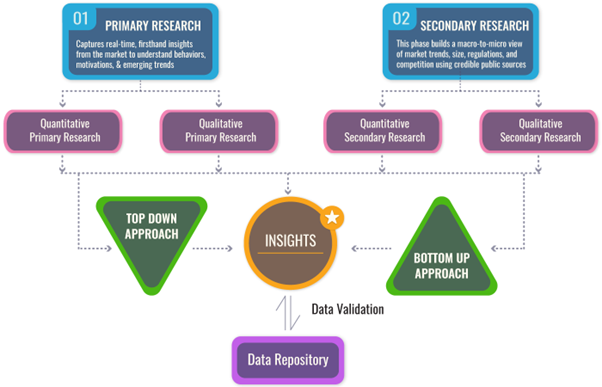
DUAL MODELING: TOP-DOWN + BOTTOM-UP
To ensure robust market estimation, we apply two complementary sizing approaches:
Top-Down Modeling:- Start with broader industry value (e.g., global or regional TAM)
- Apply filters by segment, geography, end-user, or use case
- Adjust with primary insights and validation benchmarks
- Ideal for investor-grade market scans and opportunity mapping
- Aggregate from the ground up using sales volumes, pricing, and unit economics
- Use internal modeling templates aligned with stakeholder data
- Incorporate distributor-level or region-specific inputs
- Most accurate for emerging segments and granular sub-markets
DATA VALIDATION: IN-HOUSE REPOSITORY
We close the loop with proprietary data intelligence built from ongoing projects, industry monitoring, and historical benchmarking. This repository includes:
- Multi-sector market and pricing models
- Key trendlines from past interviews and forecasts
- Benchmarked adoption rates, churn patterns, and ROI indicators
- Industry-specific deviation flags and cross-check logic
- Catches inconsistencies early
- Aligns projections across studies
- Enables consistent, high-trust deliverables