

Vacuum Blood Collection Market Size and Forecast (2026–2034), Global and Regional Growth, Trend, Share and Industry Analysis Report Coverage; By Product Type (Serum Separating Tubes, EDTA Tubes, Plasma Separation Tubes, Heparin Tubes, Citrate Tubes, Others); By Material (Plastic, Glass); By Application (Clinical Diagnostics, Biochemistry Testing, Hematology, Immunology, Molecular Diagnostics, Others); By End User (Hospitals, Diagnostic Laboratories, Blood Banks, Academic & Research Institutes, Others); and Geography
2026-08-07
Healthcare
Swetal (Research Analyst)
Description
Vacuum Blood Collection Market
Overview
The global Vacuum
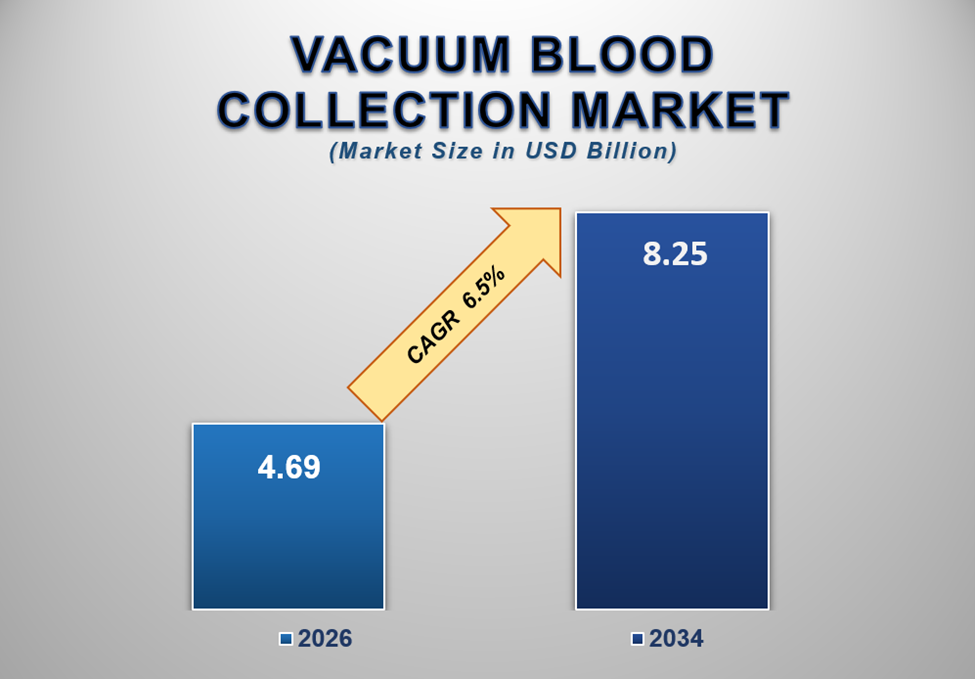
Blood Collection Market was valued at USD 4.69 billion in 2026 and
is projected to reach USD 8.25 billion by 2034, expanding at a CAGR
of 6.5% during the forecast period. Market expansion is supported by the
increasing volume of diagnostic testing, growing prevalence of chronic and
infectious diseases, rising demand for accurate laboratory diagnostics,
advancements in blood collection technologies, and continuous improvements in
healthcare infrastructure across developed and emerging economies.
Vacuum blood
collection systems have become an indispensable component of modern clinical
diagnostics by enabling safe, sterile, and standardized blood sample
collection. These systems consist of evacuated collection tubes designed to
draw a predetermined volume of blood directly from the patient, minimizing
contamination risks while preserving sample integrity. Their widespread
adoption has significantly improved laboratory workflow efficiency, diagnostic
accuracy, and patient safety compared to conventional blood collection
techniques.
The growing
dependence on laboratory-based diagnostics continues to strengthen market
demand. Physicians increasingly rely on blood analysis for early disease
detection, treatment monitoring, preventive healthcare, routine health
assessments, and therapeutic decision-making. From complete blood counts and
metabolic panels to molecular diagnostics and infectious disease screening,
vacuum blood collection tubes support virtually every stage of laboratory
medicine.
The increasing
prevalence of chronic diseases such as diabetes, cardiovascular disorders,
cancer, kidney disease, liver disorders, and endocrine abnormalities has
substantially increased diagnostic testing volumes worldwide. Regular blood
monitoring has become an essential component of disease management, creating
sustained demand for reliable blood collection consumables across hospitals,
diagnostic laboratories, and outpatient healthcare facilities.
Population aging
further contributes to market expansion. Elderly individuals typically undergo
more frequent medical evaluations, requiring repeated blood testing for chronic
disease management, medication monitoring, nutritional assessment, and preventive
health screening. As global life expectancy continues to rise, healthcare
providers are expected to perform increasing numbers of laboratory
investigations annually.
Technological
improvements have enhanced the performance and safety of modern vacuum blood
collection systems. Manufacturers continue developing tubes with improved
additives, advanced separator gels, enhanced clot activators, optimized
anticoagulants, and durable plastic materials that improve sample stability
while reducing handling errors. Safety-engineered collection systems
incorporating needle protection mechanisms and closed-system designs help
minimize occupational exposure risks for healthcare professionals.
Automation
within clinical laboratories has also accelerated adoption. Modern laboratory
analyzers require standardized specimen quality to ensure accurate and
reproducible results. Vacuum blood collection tubes are specifically designed
to integrate with automated laboratory workflows, reducing manual processing,
minimizing specimen variability, and improving operational efficiency.
Growing emphasis
on preventive healthcare and routine wellness screening is expanding blood
testing beyond hospitals into diagnostic centers, corporate wellness programs,
community health initiatives, and home healthcare services. Increasing public
awareness regarding early diagnosis encourages more individuals to undergo
periodic health assessments, further supporting market growth.
Emerging
healthcare systems are investing significantly in expanding diagnostic
infrastructure through new hospitals, pathology laboratories, blood banks, and
primary healthcare centers. These investments are creating long-term
opportunities for manufacturers supplying blood collection consumables,
particularly in rapidly developing regions where access to quality diagnostic
services continues improving.
As healthcare systems increasingly prioritize accurate diagnostics, patient safety, laboratory automation, and standardized specimen collection practices, the vacuum blood collection market is expected to witness stable and sustained growth throughout the forecast period.
Vacuum Blood Collection Market
Drivers and Opportunities
Rising
Diagnostic Testing Volumes Are Driving Market Growth
One of the
primary factors accelerating market expansion is the continuous increase in
laboratory diagnostic testing worldwide.
Healthcare
providers increasingly depend on blood-based diagnostic procedures to detect
diseases at earlier stages, evaluate treatment outcomes, monitor chronic
illnesses, and guide personalized therapeutic decisions. Routine health
check-ups, preventive screening programs, emergency care, surgical procedures,
and disease surveillance collectively generate millions of blood collection
procedures each day.
The growing
burden of diabetes, cardiovascular diseases, infectious diseases, autoimmune
disorders, and cancer has substantially increased the frequency of blood
testing across all age groups. In addition, expanding health insurance coverage
and greater awareness of preventive healthcare are encouraging more individuals
to undergo regular diagnostic evaluations.
As laboratory testing volumes continue rising globally, demand for high-quality vacuum blood collection systems is expected to remain consistently strong.
Laboratory
Automation and Safety Standards Continue to Strengthen Market Demand
Healthcare
facilities worldwide are modernizing laboratory operations by implementing
automation technologies that improve efficiency, accuracy, and turnaround time.
Automated
laboratory analyzers require standardized blood specimens collected under
controlled conditions. Vacuum blood collection tubes provide consistent sample
volumes, reliable additive concentrations, and improved specimen quality,
making them highly compatible with automated diagnostic workflows.
Simultaneously, increasing
emphasis on occupational safety has accelerated the adoption of closed blood
collection systems that minimize exposure to bloodborne pathogens.
Safety-engineered devices, needle protection mechanisms, and
contamination-resistant tube designs help healthcare professionals comply with
evolving infection prevention regulations while improving workplace safety.
These technological and regulatory developments continue supporting widespread adoption across hospitals and diagnostic laboratories.
Emerging
Healthcare Infrastructure and Specialized Diagnostics Create Long-Term
Opportunities
Several
long-term opportunities are expected to shape the future of the vacuum blood
collection market.
Rapid healthcare
infrastructure development across emerging economies is increasing the number
of hospitals, diagnostic laboratories, specialty clinics, and community
healthcare centers. These facilities require reliable blood collection
consumables to support expanding diagnostic services.
Advancements in
molecular diagnostics, genetic testing, liquid biopsy, precision medicine, and
biomarker-based disease detection are creating demand for specialized blood
collection tubes capable of preserving nucleic acids, proteins, and cellular
components for advanced laboratory analysis.
Home healthcare
and decentralized diagnostics represent another promising growth area. Portable
blood collection solutions designed for home-based sample collection, remote
patient monitoring, and telemedicine-supported healthcare services are expected
to gain increasing adoption as healthcare delivery models continue evolving.
Furthermore,
manufacturers investing in environmentally sustainable materials, recyclable
plastics, improved tube labeling technologies, and digital specimen tracking
systems are likely to gain competitive advantages as healthcare providers
prioritize operational efficiency and environmental responsibility.
Vacuum Blood Collection Market Scope
|
Report Attributes |
Description |
|
Market Size in 2026 |
USD 4.69 Billion |
|
Market Forecast in 2034 |
USD 8.25 Billion |
|
CAGR % 2026-2034 |
6.5% |
|
Base Year |
2025 |
|
Historic Data |
2021-2025 |
|
Forecast Period |
2026-2034 |
|
Report USP |
Production, Consumption,
Company Share, Company Heatmap, Company Production, Service Type, Growth
Factors and more |
|
Segments Covered |
●
By Product Type ●
By Material ●
By Application ●
By End User |
|
Regional Scope |
● North America |
|
Country Scope |
U.S. |
Vacuum Blood Collection Market Report
Segmentation Analysis
The global Vacuum Blood Collection Market is segmented based on product type, material, application, end user, and geography. Rising diagnostic testing volumes, increasing laboratory automation, growing healthcare expenditure, and continuous innovation in blood collection technologies are influencing demand across all market segments. Each segment contributes to improving specimen quality, laboratory efficiency, patient safety, and diagnostic accuracy within modern healthcare systems.
Serum
Separating Tubes Segment Is Expected to Dominate the Market During the Forecast
Period
The Serum
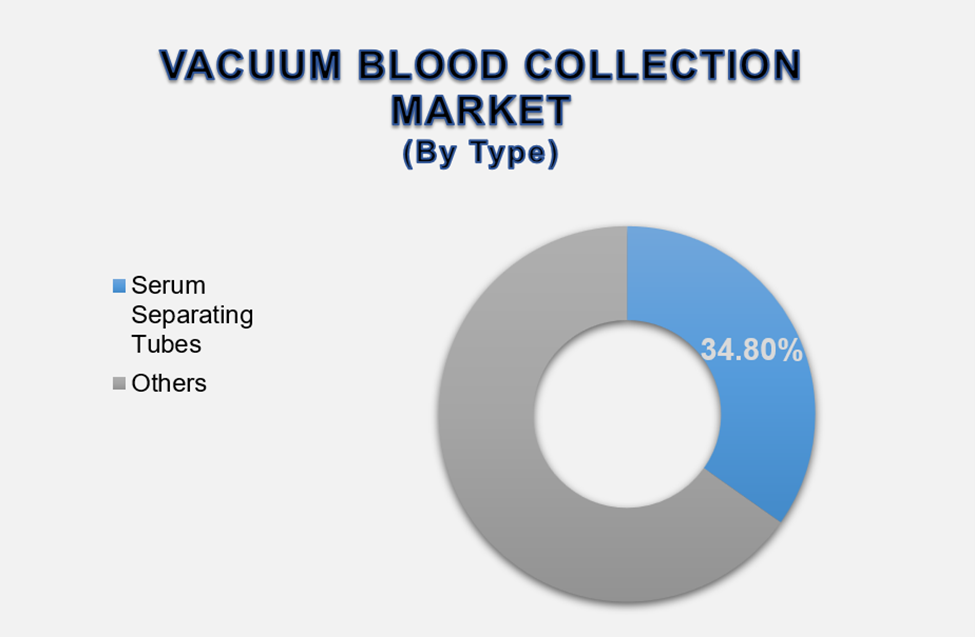
Separating Tubes (SST) segment accounted for approximately 34.8% of
the global vacuum blood collection market in 2026, making it the largest
product category.
Serum separating
tubes dominate the market because they are extensively used in routine clinical
chemistry testing, immunology, serology, endocrinology, and biochemical
analysis. These tubes contain clot activators and separator gels that
facilitate efficient serum separation following centrifugation, reducing sample
contamination while improving laboratory productivity.
The growing
number of routine health examinations, chronic disease monitoring programs,
hospital admissions, and preventive diagnostic screenings continues to increase
worldwide consumption of serum- separating tubes. Their compatibility with
automated laboratory analyzers further strengthens adoption across hospitals
and independent diagnostic laboratories.
Manufacturers continue improving separator gel stability, additive performance, and specimen preservation capabilities to ensure reliable laboratory results. As diagnostic testing volumes continue increasing globally, serum-separating tubes are expected to maintain their leading market position throughout the forecast period.
Plastic
Segment Is Expected to Lead the Market by Material
The Plastic
segment represents the largest material category within the vacuum blood
collection market.
Plastic blood
collection tubes have largely replaced traditional glass tubes because they
offer superior durability, reduced breakage risk, lighter weight, and enhanced
user safety. Modern polyethylene terephthalate (PET) tubes maintain vacuum
integrity while minimizing accidental injuries associated with broken glass
during specimen collection, transportation, and laboratory handling.
Healthcare
facilities increasingly prefer plastic tubes because they comply with
occupational safety standards and are compatible with automated laboratory
systems. Continuous improvements in polymer engineering have enhanced chemical
resistance, transparency, dimensional stability, and shelf life, making plastic
the preferred material across healthcare institutions worldwide.
Growing emphasis on laboratory safety and operational efficiency is expected further to strengthen demand for plastic vacuum blood collection tubes.
Clinical
Diagnostics Segment Is Expected to Dominate the Market by Application
The Clinical
Diagnostics segment accounts for the largest application share within the
global market.
Clinical
diagnostic laboratories perform millions of blood tests every day to support
disease diagnosis, treatment planning, therapeutic monitoring, preventive
healthcare, and routine medical examinations. Blood specimens collected using
vacuum tubes are utilized across numerous laboratory disciplines, including
clinical chemistry, hematology, microbiology, immunology, pathology, and
molecular diagnostics.
The increasing
burden of chronic diseases, infectious diseases, metabolic disorders,
cardiovascular conditions, and cancer continues driving higher laboratory
testing volumes globally. Expansion of preventive healthcare programs and
routine wellness check-ups further contributes to sustained demand for
standardized blood collection systems.
As healthcare providers increasingly emphasize accurate and timely diagnosis, clinical diagnostics will remain the dominant application segment throughout the forecast period.
The Hospitals
Segment Is Expected to Lead the Market by End User
The Hospitals
segment represents the largest end-user category within the vacuum blood
collection market.
Hospitals
conduct a broad range of diagnostic procedures for emergency medicine,
inpatient care, outpatient consultations, surgical interventions, intensive
care units, and specialized treatment programs. Blood testing is routinely
performed for disease diagnosis, treatment monitoring, infection control,
pre-operative assessment, and post-operative follow-up, resulting in
consistently high demand for vacuum blood collection products.
Large hospital
networks are increasingly adopting automated specimen management systems,
standardized blood collection protocols, barcode-enabled sample identification,
and integrated laboratory information systems to improve operational efficiency
and minimize diagnostic errors.
Growing hospital infrastructure, increasing patient admissions, and expanding diagnostic capabilities are expected to maintain the hospital segment's market leadership during the forecast period.
The following segments are part of an in-depth analysis of the global Vacuum Blood Collection Market.
|
Market Segments |
|
|
By Product Type |
●
Serum Separating Tubes ●
EDTA Tubes ●
Plasma Separation Tubes ●
Heparin Tubes ●
Citrate Tubes ●
Others |
|
By
Material |
●
Plastic ●
Glass |
|
By Application |
Clinical Diagnostics ●
Biochemistry Testing ●
Hematology ●
Immunology ●
Molecular Diagnostics ●
Others |
|
By End User |
●
Hospitals ●
Diagnostic Laboratories ●
Blood Banks ●
Academic & Research Institutes ●
Others |
Vacuum Blood Collection Market Share
Analysis By Region
North America accounted for approximately 39.6% of the global Vacuum Blood
Collection Market in 2026, making it the leading regional market.
North America
maintains its dominant position due to its highly developed healthcare
infrastructure, extensive network of hospitals and diagnostic laboratories,
high diagnostic testing volumes, and widespread adoption of advanced blood
collection technologies. The region performs millions of laboratory tests annually
for preventive health screenings, chronic disease management, infectious
disease diagnosis, oncology, and emergency medicine, creating sustained demand
for vacuum blood collection consumables.
The United
States represents the largest market within the region, supported by
increasing healthcare expenditure, growing prevalence of chronic illnesses,
technological advancements in laboratory automation, and strong regulatory
emphasis on patient safety and specimen quality.
Canada also contributes significantly through expanding diagnostic
laboratory services, increasing preventive healthcare initiatives, and growing
demand for standardized blood collection systems in both public and private
healthcare facilities.
Europe remains the second-largest regional market owing to its
well-established healthcare systems, stringent laboratory quality standards,
and increasing emphasis on early disease detection.
Asia-Pacific is projected to register the fastest growth during the forecast
period. Rapid urbanization, expanding healthcare infrastructure, rising
healthcare expenditure, increasing awareness of preventive diagnostics, and
growing government investments in public health are accelerating market
expansion across China, India, Japan, South Korea, and Australia.
Latin America is steadily expanding due to improving healthcare accessibility,
increasing government healthcare investments, and modernization of diagnostic
laboratories.
The Middle East & Africa region is also witnessing gradual market development. Investments in healthcare infrastructure, increasing establishment of specialized diagnostic centers, expanding medical tourism, and improved access to quality healthcare services are expected to support long-term demand for vacuum blood collection products.
Vacuum Blood
Collection Market Competition Landscape Analysis
The global
Vacuum Blood Collection Market is characterized by intense competition among
multinational medical device manufacturers and specialized diagnostic
consumable suppliers. Companies compete by developing innovative blood
collection systems that improve specimen integrity, patient safety, laboratory
efficiency, and compatibility with automated diagnostic platforms.
Product
innovation remains one of the primary competitive strategies. Manufacturers
continue introducing blood collection tubes with enhanced separator gels,
improved anticoagulant formulations, optimized clot activators, and advanced
specimen preservation technologies that ensure reliable laboratory performance
across diverse diagnostic applications.
Automation
compatibility has become another important area of competition. Leading
companies are designing blood collection products that seamlessly integrate
with automated laboratory analyzers, robotic specimen handling systems, barcode
tracking technologies, and laboratory information management systems (LIMS).
These solutions reduce manual handling, improve workflow efficiency, and
minimize diagnostic errors.
Regulatory
compliance and quality assurance also play critical roles in maintaining
competitive advantage. Manufacturers prioritize adherence to international
quality standards while investing in sterile manufacturing processes, precision
engineering, and rigorous product validation to ensure consistent clinical
performance.
Strategic
collaborations with hospitals, diagnostic laboratories, healthcare
distributors, and research organizations continue strengthening market
presence. Companies are also expanding production capacity, enhancing global
distribution networks, and investing in environmentally sustainable
manufacturing practices to address growing market demand.
The increasing adoption of molecular diagnostics, personalized medicine, liquid biopsy technologies, and decentralized healthcare is expected to encourage further product innovation and intensify competition throughout the forecast period.
Global Vacuum
Blood Collection Market Recent Developments
●
April 2026: Several diagnostic consumable manufacturers expanded production
capacity to address increasing global demand for blood collection products used
in clinical laboratories and healthcare facilities.
●
February 2026: Multiple medical device companies introduced next-generation vacuum
blood collection tubes designed to improve specimen stability and compatibility
with high-throughput automated laboratory systems.
●
November 2025: Leading manufacturers enhanced safety-engineered blood collection
devices incorporating advanced needle protection mechanisms to reduce
occupational exposure among healthcare professionals.
The Global
Vacuum Blood Collection Market is Dominated by a Few Large Companies, Such As
●
Becton, Dickinson and Company
(BD)
●
Greiner Bio-One International
GmbH
●
Terumo Corporation
●
FL MEDICAL S.r.l.
●
Sarstedt AG & Co. KG
●
Sekisui Medical Co., Ltd.
●
Nipro Corporation
●
Narang Medical Limited
●
Improve Medical Technology Co.,
Ltd.
●
CML Biotech Pvt. Ltd.
●
Medtronic plc
●
Cardinal Health, Inc.
●
Fresenius SE & Co. KGaA
●
AdvaCare Pharma
●
ELITechGroup
● Others
Frequently Asked Questions
Swetal (Research Analyst)
Swetal is a Research Analyst with 4+ years of experience specializing in healthcare market research, medical devices, healthcare IT, and medical technology industry analysis. Her expertise includes competitive intelligence, secondary research, market trend forecasting, and healthcare business insights across global healthcare ecosystems.
She contributes to advanced market research reports by analyzing regulatory frameworks, emerging healthcare technologies, competitive landscapes, and innovation trends shaping the medical industry. With a strong focus on accurate market intelligence, strategic insights, and healthcare industry trends, Swetal supports businesses in making informed, data-backed decisions in a rapidly transforming healthcare environment.
1.
Global Vacuum Blood
Collection Market Introduction and Market Overview
1.1. Objectives of the Study
1.2. Global Vacuum Blood Collection Market Scope and Market Estimation
1.2.1.
Global Vacuum Blood Collection
Market Size (US$ Million), Market CAGR (%), Market Forecast (2026 - 2034)
1.2.2.
Global Vacuum Blood Collection
Market Revenue Share (%) and Growth Rate (Y-o-Y) Analysis (2021 - 2034)
1.3. Market Segmentation
1.3.1.
Product Type of Global Vacuum
Blood Collection Market
1.3.2.
Material of Global Vacuum Blood
Collection Market
1.3.3.
Application of Global Vacuum
Blood Collection Market
1.3.4.
End User of Global Vacuum Blood
Collection Market
1.3.5.
Region of Global Vacuum Blood
Collection Market
1.4. Competition Coverage List of Market Participants
1.5. Market Definition: Vacuum Blood Collection Market
2.
Executive Summary
2.1. Demand Side Trends
2.2. Key Market Trends
2.3. Market Demand (US$ Million) Analysis 2021 – 2025 and Forecast, 2026
– 2034
2.4. Demand and Opportunity Assessment
2.5. Key Developments
2.6. Overview of Regulatory Landscape, Compliance Framework, and Industry
Standards
2.7. Market Entry Strategies
2.8. Market Dynamics
2.8.1.
Drivers
2.8.2.
Limitations
2.8.3.
Opportunities
2.8.4.
Impact Analysis of Drivers and
Restraints
2.9. Porter's Five Forces Analysis
2.10.
PEST Analysis
3.
Global Vacuum Blood
Collection Market Estimates & Historical Trend Analysis (2021 - 2025)
4.
Global Vacuum Blood
Collection Market Estimates & Forecast Trend Analysis, by Product Type
4.1. Global Vacuum Blood Collection Market Revenue (US$ Million)
Estimates and Forecasts, by Product Type, 2021 - 2034
4.1.1.
Serum Separating Tubes
4.1.2.
EDTA Tubes
4.1.3.
Plasma Separation Tubes
4.1.4.
Heparin Tubes
4.1.5.
Citrate Tubes
4.1.6.
Others
5.
Global Vacuum Blood
Collection Market Estimates & Forecast Trend Analysis, by Material
5.1. Global Vacuum Blood Collection Market Revenue (US$ Million)
Estimates and Forecasts, by Material, 2021 - 2034
5.1.1.
Plastic
5.1.2.
Glass
6.
Global Vacuum Blood
Collection Market Estimates & Forecast Trend Analysis, by Application
6.1. Global Vacuum Blood Collection Market Revenue (US$ Million)
Estimates and Forecasts, by Application, 2021 - 2034
6.1.1.
Clinical Diagnostics
6.1.2.
Biochemistry Testing
6.1.3.
Hematology
6.1.4.
Immunology
6.1.5.
Molecular Diagnostics
6.1.6.
Others
7.
Global Vacuum Blood
Collection Market Estimates & Forecast Trend Analysis, by End User
7.1. Global Vacuum Blood Collection Market Revenue (US$ Million)
Estimates and Forecasts, by End User, 2021 - 2034
7.1.1.
Hospitals
7.1.2.
Diagnostic Laboratories
7.1.3.
Blood Banks
7.1.4.
Academic & Research
Institutes
7.1.5.
Others
8.
Global Vacuum Blood
Collection Market Estimates & Forecast Trend Analysis, by Region
8.1. Global Vacuum Blood Collection Market Revenue (US$ Million)
Estimates and Forecasts, by Region, 2021 - 2034
8.1.1.
North America
8.1.2.
Europe
8.1.3.
Asia Pacific
8.1.4.
Middle East & Africa
8.1.5.
Latin America
9.
North America Vacuum
Blood Collection Market: Estimates & Forecast Trend Analysis
9.1. North America Vacuum Blood Collection Market Assessments & Key
Findings
9.1.1.
North America Vacuum Blood
Collection Market Introduction
9.1.2.
North America Vacuum Blood
Collection Market Size Estimates and Forecast (US$ Million) (2021 - 2034)
9.1.2.1.
By Product Type
9.1.2.2.
By Material
9.1.2.3.
By Application
9.1.2.4.
By End User
9.1.2.5.
By Country
9.1.2.5.1.
The U.S.
9.1.2.5.2.
Canada
10. Europe Vacuum Blood Collection Market: Estimates & Forecast
Trend Analysis
10.1.
Europe Vacuum Blood Collection
Market Assessments & Key Findings
10.1.1.
Europe Vacuum Blood Collection
Market Introduction
10.1.2.
Europe Vacuum Blood Collection
Market Size Estimates and Forecast (US$ Million) (2021 - 2034)
10.1.2.1.
By Product Type
10.1.2.2.
By Material
10.1.2.3.
By Application
10.1.2.4.
By End User
10.1.2.5.
By Country
10.1.2.5.1.
Germany
10.1.2.5.2.
Italy
10.1.2.5.3.
U.K.
10.1.2.5.4.
France
10.1.2.5.5.
Spain
10.1.2.5.6.
Switzerland
10.1.2.5.7.
Rest of Europe
11. Asia Pacific Vacuum Blood Collection Market: Estimates &
Forecast Trend Analysis
11.1.
Asia Pacific Vacuum Blood
Collection Market Assessments & Key Findings
11.1.1.
Asia Pacific Vacuum Blood
Collection Market Introduction
11.1.2.
Asia Pacific Vacuum Blood
Collection Market Size Estimates and Forecast (US$ Million) (2021 - 2034)
11.1.2.1.
By Product Type
11.1.2.2.
By Material
11.1.2.3.
By Application
11.1.2.4.
By End User
11.1.2.5.
By Country
11.1.2.5.1.
China
11.1.2.5.2.
Japan
11.1.2.5.3.
India
11.1.2.5.4.
Australia
11.1.2.5.5.
South Korea
11.1.2.5.6.
Rest of Asia Pacific
12. Middle East & Africa Vacuum Blood Collection Market: Estimates
& Forecast Trend Analysis
12.1.
Middle East & Africa Vacuum
Blood Collection Market Assessments & Key Findings
12.1.1.
Middle East & Africa Vacuum
Blood Collection Market Introduction
12.1.2.
Middle East & Africa Vacuum
Blood Collection Market Size Estimates and Forecast (US$ Million) (2021 - 2034)
12.1.2.1.
By Product Type
12.1.2.2.
By Material
12.1.2.3.
By Application
12.1.2.4.
By End User
12.1.2.5.
By Country
12.1.2.5.1.
UAE
12.1.2.5.2.
Saudi Arabia
12.1.2.5.3.
South Africa
12.1.2.5.4.
Rest of MEA
13. Latin America Vacuum Blood Collection Market: Estimates &
Forecast Trend Analysis
13.1.
Latin America Vacuum Blood
Collection Market Assessments & Key Findings
13.1.1.
Latin America Vacuum Blood
Collection Market Introduction
13.1.2.
Latin America Vacuum Blood
Collection Market Size Estimates and Forecast (US$ Million) (2021 - 2034)
13.1.2.1.
By Product Type
13.1.2.2.
By Material
13.1.2.3.
By Application
13.1.2.4.
By End User
13.1.2.5.
By Country
13.1.2.5.1.
Brazil
13.1.2.5.2.
Mexico
13.1.2.5.3.
Argentina
13.1.2.5.4.
Rest of LATAM
14. Competition Landscape
14.1.
Global Vacuum Blood Collection
Market Product Mapping
14.2.
Global Vacuum Blood Collection
Market Concentration Analysis, by Leading Players / Innovators / Emerging
Players / New Entrants
14.3.
Global Vacuum Blood Collection
Market Tier Structure Analysis
14.4.
Global Vacuum Blood Collection
Market Concentration & Company Market Shares (%) Analysis, 2025
15. Company Profiles
15.1.
Becton, Dickinson and Company
(BD)
15.1.1.
Company Overview & Key
Stats
15.1.2.
Financial Performance &
KPIs
15.1.3.
Product Portfolio
15.1.4.
SWOT Analysis
15.1.5.
Business Strategy & Recent
Developments
*Similar details would be provided for all
the players mentioned below
15.2.
Greiner Bio-One International
GmbH
15.3.
Terumo Corporation
15.4.
FL MEDICAL S.r.l.
15.5.
Sarstedt AG & Co. KG
15.6.
Sekisui Medical Co., Ltd.
15.7.
Nipro Corporation
15.8.
Narang Medical Limited
15.9.
Improve Medical Technology Co.,
Ltd.
15.10.
CML Biotech Pvt. Ltd.
15.11.
Medtronic plc
15.12.
Cardinal Health, Inc.
15.13.
Fresenius SE & Co. KGaA
15.14.
AdvaCare Pharma
15.15.
ELITechGroup
15.16.
Others
16. Research Findings & Conclusion
17. Assumptions & Acronyms Used
18. Research Methodology
18.1.
External Databases
18.2.
Internal Proprietary Database
18.3.
Primary Research
18.4.
Secondary Research
18.5.
Assumptions
18.6.
Limitations
18.7.
Report FAQs
Our Research Methodology
"Insight without rigor is just noise."
We follow a comprehensive, multi-phase research framework designed to deliver accurate, strategic, and decision-ready intelligence. Our process integrates primary and secondary research , both quantitative and qualitative , along with dual modeling techniques ( top-down and bottom-up) and a final layer of validation through our proprietary in-house repository.
PRIMARY RESEARCH
Primary research captures real-time, firsthand insights from the market to understand behaviors, motivations, and emerging trends.
1. Quantitative Primary Research
Objective: Generate statistically significant data directly from market participants.
Approaches:- Structured surveys with customers, distributors, and field agents
- Mobile-based data collection for point-of-sale audits and usage behavior
- Phone-based interviews (CATI) for market sizing and product feedback
- Online polling around industry events and digital campaigns
- Purchase frequency by customer type
- Channel performance across geographies
- Feature demand by application or demographic
2. Qualitative Primary Research
Objective: Explore decision-making drivers, pain points, and market readiness.
Approaches:- In-depth interviews (IDIs) with executives, product managers, and key decision-makers
- Focus groups among end users and early adopters
- Site visits and observational research for consumer products
- Informal field-level discussions for regional and cultural nuances
SECONDARY RESEARCH
This phase helps establish a macro-to-micro understanding of market trends, size, regulation, and competitive dynamics, sourced from credible and public domain information.
1. Quantitative Secondary Research
Objective: Model market value and segment-level forecasts based on published data.
Sources include:- Financial reports and investor summaries
- Government trade data, customs records, and regulatory statistics
- Industry association publications and economic databases
- Channel performance and pricing data from marketplace listings
- Revenue splits, pricing trends, and CAGR estimates
- Supply-side capacity and volume tracking
- Investment analysis and funding benchmarks
2. Qualitative Secondary Research
Objective: Capture strategic direction, innovation signals, and behavioral trends.
Sources include:- Company announcements, roadmaps, and product pipelines
- Publicly available whitepapers, conference abstracts, and academic research
- Regulatory body publications and policy briefs
- Social and media sentiment scanning for early-stage shifts
- Strategic shifts in market positioning
- Unmet needs and white spaces
- Regulatory triggers and compliance impact

DUAL MODELING: TOP-DOWN + BOTTOM-UP
To ensure robust market estimation, we apply two complementary sizing approaches:
Top-Down Modeling:- Start with broader industry value (e.g., global or regional TAM)
- Apply filters by segment, geography, end-user, or use case
- Adjust with primary insights and validation benchmarks
- Ideal for investor-grade market scans and opportunity mapping
- Aggregate from the ground up using sales volumes, pricing, and unit economics
- Use internal modeling templates aligned with stakeholder data
- Incorporate distributor-level or region-specific inputs
- Most accurate for emerging segments and granular sub-markets
DATA VALIDATION: IN-HOUSE REPOSITORY
We close the loop with proprietary data intelligence built from ongoing projects, industry monitoring, and historical benchmarking. This repository includes:
- Multi-sector market and pricing models
- Key trendlines from past interviews and forecasts
- Benchmarked adoption rates, churn patterns, and ROI indicators
- Industry-specific deviation flags and cross-check logic
- Catches inconsistencies early
- Aligns projections across studies
- Enables consistent, high-trust deliverables