

Veterinary Point of Care Diagnostics Market Size and Forecast (2020 - 2033), Global and Regional Growth, Trend, Share, and Industry Analysis Report Coverage: By Product (Consumables, Devices), By Technology (Immunoassay, Clinical Chemistry, Haematology, Urinalysis, Others), By Animal Type (Companion Animals, Livestock Animals), By End-User (Veterinary Hospitals & Clinics, Home Care Settings, Research Institutes) And Geography
2025-12-12
Healthcare
Swetal (Research Analyst)
Description
Veterinary
Point of Care Diagnostics Market Overview
The Veterinary Point of Care (POC) Diagnostics Market is set to experience significant expansion from 2025 to 2033, fueled by the growing demand for immediate clinical decisions, the rising prevalence of animal diseases, and the increasing integration of pets into families. The market is projected to be valued at approximately USD 2.9 billion in 2025 and is forecasted to reach nearly USD 5.9 billion by 2033, exhibiting a compound annual growth rate (CAGR) of 9.5% during this period.
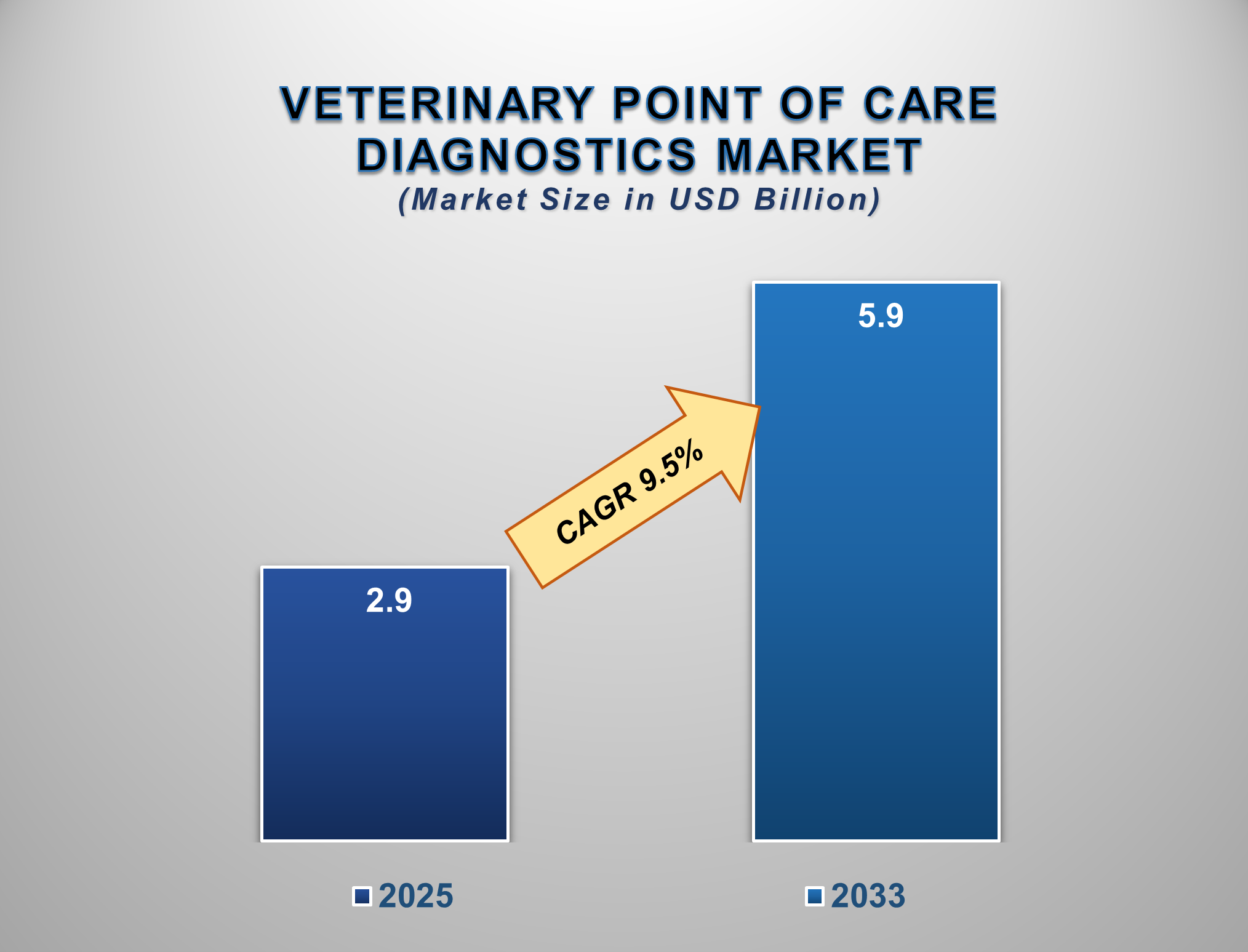
Veterinary point-of-care diagnostics encompass a wide range of tests and devices used to perform diagnostic procedures at or near the site of patient care, delivering results within minutes. This immediacy allows veterinarians to diagnose conditions, monitor treatments, and initiate therapies without delay, greatly enhancing patient outcomes and client satisfaction. The market's growth is primarily driven by the surging pet ownership globally, coupled with the increasing willingness of pet owners to spend on advanced healthcare.
The trend towards humanization of pets is
leading to a higher standard of care, comparable to human medicine, where rapid
diagnostics are the norm. Technological advancements that have made POC devices
more compact, affordable, and user-friendly are also critical drivers. North
America currently leads the market, while the Asia-Pacific region is
anticipated to witness the fastest growth, spurred by a growing middle class,
increasing awareness of animal health, and the development of veterinary
infrastructure.
Veterinary Point of Care Diagnostics Market
Drivers and Opportunities
Rising Pet Ownership and Humanization of Pets are the Primary
Market Drivers
The increasing number of companion animals and
their elevated status as family members represent the most significant driver
for the veterinary POC diagnostics market. Pet owners are now more invested in
the health and well-being of their animals, seeking immediate and high-quality
medical care. This shift in mindset translates to a greater demand for
in-clinic testing that provides quick answers, avoids the anxiety of waiting
for external lab results, and enables faster treatment. Conditions like diabetes,
kidney disease, and infections can be managed more effectively with regular,
on-the-spot monitoring. This client-driven demand for rapid service and
comprehensive care is compelling veterinary practices to invest in POC
diagnostic equipment, making it a standard of care in modern veterinary
practice.
Growing Prevalence of Zoonotic and Chronic Diseases in
Animals is Driving Market Evolution
The rising incidence of chronic diseases such as
diabetes, arthritis, and renal failure in aging pet populations, alongside the
persistent threat of zoonotic diseases (like Lyme disease or leptospirosis), necessitates frequent and rapid diagnostic monitoring. POC
testing allows for the immediate detection of these conditions during a single
visit, facilitating prompt intervention and long-term disease management. For
livestock, the economic impact of diseases like Bovine Respiratory Disease
(BRD) or mastitis drives the need for rapid on-farm testing to isolate sick
animals, prevent herd-wide outbreaks, and optimize antibiotic use. This focus
on preventive healthcare and biosecurity in both companion and livestock
animals is a major catalyst for the adoption of POC diagnostics.
Technological Innovation and Expansion into Home Care Present
Significant Opportunities
Continuous technological advancements are
creating substantial growth frontiers for the market. Key opportunities lie in
the development of multi-analyte platforms that can run a suite of tests (e.g.,
chemistry, electrolytes, immunoassays) from a single small blood sample. The
integration of connectivity features, such as cloud-based data management and
digital health records, allows for seamless tracking of patient health over
time. Another significant opportunity is the emerging market for at-home POC
test kits, allowing pet owners to monitor certain health parameters, such as
glucose levels or UTI strips, between veterinary visits. For manufacturers,
investing in R&D for novel biomarkers, creating more robust and portable
devices for field use in livestock, and tapping into the vast potential of
emerging markets are key strategies for future growth.
Veterinary Point of Care Diagnostics Market Scope
|
Report Attributes |
Description |
|
Market Size in 2025 |
USD 2.9 Billion |
|
Market Forecast in 2033 |
USD 5.9 Billion |
|
CAGR % 2025-2033 |
9.5% |
|
Base Year |
2024 |
|
Historic Data |
2020-2024 |
|
Forecast Period |
2025-2033 |
|
Report USP |
Product Portfolio,
Technological Analysis, Company Market Share, Company Heatmap, Pricing
Analysis, Growth Factors and more |
|
Segments Covered |
●
By Product ●
By Technology ●
By Animal Type ●
By End-user |
|
Regional Scope |
●
North America, ●
Europe, ●
APAC, ●
Latin America ●
Middle East and
Africa |
|
Country Scope |
1)
U.S. 2)
Canada 3)
Germany 4)
UK 5)
France 6)
Spain 7)
Italy 8)
Switzerland 9)
China 10)
Japan 11)
India 12)
Australia 13)
South Korea 14)
Brazil 15)
Mexico 16)
Argentina 17)
South Africa 18)
Saudi Arabia 19)
UAE |
Veterinary Point of Care Diagnostics Market
Report Segmentation Analysis
The global Veterinary Point of
Care Diagnostics Market industry analysis is segmented by Product, by
Technology, by Animal Type, by End-User, and by region.
The Consumables segment
is anticipated to command a dominant market share in 2025.
The Product segment is categorized into Consumables and Devices. The Consumables segment, which includes test kits, reagents, cartridges, and dipsticks, commands the largest market share. This is due to their recurrent nature of purchase; while a diagnostic analyzer is a one-time capital investment, the consumables are purchased continuously for every test run. The high and growing volume of POC tests performed daily in veterinary clinics and hospitals worldwide ensures consistent and recurring revenue from this segment. The development of multi-test panels and the expansion of test menus further drive the consumption of these disposable products.
The Companion Animals
segment is projected to be the largest and fastest-growing.
The
Animal Type segment is divided into Companion Animals and Livestock Animals.
The Companion Animals segment is the largest and fastest-growing segment. This
dominance is directly linked to the primary market driver of pet humanization.
The deep emotional bond between owners and their pets leads to higher spending
on advanced healthcare services. Companion animals, especially dogs and cats,
are also more frequently presented to veterinarians for routine check-ups,
vaccinations, and illness, creating more opportunities for POC testing compared
to livestock, where testing is often more targeted towards disease outbreaks or
herd health screening.
The Immunoassay segment
is projected to exhibit strong growth.
The
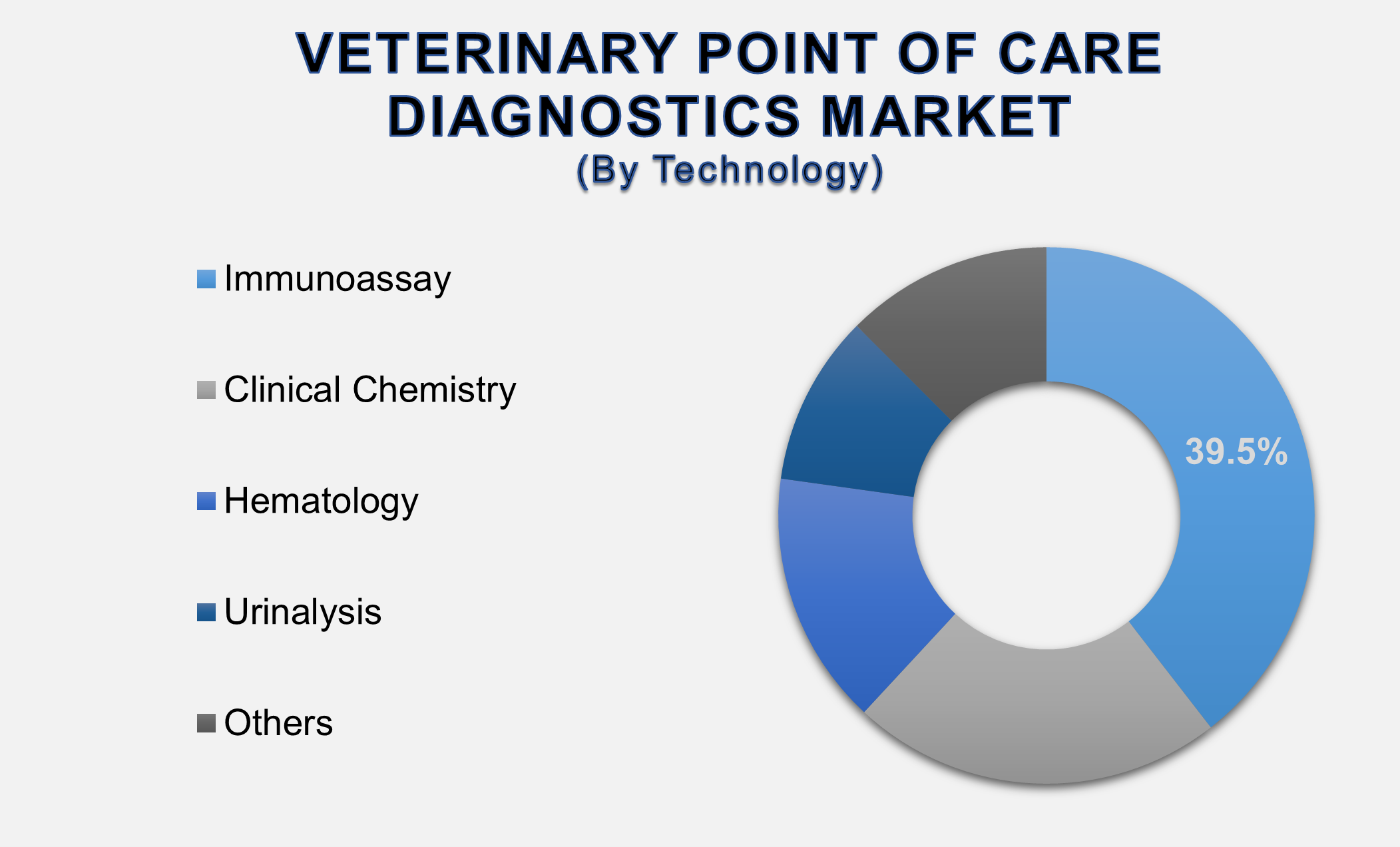
Technology segment includes Immunoassay, Clinical Chemistry, Hematology,
Urinalysis, and Others. The Immunoassay segment exhibits strong growth due to
its critical role in detecting specific pathogens, hormones, and biomarkers.
This technology is essential for rapid tests for heartworm, Lyme disease,
Ehrlichia, Parvovirus, and Feline Immunodeficiency Virus (FIV). The high
sensitivity and specificity of immunoassays, combined with their format as
easy-to-use lateral flow assays (rapid test kits), make them immensely popular
in the clinic for confirming infections and guiding treatment decisions
quickly. The continuous introduction of new tests for various infectious
diseases ensures this segment's robust expansion.
The following segments are
part of an in-depth analysis of the global Veterinary Point of Care Diagnostics
Market:
|
Market
Segments |
|
|
By Product |
●
Consumables ●
Devices |
|
By Technology |
●
Immunoassay ●
Clinical Chemistry ●
Hematology ●
Urinalysis ●
Others |
|
By Animal Type |
●
Companion Animals ●
Livestock Animals |
|
By End-user |
●
Veterinary Hospitals
& Clinics ●
Home Care Settings |
Veterinary Point of Care Diagnostics Market Share
Analysis by Region
The North America region
is anticipated to hold the largest portion of the Veterinary Point of Care
Diagnostics Market globally throughout the forecast period.
North
America's dominance is attributed to its well-established and technologically
advanced veterinary healthcare infrastructure, high pet insurance penetration,
and strong presence of leading market players. The region has a high number of
veterinary practices that have adopted POC diagnostics as a standard of care.
High awareness and spending power of pet owners, coupled with stringent
regulations promoting animal health and welfare, solidify North America's
position as the largest regional market.
The
U.S. boasts the world's largest per capita
expenditure on pet care, with the American Pet Products Association (APPA)
estimating national spending to exceed US$147 billion in 2023. This
immense financial commitment directly fuels the demand for advanced veterinary
services, including immediate diagnostics. The country's advanced veterinary
infrastructure is a key driver, with over 30,000 private veterinary
clinics and a rapidly consolidating network of large corporate-owned
hospitals. These entities heavily invest in POC equipment to enhance clinical
efficiency and client service.
Technologically,
the U.S. is the headquarters for global industry leaders like IDEXX
Laboratories and Zoetis, which continuously drive innovation and set the
standard for in-clinic testing. Their widespread distribution networks and deep
market penetration ensure the rapid adoption of new devices and consumables.
Culturally, the intense "humanization" of pets compels owners to seek
a standard of care parallel to human medicine, where rapid, accurate
diagnostics are non-negotiable. This demand, supported by high pet insurance
adoption and stringent standards of care, ensures the U.S. will maintain its
dominant market position for the foreseeable future.
Veterinary Point of Care Diagnostics Market
Competition Landscape Analysis
The global veterinary point of
care diagnostics market is moderately consolidated and is characterized by the
presence of both large, diversified medical companies and specialized
veterinary diagnostic firms. Competition is intense and based on factors such
as product accuracy, test menu breadth, ease of use, price, and the strength of
distribution and support networks. Key strategies observed in the market
include continuous product innovation and launches, strategic acquisitions to
expand technological portfolios and geographic reach, and forming partnerships
with veterinary teaching hospitals and large corporate practice chains.
Global Veterinary Point
of Care Diagnostics Market Recent Developments News:
- In January 2025, IDEXX Laboratories, Inc.,
announced the launch of its next-generation in-clinic chemistry analyzer,
featuring enhanced connectivity and a broader test menu for exotic pets.
- In October 2024, Zoetis Inc. acquired a company specializing in
digital cytology and AI-based image analysis for POC diagnostics.
- In August 2024, Heska Corporation (now part of Mars, Inc.) received
CE marking for its new multi-parameter POC blood analyzer designed for
high-volume veterinary hospitals.
- In May 2024, Virbac launched a new rapid, single-use test for the
early detection of Feline Leukemia
Virus (FeLV) antigen in-clinic.
The Global Veterinary
Point of Care Diagnostics Market Is Dominated by a Few Large Companies, such as
●
IDEXX Laboratories,
Inc.
●
Zoetis Inc.
●
Thermo Fisher
Scientific Inc.
●
Heska Corporation
●
Virbac
●
bioMérieux SA
●
Randox Laboratories
Ltd.
●
Woodley Equipment
Company Ltd.
●
CareHealth America
Corporation
●
Eurolyser Diagnostica
GmbH
●
NeuroLogica Corp.
●
Shenzhen Mindray
Animal Medical Technology Co., Ltd.
●
Henry Schein, Inc.
●
Abaxis
● Other Prominent Players
Frequently Asked Questions
Swetal (Research Analyst)
Swetal is a Research Analyst with 4+ years of experience specializing in healthcare market research, medical devices, healthcare IT, and medical technology industry analysis. Her expertise includes competitive intelligence, secondary research, market trend forecasting, and healthcare business insights across global healthcare ecosystems.
She contributes to advanced market research reports by analyzing regulatory frameworks, emerging healthcare technologies, competitive landscapes, and innovation trends shaping the medical industry. With a strong focus on accurate market intelligence, strategic insights, and healthcare industry trends, Swetal supports businesses in making informed, data-backed decisions in a rapidly transforming healthcare environment.
1. Global Veterinary Point of Care Diagnostics Market Introduction
and Market Overview
1.1.
Objectives
of the Study
1.2.
Global
Veterinary Point of Care Diagnostics Market Scope and Market Estimation
1.2.1.Global Electronic Toll
Collection Overall Market Size (US$ Mn), Market CAGR (%), Market forecast (2025
- 2033)
1.2.2.Global Veterinary Point of
Care Diagnostics Market Revenue Share (%) and Growth Rate (Y-o-Y) from 2020 - 2033
1.3.
Market
Segmentation
1.3.1.Product of Global Veterinary
Point of Care Diagnostics Market
1.3.2.Technology of Global Veterinary
Point of Care Diagnostics Market
1.3.3.Animal Type of Global Veterinary
Point of Care Diagnostics Market
1.3.4.End-user of Global Veterinary
Point of Care Diagnostics Market
1.3.5.Region of Global Veterinary
Point of Care Diagnostics Market
2. Executive
Summary
2.1.
Demand
Side Trends
2.2.
Key
Market Trends
2.3.
Market
Demand (US$ Mn) Analysis 2020 – 2024 and forecast, 2025 – 2033
2.4.
Demand
and Opportunity Assessment
2.5.
Technological
Advancements
2.6.
Regulatory
Scenario by Region
2.7.
Key
Developments
2.8.
Market
Entry Strategies
2.9.
Market
Dynamics
2.9.1.Drivers
2.9.2.Limitations
2.9.3.Opportunities
2.9.4.Impact Analysis of Drivers
and Restraints
2.10.
Porter’s
Five Forces Analysis
2.11.
PEST
Analysis
3. Global
Veterinary Point of Care Diagnostics Market
Estimates & Historical Trend Analysis (2020 - 2024)
4. Global
Veterinary Point of Care Diagnostics Market
Estimates & Forecast Trend Analysis, by Product
4.1.
Global
Veterinary Point of Care Diagnostics Market Revenue (US$ Mn) Estimates and
Forecasts, by Product, 2020 - 2033
4.1.1.Consumables
4.1.2.Devices
5. Global
Veterinary Point of Care Diagnostics Market
Estimates & Forecast Trend Analysis, by Technology
5.1.
Global
Veterinary Point of Care Diagnostics Market Revenue (US$ Mn) Estimates and
Forecasts, by Technology, 2020 - 2033
5.1.1.Immunoassay
5.1.2.Clinical Chemistry
5.1.3.Hematology
5.1.4.Urinalysis
5.1.5.Others
6. Global
Veterinary Point of Care Diagnostics Market
Estimates & Forecast Trend Analysis, by Animal
Type
6.1.
Global
Veterinary Point of Care Diagnostics Market Revenue (US$ Mn) Estimates and
Forecasts, by Animal Type 2020 - 2033
6.1.1.Companion Animals
6.1.2.Livestock Animals
7. Global
Veterinary Point of Care Diagnostics Market
Estimates & Forecast Trend Analysis, by End-user
7.1.
Global
Veterinary Point of Care Diagnostics Market Revenue (US$ Mn) Estimates and
Forecasts, by End-user 2020 - 2033
7.1.1.Veterinary Hospitals &
Clinics
7.1.2.Home Care Settings
8. Global
Veterinary Point of Care Diagnostics Market
Estimates & Forecast Trend Analysis, by region
8.1.
Global
Veterinary Point of Care Diagnostics Market Revenue (US$ Mn) Estimates and
Forecasts, by region, 2020 - 2033
8.1.1.North America
8.1.2.Europe
8.1.3.Asia Pacific
8.1.4.Middle East & Africa
8.1.5.Latin America
9. North America Veterinary
Point of Care Diagnostics Market:
Estimates & Forecast Trend Analysis
9.1.
North
America Veterinary Point of Care Diagnostics Market Assessments & Key
Findings
9.1.1.North America Veterinary
Point of Care Diagnostics Market Introduction
9.1.2.North America Veterinary
Point of Care Diagnostics Market Size Estimates and Forecast (US$ Billion) (2020
- 2033)
9.1.2.1. By Product
9.1.2.2. By Technology
9.1.2.3. By Animal
Type
9.1.2.4. By End-user
9.1.2.5.
By
Country
9.1.2.5.1. The U.S.
9.1.2.5.2. Canada
10. Europe Veterinary
Point of Care Diagnostics Market:
Estimates & Forecast Trend Analysis
10.1.
Europe
Veterinary Point of Care Diagnostics Market Assessments & Key Findings
10.1.1.
Europe
Veterinary Point of Care Diagnostics Market Introduction
10.1.2.
Europe
Veterinary Point of Care Diagnostics Market Size Estimates and Forecast (US$ Billion)
(2020 - 2033)
10.1.2.1. By Product
10.1.2.2. By Technology
10.1.2.3. By Animal
Type
10.1.2.4. By End-user
10.1.2.5.
By
Country
10.1.2.5.1.
Germany
10.1.2.5.2.
Italy
10.1.2.5.3.
U.K.
10.1.2.5.4.
France
10.1.2.5.5.
Spain
10.1.2.5.6.
Switzerland
10.1.2.5.7. Rest
of Europe
11. Asia Pacific Veterinary
Point of Care Diagnostics Market:
Estimates & Forecast Trend Analysis
11.1.
Asia
Pacific Market Assessments & Key Findings
11.1.1.
Asia
Pacific Veterinary Point of Care Diagnostics Market Introduction
11.1.2.
Asia
Pacific Veterinary Point of Care Diagnostics Market Size Estimates and Forecast
(US$ Billion) (2020 - 2033)
11.1.2.1. By Product
11.1.2.2. By Technology
11.1.2.3. By Animal
Type
11.1.2.4. By End-user
11.1.2.5.
By
Country
11.1.2.5.1. China
11.1.2.5.2. Japan
11.1.2.5.3. India
11.1.2.5.4. Australia
11.1.2.5.5. South Korea
11.1.2.5.6. Rest of Asia Pacific
12. Middle East & Africa Veterinary
Point of Care Diagnostics Market:
Estimates & Forecast Trend Analysis
12.1.
Middle
East & Africa Market Assessments & Key Findings
12.1.1.
Middle East & Africa Veterinary Point of Care Diagnostics
Market Introduction
12.1.2.
Middle East & Africa Veterinary Point of Care Diagnostics
Market Size Estimates and Forecast (US$ Billion) (2020 - 2033)
12.1.2.1. By Product
12.1.2.2. By Technology
12.1.2.3. By Animal
Type
12.1.2.4. By End-user
12.1.2.5.
By
Country
12.1.2.5.1. UAE
12.1.2.5.2. Saudi
Arabia
12.1.2.5.3. South
Africa
12.1.2.5.4. Rest
of MEA
13. Latin America
Veterinary Point of Care Diagnostics Market: Estimates & Forecast Trend Analysis
13.1.
Latin
America Market Assessments & Key Findings
13.1.1.
Latin
America Veterinary Point of Care Diagnostics Market Introduction
13.1.2.
Latin
America Veterinary Point of Care Diagnostics Market Size Estimates and Forecast
(US$ Billion) (2020 - 2033)
13.1.2.1. By Product
13.1.2.2. By Technology
13.1.2.3. By Animal
Type
13.1.2.4. By End-user
13.1.2.5.
By
Country
13.1.2.5.1. Brazil
13.1.2.5.2. Argentina
13.1.2.5.3. Mexico
13.1.2.5.4. Rest
of LATAM
14. Country Wise Market:
Introduction
15.
Competition
Landscape
15.1.
Global
Veterinary Point of Care Diagnostics Market Product Mapping
15.2.
Global
Veterinary Point of Care Diagnostics Market Concentration Analysis, by Leading
Players / Innovators / Emerging Players / New Entrants
15.3.
Global
Veterinary Point of Care Diagnostics Market Tier Structure Analysis
15.4.
Global
Veterinary Point of Care Diagnostics Market Concentration & Company Market
Shares (%) Analysis, 2024
16.
Company
Profiles
16.1.
IDEXX Laboratories, Inc.
16.1.1.
Company
Overview & Key Stats
16.1.2.
Financial
Performance & KPIs
16.1.3.
Product
Portfolio
16.1.4.
SWOT
Analysis
16.1.5.
Business
Strategy & Recent Developments
* Similar details would be provided for all the players
mentioned below
16.2. Zoetis Inc.
16.3. Thermo Fisher
Scientific Inc.
16.4. Heska
Corporation (Part of Mars, Inc.)
16.5. Virbac
16.6. bioMérieux SA
(via its subsidiary bioMérieux Vet)
16.7. Randox
Laboratories Ltd.
16.8. Woodley
Equipment Company Ltd.
16.9. CareHealth
America Corporation
16.10. Eurolyser
Diagnostica GmbH
16.11. NeuroLogica
Corp. (A Samsung Electronics Company)
16.12. Shenzhen
Mindray Animal Medical Technology Co., Ltd.
16.13. Henry Schein,
Inc.
16.14. Abaxis
16.15. Other
Prominent Players
17. Research
Methodology
17.1.
External
Transportations / Databases
17.2.
Internal
Proprietary Database
17.3.
Primary
Research
17.4.
Secondary
Research
17.5.
Assumptions
17.6.
Limitations
17.7.
Report
FAQs
18. Research
Findings & Conclusion
Our Research Methodology
"Insight without rigor is just noise."
We follow a comprehensive, multi-phase research framework designed to deliver accurate, strategic, and decision-ready intelligence. Our process integrates primary and secondary research , both quantitative and qualitative , along with dual modeling techniques ( top-down and bottom-up) and a final layer of validation through our proprietary in-house repository.
PRIMARY RESEARCH
Primary research captures real-time, firsthand insights from the market to understand behaviors, motivations, and emerging trends.
1. Quantitative Primary Research
Objective: Generate statistically significant data directly from market participants.
Approaches:- Structured surveys with customers, distributors, and field agents
- Mobile-based data collection for point-of-sale audits and usage behavior
- Phone-based interviews (CATI) for market sizing and product feedback
- Online polling around industry events and digital campaigns
- Purchase frequency by customer type
- Channel performance across geographies
- Feature demand by application or demographic
2. Qualitative Primary Research
Objective: Explore decision-making drivers, pain points, and market readiness.
Approaches:- In-depth interviews (IDIs) with executives, product managers, and key decision-makers
- Focus groups among end users and early adopters
- Site visits and observational research for consumer products
- Informal field-level discussions for regional and cultural nuances
SECONDARY RESEARCH
This phase helps establish a macro-to-micro understanding of market trends, size, regulation, and competitive dynamics, sourced from credible and public domain information.
1. Quantitative Secondary Research
Objective: Model market value and segment-level forecasts based on published data.
Sources include:- Financial reports and investor summaries
- Government trade data, customs records, and regulatory statistics
- Industry association publications and economic databases
- Channel performance and pricing data from marketplace listings
- Revenue splits, pricing trends, and CAGR estimates
- Supply-side capacity and volume tracking
- Investment analysis and funding benchmarks
2. Qualitative Secondary Research
Objective: Capture strategic direction, innovation signals, and behavioral trends.
Sources include:- Company announcements, roadmaps, and product pipelines
- Publicly available whitepapers, conference abstracts, and academic research
- Regulatory body publications and policy briefs
- Social and media sentiment scanning for early-stage shifts
- Strategic shifts in market positioning
- Unmet needs and white spaces
- Regulatory triggers and compliance impact

DUAL MODELING: TOP-DOWN + BOTTOM-UP
To ensure robust market estimation, we apply two complementary sizing approaches:
Top-Down Modeling:- Start with broader industry value (e.g., global or regional TAM)
- Apply filters by segment, geography, end-user, or use case
- Adjust with primary insights and validation benchmarks
- Ideal for investor-grade market scans and opportunity mapping
- Aggregate from the ground up using sales volumes, pricing, and unit economics
- Use internal modeling templates aligned with stakeholder data
- Incorporate distributor-level or region-specific inputs
- Most accurate for emerging segments and granular sub-markets
DATA VALIDATION: IN-HOUSE REPOSITORY
We close the loop with proprietary data intelligence built from ongoing projects, industry monitoring, and historical benchmarking. This repository includes:
- Multi-sector market and pricing models
- Key trendlines from past interviews and forecasts
- Benchmarked adoption rates, churn patterns, and ROI indicators
- Industry-specific deviation flags and cross-check logic
- Catches inconsistencies early
- Aligns projections across studies
- Enables consistent, high-trust deliverables