

Virtual Companion Care Market Size and Forecast (2020 - 2033), Global and Regional Growth, Trend, Share, and Industry Analysis Report Coverage: By Service Type (Video Service, Voice Service, Others), By End User (Long-term Care Centers, Home Care Settings, Rehabilitation Centers, Others), And Geography
2025-12-30
Chemicals & Materials
Jaya Bundele (Research Analyst)
Description
Virtual
Companion Care Market Overview
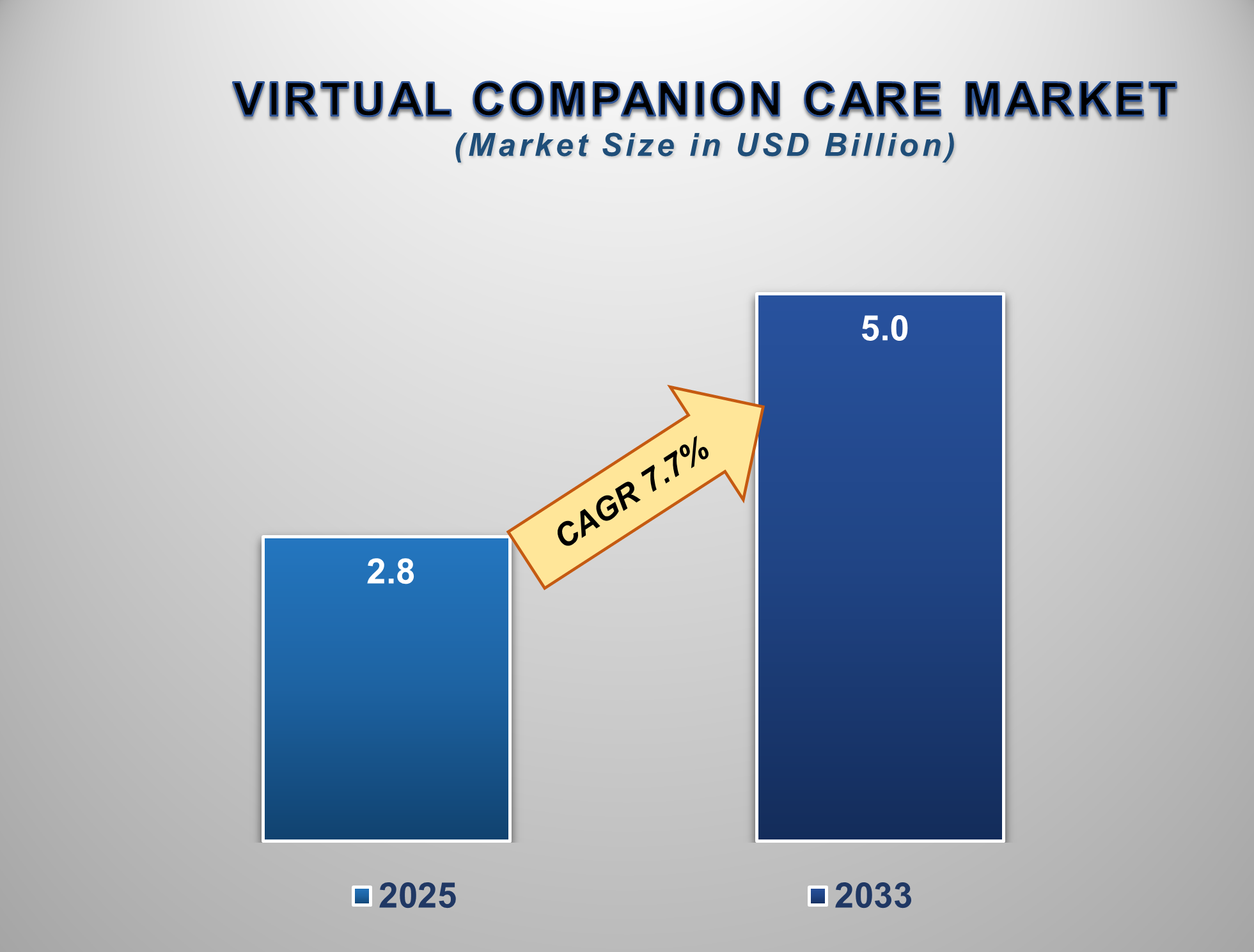
The global Virtual Companion Care Market is poised for exceptional growth from 2025 to 2033, driven by a rapidly aging global population, increasing societal focus on mental health and social isolation, and significant technological advancements in telehealth and artificial intelligence. The market was estimated at USD 2.8 billion in 2024 and is projected to reach USD 5.0 billion by 2033, exhibiting a compound annual growth rate (CAGR) of 7.7% during this period.
Virtual companion care refers to digital services designed
to provide individuals, particularly the elderly and those with special needs,
with emotional support, social connection, and non-clinical assistance through
technological platforms. The market's expansion is underpinned by the critical
objective of promoting independent living, combating loneliness, and extending
care beyond the clinical setting to enhance overall quality of life. A key
trend is the evolution from basic voice and video calls to AI-driven,
empathetic interactions capable of monitoring health and providing personalized
engagement. Factors such as growing acceptance of telehealth, escalating
healthcare costs, and a global shortage of caregivers are key contributors to
market growth. North America currently holds the largest market share due to
advanced healthcare infrastructure and supportive regulatory environments,
while the Asia-Pacific region is expected to be the fastest-growing market,
fueled by a massive aging demographic, rapid digitalization, and government
initiatives.
Virtual Companion Care Market Drivers and
Opportunities
Aging Global Population and Rising Demand for Accessible Care
are the Primary Market Drivers
The most significant driver for the virtual companion care
market is the unprecedented demographic shift towards an older population
worldwide. By 2050, the global elderly population is expected to double,
creating immense pressure on traditional healthcare systems and families.
Virtual companion care offers a scalable, cost-effective solution that allows
seniors to age in place safely, providing continuous companionship and
monitoring without the need for a full-time, in-person caregiver. This demand is
further amplified by a well-documented shortage of professional caregivers and
the increasing prevalence of chronic diseases that require ongoing management
and support.
Technological Integration of AI and IoT Presents a Major
Growth Vector
A powerful and defining trend is the accelerated
integration of sophisticated technologies, including Artificial Intelligence
(AI), machine learning, and Internet of Things (IoT) devices. These
technologies are transforming virtual companions from simple communication
tools into proactive, predictive support systems. AI enables natural,
empathetic conversations, emotion recognition, and adaptive learning to
personalize interactions. When combined with IoT wearables and smart home
sensors, these systems can monitor vital signs, detect falls, and automate
daily tasks, creating a holistic and intelligent care ecosystem. This evolution
significantly enhances their value proposition and opens new revenue streams.
Post-Pandemic Acceptance of Telehealth and Corporate
Expansion Creates Significant Opportunities
The COVID-19 pandemic fundamentally accelerated the
adoption of all forms of remote care and normalized digital interaction for
vulnerable populations. This lasting shift in consumer and provider behavior presents a sustained tailwind for the market. Key
opportunities for market players lie in developing multilingual platforms for
global markets, forging partnerships with major healthcare providers and
insurers to integrate services into patient management and reimbursement
models, and creating specialized offerings for chronic disease management,
post-surgery care, and mental health support to address specific, high-need
applications.
Virtual Companion Care Market Scope
|
Report Attributes |
Description |
|
Market Size in 2025 |
USD 2.8 Billion |
|
Market Forecast in 2033 |
USD 5.0 Billion |
|
CAGR % 2025-2033 |
7.7% |
|
Base Year |
2024 |
|
Historic Data |
2020-2024 |
|
Forecast Period |
2025-2033 |
|
Report USP |
Product Portfolio,
Technological Analysis, Company Market Share, Company Heatmap, Pricing
Analysis, Growth Factors and more |
|
Segments Covered |
●
By Service Type ●
By End-User |
|
Regional Scope |
●
North America, ●
Europe, ●
APAC, ●
Latin America ●
Middle East and
Africa |
|
Country Scope |
1)
U.S. 2)
Canada 3)
Germany 4)
UK 5)
France 6)
Spain 7)
Italy 8)
Switzerland 9)
China 10)
Japan 11)
India 12)
Australia 13)
South Korea 14)
Brazil 15)
Mexico 16)
Argentina 17)
South Africa 18)
Saudi Arabia 19)
UAE |
Virtual Companion Care Market Report Segmentation
Analysis
The global Virtual
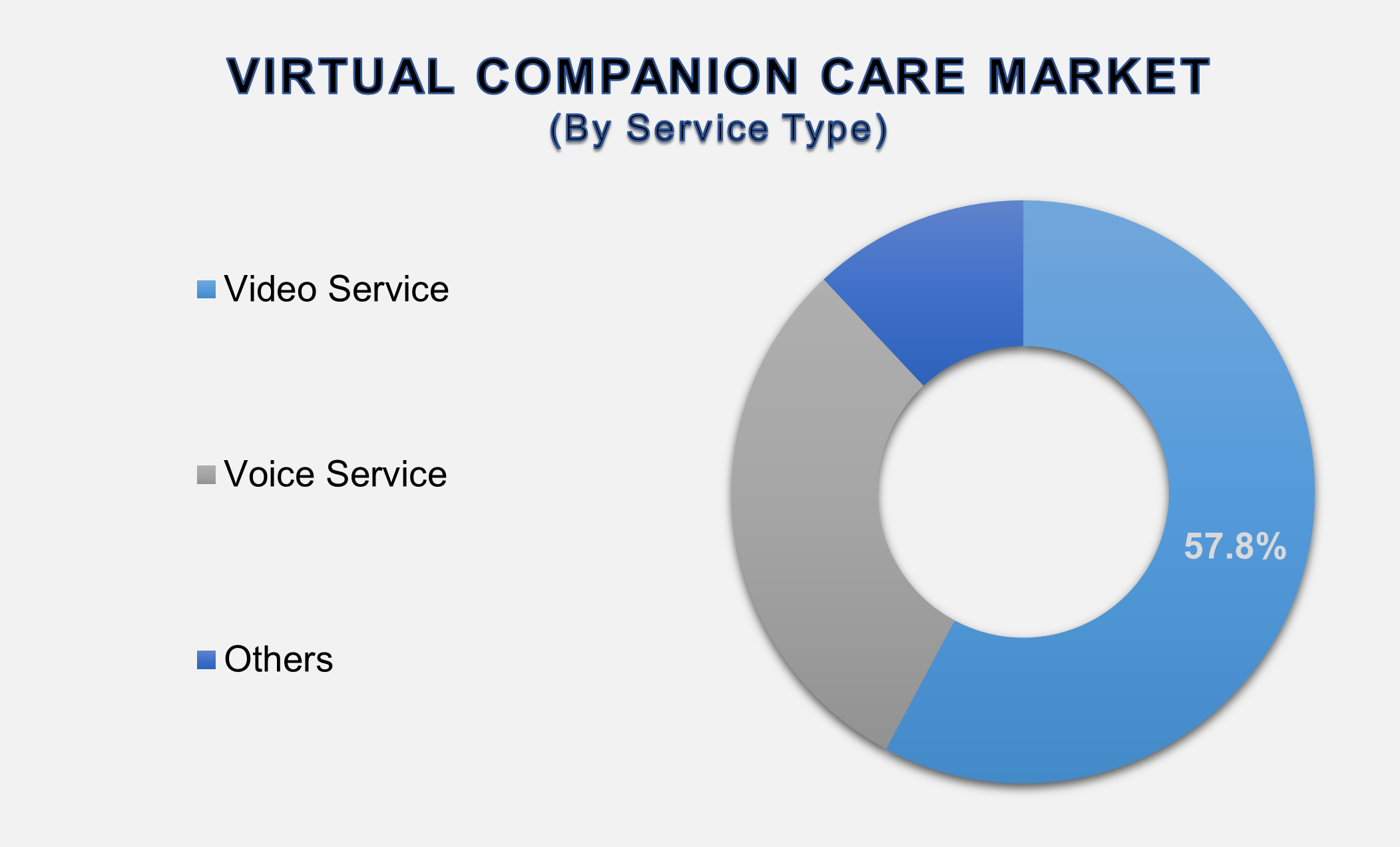
Companion Care Market is segmented by Service Type and End-user Region.
The
Video Service segment is positioned as both the largest and fastest-growing
category within the virtual companion care market due to its unparalleled
ability to deliver high-fidelity, emotionally resonant support. Unlike voice or
text-based services, live video facilitates genuine face-to-face interaction,
enabling caregivers and family members to observe a senior's physical
condition, living environment, and non-verbal cues—critical elements for holistic well-being and safety monitoring.
This visual component allows for proactive health checks, such as noticing changes in mobility, signs of potential falls, or fluctuations in general appearance that might indicate a health issue, turning a simple check-in into a valuable wellness assessment. The widespread proliferation of high-speed broadband and 5G, coupled with the mass adoption of intuitive video platforms during the COVID-19 pandemic, has normalized this technology for older adults and their support networks. Consequently, video service has evolved from a supplementary communication tool into the foundational medium for remote companionship and care, offering a scalable solution that effectively bridges geographical distance while preserving the human connection essential for combating social isolation and promoting mental health.
The Home Care Settings
Segment dominates the virtual companion care market
The
Home Care Settings segment is the cornerstone and dominant end-user of the
virtual companion care market, fundamentally driven by the powerful and nearly
universal preference among seniors for "aging in place." This trend
reflects a deep-seated desire to maintain independence, dignity, and comfort
within one's own familiar environment for as long as possible, rather than
transitioning to an institutional setting. Virtual companion care serves as a
critical technological enabler of this preference, offering a compelling and
cost-effective alternative to full-time, in-person caregiving.
By
providing scheduled and on-demand video check-ins, medication reminders, and
social engagement, these platforms directly address key challenges of living
alone, such as loneliness and safety concerns. For family members and
professional care coordinators, virtual services deliver indispensable peace of
mind through remote monitoring capabilities, allowing them to verify well-being
and intervene proactively if needed. This capability not only enhances the
quality of life for the senior but also acts as a powerful tool to delay or
reduce the need for more expensive and disruptive institutional care, aligning
perfectly with both personal desires and broader healthcare system goals
focused on reducing hospitalization and long-term care facility admissions.
The following segments are
part of an in-depth analysis of the global Virtual Companion Care Market:
|
Market
Segments |
|
|
By Service
Type |
●
Video Service ●
Voice Service ●
Others |
|
By
End-user |
●
Long-term Care
Centers ●
Home Care Settings ●
Rehabilitation
Centers ●
Others |
Virtual Companion Care Market Share Analysis by
Region
The North America region
is anticipated to hold the largest portion of the Virtual Companion Care Market
globally throughout the forecast period.
North
America's dominance is attributed to its advanced technological infrastructure,
high healthcare expenditure, and a mature telehealth regulatory framework that
facilitates reimbursement. The region has a high concentration of innovative
technology companies and healthcare providers who are early adopters of digital
health solutions. A significant aging population with growing disposable income
further drives demand, solidifying the region's leadership. The Asia-Pacific
region is poised to be the fastest-growing market, driven by its rapidly
expanding elderly population, particularly in countries like Japan and China,
coupled with improving digital connectivity and supportive government policies
promoting home-based care. Rising healthcare costs and a cultural emphasis on
family care are also accelerating the search for technological solutions to
support caregivers, creating a fertile ground for market expansion.
Virtual Companion Care Market Competition
Landscape Analysis
The global virtual companion
care market is fragmented and evolving, featuring a diverse mix of healthcare
technology firms, established medical device companies, telecommunications
giants, and innovative startups. Competition centers on technological sophistication
(especially AI capabilities), user experience, integration with broader
healthcare ecosystems, and the ability to form strategic partnerships with
insurers and care providers. Key strategies include heavy investment in R&D
for emotion-aware AI, forming alliances with hardware manufacturers for
integrated device solutions, and geographic expansion to capture growth in
underserved but populous regions like the Asia-Pacific.
Global Virtual Companion Care Market Recent Developments
News:
- In May 2025, Microsoft announced a strategic partnership with Elder
Care Technologies to integrate AI-powered companion features into Windows
and Azure for elder-care solutions.
- In June 2025, Google announced a collaboration with Intuition
Robotics to co-develop AI-assisted elder-care tools for Google Cloud and
Android devices.
- In April 2025, Amazon announced the launch of a home care assistant
robot integrated with Alexa for remote elder-care support.
- In March 2021, HealthTap, a virtual healthcare service provider,
announced the expansion of its primary care service in virtual mode,
starting in seven U.S. states.
The Global Virtual Companion Care Market Is
Dominated by a Few Large Companies, such as
●
Claris Healthcare Inc.
●
General Electric
Company (GE Healthcare)
●
AT&T Inc.
●
Koninklijke Philips NV.
●
GeriJoy Limited
●
UnitedHealth Group
(United HealthCare Services)
●
Amazon.com, Inc.
●
Apple Inc.
●
Google LLC (Alphabet
Inc.)
●
Microsoft Corporation
●
Intuition Robotics
● Other Prominent Players
Frequently Asked Questions
Jaya Bundele (Research Analyst)
Jaya Bundele is a skilled Research Analyst with 4+ years of experience in market intelligence, consumer insights, competitive analysis, and industry forecasting across the consumer goods, agriculture, and food & beverage sectors. She specializes in market sizing, trend analysis, growth opportunity mapping, and strategic secondary research for global and regional markets.
Her expertise lies in transforming complex industry data into actionable business strategies that help organizations identify emerging trends, understand customer behavior, and gain a competitive edge. With a strong focus on data-driven insights, business intelligence, and future market trends, Jaya delivers high-quality research solutions aligned with evolving industry demands and market dynamics.
1. Global Virtual Companion
Care Market Introduction and Market Overview
1.1.
Objectives
of the Study
1.2.
Global
Virtual Companion Care Market Scope and Market Estimation
1.2.1.Global Electronic Toll
Collection Overall Market Size (US$ Bn), Market CAGR (%), Market forecast (2025
- 2033)
1.2.2.Global Virtual Companion
Care Market Revenue Share (%) and Growth Rate (Y-o-Y) from 2020 - 2033
1.3.
Market
Segmentation
1.3.1.Service Type of Global Virtual
Companion Care Market
1.3.2.End-user of Global Virtual
Companion Care Market
1.3.3.Region of Global Virtual
Companion Care Market
2. Executive
Summary
2.1.
Demand
Side Trends
2.2.
Key
Market Trends
2.3.
Market
Demand (US$ Bn) Analysis 2020 – 2024 and forecast, 2025 – 2033
2.4.
Demand
and Opportunity Assessment
2.5.
Key
Developments
2.6.
Market
Entry Strategies
2.7.
Market
Dynamics
2.7.1.Drivers
2.7.2.Limitations
2.7.3.Opportunities
2.7.4.Impact Analysis of Drivers
and Restraints
2.8.
Porter’s
Five Forces Analysis
2.9.
Pricing
Analysis
2.10.
PEST
Analysis
3. Global
Virtual Companion Care Market Estimates
& Historical Trend Analysis (2020 - 2024)
4. Global
Virtual Companion Care Market Estimates
& Forecast Trend Analysis, by Service Type
4.1.
Global
Virtual Companion Care Market Revenue (US$ Bn) Estimates and Forecasts, by Service
Type, 2020 - 2033
4.1.1.Video Service
4.1.2.Voice Service
4.1.3.Others
5. Global
Virtual Companion Care Market Estimates
& Forecast Trend Analysis, by End-user
5.1.
Global
Virtual Companion Care Market Revenue (US$ Bn) Estimates and Forecasts, by End-user,
2020 - 2033
5.1.1.Long-term Care Centers
5.1.2.Home Care Settings
5.1.3.Rehabilitation Centers
6. Global
Virtual Companion Care Market Estimates
& Forecast Trend Analysis, by region
6.1.
Global
Virtual Companion Care Market Revenue (US$ Bn) Estimates and Forecasts, by region,
2020 - 2033
6.1.1.North America
6.1.2.Europe
6.1.3.Asia Pacific
6.1.4.Middle East & Africa
6.1.5.Latin America
7. North America Virtual
Companion Care Market: Estimates &
Forecast Trend Analysis
7.1.
North
America Virtual Companion Care Market Assessments & Key Findings
7.1.1.North America Virtual
Companion Care Market Introduction
7.1.2.North America Virtual
Companion Care Market Size Estimates and Forecast (US$ Billion) (2020 - 2033)
7.1.2.1. By Service
Type
7.1.2.2. By End-user
7.1.2.3.
By
Country
7.1.2.3.1. The U.S.
7.1.2.3.2. Canada
8. Europe Virtual
Companion Care Market: Estimates &
Forecast Trend Analysis
8.1.
Europe
Virtual Companion Care Market Assessments & Key Findings
8.1.1.Europe Virtual Companion
Care Market Introduction
8.1.2.Europe Virtual Companion
Care Market Size Estimates and Forecast (US$ Billion) (2020 - 2033)
8.1.2.1. By Service
Type
8.1.2.2. By End-user
8.1.2.3.
By
Country
8.1.2.3.1.
Germany
8.1.2.3.2.
Italy
8.1.2.3.3.
U.K.
8.1.2.3.4.
France
8.1.2.3.5.
Spain
8.1.2.3.6.
Switzerland
8.1.2.3.7. Rest
of Europe
9. Asia Pacific Virtual
Companion Care Market: Estimates &
Forecast Trend Analysis
9.1.
Asia
Pacific Market Assessments & Key Findings
9.1.1.Asia Pacific Virtual
Companion Care Market Introduction
9.1.2.Asia Pacific Virtual
Companion Care Market Size Estimates and Forecast (US$ Billion) (2020 - 2033)
9.1.2.1. By Service
Type
9.1.2.2. By End-user
9.1.2.3.
By
Country
9.1.2.3.1.
China
9.1.2.3.2.
Japan
9.1.2.3.3.
India
9.1.2.3.4.
Australia
9.1.2.3.5.
South
Korea
9.1.2.3.6. Rest of Asia Pacific
10. Middle East & Africa Virtual
Companion Care Market: Estimates &
Forecast Trend Analysis
10.1.
Middle
East & Africa Market Assessments & Key Findings
10.1.1.
Middle East & Africa Virtual Companion Care Market
Introduction
10.1.2.
Middle East & Africa Virtual Companion Care Market Size Estimates
and Forecast (US$ Billion) (2020 - 2033)
10.1.2.1. By Service
Type
10.1.2.2. By End-user
10.1.2.3.
By
Country
10.1.2.3.1. UAE
10.1.2.3.2. Saudi
Arabia
10.1.2.3.3. South
Africa
10.1.2.3.4. Rest
of MEA
11. Latin America
Virtual Companion Care Market:
Estimates & Forecast Trend Analysis
11.1.
Latin
America Market Assessments & Key Findings
11.1.1.
Latin
America Virtual Companion Care Market Introduction
11.1.2.
Latin
America Virtual Companion Care Market Size Estimates and Forecast (US$ Billion)
(2020 - 2033)
11.1.2.1. By Service
Type
11.1.2.2. By End-user
11.1.2.3.
By
Country
11.1.2.3.1. Brazil
11.1.2.3.2. Argentina
11.1.2.3.3. Mexico
11.1.2.3.4. Rest
of LATAM
12. Country Wise Market:
Introduction
13.
Competition
Landscape
13.1.
Global
Virtual Companion Care Market Product Mapping
13.2.
Global
Virtual Companion Care Market Concentration Analysis, by Leading Players /
Innovators / Emerging Players / New Entrants
13.3.
Global
Virtual Companion Care Market Tier Structure Analysis
13.4.
Global
Virtual Companion Care Market Concentration & Company Market Shares (%)
Analysis, 2024
14.
Company
Profiles
14.1.
Claris Healthcare Inc.
14.1.1.
Company
Overview & Key Stats
14.1.2.
Financial
Performance & KPIs
14.1.3.
Product
Portfolio
14.1.4.
SWOT
Analysis
14.1.5.
Business
Strategy & Recent Developments
* Similar details would be provided for all the players
mentioned below
14.2. General
Electric Company (GE Healthcare)
14.3. AT&T Inc.
14.4. Koninklijke
Philips N.V.
14.5. GeriJoy
Limited
14.6. UnitedHealth
Group (United HealthCare Services)
14.7. Amazon.com, Inc.
14.8. Apple Inc.
14.9. Google LLC
(Alphabet Inc.)
14.10. Microsoft
Corporation
14.11. Intuition
Robotics
14.12. Other
Prominent Players
15. Research
Methodology
15.1.
External
Transportations / Databases
15.2.
Internal
Proprietary Database
15.3.
Primary
Research
15.4.
Secondary
Research
15.5.
Assumptions
15.6.
Limitations
15.7.
Report
FAQs
16. Research
Findings & Conclusion
Our Research Methodology
"Insight without rigor is just noise."
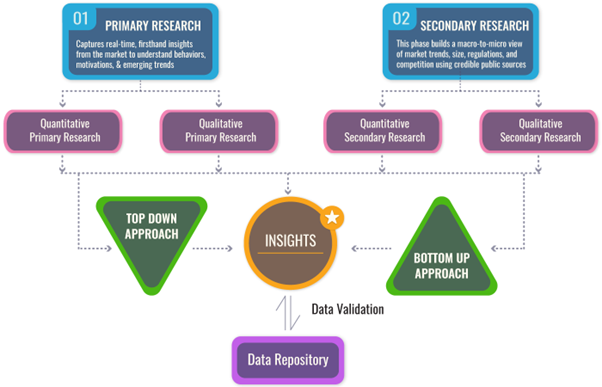
We follow a comprehensive, multi-phase research framework designed to deliver accurate, strategic, and decision-ready intelligence. Our process integrates primary and secondary research , both quantitative and qualitative , along with dual modeling techniques ( top-down and bottom-up) and a final layer of validation through our proprietary in-house repository.
PRIMARY RESEARCH
Primary research captures real-time, firsthand insights from the market to understand behaviors, motivations, and emerging trends.
1. Quantitative Primary Research
Objective: Generate statistically significant data directly from market participants.
Approaches:- Structured surveys with customers, distributors, and field agents
- Mobile-based data collection for point-of-sale audits and usage behavior
- Phone-based interviews (CATI) for market sizing and product feedback
- Online polling around industry events and digital campaigns
- Purchase frequency by customer type
- Channel performance across geographies
- Feature demand by application or demographic
2. Qualitative Primary Research
Objective: Explore decision-making drivers, pain points, and market readiness.
Approaches:- In-depth interviews (IDIs) with executives, product managers, and key decision-makers
- Focus groups among end users and early adopters
- Site visits and observational research for consumer products
- Informal field-level discussions for regional and cultural nuances
SECONDARY RESEARCH
This phase helps establish a macro-to-micro understanding of market trends, size, regulation, and competitive dynamics, sourced from credible and public domain information.
1. Quantitative Secondary Research
Objective: Model market value and segment-level forecasts based on published data.
Sources include:- Financial reports and investor summaries
- Government trade data, customs records, and regulatory statistics
- Industry association publications and economic databases
- Channel performance and pricing data from marketplace listings
- Revenue splits, pricing trends, and CAGR estimates
- Supply-side capacity and volume tracking
- Investment analysis and funding benchmarks
2. Qualitative Secondary Research
Objective: Capture strategic direction, innovation signals, and behavioral trends.
Sources include:- Company announcements, roadmaps, and product pipelines
- Publicly available whitepapers, conference abstracts, and academic research
- Regulatory body publications and policy briefs
- Social and media sentiment scanning for early-stage shifts
- Strategic shifts in market positioning
- Unmet needs and white spaces
- Regulatory triggers and compliance impact
DUAL MODELING: TOP-DOWN + BOTTOM-UP
To ensure robust market estimation, we apply two complementary sizing approaches:
Top-Down Modeling:- Start with broader industry value (e.g., global or regional TAM)
- Apply filters by segment, geography, end-user, or use case
- Adjust with primary insights and validation benchmarks
- Ideal for investor-grade market scans and opportunity mapping
- Aggregate from the ground up using sales volumes, pricing, and unit economics
- Use internal modeling templates aligned with stakeholder data
- Incorporate distributor-level or region-specific inputs
- Most accurate for emerging segments and granular sub-markets
DATA VALIDATION: IN-HOUSE REPOSITORY
We close the loop with proprietary data intelligence built from ongoing projects, industry monitoring, and historical benchmarking. This repository includes:
- Multi-sector market and pricing models
- Key trendlines from past interviews and forecasts
- Benchmarked adoption rates, churn patterns, and ROI indicators
- Industry-specific deviation flags and cross-check logic
- Catches inconsistencies early
- Aligns projections across studies
- Enables consistent, high-trust deliverables