

Wall Decor Market Size and Forecast (2020–2033), Global and Regional Growth, Trend, Share, and Industry Analysis Report Coverage: By Product Type (Wall Art, Mirrors, Wall Hangings, Clocks, Shelves & Others), By Application (Residential, Commercial), By Distribution Channel (Online, Offline), And Geography
2026-01-09
Consumer Products
Jaya Bundele (Research Analyst)
Description
Wall Decor
Market Overview
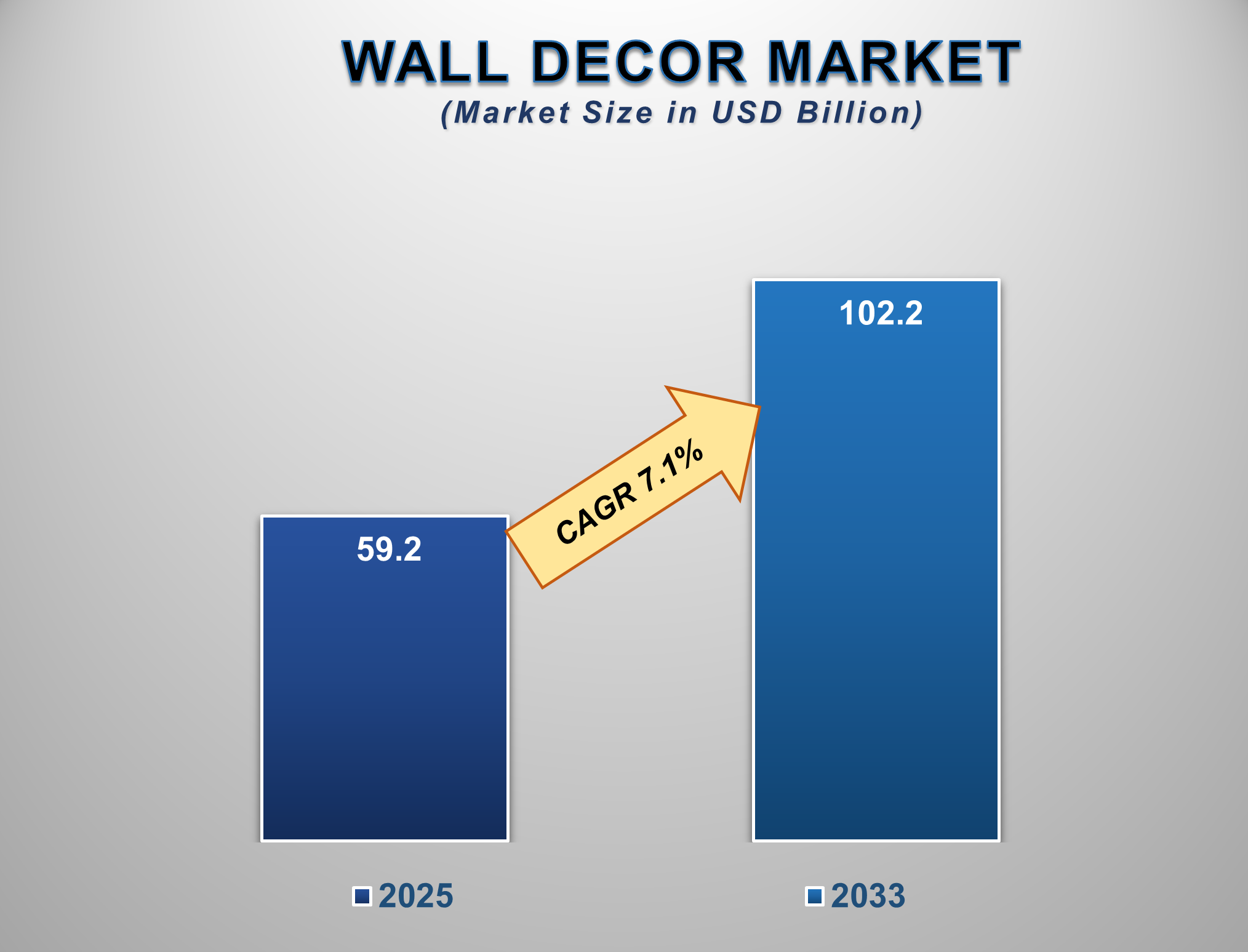
The global Wall Decor Market is expected to witness steady and sustained growth from 2025 to 2033, driven by rising consumer interest in home personalization, increasing urbanization, and growing investments in residential and commercial interior aesthetics. The market was valued at USD 59.2 billion in 2024 and is projected to reach USD 102.2 billion by 2033, expanding at a CAGR of 7.1% during the forecast period.
Wall decor products include decorative wall art, paintings,
mirrors, wall clocks, shelves, hangings, murals, and customized décor elements
that enhance the visual appeal of interior spaces. Growth is supported by
expanding housing construction, renovation activities, the growth of hospitality and retail spaces, and the increasing influence of social media–driven interior design
trends. The rise of e-commerce platforms and the availability of customizable and affordable décor solutions further
support market expansion. Asia-Pacific and North America together account for a
significant share of global demand, with Asia-Pacific emerging as the
fastest-growing region due to rising middle-class populations and urban housing
development.
Wall Decor Market Drivers and Opportunities
Rising Demand for Home Personalization and Interior
Aesthetics Is the Primary Market Driver
The primary driver of the wall decor market is the growing
consumer preference for personalized and aesthetically appealing living and
working spaces. Modern consumers increasingly view home décor as a reflection
of personal style and lifestyle, driving demand for artistic wall art,
statement mirrors, wall hangings, and themed décor collections. Urbanization,
smaller living spaces, and higher disposable incomes encourage consumers to
invest in décor products that enhance ambience without requiring major structural
changes. Additionally, increased work-from-home adoption has amplified focus on
interior aesthetics, boosting demand for decorative wall elements in
residential settings. Continuous exposure to global design trends through
digital platforms and social media further accelerates purchasing decisions.
Growth of Residential Construction, Renovation, and
Commercial Spaces Fuels Market Expansion
Rising residential construction activities, renovation
projects, and commercial infrastructure development significantly support the
wall decor market growth. New housing developments,
remodeling of existing homes, and interior upgrades drive consistent demand for
decorative wall solutions. Commercial applications such as hotels, offices,
retail stores, cafés, and healthcare facilities increasingly invest in visually
appealing interiors to enhance customer experience and brand identity. Wall
décor products offer a cost-effective way to refresh spaces, making them
popular across both residential and commercial segments. As real estate
development expands in emerging economies, demand for functional and decorative
wall solutions continues to rise steadily.
E-commerce Expansion and Customization Trends Create
Lucrative Opportunities
The rapid growth of e-commerce platforms presents
substantial opportunities for wall decor manufacturers and retailers. Online
channels offer extensive product variety, customization options, price
transparency, and doorstep delivery, making wall décor accessible to a wider
consumer base. Custom wall art, personalized prints, modular shelves, and
eco-friendly décor made from sustainable materials are gaining popularity,
especially among younger consumers. Emerging markets in Asia-Pacific, Latin
America, and the Middle East are witnessing rising internet penetration and
homeownership rates, creating new revenue opportunities. Digital printing,
augmented reality (AR) visualization tools, and influencer-driven marketing
further enhance consumer engagement and purchase conversion rates.
Wall Decor Market Scope
|
Report Attributes |
Description |
|
Market Size in 2025 |
USD 59.2 Billion |
|
Market Forecast in 2033 |
USD 102.2 Billion |
|
CAGR % 2025-2033 |
7.1% |
|
Base Year |
2024 |
|
Historic Data |
2020-2024 |
|
Forecast Period |
2025-2033 |
|
Report USP |
Product Portfolio,
Technological Analysis, Company Market Share, Company Heatmap, Pricing
Analysis, Growth Factors and more |
|
Segments Covered |
●
By Product Type ●
By Application ●
By Distribution
Channel |
|
Regional Scope |
●
North America ●
Europe ●
APAC ●
Latin America ●
Middle East and
Africa |
|
Country Scope |
1)
U.S. 2)
Canada 3)
Germany 4)
UK 5)
France 6)
Spain 7)
Italy 8)
Switzerland 9)
China 10)
Japan 11)
India 12)
Australia 13)
South Korea 14)
Brazil 15)
Mexico 16)
Argentina 17)
South Africa 18)
Saudi Arabia 19)
UAE |
Wall Decor Market Report Segmentation Analysis
The
global Wall Decor Market is segmented by product type, application,
distribution channel, and region.
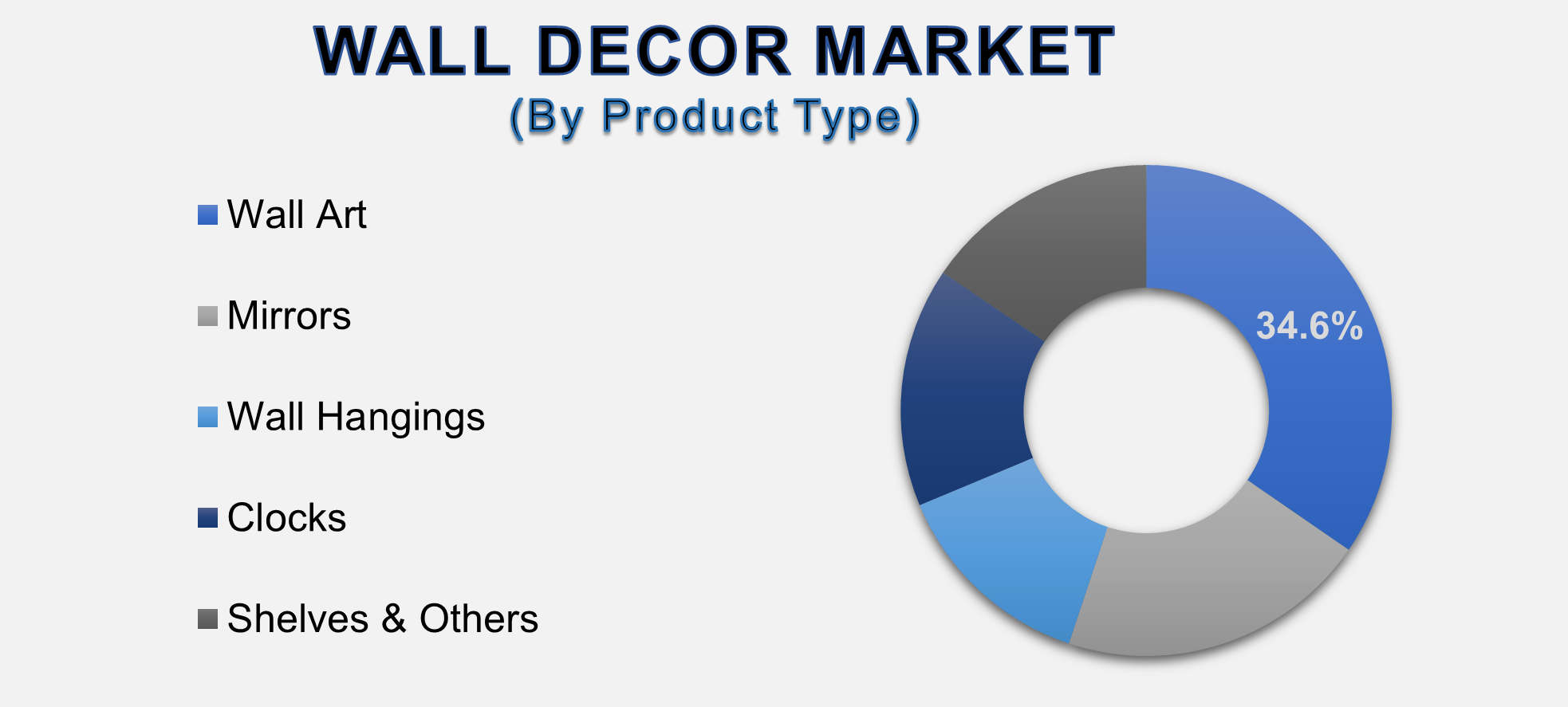
Wall Art and Mirrors
Represent the Largest Market Share
Wall art and mirrors account for the largest share of the global wall decor market due to their widespread adoption across residential and commercial spaces. Wall art, including paintings, framed prints, posters, and murals, remains a popular décor choice, as it allows consumers to express personal taste and follow changing design trends easily. The availability of diverse themes, sizes, and price points supports strong adoption across income groups. Mirrors are increasingly used not only for functionality but also as decorative elements to enhance space perception, lighting, and visual appeal. Decorative mirrors with artistic frames are widely adopted in living rooms, bedrooms, hotels, and retail environments. Continuous innovation in materials, digital printing, and modular designs strengthens the dominance of wall art and mirrors in overall market revenue.
Residential Segment
Drives Application-Based Demand
The
residential segment accounts for the greatest
application-based demand in the wall decor market due to rising homeownership
rates, increased renovation activities, and growing interest in interior
decoration. Homeowners increasingly invest in wall décor products to enhance
living spaces without major renovation costs. Decorative shelves, clocks, wall
hangings, and customized artwork are popular choices for apartments and
independent homes. The commercial segment, including hospitality, offices, and
retail spaces, is witnessing steady growth as businesses focus on creating
visually engaging interiors to improve customer experience and employee
well-being. This balanced demand across applications supports long-term market
stability and growth.
The following segments are
part of an in-depth analysis of the global Wall Decor Market:
|
Market
Segments |
|
|
By Product
Type |
●
Wall Art ●
Mirrors ●
Wall Hangings ●
Clocks ●
Shelves & Others |
|
By Application
|
●
Residential ●
Commercial |
|
By End-user |
●
Online ●
Offline |
Wall Decor Market Share Analysis by Region
The Asia Pacific region
is anticipated to hold the largest portion of the Wall Decor Market globally
throughout the forecast period.
The
Asia-Pacific region is expected to dominate the global wall décor market
throughout the forecast period, supported by a combination of demographic,
economic, and structural factors. Rapid urbanization across major economies
such as China, India, Indonesia, and Vietnam has led to a surge in residential
construction, including apartments, condominiums, and affordable housing
projects, all of which create consistent demand for decorative interior
solutions. Rising disposable incomes and the expansion of the middle-class
population have encouraged consumers to invest in aesthetically pleasing and
personalized living spaces, driving higher spending on wall art, mirrors,
shelves, and decorative hangings.
Additionally,
the strong presence of local manufacturers enables cost-effective production
and wide product availability, making stylish wall décor accessible across
multiple price segments. The rapid growth of e-commerce and social media–driven
home décor trends has further accelerated market penetration, allowing
consumers to easily access diverse designs and customized products. In
parallel, North America and Europe continue to represent significant and mature
markets, characterized by steady demand for premium and designer wall décor
products. In these regions, renovation and remodeling activities, particularly in aging housing stock, play a
crucial role in sustaining demand. High consumer spending power, preference for
sustainable and artisanal décor, and strong brand presence further support
market stability, even as growth rates remain comparatively moderate.
Wall Decor Market Competition Landscape Analysis
The wall decor market is
moderately fragmented, with global brands, regional manufacturers, and local
artisans competing on design innovation, pricing, and customization. Companies
focus on trend-driven collections, sustainable materials, and omnichannel
distribution strategies. Collaborations with interior designers, digital
marketing, and influencer partnerships are key competitive approaches.
Global Wall Decor Market Recent Developments News:
- In April 2025, IKEA broadened its wall décor offerings by expanding
its range of customizable wall art and modular shelving solutions across
key global markets. This strategic move reflects growing consumer demand
for flexible, space-efficient, and personalized home décor products,
particularly in urban living environments.
- In January 2025, Wayfair launched augmented reality (AR)–based
visualization tools to enhance the online wall décor shopping experience.
The technology enables customers to virtually place wall art, mirrors, and
shelves within their own spaces using smartphones or tablets, helping them
assess size, style, and color compatibility before purchasing.
- In September 2024, Williams-Sonoma introduced a new sustainable wall
décor collection made from recycled and responsibly sourced materials. The
collection includes wall art, decorative panels, and accent pieces
designed to meet growing consumer demand for eco-friendly and ethically
produced home décor.
The Global Wall Decor Market Is Dominated by a
Few Large Companies, such as
●
IKEA
●
Wayfair Inc.
●
Williams-Sonoma Inc.
●
Ashley Furniture
Industries
●
Crate & Barrel
●
Home Depot
●
Lowe’s Companies
●
West Elm
●
Bed Bath & Beyond
●
Urban Outfitters
●
Dunelm Group
●
Pepperfry
●
Godrej Interio
●
At Home Group
● Other Players
Frequently Asked Questions
Jaya Bundele (Research Analyst)
Jaya Bundele is a skilled Research Analyst with 4+ years of experience in market intelligence, consumer insights, competitive analysis, and industry forecasting across the consumer goods, agriculture, and food & beverage sectors. She specializes in market sizing, trend analysis, growth opportunity mapping, and strategic secondary research for global and regional markets.
Her expertise lies in transforming complex industry data into actionable business strategies that help organizations identify emerging trends, understand customer behavior, and gain a competitive edge. With a strong focus on data-driven insights, business intelligence, and future market trends, Jaya delivers high-quality research solutions aligned with evolving industry demands and market dynamics.
1. Global Wall Decor Market
Introduction and Market Overview
1.1.
Objectives
of the Study
1.2.
Global
Wall Decor Market Scope and Market Estimation
1.2.1.Global Electronic Toll
Collection Overall Market Size (US$ Bn), Market CAGR (%), Market forecast (2025
- 2033)
1.2.2.Global Wall Decor Market
Revenue Share (%) and Growth Rate (Y-o-Y) from 2020 - 2033
1.3.
Market
Segmentation
1.3.1.Product Type of Global Wall
Decor Market
1.3.2.Application of Global Wall
Decor Market
1.3.3.Distribution Channel of Global
Wall Decor Market
1.3.4.Region of Global Wall
Decor Market
2. Executive
Summary
2.1.
Demand
Side Trends
2.2.
Key
Market Trends
2.3.
Market
Demand (US$ Bn) Analysis 2020 – 2024 and forecast, 2025 – 2033
2.4.
Demand
and Opportunity Assessment
2.5.
Key
Developments
2.6.
Market
Entry Strategies
2.7.
Market
Dynamics
2.7.1.Drivers
2.7.2.Limitations
2.7.3.Opportunities
2.7.4.Impact Analysis of Drivers
and Restraints
2.8.
Porter’s
Five Forces Analysis
2.9.
Pricing
Analysis
2.10.
PEST
Analysis
3. Global
Wall Decor Market Estimates
& Historical Trend Analysis (2020 - 2024)
4. Global
Wall Decor Market Estimates
& Forecast Trend Analysis, by Product Type
4.1.
Global
Wall Decor Market Revenue (US$ Bn) Estimates and Forecasts, by Product Type,
2020 - 2033
4.1.1.Wall Art
4.1.2.Mirrors
4.1.3.Wall Hangings
4.1.4.Clocks
4.1.5.Shelves & Others
5. Global
Wall Decor Market Estimates
& Forecast Trend Analysis, by Application
5.1.
Global
Wall Decor Market Revenue (US$ Bn) Estimates and Forecasts, by Application, 2020
- 2033
5.1.1.Residential
5.1.2.Commercial
6. Global
Wall Decor Market Estimates
& Forecast Trend Analysis, by Distribution Channel
6.1.
Global
Wall Decor Market Revenue (US$ Bn) Estimates and Forecasts, by Distribution
Channel, 2020 - 2033
6.1.1.Online
6.1.2.Offline
7. Global
Wall Decor Market Estimates
& Forecast Trend Analysis, by region
7.1.
Global
Wall Decor Market Revenue (US$ Bn) Estimates and Forecasts, by region, 2020 - 2033
7.1.1.North America
7.1.2.Europe
7.1.3.Asia Pacific
7.1.4.Middle East & Africa
7.1.5.Latin America
8. North America Wall
Decor Market: Estimates & Forecast
Trend Analysis
8.1.
North
America Wall Decor Market Assessments & Key Findings
8.1.1.North America Wall Decor
Market Introduction
8.1.2.North America Wall Decor
Market Size Estimates and Forecast (US$ Billion) (2020 - 2033)
8.1.2.1. By Product
Type
8.1.2.2. By Application
8.1.2.3. By Distribution
Channel
8.1.2.4.
By
Country
8.1.2.4.1. The U.S.
8.1.2.4.2. Canada
9. Europe Wall
Decor Market: Estimates & Forecast
Trend Analysis
9.1.
Europe
Wall Decor Market Assessments & Key Findings
9.1.1.Europe Wall Decor Market
Introduction
9.1.2.Europe Wall Decor Market
Size Estimates and Forecast (US$ Billion) (2020 - 2033)
9.1.2.1. By Product
Type
9.1.2.2. By Application
9.1.2.3. By Distribution
Channel
9.1.2.4.
By
Country
9.1.2.4.1.
Germany
9.1.2.4.2.
Italy
9.1.2.4.3.
U.K.
9.1.2.4.4.
France
9.1.2.4.5.
Spain
9.1.2.4.6.
Switzerland
9.1.2.4.7. Rest
of Europe
10. Asia Pacific Wall
Decor Market: Estimates & Forecast
Trend Analysis
10.1.
Asia
Pacific Market Assessments & Key Findings
10.1.1.
Asia
Pacific Wall Decor Market Introduction
10.1.2.
Asia
Pacific Wall Decor Market Size Estimates and Forecast (US$ Billion) (2020 - 2033)
10.1.2.1. By Product
Type
10.1.2.2. By Application
10.1.2.3. By Distribution
Channel
10.1.2.4.
By
Country
10.1.2.4.1. China
10.1.2.4.2. Japan
10.1.2.4.3. India
10.1.2.4.4. Australia
10.1.2.4.5. South Korea
10.1.2.4.6. Rest of Asia Pacific
11. Middle East & Africa Wall
Decor Market: Estimates & Forecast
Trend Analysis
11.1.
Middle
East & Africa Market Assessments & Key Findings
11.1.1.
Middle East & Africa Wall Decor Market Introduction
11.1.2.
Middle East & Africa Wall Decor Market Size Estimates and
Forecast (US$ Billion) (2020 - 2033)
11.1.2.1. By Product
Type
11.1.2.2. By Application
11.1.2.3. By Distribution
Channel
11.1.2.4.
By
Country
11.1.2.4.1. UAE
11.1.2.4.2. Saudi
Arabia
11.1.2.4.3. South
Africa
11.1.2.4.4. Rest
of MEA
12. Latin America
Wall Decor Market: Estimates &
Forecast Trend Analysis
12.1.
Latin
America Market Assessments & Key Findings
12.1.1.
Latin
America Wall Decor Market Introduction
12.1.2.
Latin
America Wall Decor Market Size Estimates and Forecast (US$ Billion) (2020 - 2033)
12.1.2.1. By Product
Type
12.1.2.2. By Application
12.1.2.3. By Distribution
Channel
12.1.2.4.
By
Country
12.1.2.4.1. Brazil
12.1.2.4.2. Argentina
12.1.2.4.3. Mexico
12.1.2.4.4. Rest
of LATAM
13. Country Wise Market:
Introduction
14.
Competition
Landscape
14.1.
Global
Wall Decor Market Product Mapping
14.2.
Global
Wall Decor Market Concentration Analysis, by Leading Players / Innovators /
Emerging Players / New Entrants
14.3.
Global
Wall Decor Market Tier Structure Analysis
14.4.
Global
Wall Decor Market Concentration & Company Market Shares (%) Analysis, 2024
15.
Company
Profiles
15.1.
IKEA
15.1.1.
Company
Overview & Key Stats
15.1.2.
Financial
Performance & KPIs
15.1.3.
Product
Portfolio
15.1.4.
SWOT
Analysis
15.1.5.
Business
Strategy & Recent Developments
* Similar details would be provided for all the players
mentioned below
15.2. Wayfair Inc.
15.3. Williams-Sonoma
Inc.
15.4. Ashley
Furniture Industries
15.5. Crate &
Barrel
15.6. Home Depot
15.7. Lowe’s
Companies
15.8. West Elm
15.9. Bed Bath
& Beyond
15.10. Urban
Outfitters
15.11. Dunelm Group
15.12. Pepperfry
15.13. Godrej
Interio
15.14. At Home Group
15.15. Other Players
16. Research
Methodology
16.1.
External
Transportations / Databases
16.2.
Internal
Proprietary Database
16.3.
Primary
Research
16.4.
Secondary
Research
16.5.
Assumptions
16.6.
Limitations
16.7.
Report
FAQs
17. Research
Findings & Conclusion
Our Research Methodology
"Insight without rigor is just noise."
We follow a comprehensive, multi-phase research framework designed to deliver accurate, strategic, and decision-ready intelligence. Our process integrates primary and secondary research , both quantitative and qualitative , along with dual modeling techniques ( top-down and bottom-up) and a final layer of validation through our proprietary in-house repository.
PRIMARY RESEARCH
Primary research captures real-time, firsthand insights from the market to understand behaviors, motivations, and emerging trends.
1. Quantitative Primary Research
Objective: Generate statistically significant data directly from market participants.
Approaches:- Structured surveys with customers, distributors, and field agents
- Mobile-based data collection for point-of-sale audits and usage behavior
- Phone-based interviews (CATI) for market sizing and product feedback
- Online polling around industry events and digital campaigns
- Purchase frequency by customer type
- Channel performance across geographies
- Feature demand by application or demographic
2. Qualitative Primary Research
Objective: Explore decision-making drivers, pain points, and market readiness.
Approaches:- In-depth interviews (IDIs) with executives, product managers, and key decision-makers
- Focus groups among end users and early adopters
- Site visits and observational research for consumer products
- Informal field-level discussions for regional and cultural nuances
SECONDARY RESEARCH
This phase helps establish a macro-to-micro understanding of market trends, size, regulation, and competitive dynamics, sourced from credible and public domain information.
1. Quantitative Secondary Research
Objective: Model market value and segment-level forecasts based on published data.
Sources include:- Financial reports and investor summaries
- Government trade data, customs records, and regulatory statistics
- Industry association publications and economic databases
- Channel performance and pricing data from marketplace listings
- Revenue splits, pricing trends, and CAGR estimates
- Supply-side capacity and volume tracking
- Investment analysis and funding benchmarks
2. Qualitative Secondary Research
Objective: Capture strategic direction, innovation signals, and behavioral trends.
Sources include:- Company announcements, roadmaps, and product pipelines
- Publicly available whitepapers, conference abstracts, and academic research
- Regulatory body publications and policy briefs
- Social and media sentiment scanning for early-stage shifts
- Strategic shifts in market positioning
- Unmet needs and white spaces
- Regulatory triggers and compliance impact
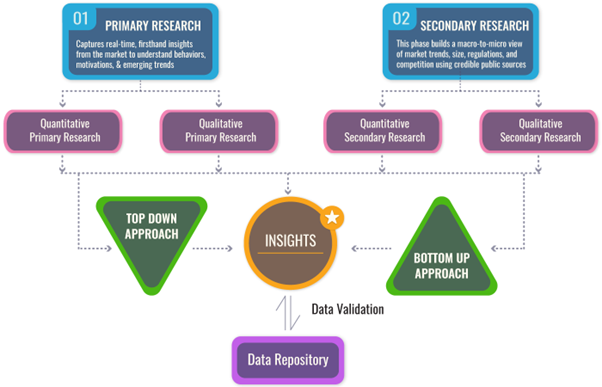
DUAL MODELING: TOP-DOWN + BOTTOM-UP
To ensure robust market estimation, we apply two complementary sizing approaches:
Top-Down Modeling:- Start with broader industry value (e.g., global or regional TAM)
- Apply filters by segment, geography, end-user, or use case
- Adjust with primary insights and validation benchmarks
- Ideal for investor-grade market scans and opportunity mapping
- Aggregate from the ground up using sales volumes, pricing, and unit economics
- Use internal modeling templates aligned with stakeholder data
- Incorporate distributor-level or region-specific inputs
- Most accurate for emerging segments and granular sub-markets
DATA VALIDATION: IN-HOUSE REPOSITORY
We close the loop with proprietary data intelligence built from ongoing projects, industry monitoring, and historical benchmarking. This repository includes:
- Multi-sector market and pricing models
- Key trendlines from past interviews and forecasts
- Benchmarked adoption rates, churn patterns, and ROI indicators
- Industry-specific deviation flags and cross-check logic
- Catches inconsistencies early
- Aligns projections across studies
- Enables consistent, high-trust deliverables