

Wall-Mounted Kitchen Chimney Market Size and Forecast (2025–2033), Global and Regional Growth, Trend, Share and Industry Analysis Report Coverage: By Duct Type (Ducted, Ductless), By Application (Residential, Commercial), By Distribution Channel (Specialty Stores, Supermarkets & Hypermarkets, Online Stores, Others), and Geography
2026-01-02
Semiconductor and Electronics
Ekta Chaurasia (Team Lead)
Description
Wall-Mounted Kitchen Chimney Market Overview
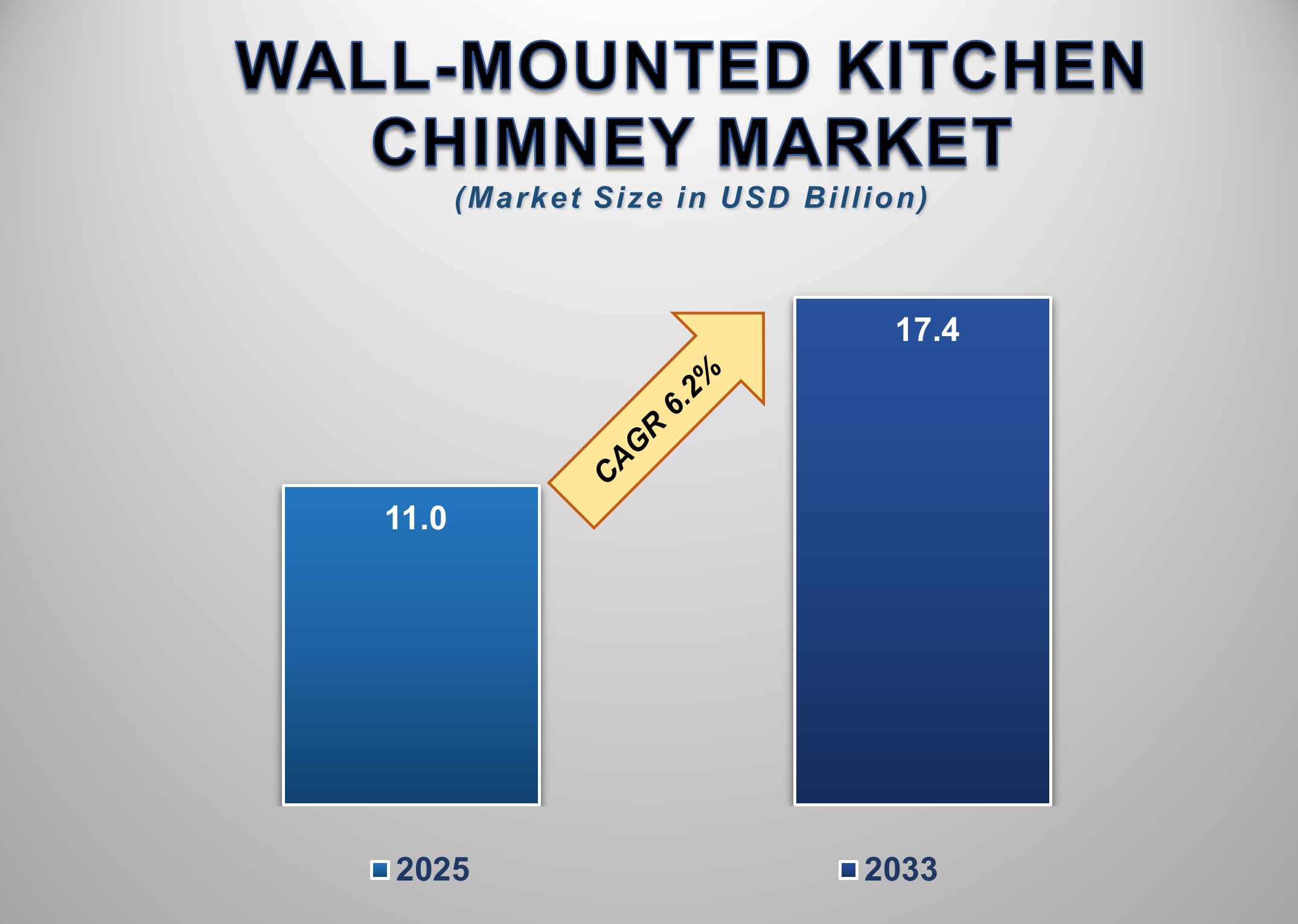
The Global Wall-Mounted Kitchen Chimney Market is poised for healthy expansion between 2025 and 2033, supported by rising urbanization, increasing adoption of modular kitchens, and heightened consumer awareness regarding indoor air quality. The market is valued at USD 11.0 billion in 2025 and is expected to reach USD 17.4 billion by 2033, registering a CAGR of 6.2% over the forecast period. Wall-mounted kitchen chimneys have become essential household appliances, especially in regions experiencing rapid residential construction and smaller housing layouts where smoke, oil particles, and heat accumulation pose higher risks.
Growing health consciousness and
the desire for cleaner, odor-free cooking environments are further driving
demand for technologically advanced chimneys equipped with high-suction motors,
auto-clean mechanisms, baffle filters, and IoT-enabled monitoring features.
Moreover, the rise in nuclear families, women’s increasing participation in the
workforce, and lifestyle upgrades have strengthened the consumer shift toward
modern kitchen appliances. Significant growth in online retail, easy financing
options, and frequent discounts by brands have also accelerated product
penetration across developing markets.
Wall-Mounted Kitchen Chimney Market
Drivers and Opportunities
Rising
Demand for Modular Kitchens and Improved Home Aesthetics Is Driving Market
Growth
The
rapid global adoption of modular kitchens is one of the key forces propelling
the Wall-Mounted Kitchen Chimney Market. Consumers are increasingly
prioritizing kitchen aesthetics, efficient ventilation, and space optimization
as part of home renovation and modernization trends. The shift toward modular
kitchens characterized by sleek cabinetry, integrated appliances, and ergonomic
layouts has elevated the need for wall-mounted chimneys that complement
contemporary designs. In addition, growing investments in premium residential
real estate and rising middle-class aspirations are fueling demand for
high-performance chimneys featuring advanced controls, LED illumination, and
noise-reduction technologies. Urban households, in particular, face challenges
such as compact kitchen spaces, increased cooking frequency, and the use of oil-rich cuisines, all of which generate heavy
smoke, grease particles, and odors. This has intensified the requirement for
robust ventilation solutions. The rise of home improvement culture, DIY
installation trends, and social media influence on home décor have further
strengthened market uptake.
Increasing
Focus on Indoor Air Quality and Health is Accelerating Product Adoption
Worldwide.
Growing
awareness about the harmful effects of indoor air pollution, such as respiratory issues, eye irritation, allergies, and
long-term lung complications, is fueling the
adoption of kitchen chimneys. Studies indicate that cooking fumes contain
carbon monoxide, particulate matter (PM2.5), nitrogen dioxide, and carcinogenic
compounds released during high-temperature frying. With households spending
more time indoors, particularly post-pandemic, the emphasis on maintaining
healthy air circulation and reducing toxic emissions has intensified.
Governments and environmental bodies are increasingly promoting safe indoor
environments through campaigns, guidelines, and housing quality standards. This
has encouraged homeowners to upgrade from traditional exhaust fans to
high-efficiency chimneys capable of capturing fine particles and deodorizing
the cooking space. The adoption of IoT-enabled chimneys that provide real-time
air quality tracking and automatic speed adjustment is also rising. Moreover,
consumers are becoming more informed about the difference between ducted and
ductless systems and choosing solutions tailored to their cooking style and
home layout. As indoor air quality continues to gain global attention, chimney
installation is becoming a necessity rather than a luxury, thus driving
sustained industry growth.
Emerging Markets’ Focus on Smart Homes and Rapid Urban
Development Creates Significant Growth Opportunities
Emerging economies across Asia-Pacific, Latin America, Africa, and
the Middle East represent high-growth markets for wall-mounted kitchen
chimneys. Rapid urbanization, increasing construction of apartment complexes,
and rising disposable incomes are transforming consumer lifestyles in these
regions. Countries like India, China, Indonesia, Brazil, and Vietnam are
witnessing strong demand for modern kitchen appliances due to expanding
middle-class populations and growing awareness of health and hygiene. Government
initiatives supporting affordable housing, smart city projects, and improved
electricity access are further contributing to product adoption. Additionally,
the booming e-commerce ecosystem, coupled with aggressive promotional campaigns
from leading brands, has increased consumer accessibility to a wide range of
chimney models. The opportunity is especially strong in the ductless chimney
segment, which is easier to install in older construction and rental units
common in developing regions. Foreign investments, rising product localization,
and franchised retail expansions by major kitchen appliance manufacturers are
enabling greater market penetration. With continued economic growth and
digitalization, emerging markets are expected to create substantial
opportunities for global chimney brands in the years ahead.
Wall-mounted Kitchen
Chimney Market Scope
|
Report Attributes |
Description |
|
Market Size in 2025 |
USD 11.0 Billion |
|
Market Forecast in 2033 |
USD 17.4 Billion |
|
CAGR % 2025-2033 |
6.2% |
|
Base Year |
2024 |
|
Historic Data |
2020-2024 |
|
Forecast Period |
2025-2033 |
|
Report USP |
Production, Consumption,
Company Share, Company Heatmap, Company Production Capacity, Growth Factors,
and more |
|
Segments Covered |
●
By Duct Type, By
Application, By Distribution Channel |
|
Regional Scope |
●
North America, ●
Europe, ●
APAC, ●
Latin America ●
Middle East and
Africa |
|
Country Scope |
1)
U.S. 2)
Canada 3)
Germany 4)
UK 5)
France 6)
Spain 7)
Italy 8)
Switzerland 9)
China 10)
Japan 11)
India 12)
Australia 13)
South Korea 14)
Brazil 15)
Mexico 16)
Argentina 17)
South Africa 18)
Saudi Arabia 19)
UAE |
Wall-mounted Kitchen
Chimney Market Report Segmentation Analysis
The Global Wall-Mounted Kitchen Chimney Market is segmented by
duct type, application, distribution channel, and region.
Ducted Segment Accounted
for the Largest Market Share in the Global Wall-Mounted Kitchen Chimney Market
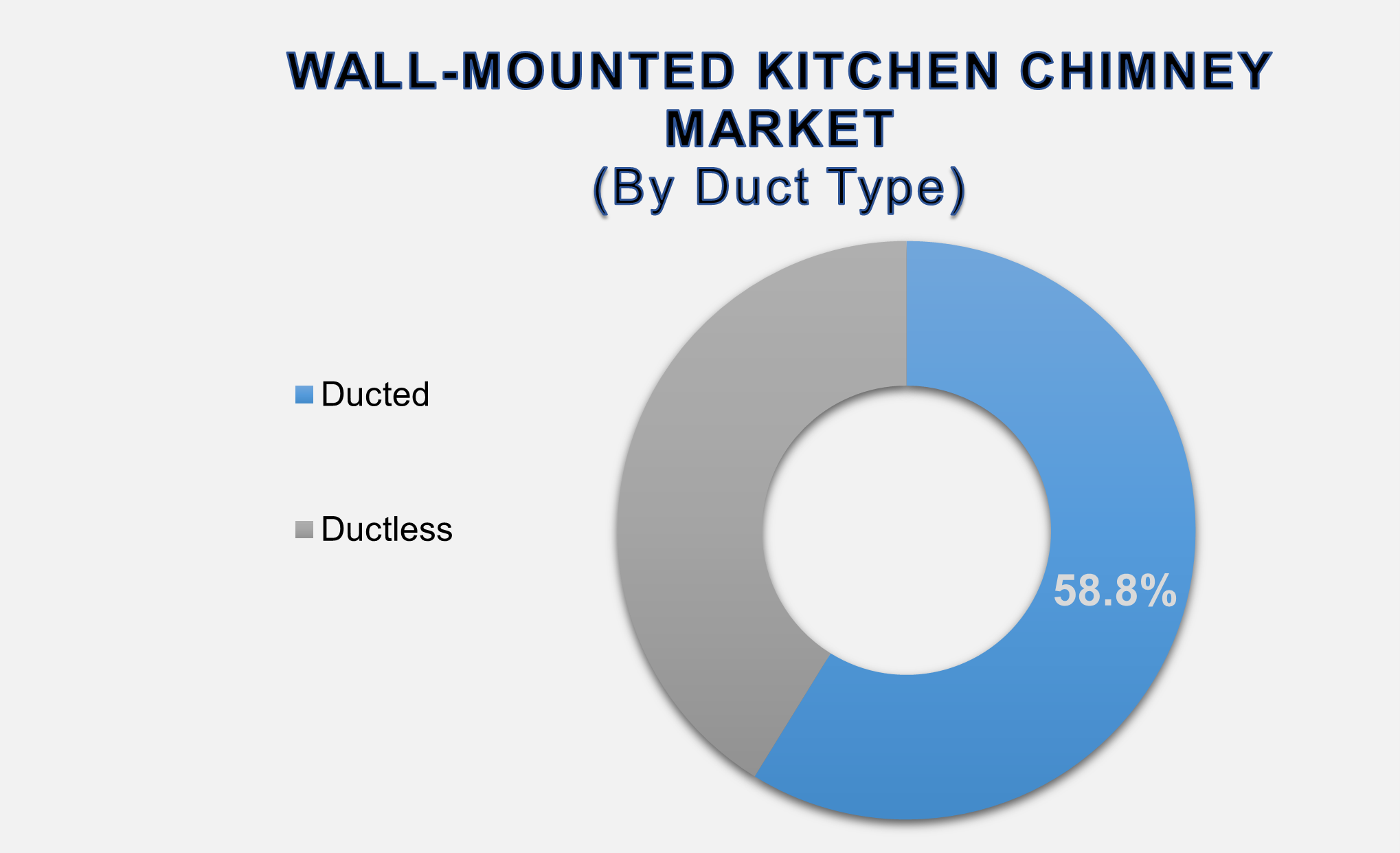
The ducted chimney segment, holding a 58.8% share in 2025, dominates the global market owing to its superior performance and high suction efficiency. Ducted chimneys expel smoke, fumes, heat, and grease particles directly outside the kitchen, making them ideal for households with heavy cooking habits, especially in Asian and Middle Eastern countries that rely extensively on frying and grilling. The segment’s growth is strongly supported by rising consumer preference for strong ventilation systems, increasing installation in under-construction apartments, and sales driven by premium modular kitchen setups. Manufacturers are introducing ducted models with advanced features such as stainless-steel baffle filters, high-capacity motors, motion sensors, and auto-clean technology that reduce maintenance efforts. Their long-term durability and efficiency make them a preferred choice for customers willing to invest in premium kitchen appliances. Although installation requires proper ducting infrastructure, rapid urban development and growth in residential projects are eliminating these challenges. With growing awareness of kitchen hygiene and air purification, ducted chimneys are expected to maintain their leadership throughout the forecast period.
Residential Segment
Accounted for the Largest Share in the Global Wall-Mounted Kitchen Chimney
Market
The residential segment remains
the largest application category, driven by increasing adoption of chimneys in
urban homes, renovations, and premium apartment projects. With rising
dual-income households, lifestyle upgrades, and rising women's workforce participation,
home cooking frequency has increased, requiring better ventilation systems. The
rising popularity of modular kitchens in residential properties globally is
further fueling chimney installations. Residential consumers are increasingly
prioritizing low-noise, sleek, compact, and easy-to-install chimney designs
that integrate seamlessly with cabinetry. Auto-clean chimneys, touch-control
panels, and smart connectivity features are particularly appealing to new-age
consumers. Rapid penetration of online retail and EMI options has also made
premium appliances more accessible. Moreover, post-pandemic focus on health and
indoor air quality has significantly strengthened long-term demand in this
segment. As home improvement spending continues to surge, the residential
sector is expected to dominate market revenue through 2033.
Specialty Stores Segment
Leads the Market Owing to Diverse Product Range and Expert Assistance
Specialty stores captured the
largest market share within distribution channels in 2025 due to their ability
to offer personalized guidance, product demonstrations, and installation
support. Consumers prefer specialty kitchen appliance stores for comparing
models, understanding suction capacity requirements, and receiving consultation
based on kitchen layout. These stores are also key points of sale for premium
and ducted chimney models requiring professional installation. Brands often
launch their latest designs and technology innovations through exclusive retail
partnerships, further boosting specialty store sales. Additionally, specialty
outlets maintain a wide inventory, enabling customers to evaluate noise levels,
build quality, and filtration mechanisms before purchase. Despite growing
online retail adoption, specialty stores continue to dominate due to their
trust factor, after-sales support, and expert service teams. This segment is
expected to maintain a strong revenue share as consumers increasingly opt for
customized modular kitchen setups requiring in-person assistance.
The following segments are
part of an in-depth analysis of the global Wall-mounted Kitchen Chimney market:
|
Market Segments |
|
|
By Duct Type |
●
Ducted ●
Ductless |
|
By Application |
●
Residential ●
Commercial |
|
By
Distribution Channel |
●
Specialty Stores ●
Supermarkets &
Hypermarkets ●
Online Stores ●
Others |
Wall-Mounted Kitchen
Chimney Market Share Analysis by Region
North America is
anticipated to hold the largest portion of the Wall-mounted Kitchen Chimney
Market globally throughout the forecast period.
North America emerged as the
dominant region in 2025 with 39.9% market share, driven by high household
awareness regarding indoor air quality, strong spending on kitchen remodeling,
and widespread adoption of advanced smart home appliances. The U.S. market, in
particular, benefits from high penetration of premium chimney brands,
increasing residential renovation projects, and growth in open-kitchen layouts
that necessitate efficient ventilation systems. Advanced features such as
noise-control technologies, IoT integrations, and smart sensors further appeal
to North American consumers. Additionally, a mature retail network spanning
specialty stores, large-format retailers, and e-commerce supports strong
product availability.
Meanwhile, Asia-Pacific (APAC) is
expected to register the highest CAGR during the forecast period. Rapid
urbanization, rising disposable incomes, and increasing residential
construction across India, China, Japan, Indonesia, and Vietnam are major
growth contributors. The region’s cooking styles, which involve heavy oil usage
and high-temperature frying, significantly benefit from chimney installations.
Government housing schemes, the booming modular kitchen industry, and
aggressive expansion of online retail channels are further accelerating APAC
market growth. Continuous product innovation by regional players such as Kaff,
Hindware, Robam, Fotile, and Panasonic is also enhancing affordability and
accessibility. With strong economic growth and rising health awareness, APAC is
projected to become the fastest-growing region by 2033.
Wall-Mounted Kitchen
Chimney Market Competition Landscape Analysis
The global Wall-Mounted Kitchen
Chimney Market is moderately fragmented, with key players focusing on expanding
product portfolios, improving suction technologies, and enhancing auto-clean
efficiency. Manufacturers are investing in energy-efficient motors, silent
operation designs, and premium aesthetics to attract modern home buyers.
Strategic partnerships with modular kitchen manufacturers, online retail
platforms, and construction firms are also facilitating deeper market
penetration. Additionally, brands are increasingly launching IoT-enabled
chimneys to gain a competitive edge.
Global Wall-Mounted
Kitchen Chimney Market Recent Developments News:
- In February 2025,
Hindware Smart Appliances launched a new wall-mounted chimney range
with BLDC motor technology, designed to efficiently eliminate odors,
smoke, and cooking fumes while improving energy efficiency.
- In March 2023,
Hindware Smart Appliances introduced the ‘LEXIA PLUS’ wall-mounted
chimney with auto-clean functionality, enhancing user convenience and
maintaining performance over time.
- In March 2023,
Elica unveiled its ‘BLDC LTW HAC’ wall-mounted chimney, featuring
auto-clean technology and a BLDC motor for quiet, energy-efficient
ventilation in modern kitchens.
The Global Wall-mounted Kitchen
Chimney Market Is Dominated by a Few Large Companies, such as
●
Elica
●
Faber
●
Kaff
●
Falmec
●
Siemens
●
Bosch
●
Whirlpool
●
Fotile
●
Robam
●
Vatti
●
Miele
●
Smeg
●
Samsung
●
LG
●
Panasonic
●
Hindware
●
Kutchina
●
Glen
●
Prestige
●
Pigeon
● Others
Frequently Asked Questions
Ekta Chaurasia (Team Lead)
Ekta Chaurasia is a highly experienced Team Lead at M2Square Consultancy with over 7 years of expertise in market research, strategic consulting, competitive benchmarking, and business intelligence solutions. She specializes in ICT, semiconductors & electronics, automotive & transportation, and industrial machinery markets.
She leads end-to-end global research projects focused on market trends, industry analysis, growth forecasting, customer insights, and strategic decision-making. Known for her analytical leadership and industry expertise, Ekta helps businesses uncover growth opportunities, evaluate competitive landscapes, and stay ahead in rapidly evolving markets through accurate and insight-driven research.
1. Global Wall-mounted
Kitchen Chimney Market Introduction and Market Overview
1.1.
Objectives
of the Study
1.2.
Global
Wall-mounted Kitchen Chimney Market Scope and Market Estimation
1.2.1.Global Wall-mounted
Kitchen Chimney Overall Market Size (US$ Bn), Market CAGR (%), Market forecast
(2025 - 2033)
1.2.2.Global Wall-mounted
Kitchen Chimney Market Revenue Share (%) and Growth Rate (Y-o-Y) from 2020 - 2033
1.3.
Market
Segmentation
1.3.1.Duct Type of Global Wall-mounted
Kitchen Chimney Market
1.3.2.Application of Global Wall-mounted
Kitchen Chimney Market
1.3.3.Distribution Channel of
Global Wall-mounted Kitchen Chimney Market
1.3.4.Region of Global Wall-mounted
Kitchen Chimney Market
2. Executive
Summary
2.1.
Demand
Side Trends
2.2.
Key
Market Trends
2.3.
Market
Demand (US$ Bn) Analysis 2020 – 2024 and Forecast, 2025 – 2033
2.4.
Demand
and Opportunity Assessment
2.5.
Key
Developments
2.6.
Overview
of Tariff, Regulatory Landscape and Standards
2.7.
Market
Entry Strategies
2.8.
Market
Dynamics
2.8.1.Drivers
2.8.2.Limitations
2.8.3.Opportunities
2.8.4.Impact Analysis of Drivers
and Restraints
2.9.
Porter’s
Five Forces Analysis
2.10.
PEST
Analysis
3. Global
Wall-mounted Kitchen Chimney Market
Estimates & Historical Trend Analysis (2020 - 2024)
4. Global
Wall-mounted Kitchen Chimney Market
Estimates & Forecast Trend Analysis, by Duct Type
4.1.
Global
Wall-mounted Kitchen Chimney Market Revenue (US$ Bn) Estimates and Forecasts,
by Duct Type, 2020 - 2033
4.1.1.Ducted
4.1.2.Ductless
5. Global
Wall-mounted Kitchen Chimney Market
Estimates & Forecast Trend Analysis, by Application
5.1.
Global
Wall-mounted Kitchen Chimney Market Revenue (US$ Bn) Estimates and Forecasts,
by Application, 2020 - 2033
5.1.1.Residential
5.1.2.Commercial
6. Global
Wall-mounted Kitchen Chimney Market
Estimates & Forecast Trend Analysis, by Distribution
Channel
6.1.
Global
Wall-mounted Kitchen Chimney Market Revenue (US$ Bn) Estimates and Forecasts,
by Distribution Channel, 2020 - 2033
6.1.1.Specialty Stores
6.1.2.Supermarkets &
Hypermarkets
6.1.3.Online Stores
6.1.4.Others
7. Global
Wall-mounted Kitchen Chimney Market
Estimates & Forecast Trend Analysis, by Region
7.1.
Global
Wall-mounted Kitchen Chimney Market Revenue (US$ Bn) Estimates and Forecasts,
by Region, 2020 - 2033
7.1.1.North America
7.1.2.Europe
7.1.3.Asia Pacific
7.1.4.Middle East & Africa
7.1.5.Latin America
8. North America Wall-mounted
Kitchen Chimney Market: Estimates &
Forecast Trend Analysis
8.1.
North
America Wall-mounted Kitchen Chimney Market Assessments & Key Findings
8.1.1.North America Wall-mounted
Kitchen Chimney Market Introduction
8.1.2.North America Wall-mounted
Kitchen Chimney Market Size Estimates and Forecast (US$ Billion) (2020 - 2033)
8.1.2.1. By Duct Type
8.1.2.2. By Application
8.1.2.3. By Distribution
Channel
8.1.2.4.
By
Country
8.1.2.4.1. The U.S.
8.1.2.4.2. Canada
9. Europe Wall-mounted
Kitchen Chimney Market: Estimates &
Forecast Trend Analysis
9.1.
Europe
Wall-mounted Kitchen Chimney Market Assessments & Key Findings
9.1.1.Europe Wall-mounted
Kitchen Chimney Market Introduction
9.1.2.Europe Wall-mounted
Kitchen Chimney Market Size Estimates and Forecast (US$ Billion) (2020 - 2033)
9.1.2.1. By Duct Type
9.1.2.2. By Application
9.1.2.3. By Distribution
Channel
9.1.2.4.
By
Country
9.1.2.4.1.
Germany
9.1.2.4.2.
Italy
9.1.2.4.3.
U.K.
9.1.2.4.4.
France
9.1.2.4.5.
Spain
9.1.2.4.6.
Switzerland
9.1.2.4.7. Rest
of Europe
10. Asia Pacific Wall-mounted
Kitchen Chimney Market: Estimates &
Forecast Trend Analysis
10.1.
Asia
Pacific Market Assessments & Key Findings
10.1.1.
Asia
Pacific Wall-mounted Kitchen Chimney Market Introduction
10.1.2.
Asia
Pacific Wall-mounted Kitchen Chimney Market Size Estimates and Forecast (US$ Billion)
(2020 - 2033)
10.1.2.1. By Duct Type
10.1.2.2. By Application
10.1.2.3. By Distribution
Channel
10.1.2.4.
By
Country
10.1.2.4.1. China
10.1.2.4.2. Japan
10.1.2.4.3. India
10.1.2.4.4. Australia
10.1.2.4.5. South Korea
10.1.2.4.6. Rest of Asia Pacific
11. Middle East & Africa Wall-mounted
Kitchen Chimney Market: Estimates &
Forecast Trend Analysis
11.1.
Middle
East & Africa Market Assessments & Key Findings
11.1.1.
Middle East & Africa Wall-mounted Kitchen Chimney Market
Introduction
11.1.2.
Middle East & Africa Wall-mounted Kitchen Chimney Market
Size Estimates and Forecast (US$ Billion) (2020 - 2033)
11.1.2.1. By Duct Type
11.1.2.2. By Application
11.1.2.3. By Distribution
Channel
11.1.2.4.
By
Country
11.1.2.4.1. UAE
11.1.2.4.2. Saudi
Arabia
11.1.2.4.3. South
Africa
11.1.2.4.4. Rest
of MEA
12. Latin America
Wall-mounted Kitchen Chimney Market:
Estimates & Forecast Trend Analysis
12.1.
Latin
America Market Assessments & Key Findings
12.1.1.
Latin
America Wall-mounted Kitchen Chimney Market Introduction
12.1.2.
Latin
America Wall-mounted Kitchen Chimney Market Size Estimates and Forecast (US$ Billion)
(2020 - 2033)
12.1.2.1. By Duct Type
12.1.2.2. By Application
12.1.2.3. By Distribution
Channel
12.1.2.4.
By
Country
12.1.2.4.1. Brazil
12.1.2.4.2. Argentina
12.1.2.4.3. Mexico
12.1.2.4.4. Rest
of LATAM
13. Country Wise Market:
Introduction
14.
Competition
Landscape
14.1.
Global
Wall-mounted Kitchen Chimney Market Product Mapping
14.2.
Global
Wall-mounted Kitchen Chimney Market Concentration Analysis, by Leading Players
/ Innovators / Emerging Players / New Entrants
14.3.
Global
Wall-mounted Kitchen Chimney Market Tier Structure Analysis
14.4.
Global
Wall-mounted Kitchen Chimney Market Concentration & Company Market Shares
(%) Analysis, 2024
15.
Company
Profiles
15.1.
Elica
15.1.1.
Company
Overview & Key Stats
15.1.2.
Financial
Performance & KPIs
15.1.3.
Product
Portfolio
15.1.4.
SWOT
Analysis
15.1.5.
Business
Strategy & Recent Developments
* Similar details would be provided for all the players
mentioned below
15.2. Faber
15.3. Kaff
15.4. Falmec
15.5. Simens
15.6. Bosch
15.7. Whirlpool
15.8. Fotile
15.9. Robam
15.10. Vatti
15.11. Miele
15.12. Smeg
15.13. Samsung
15.14. LG
15.15. Panasonic
15.16. Hindware
15.17. Kutchina
15.18. Glen
15.19. Prestige
15.20. Pigeon
15.21. Others
16. Research
Methodology
16.1.
External
Transportations / Databases
16.2.
Internal
Proprietary Database
16.3.
Primary
Research
16.4.
Secondary
Research
16.5.
Assumptions
16.6.
Limitations
16.7.
Report
FAQs
17. Research
Findings & Conclusion
Our Research Methodology
"Insight without rigor is just noise."
We follow a comprehensive, multi-phase research framework designed to deliver accurate, strategic, and decision-ready intelligence. Our process integrates primary and secondary research , both quantitative and qualitative , along with dual modeling techniques ( top-down and bottom-up) and a final layer of validation through our proprietary in-house repository.
PRIMARY RESEARCH
Primary research captures real-time, firsthand insights from the market to understand behaviors, motivations, and emerging trends.
1. Quantitative Primary Research
Objective: Generate statistically significant data directly from market participants.
Approaches:- Structured surveys with customers, distributors, and field agents
- Mobile-based data collection for point-of-sale audits and usage behavior
- Phone-based interviews (CATI) for market sizing and product feedback
- Online polling around industry events and digital campaigns
- Purchase frequency by customer type
- Channel performance across geographies
- Feature demand by application or demographic
2. Qualitative Primary Research
Objective: Explore decision-making drivers, pain points, and market readiness.
Approaches:- In-depth interviews (IDIs) with executives, product managers, and key decision-makers
- Focus groups among end users and early adopters
- Site visits and observational research for consumer products
- Informal field-level discussions for regional and cultural nuances
SECONDARY RESEARCH
This phase helps establish a macro-to-micro understanding of market trends, size, regulation, and competitive dynamics, sourced from credible and public domain information.
1. Quantitative Secondary Research
Objective: Model market value and segment-level forecasts based on published data.
Sources include:- Financial reports and investor summaries
- Government trade data, customs records, and regulatory statistics
- Industry association publications and economic databases
- Channel performance and pricing data from marketplace listings
- Revenue splits, pricing trends, and CAGR estimates
- Supply-side capacity and volume tracking
- Investment analysis and funding benchmarks
2. Qualitative Secondary Research
Objective: Capture strategic direction, innovation signals, and behavioral trends.
Sources include:- Company announcements, roadmaps, and product pipelines
- Publicly available whitepapers, conference abstracts, and academic research
- Regulatory body publications and policy briefs
- Social and media sentiment scanning for early-stage shifts
- Strategic shifts in market positioning
- Unmet needs and white spaces
- Regulatory triggers and compliance impact
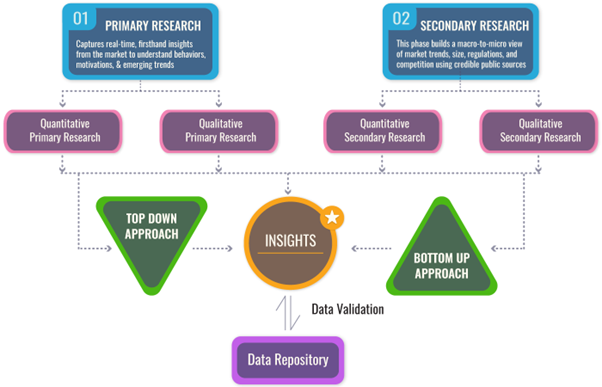
DUAL MODELING: TOP-DOWN + BOTTOM-UP
To ensure robust market estimation, we apply two complementary sizing approaches:
Top-Down Modeling:- Start with broader industry value (e.g., global or regional TAM)
- Apply filters by segment, geography, end-user, or use case
- Adjust with primary insights and validation benchmarks
- Ideal for investor-grade market scans and opportunity mapping
- Aggregate from the ground up using sales volumes, pricing, and unit economics
- Use internal modeling templates aligned with stakeholder data
- Incorporate distributor-level or region-specific inputs
- Most accurate for emerging segments and granular sub-markets
DATA VALIDATION: IN-HOUSE REPOSITORY
We close the loop with proprietary data intelligence built from ongoing projects, industry monitoring, and historical benchmarking. This repository includes:
- Multi-sector market and pricing models
- Key trendlines from past interviews and forecasts
- Benchmarked adoption rates, churn patterns, and ROI indicators
- Industry-specific deviation flags and cross-check logic
- Catches inconsistencies early
- Aligns projections across studies
- Enables consistent, high-trust deliverables