
Warehouse Simulation Market Size and Forecast (2026–2034), Global and Regional Growth, Trends, Share and Industry Analysis Report Coverage; By Component, Deployment Mode, Simulation Type, Application, End User and Geography
2026-11-02
ICT
Ekta Chaurasia (Team Lead)
Description
Warehouse Simulation Market Overview
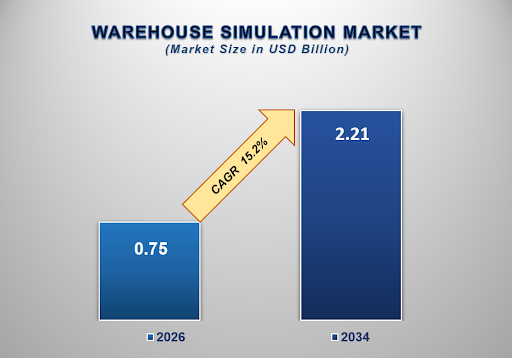
The global Warehouse Simulation Market is valued at USD 0.75 billion in 2026 and is projected to reach USD 2.21 billion by 2034, registering a CAGR of 15.2% during the forecast period. Warehouse simulation uses digital models to represent warehouse layouts, inventory movement, labor activities, storage systems and material-handling equipment. Businesses use these models to assess operational performance and test process changes before investing in physical infrastructure or modifying live facilities.
Simulation software helps warehouse operators examine how different variables interact, including order volumes, picking strategies, storage allocation, conveyor capacity, staffing levels and equipment utilization. By evaluating multiple operating scenarios, companies can identify bottlenecks and compare potential improvements with less disruption to ongoing operations.
Growth in e-commerce, omnichannel retail and time-sensitive fulfillment is increasing pressure on warehouses to process more orders accurately and quickly. Simulation can help businesses determine whether existing layouts and workflows can support higher volumes or whether they require changes to storage, staffing, automation or order-picking methods.
The adoption of automated storage and retrieval systems, autonomous mobile robots, conveyors and robotic picking technologies adds complexity to warehouse planning. These technologies must coordinate with workers, inventory systems and order-management platforms. Simulation allows operators to assess equipment interactions, traffic congestion and throughput constraints before deploying automation at scale.
Warehouse simulation is also becoming relevant to digital-twin initiatives. A simulation model can be connected with operational data to help businesses compare planned performance with actual activity. Depending on its design, the model may support capacity planning, operational monitoring and scenario testing. However, the sophistication and real-time capabilities of these solutions vary by implementation.
Cloud computing is widening access to simulation tools by reducing some of the infrastructure and deployment requirements associated with complex modeling applications. Cloud-based platforms can also support collaboration among warehouse planners, software providers, engineering teams and supply chain managers across different locations.
Implementation challenges remain important. Accurate simulations require dependable data on inventory, order profiles, processing times, equipment performance and labor availability. Organizations may also need specialist modeling skills and integration with warehouse management systems. Poor assumptions can produce misleading results, making model validation and continuous refinement essential.
North America and Europe benefit from established logistics networks, warehouse automation adoption and investments in supply chain technology. Asia-Pacific offers opportunities as e-commerce, manufacturing and modern distribution infrastructure expand. Regional demand ultimately depends on technology investment, labor conditions, warehouse complexity and the expected return from operational improvements.
Warehouse Simulation Market Drivers and Opportunities
Rising E-Commerce Fulfillment Requirements Are Increasing Demand for Warehouse Optimization.
E-commerce and omnichannel retail have created more demanding fulfillment patterns, including smaller orders, greater product variety and tighter delivery expectations. Warehouses must coordinate receiving, storage, picking, packing and dispatch while maintaining accuracy and controlling costs.
Simulation helps businesses test changes to picking routes, slotting strategies, labor allocation and order batching. Operators can compare alternative workflows under different demand scenarios and identify where congestion or resource shortages may occur before changing actual operations.
This capability is particularly valuable during seasonal peaks, facility expansions and network redesigns. Retailers and third-party logistics providers can use simulation to evaluate whether existing capacity can accommodate forecast demand or whether additional equipment and floor space are required.
Increasing Warehouse Automation Is Creating Demand for Advanced Simulation Tools.
Automated warehouses involve multiple connected systems, including conveyors, robotic picking equipment, automated storage systems and mobile robots. Their performance depends on coordinated movement, equipment availability, charging requirements and interactions with people and other machines.
Simulation allows planners to evaluate these dependencies and estimate system throughput before purchasing or installing equipment. It can also help compare automation configurations, test robot fleet sizes and identify traffic conflicts or underused assets.
As automation projects become more complex, software that supports detailed modeling and integration with warehouse data can provide value to operators, engineering consultants and system integrators. Successful deployment still requires accurate operational data and realistic assumptions about equipment behavior.
Digital Twins and Data-Driven Planning Are Creating Opportunities for Warehouse Simulation Providers.
Digital-twin initiatives are encouraging businesses to create digital representations of facilities and operating processes. When connected with relevant operational data, these models can support performance analysis, scenario testing and selected planning decisions.
Artificial intelligence and analytics may further support demand forecasting, resource allocation and the identification of recurring bottlenecks. Simulation provides a way to test recommendations under different operating conditions before introducing them into a live warehouse.
Providers have opportunities to develop easier-to-use platforms, cloud-based collaboration and reusable models for different warehouse configurations. Adoption will depend on integration costs, data quality, user skills and whether the solution delivers measurable operational benefits.
Warehouse Simulation Market Scope
Warehouse Simulation Market Report Segmentation Analysis
The market is segmented by component, deployment mode, simulation type, application and end user. These categories reflect differences in software requirements, infrastructure preferences and the operational problems businesses aim to solve.
Software Represents the Core Component of the Warehouse Simulation Market.
Simulation software provides the modeling environment used to represent warehouse processes, test operational scenarios and assess system performance. It can support facility planning, resource allocation, automation design and capacity evaluation.
Services complement these platforms through implementation, model development, system integration, training and ongoing support. Their importance depends on the complexity of the warehouse and the internal technical capabilities of the customer.
For charting purposes, the software segment is treated as the primary component category, while services form the complementary category. No verified percentage split is assigned here, because a consistent, independently confirmed share for the supplied market definition is not established.
Cloud-Based Deployment Supports Flexible Access and Collaboration.
Cloud-based platforms can simplify access to simulation tools and support collaboration across facilities and project teams. They may also reduce the need for organizations to maintain all simulation infrastructure internally.
On-premises deployment remains relevant where businesses require greater control over data, infrastructure or integration with internal systems. Selection depends on security requirements, model complexity, IT policies and total ownership cost.
Discrete Event Simulation Helps Businesses Model Warehouse Workflows.
Discrete event simulation represents operations as sequences of events, such as orders arriving, items being picked or equipment completing a task. It is useful for studying throughput, queue formation, resource utilization and process delays.
Agent-based and system dynamics methods address other modeling needs, including interactions among independent entities and broader changes in system behavior. Hybrid approaches combine methods where a warehouse operation requires multiple levels of analysis.
Facility Planning and Order Fulfillment Are Important Simulation Applications.
Facility planning allows businesses to test layouts, storage arrangements and equipment positioning before construction or expansion. Order fulfillment models can examine picking methods, travel distances, batching and labor allocation.
Other applications include inventory placement, workforce scheduling and automation planning. Their effectiveness depends on accurate process data and clear operational objectives.
E-Commerce, Logistics and Manufacturing Businesses Have Distinct Simulation Requirements.
E-commerce operators often focus on order peaks, picking efficiency and rapid dispatch. Third-party logistics providers may need models that account for multiple customers, changing inventory profiles and different service-level requirements.
Manufacturers use warehouse simulation to coordinate material supply, production staging and finished-goods movement. Healthcare and pharmaceutical facilities may emphasize traceability, controlled storage and dependable handling processes.
The Following Segments Are Part of an In-Depth Analysis of the Global Warehouse Simulation Market.
Warehouse Simulation Software Helps Organizations Evaluate Operational Scenarios Before Implementation.
Software platforms allow users to build digital representations of warehouse layouts, equipment, inventory flows and workforce activity. They can compare alternative designs and estimate the likely effects of operational changes.
Product capabilities differ, from specialist discrete event simulation tools to platforms supporting broader digital-twin and automation projects. Ease of use, integration options and the ability to represent complex operations influence purchasing decisions.
Simulation Services Help Businesses Build and Validate Reliable Models.
Services include process assessment, data preparation, model development, implementation, training and technical support. These activities are important where warehouse operations involve complex equipment or multiple interconnected systems.
Consultants and system integrators can help organizations translate operating requirements into usable models. However, successful projects require cooperation between technical teams and warehouse personnel who understand actual operating conditions.
Cloud-Based Solutions Can Support Distributed Warehouse Planning.
Cloud-based deployment can help businesses access simulation tools across locations and collaborate with external engineering partners. It can also support scalable computing for some modeling workloads.
Organizations must assess data security, integration, connectivity and recurring subscription costs. On-premises solutions may remain preferable where strict internal infrastructure requirements apply.
On-Premises Solutions Offer Greater Direct Control Over the Computing Environment.
On-premises simulation systems can be integrated with internal IT infrastructure and may suit organizations with specific security or data-governance requirements. They can also support workflows built around established engineering systems.
The trade-off may include greater responsibility for software maintenance, infrastructure and upgrades. Businesses select deployment models according to internal capabilities and project needs.
Discrete Event Simulation Supports Detailed Analysis of Warehouse Processes.
Discrete event simulation models individual operational events and the queues or delays they create. It can help determine whether picking stations, conveyors, storage systems or labor resources are limiting throughput.
Businesses can use the results to compare staffing plans, equipment configurations and order-processing rules. Model accuracy depends on representative data and appropriate assumptions.
Agent-Based and Hybrid Simulation Can Represent More Complex Warehouse Interactions.
Agent-based simulation represents entities such as workers, robots or vehicles as independent actors following defined rules. It can help assess movement patterns, congestion and interactions within busy facilities.
Hybrid simulation combines multiple modeling techniques when one approach cannot adequately represent the full operation. These methods can support more complex studies but may require additional development expertise.
E-Commerce and Retail Warehouses Use Simulation to Manage Variable Order Volumes.
Retail distribution centers must handle product variety, changing demand and time-sensitive dispatch requirements. Simulation can test picking strategies, storage allocation and staffing plans against different order profiles.
This is particularly useful when businesses prepare for seasonal demand or introduce new fulfillment methods. Operational gains depend on whether model recommendations can be implemented within existing facility constraints.
Third-Party Logistics Providers Use Simulation to Evaluate Capacity and Service Performance.
Third-party logistics providers manage different customers, inventory profiles and service commitments within shared or dedicated facilities. Simulation can help them evaluate resource allocation, dock utilization and the impact of changing customer volumes.
It may also support warehouse proposals by comparing layout and staffing options before a new contract begins. Reliable customer and process data are necessary for useful results.
Manufacturing Warehouses Use Simulation to Coordinate Material Flow and Production Support.
Manufacturing facilities need a consistent flow of components, work-in-progress and finished products. Simulation can assess material replenishment, staging areas, internal transport and the relationship between warehouse activity and production schedules.
By testing alternative workflows, manufacturers can identify potential interruptions and evaluate changes before modifying physical operations.
Healthcare and Pharmaceutical Facilities Require Carefully Controlled Warehouse Processes.
Healthcare and pharmaceutical warehouses may need to account for traceability, storage conditions, product segregation and strict handling procedures. Simulation can support layout planning, movement analysis and capacity assessment while preserving defined operational rules.
Its value depends on incorporating the facility's actual compliance and handling requirements into the model. Simulation supports planning but does not replace regulatory controls or validated operating procedures.
Warehouse Simulation Market Share Analysis by Region
Regional demand is shaped by warehouse investment, e-commerce activity, manufacturing networks and the pace of automation. Adoption also depends on digital skills, software availability and the ability to collect reliable operational data.
North America Remains an Important Market for Warehouse Simulation and Automation Planning.
North America benefits from established logistics networks, large distribution facilities and continued investment in automation. Retailers and logistics providers use advanced planning tools to evaluate throughput, labor requirements and equipment utilization.
Demand is supported by the need to improve fulfillment performance and manage operating costs. Integration with warehouse management systems and automation platforms remains important for successful implementation.
Europe Supports Simulation Adoption Through Logistics Modernization and Industrial Automation.
European warehouses serve complex manufacturing and distribution networks, creating demand for planning tools that can improve space utilization and process efficiency. Automation projects also require careful coordination among equipment, workers and inventory systems.
Simulation can help businesses evaluate proposed layouts and equipment configurations before committing capital. Data integration, implementation expertise and measurable operational benefits influence adoption.
Asia-Pacific Offers Growth Opportunities Through E-Commerce and Warehouse Infrastructure Expansion.
Asia-Pacific's manufacturing base, e-commerce activity and expanding logistics infrastructure create opportunities for simulation technologies. Businesses may use simulation to plan new facilities, improve order fulfillment and assess automation investments.
Demand varies across countries according to technology adoption, labor costs and warehouse maturity. Providers that offer scalable solutions and practical implementation support may appeal to a broad range of businesses.
Latin America Presents Opportunities in Distribution Efficiency and Logistics Modernization.
Latin American businesses are investing in distribution operations to improve inventory handling and service reliability. Simulation can help evaluate warehouse layouts, labor allocation and material movement before making costly changes.
Adoption depends on budgets, data availability and access to technical expertise. Solutions that demonstrate clear operational value may be more attractive to cost-conscious organizations.
The Middle East and Africa Offer Opportunities Through Logistics Development and New Distribution Facilities.
Investment in logistics infrastructure, regional distribution hubs and modern supply chains can create demand for warehouse planning tools. Simulation can help businesses assess capacity, equipment layouts and operating scenarios as facilities expand.
The pace of adoption differs across markets and industries. Implementation support, software affordability and the availability of skilled personnel remain important considerations.
Warehouse Simulation Market Competition Landscape Analysis
The Warehouse Simulation Market includes specialist simulation software developers, industrial automation technology providers, engineering consultancies and digital-twin solution vendors. Competition depends on modeling capabilities, ease of implementation, integration with warehouse systems and the ability to produce useful operational insights.
Some providers focus on detailed discrete event simulation, while others offer broader engineering, process modeling or digital-twin environments. Customers evaluate whether a platform can represent their facility accurately and support decisions about capacity, staffing and equipment.
Key competitive priorities include:
Modeling capabilities: Representing warehouse layouts, workflows, equipment and resource constraints.
Integration: Connecting simulation models with warehouse management and automation systems.
Usability: Helping operational teams interpret scenarios and results.
Scalability: Supporting facilities with different sizes and levels of complexity.
Implementation services: Providing data preparation, model validation and user training.
Return on investment: Demonstrating measurable improvements in throughput, resource utilization or planning quality.
Potential providers across the broader simulation and industrial software ecosystem include Siemens, Dassault Systèmes, Rockwell Automation, AnyLogic, FlexSim, Simio, Autodesk and related specialist solution companies. Their capabilities and relevance differ, and not all offer products exclusively dedicated to warehouse simulation.
Global Warehouse Simulation Recent Developments News
Digital-Twin Initiatives Are Increasing the Importance of Connected Warehouse Models.
Businesses are exploring digital representations of facilities to improve visibility into operations and test changes before implementation. When supported by reliable data, these models can help compare actual performance with expected outcomes.
The value depends on the quality of data connections and the frequency with which models are updated. A digital model that does not reflect real operating conditions may provide limited decision-making value.
Warehouse Automation Projects Are Increasing the Need for Pre-Deployment Testing.
Automated storage systems, conveyors and mobile robots can introduce complex interactions within warehouses. Simulation helps engineering teams evaluate throughput, traffic patterns and potential bottlenecks before equipment is installed.
This can reduce the risk of costly design changes, although actual performance still depends on commissioning, maintenance and operational execution.
Cloud Computing and Analytics Are Expanding Options for Simulation Deployment.
Cloud-based platforms can support collaboration, access across locations and flexible computing resources. Analytics can also help businesses evaluate operational data and identify scenarios worth testing.
Adoption will depend on security, integration, usability and the business value delivered by the solution.
The Global Warehouse Simulation Market Includes Several Established Software and Technology Providers.
The following companies operate in simulation software, industrial software, digital-twin technology or related modeling solutions. Their products serve different use cases, and the list is not a ranking by warehouse simulation revenue.
Siemens
Dassault Systèmes
Rockwell Automation
Autodesk
AnyLogic
FlexSim
Simio
Visual Components
PTV Logistics
Lanner
InControl Simulation Solutions
Emulate3D
Altair
Honeywell
Korber Supply Chain
Frequently Asked Questions
Ekta Chaurasia (Team Lead)
Ekta Chaurasia is a highly experienced Team Lead at M2Square Consultancy with over 7 years of expertise in market research, strategic consulting, competitive benchmarking, and business intelligence solutions. She specializes in ICT, semiconductors & electronics, automotive & transportation, and industrial machinery markets.
She leads end-to-end global research projects focused on market trends, industry analysis, growth forecasting, customer insights, and strategic decision-making. Known for her analytical leadership and industry expertise, Ekta helps businesses uncover growth opportunities, evaluate competitive landscapes, and stay ahead in rapidly evolving markets through accurate and insight-driven research.
Global Warehouse Simulation Market Introduction and Market Overview
Objectives of the Study
Global Warehouse Simulation Market Scope and Market Estimation
Global Warehouse Simulation Market Size (US$ Million), Market CAGR (%), Market Forecast (2026 - 2034)
Global Warehouse Simulation Market Revenue Share (%) and Growth Rate (Y-o-Y) Analysis (2021 - 2034)
Market Segmentation
By Component of Global Warehouse Simulation Market
Software
Services
By Deployment Mode of Global Warehouse Simulation Market
On-Premises
Cloud-Based
By Simulation Type of Global Warehouse Simulation Market
Discrete Event Simulation
Agent-Based Simulation
System Dynamics Simulation
Hybrid Simulation
By Application of Global Warehouse Simulation Market
Facility Design and Layout Planning
Inventory and Storage Optimization
Order Picking and Fulfillment
Workforce Planning
Material Handling and Automation Planning
By End User of Global Warehouse Simulation Market
E-Commerce and Retail
Third-Party Logistics Providers
Manufacturing
Food and Beverage
Healthcare and Pharmaceuticals
Others
Region of Global Warehouse Simulation Market
Competition Coverage List of Market Participants
Market Definition: Warehouse Simulation Market
Executive Summary
Demand Side Trends
Key Market Trends
Market Demand (US$ Million) Analysis 2021 – 2025 and Forecast, 2026 – 2034
Demand and Opportunity Assessment
Key Developments
Overview of Regulatory Landscape, Compliance Framework, and Industry Standards
Market Entry Strategies
Market Dynamics
Drivers
Limitations
Opportunities
Impact Analysis of Drivers and Restraints
Porter's Five Forces Analysis
PEST Analysis
Global Warehouse Simulation Market Estimates & Historical Trend Analysis (2021 – 2025)
Global Warehouse Simulation Market Estimates & Forecast Trend Analysis, by Component
Global Warehouse Simulation Market Revenue (US$ Million) Estimates and Forecasts, by Component, 2021 - 2034
Software
Services
Global Warehouse Simulation Market Estimates & Forecast Trend Analysis, by Deployment Mode
Global Warehouse Simulation Market Revenue (US$ Million) Estimates and Forecasts, by Deployment Mode, 2021 - 2034
On-Premises
Cloud-Based
Global Warehouse Simulation Market Estimates & Forecast Trend Analysis, by Simulation Type
Global Warehouse Simulation Market Revenue (US$ Million) Estimates and Forecasts, by Simulation Type, 2021 - 2034
Discrete Event Simulation
Agent-Based Simulation
System Dynamics Simulation
Hybrid Simulation
Global Warehouse Simulation Market Estimates & Forecast Trend Analysis, by Application
Global Warehouse Simulation Market Revenue (US$ Million) Estimates and Forecasts, by Application, 2021 - 2034
Facility Design and Layout Planning
Inventory and Storage Optimization
Order Picking and Fulfillment
Workforce Planning
Material Handling and Automation Planning
Global Warehouse Simulation Market Estimates & Forecast Trend Analysis, by End User
Global Warehouse Simulation Market Revenue (US$ Million) Estimates and Forecasts, by End User, 2021 - 2034
E-Commerce and Retail
Third-Party Logistics Providers
Manufacturing
Food and Beverage
Healthcare and Pharmaceuticals
Others
Global Warehouse Simulation Market Estimates & Forecast Trend Analysis, by Region
Global Warehouse Simulation Market Revenue (US$ Million) Estimates and Forecasts, by Region, 2021 - 2034
North America
Europe
Asia Pacific
Middle East & Africa
Latin America
North America Warehouse Simulation Market: Estimates & Forecast Trend Analysis
North America Warehouse Simulation Market Assessments & Key Findings
North America Warehouse Simulation Market Introduction
North America Warehouse Simulation Market Size Estimates and Forecast (US$ Million) (2021 - 2034)
By Component
By Deployment Mode
By Simulation Type
By Application
By End User
By Country
The U.S.
Canada
Europe Warehouse Simulation Market: Estimates & Forecast Trend Analysis
Europe Warehouse Simulation Market Assessments & Key Findings
Europe Warehouse Simulation Market Introduction
Europe Warehouse Simulation Market Size Estimates and Forecast (US$ Million) (2021 - 2034)
By Component
By Deployment Mode
By Simulation Type
By Application
By End User
By Country
Germany
Italy
The U.K.
France
Spain
Switzerland
Rest of Europe
Asia Pacific Warehouse Simulation Market: Estimates & Forecast Trend Analysis
Asia Pacific Warehouse Simulation Market Assessments & Key Findings
Asia Pacific Warehouse Simulation Market Introduction
Asia Pacific Warehouse Simulation Market Size Estimates and Forecast (US$ Million) (2021 - 2034)
By Component
By Deployment Mode
By Simulation Type
By Application
By End User
By Country
China
Japan
India
Australia
South Korea
Rest of Asia Pacific
Middle East & Africa Warehouse Simulation Market: Estimates & Forecast Trend Analysis
Middle East & Africa Warehouse Simulation Market Assessments & Key Findings
Middle East & Africa Warehouse Simulation Market Introduction
Middle East & Africa Warehouse Simulation Market Size Estimates and Forecast (US$ Million) (2021 - 2034)
By Component
By Deployment Mode
By Simulation Type
By Application
By End User
By Country
UAE
Saudi Arabia
South Africa
Rest of Middle East & Africa
Latin America Warehouse Simulation Market: Estimates & Forecast Trend Analysis
Latin America Warehouse Simulation Market Assessments & Key Findings
Latin America Warehouse Simulation Market Introduction
Latin America Warehouse Simulation Market Size Estimates and Forecast (US$ Million) (2021 - 2034)
By Component
By Deployment Mode
By Simulation Type
By Application
By End User
By Country
Brazil
Mexico
Argentina
Rest of Latin America
Competition Landscape
Global Warehouse Simulation Market Product Mapping
Global Warehouse Simulation Market Concentration Analysis, by Leading Players
Global Warehouse Simulation Market Concentration Analysis, by Innovators
Global Warehouse Simulation Market Concentration Analysis, by Emerging Players
Global Warehouse Simulation Market Concentration Analysis, by New Entrants
Global Warehouse Simulation Market Tier Structure Analysis
Global Warehouse Simulation Market Concentration & Company Market Shares (%) Analysis, 2026
Company Profiles
Siemens
Company Overview & Key Stats
Financial Performance & KPIs
Product Portfolio
SWOT Analysis
Business Strategy & Recent Developments
*Similar details would be provided for all the players mentioned below
Dassault Systèmes
Rockwell Automation
Autodesk
AnyLogic
FlexSim
Simio
Visual Components
PTV Logistics
Lanner
InControl Simulation Solutions
Emulate3D
Altair
Honeywell
Korber Supply Chain
Research Findings & Conclusion
Assumptions & Acronyms Used
Research Methodology
External Databases
Internal Proprietary Database
Primary Research
Secondary Research
Assumptions
Limitations
Report FAQ
Our Research Methodology
"Insight without rigor is just noise."
We follow a comprehensive, multi-phase research framework designed to deliver accurate, strategic, and decision-ready intelligence. Our process integrates primary and secondary research , both quantitative and qualitative , along with dual modeling techniques ( top-down and bottom-up) and a final layer of validation through our proprietary in-house repository.
PRIMARY RESEARCH
Primary research captures real-time, firsthand insights from the market to understand behaviors, motivations, and emerging trends.
1. Quantitative Primary Research
Objective: Generate statistically significant data directly from market participants.
Approaches:- Structured surveys with customers, distributors, and field agents
- Mobile-based data collection for point-of-sale audits and usage behavior
- Phone-based interviews (CATI) for market sizing and product feedback
- Online polling around industry events and digital campaigns
- Purchase frequency by customer type
- Channel performance across geographies
- Feature demand by application or demographic
2. Qualitative Primary Research
Objective: Explore decision-making drivers, pain points, and market readiness.
Approaches:- In-depth interviews (IDIs) with executives, product managers, and key decision-makers
- Focus groups among end users and early adopters
- Site visits and observational research for consumer products
- Informal field-level discussions for regional and cultural nuances
SECONDARY RESEARCH
This phase helps establish a macro-to-micro understanding of market trends, size, regulation, and competitive dynamics, sourced from credible and public domain information.
1. Quantitative Secondary Research
Objective: Model market value and segment-level forecasts based on published data.
Sources include:- Financial reports and investor summaries
- Government trade data, customs records, and regulatory statistics
- Industry association publications and economic databases
- Channel performance and pricing data from marketplace listings
- Revenue splits, pricing trends, and CAGR estimates
- Supply-side capacity and volume tracking
- Investment analysis and funding benchmarks
2. Qualitative Secondary Research
Objective: Capture strategic direction, innovation signals, and behavioral trends.
Sources include:- Company announcements, roadmaps, and product pipelines
- Publicly available whitepapers, conference abstracts, and academic research
- Regulatory body publications and policy briefs
- Social and media sentiment scanning for early-stage shifts
- Strategic shifts in market positioning
- Unmet needs and white spaces
- Regulatory triggers and compliance impact
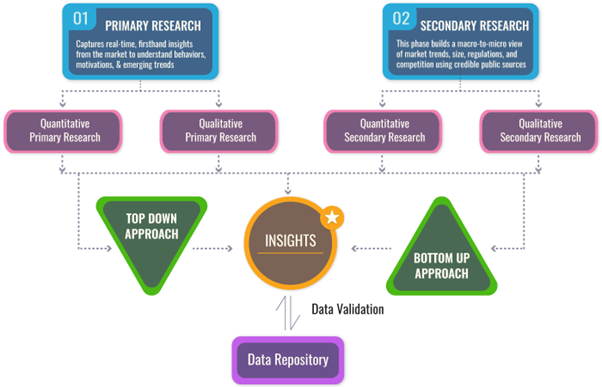
DUAL MODELING: TOP-DOWN + BOTTOM-UP
To ensure robust market estimation, we apply two complementary sizing approaches:
Top-Down Modeling:- Start with broader industry value (e.g., global or regional TAM)
- Apply filters by segment, geography, end-user, or use case
- Adjust with primary insights and validation benchmarks
- Ideal for investor-grade market scans and opportunity mapping
- Aggregate from the ground up using sales volumes, pricing, and unit economics
- Use internal modeling templates aligned with stakeholder data
- Incorporate distributor-level or region-specific inputs
- Most accurate for emerging segments and granular sub-markets
DATA VALIDATION: IN-HOUSE REPOSITORY
We close the loop with proprietary data intelligence built from ongoing projects, industry monitoring, and historical benchmarking. This repository includes:
- Multi-sector market and pricing models
- Key trendlines from past interviews and forecasts
- Benchmarked adoption rates, churn patterns, and ROI indicators
- Industry-specific deviation flags and cross-check logic
- Catches inconsistencies early
- Aligns projections across studies
- Enables consistent, high-trust deliverables