

Women’s Health Market Size and Forecast (2026–2034), Global and Regional Growth, Trend, Share and Industry Analysis Report Coverage: By Offering (Pharmaceuticals, Medical Devices, Diagnostics, Digital Health Solutions, Nutraceuticals and Wellness Products), By Application (Contraception, Infertility, Endometriosis & Uterine Fibroids, Polycystic Ovary Syndrome (PCOS), Menopause, Postmenopausal Osteoporosis, Gynecological Cancers, Pregnancy & Maternal Health, and Others), By Distribution Channel (Hospital Pharmacies, Retail Pharmacies, Online Pharmacies, Specialty Pharmacies, Direct-to-Consumer and Employer Channels) and Geography
2026-08-11
Healthcare
Swetal (Research Analyst)
Description
Women’s Health Market Overview
The Global Women’s Health
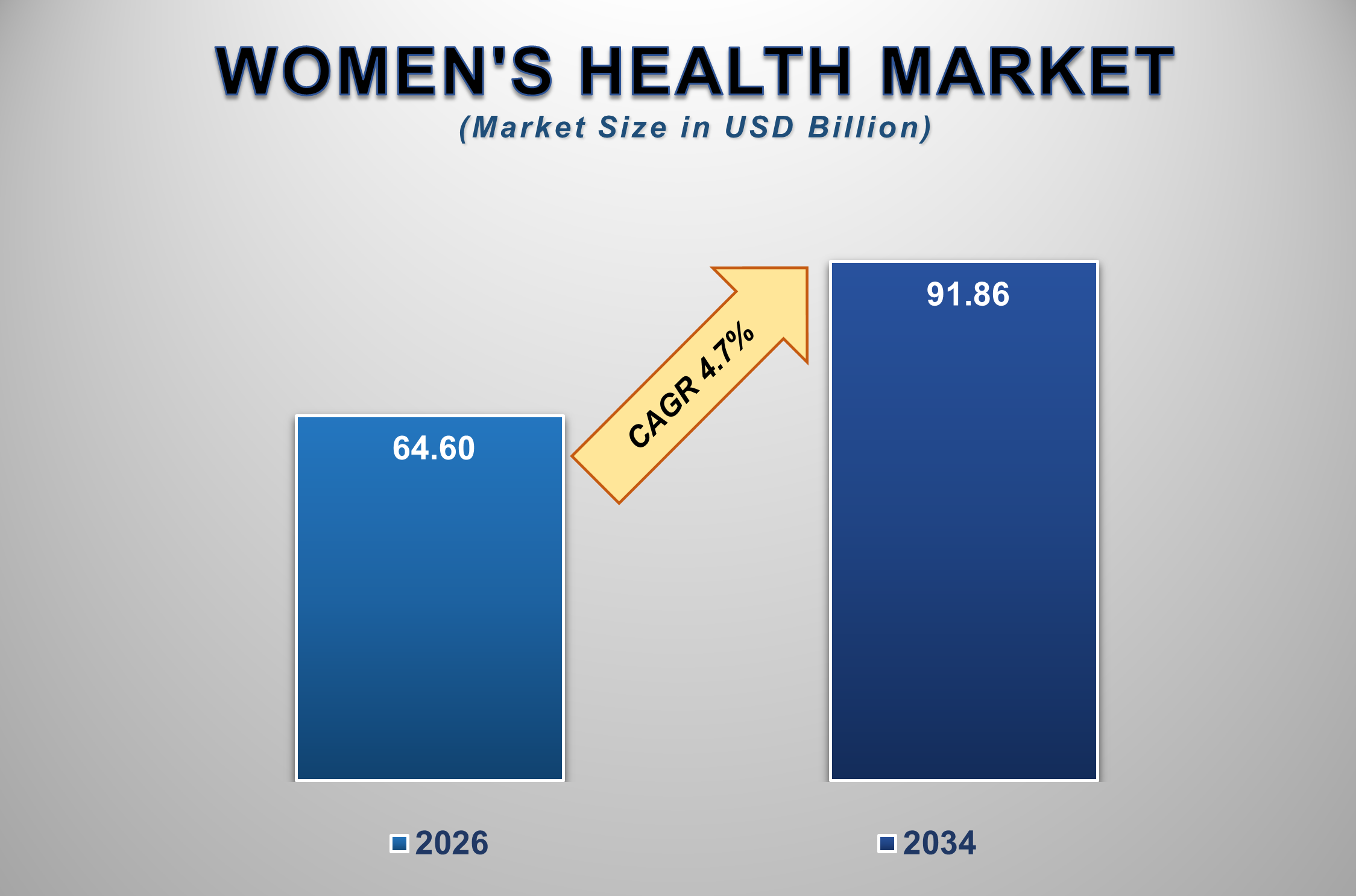
Market was valued at USD 64.60 Billion in 2026 and is projected to reach USD
91.86 Billion by 2034, expanding at a CAGR of 4.7% during the forecast
period. The Women's Health Market
includes pharmaceuticals, medical devices, diagnostic products, digital health
solutions, and wellness goods made in order to meet the needs in women's
healthcare at different ages. The sector is experiencing stable growth as the
demand for gynecology treatment is rising, due to a higher number of
gynecological disorders experienced by women, such as endometriosis, polycystic
ovary syndrome (PCOS), infertility, menopause related conditions, breast and
cervical cancer, and osteoporosis. Cutting-edge technology in minimally
invasive gynecology procedures, fertility therapy, molecular diagnostics,
wearable health technology solutions, and AI-enabled digital health solutions
helps transform women's healthcare, making it possible to set an earlier
diagnosis, enable personalized treatment, and automatically engage patients.
What is more, government support, improved reimbursement of women's health
services, allocation of funds to the femtech market, and increasing needs of
women in maternal and reproductive healthcare services help to boost sector
growth and make North America one of the leading regions in this field, and the
Asia-Pacific region the fastest-growing one because of the key players
operating in the market.
Women’s Health Market Drivers and
Opportunities
Rising Prevalence of
Gynecological Disorders and Reproductive Health Conditions Driving Market
Growth
The heightened
prevalence of gynecological ailments and reproductive disorders is a
significant factor in increasing the growth of the women's health market. The
growing cases of endometriosis and polycystic ovary syndrome, the growth of
cases of uterine fibroids, and issues related to childbirth and fertility, as
well as menopausal problems and gynecological cancers, are leading to a rise in
the need for advanced diagnostic methods, hormonal treatment options, new-age
surgical devices, fertility treatments, and disease management solutions.
Further, as more women become aware of the issues related to women's health, an
increasing number of women facing delayed pregnancies, the problems caused by
lifestyle changes, and limited access to preventive healthcare are seeking
major medical intervention to solve these issues. According to data from the
Royal College of Obstetricians and Gynaecologists (RCOG) released in January
2026, England saw a surge in gynecology referrals from 1.61 million in the
period from October 2024 to October 2025 compared to previous referrals of 1.22
million between October 2019 and October 2020, an increase of almost 24%. The
high increase in referral numbers reflects the rising need for gynecological
diagnosis and treatment, thus creating the need and importance for innovative
pharmaceutical products, medical devices, diagnostic equipment, and digital
health solutions, thus enabling the continued growth of the global women's
health market.
Growing Adoption
of FemTech and Digital Health Solutions Accelerating Women's Healthcare Fueling
Market Expansion
The women's health
market is being positively impacted by the increasing acceptance of FemTech and
digital health solutions. Thanks to AI-based fertility apps, menstrual health
apps, pregnancy monitoring technologies, telehealth solutions, and wearable devices,
early diagnosis, remote health monitoring, and management of ailments,
including infertility, polycystic ovary syndrome, endometriosis, and menopause,
can be achieved. The growth in smartphone ownership, the emergence of
supportive digital medical initiatives, and the upswing in funding for FemTech
startups are also invigorating the process.
Expansion of
Personalized Medicine and Precision Women's Healthcare Creates Significant
Growth Opportunities
Increased use of
personalized medicine offers many growth opportunities in the women’s health
market, as it enables accurate diagnoses and individualized treatments for
medical conditions such as infertility, endometriosis, gynecologic cancers, and
menopause-associated conditions. Innovations in the area of genomics, molecular
diagnostics, biomarker testing, and companion diagnostics will make it possible
to offer targeted therapy and improve treatment results. The increased focus on
precision medicine and growing demand for patient-centered healthcare are
driving the development of new diagnostics, treatment, and digital health
solutions to meet specific healthcare needs of women.
Women’s Health Market Scope
|
Report Attributes |
Description |
|
Market Size in 2026 |
USD 64.60 Billion |
|
Market Forecast in 2034 |
USD 91.86 Billion |
|
CAGR % 2026-2034 |
4.7% |
|
Base Year |
2025 |
|
Historic Data |
2021-2025 |
|
Forecast Period |
2026-2034 |
|
Report USP |
Pricing and Cost Structure Analysis, Product
Innovation Benchmarking, Whitespace Assessment, Company Share, Company
Heatmap, Growth Factors, and more |
|
Segments Covered |
●
By
Offering ●
By
Application ●
By
Distribution Channel |
|
Regional Scope |
●
North
America ●
Europe ●
APAC ●
Latin
America ●
Middle
East and Africa |
|
Country Scope |
●
U.S. ●
Canada ●
U.K. ●
Germany ●
France ●
Italy ●
Spain ●
Russia ●
China ●
India ●
Japan ●
South
Korea ●
Australia
●
Mexico ●
Brazil ●
Saudi
Arabia ●
UAE ●
South
Africa
|
Women’s Health Market Report
Segmentation Analysis
The global women’s
health market industry analysis is segmented by offering, by application, by
distribution channel, and by region.
Pharmaceuticals
Segment Is Expected to Dominate the Women’s Health Market During the Forecast
Period
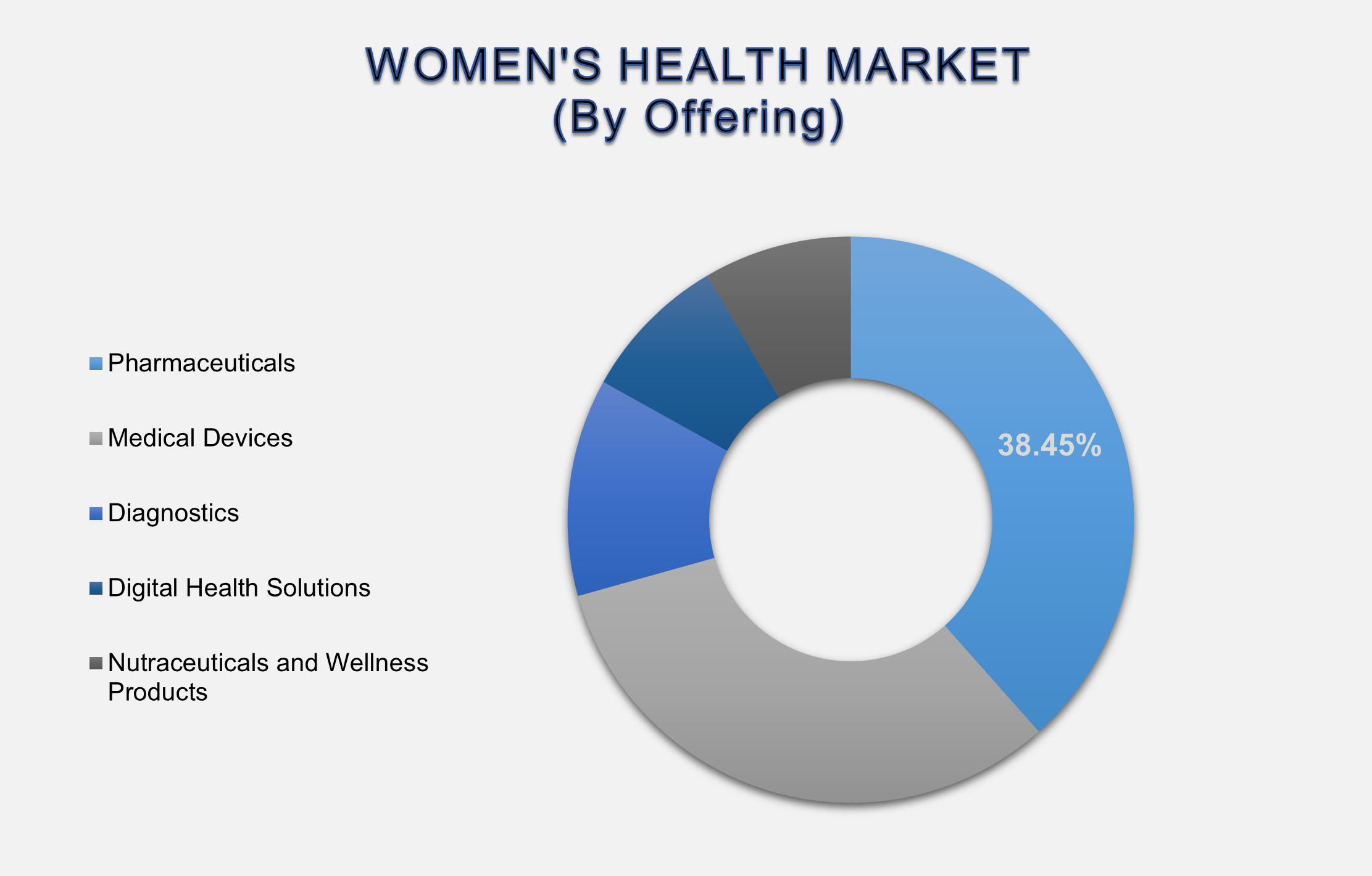
The pharmaceuticals
segment is estimated to be the leading one in the women's health market over
the forecast period as the incidence of gynecological disorders increases along
with the growing need for hormone therapy, contraceptive drugs, infertility drugs,
menopausal drugs, and drugs used to target diseases like endometriosis, uterine
fibroids, and osteoporosis. The continuous developments and advancements in
research and development are rapidly helping in bringing innovative medicines
that cater to women's health requirements at different life stages. The
pharmaceutical industry is not only concentrating on reproductive health but
also shifting its focus towards preventive and healthy aging products. For
instance, in April 2026, Surishi Pharmaceuticals launched its commitment to
promoting cellular longevity science in Indian women's healthcare by focusing
on NAD+ depletion, which causes early aging among women.
Pregnancy &
Maternal Health Segment Is Expected to Lead the Women’s Health Market by
Application
The pregnancy &
maternal health category is anticipated to hold the dominant position in terms
of application in the women's health market throughout the forecast period
owing to high awareness levels regarding maternal health, increased expenditure
on healthcare associated with births, and increasing need for complete pre- and
post-natal care. This category includes such applications as pregnancy
monitoring, prenatal diagnosis, maternal nutrition, fetal health screening,
management of labor & delivery, postpartum care, and digital maternal
health. Government and healthcare institutions in all countries of the world
develop various maternal health programs to lower the level of
pregnancy-related complications and increase maternal and neonatal health outcomes.
Moreover, recent advances in the field of NIPT, fetal monitoring, telehealth
services, pregnancy monitoring wearables, and AI-based platforms for maternal
care also contribute to the increased risk detection and personalization of the
treatment process. Thus, high demand for high-risk pregnancy monitoring, higher
age of mothers, and increased availability of obstetric care led to the
continuous growth of the mentioned segment, making it the leading application
in the women's health market during the forecast period.
Hospital Segment
Is Expected to Lead the Women’s Health Market by End User
The hospital
pharmacies segment is projected to dominate the Women's Health Market by
distribution channel during the forecast period because of the high number of
prescriptions that are written in hospitals to treat complicated diseases
associated with gynecology and reproductive health. Hospitals have a
significant part to play in providing specialty medicines, hormone medicines,
fertility medicines, oncology medicines, biologics, and other drugs needed for
treating infertility, endometriosis, fibroids, gynecological cancers, high-risk
pregnancy, and disorders of menopause. The increased number of deliveries,
surgeries, and gynecology treatments in hospitals is also driving the demand
via this channel. Further, multidisciplinary care, advanced diagnostic
capabilities, and increasing preference for treating complicated women's health
disorders via hospitals are making hospital pharmacies dominate the market.
Increasing investments in healthcare infrastructure and hospitals, as well as
maternal and reproductive healthcare facilities, will continue to boost the
segment's growth during the forecast period.
The following
segments are part of an in-depth analysis of the global women’s health market:
|
Market Segments |
|
|
By Offering |
●
Pharmaceuticals ●
Medical
Devices ●
Diagnostics ●
Digital
Health Solutions ●
Nutraceuticals
and Wellness Products |
|
By Application |
●
Contraception ●
Infertility ●
Endometriosis
& Uterine Fibroids ●
Polycystic
Ovary Syndrome (PCOS) ●
Menopause ●
Postmenopausal
Osteoporosis ●
Gynecological
Cancers ●
Pregnancy
& Maternal Health ●
Others |
|
By Distribution Channel |
●
Hospital
Pharmacies ●
Retail
Pharmacies ●
Online
Pharmacies ●
Specialty
Pharmacies ●
Direct-to-Consumer
and Employer Channels |
Women’s Health Market Share Analysis
by Region
North America is
projected to hold the largest share of the global women’s health market over
the forecast period
North America is
anticipated to maintain the major share in the global women's healthcare market
during the forecast horizon. This can be attributed to the region's developed
healthcare systems, high health expenditure, favorable reimbursement procedures,
as well as increased awareness of health problems such as menopause,
reproductive disorders, gynecological cancer, and osteoporosis. A key example
includes the approval of labeling changes by the U.S. Food and Drug
Administration (FDA) for six menopausal hormone therapy (HRT) products in
February 2026. This revision consisted of the removal of boxed warning
statements regarding cardiovascular disease, breast cancer, and probable
dementia to portray accurate scientific findings and clear explanations of benefit-risk
balance. The development is perceived to boost physician confidence while
minimizing patients' worries connected with hormone replacement therapy and
facilitating further application of treatments in the region.
Women’s Health
Market Competition Landscape Analysis
The competitive
atmosphere of the women’s health market includes the top pharmaceutical
companies, the biotechnology companies, the manufacturers of medical devices,
the companies focused on diagnostics, and those that provide digital healthcare
and fertility solutions. The companies within this market are investing a lot
of money into creating innovative medications and treatments, fertility
technologies, gynecological equipment that is minimally invasive, and
technologies related to healthcare. The competition is also influenced by new
product launches, approvals from regulators, clinical trials, R&D,
licensing agreements, mergers and acquisitions, and expansion into other
regions. The companies are beginning to apply precision medicine and artificial
intelligence in women’s healthcare.
Global Women’s
Health Market Recent Developments News:
●
In June 2026 -
Daré Bioscience, Inc., a purpose-driven health biotech company solely focused
on closing the gap in women's health between promising science and real-world
solutions, announced the upcoming commercial launch of Flora Sync LF5, a
vaginal probiotic capsule formulated specifically to restore microbiome balance
and support lasting vaginal comfort.
●
In March 2026
- PharmEasy announced the launch
of WomenCare, a dedicated category designed to offer comprehensive, end-to-end
support for women’s health. The company has introduced the new category with
exclusive offers to mark International Women’s Day.
●
In March 2026 -
Organon Asia Pacific Cluster announced the 2026 Her Health Grant recipients for
the Asia Pacific region, marking a significant milestone in efforts to
strengthen and expand women's health initiatives across the region.
●
In March 2026
- Gedeon Richter Plc. and Fuji Pharma Co., Ltd. announced that, further to the
strategic collaboration agreement announced on 3 February 2026 aiming at
joining efforts in business development and R&D, the two parties have now
signed an agreement regarding the joint development of multiple product
candidates in women’s health.
The global
women’s health market is dominated by a few large companies, such as
●
AbbVie Inc.
●
Amgen Inc.
●
Bayer AG
●
Dare Bioscience, Inc.
●
Exact Sciences Corporation
●
Femasys Inc.
●
Ferring Pharmaceuticals
●
GE HealthCare
●
Hologic, Inc.
●
Johnson & Johnson
●
Labcorp Holdings Inc.
●
Merck & Co., Inc.
●
Myovant Sciences Ltd.
●
Organon & Co.
●
Pfizer Inc.
●
Progyny, Inc.
●
Quest Diagnostics Incorporated
●
Siemens Healthineers
●
Teva Pharmaceutical Industries Ltd.
●
The Cooper Companies, Inc.
● Other Prominent Players
Frequently Asked Questions
Swetal (Research Analyst)
Swetal is a Research Analyst with 4+ years of experience specializing in healthcare market research, medical devices, healthcare IT, and medical technology industry analysis. Her expertise includes competitive intelligence, secondary research, market trend forecasting, and healthcare business insights across global healthcare ecosystems.
She contributes to advanced market research reports by analyzing regulatory frameworks, emerging healthcare technologies, competitive landscapes, and innovation trends shaping the medical industry. With a strong focus on accurate market intelligence, strategic insights, and healthcare industry trends, Swetal supports businesses in making informed, data-backed decisions in a rapidly transforming healthcare environment.
1.
Global
Women’s Health Market Introduction and Market Overview
1.1. Objectives of the Study
1.2. Market Segmentation
1.2.1.Offering of the Global Women’s
Health Market
1.2.2.Application of the Global Women’s
Health Market
1.2.3.Distribution Channel of the
Global Women’s Health Market
1.2.4.Region of the Global Women’s
Health Market
1.3. Competition Coverage List of
Market Participants
1.4. Market Definition: Women’s
Health Market
2.
Executive Summary
2.1. Global Women’s Health Market
Estimation & Forecast
2.1.1.Global Women’s Health Market
Size (US$ Million) Estimates & Historical Trend Analysis (2021 - 2025)
2.1.2.Global Women’s Health Overall
Market Size (US$ Million), Growth Rate (Y-o-Y), Market CAGR (%), Market
Forecast (2026 - 2034)
2.2. Snapshot of Global Women’s
Health Market
2.3. Global Women’s Health Market
Revenue Share (%) 2025
2.4. REGIONAL OUTLINE: Revenue CAGR,
by Region
2.5. Key Competitors & Key
Insights
3.
Market Overview (Qualitative
Analysis)
3.1. Demand Side Trends
3.2. Supply Side Trends /
Manufacturing Trends
3.3. Demand and Opportunity
Assessment, 2026 - 2034
3.4. Market Dynamics
3.4.1.Drivers
3.4.2.Limitations
3.4.3.Opportunities
3.4.4.Impact Analysis of Drivers and
Restraints
3.5. Key Developments
3.6. Regulatory Landscape
3.7. Pricing Analysis
3.8. Supply Chain Analysis
3.9. Porter’s Five Forces Analysis
3.9.1.Bargaining Power of Suppliers
3.9.2.Bargaining Power of Buyers
3.9.3.Threat of Substitutes
3.9.4.Threat of New Entrants
3.9.5.Competitive Rivalry
3.10. PEST Analysis
3.10.1. Political Factors
3.10.2. Economic Factors
3.10.3. Social Factors
3.10.4. Technology Factors
4.
Global Women’s Health Market
Estimates & Forecast Trend Analysis, by Offering
4.1. Global Women’s Health Market
Assessments & Key Findings, by Offering
4.2. Global Women’s Health Market
Revenue (US$ Million) Estimates and Forecasts, by Offering, 2021 - 2034
4.2.1.Pharmaceuticals
4.2.2.Medical Devices
4.2.3.Diagnostics
4.2.4.Digital Health Solutions
4.2.5.Nutraceuticals and Wellness
Products
5.
Global Women’s Health Market
Estimates & Forecast Trend Analysis, by Application
5.1. Global Women’s Health Market
Assessments & Key Findings, by Application
5.2. Global Women’s Health Market
Revenue (US$ Million) Estimates and Forecasts, by Application, 2021 - 2034
5.2.1.Contraception
5.2.2.Infertility
5.2.3.Endometriosis & Uterine
Fibroids
5.2.4.Polycystic Ovary Syndrome (PCOS)
5.2.5.Menopause
5.2.6.Postmenopausal Osteoporosis
5.2.7.Gynecological Cancers
5.2.8.Pregnancy & Maternal Health
5.2.9.Others
6.
Global Women’s Health Market
Estimates & Forecast Trend Analysis, by Distribution Channel
6.1. Global Women’s Health Market
Assessments & Key Findings, by Distribution Channel
6.2. Global Women’s Health Market
Revenue (US$ Million) Estimates and Forecasts, by Distribution Channel, 2021 -
2034
6.2.1.Hospital Pharmacies
6.2.2.Retail Pharmacies
6.2.3.Online Pharmacies
6.2.4.Specialty Pharmacies
6.2.5.Direct-to-Consumer and Employer
Channels
7.
Global Women’s Health Market
Estimates & Forecast Trend Analysis, by Region
7.1.
Global
Women’s Health Market Assessments & Key Findings, by Region
7.2.
Global
Women’s Health Market Revenue (US$ Million) Estimates and Forecasts, by Region,
2021 - 2034
7.2.1.North America
7.2.2.Europe
7.2.3.Asia Pacific
7.2.4.Middle East & Africa
7.2.5.Latin America
8.
North
America Women’s Health Market: Estimates & Forecast Trend Analysis
8.1. North America Women’s Health
Market Assessments & Key Findings
8.1.1.North America Women’s Health
Market Introduction
8.1.2.North America Women’s Health
Market Size Estimates and Forecast (US$ Million) (2021 - 2034)
8.1.2.2. By Application
8.1.2.3. By Distribution Channel
8.1.2.4. By Country
8.1.2.4.1. The U.S.
8.1.2.4.2. Canada
9.
Europe
Women’s Health Market: Estimates & Forecast Trend Analysis
9.1. Europe Women’s Health Market
Assessments & Key Findings
9.1.1.Europe Women’s Health Market
Introduction
9.1.2.Europe Women’s Health Market
Size Estimates and Forecast (US$ Million) (2021 - 2034)
9.1.2.1. By Offering
9.1.2.2. By Application
9.1.2.3. By Distribution Channel
9.1.2.4. By Country
9.1.2.4.1.
Germany
9.1.2.4.2.
Italy
9.1.2.4.3.
U.K.
9.1.2.4.4.
France
9.1.2.4.5.
Spain
9.1.2.4.6.
Switzerland
9.1.2.4.7. Rest
of Europe
10. Asia Pacific Women’s
Health Market: Estimates & Forecast
Trend Analysis
10.1. Asia Pacific Market Assessments
& Key Findings
10.1.1. Asia Pacific Women’s Health
Market Introduction
10.1.2. Asia Pacific Women’s Health
Market Size Estimates and Forecast (US$ Million) (2021 - 2034)
10.1.2.1. By Offering
10.1.2.2. By Application
10.1.2.3. By Distribution Channel
10.1.2.4. By Country
10.1.2.4.1. China
10.1.2.4.2. Japan
10.1.2.4.3. India
10.1.2.4.4. Australia
10.1.2.4.5. South Korea
10.1.2.4.6. Rest of Asia Pacific
11. Middle East & Africa Women’s
Health Market: Estimates & Forecast
Trend Analysis
11.1. Middle East & Africa Market
Assessments & Key Findings
11.1.1. Middle
East & Africa Women’s
Health Market Introduction
11.1.2. Middle
East & Africa Women’s
Health Market Size Estimates and Forecast (US$ Million) (2021 - 2034)
11.1.2.1. By Offering
11.1.2.2. By Application
11.1.2.3. By Distribution Channel
11.1.2.4. By Country
11.1.2.4.1. South Africa
11.1.2.4.2. UAE
11.1.2.4.3. Saudi Arabia
11.1.2.4.4. Rest of MEA
12. Latin America
Women’s Health Market: Estimates &
Forecast Trend Analysis
12.1. Latin America Market Assessments
& Key Findings
12.1.1. Latin America Women’s Health
Market Introduction
12.1.2. Latin America Women’s Health
Market Size Estimates and Forecast (US$ Million) (2021 - 2034)
12.1.2.1. By Offering
12.1.2.2. By Application
12.1.2.3. By Distribution Channel
12.1.2.4. By Country
12.1.2.4.1. Brazil
12.1.2.4.2. Mexico
12.1.2.4.3. Argentina
12.1.2.4.4. Rest of LATAM
13. Competition Landscape
13.1. Global Women’s Health Market
Product Mapping
13.2. Global Women’s Health Market
Concentration Analysis, by Leading Players / Innovators / Emerging Players /
New Entrants
13.3. Global Women’s Health Market
Tier Structure Analysis
13.4. Global Women’s Health Market
Concentration & Company Market Shares (%) Analysis, 2025
14. Company Profiles
14.1. AbbVie Inc.
14.1.1. Company Overview & Key Stats
14.1.2. Financial Performance & KPIs
14.1.3. Product Portfolio
14.1.4. SWOT Analysis
14.1.5. Business Strategy & Recent
Developments
* Similar details would be provided
for all the players mentioned below
14.2. Amgen Inc.
14.3. Bayer AG
14.4. Dare Bioscience, Inc.
14.5. Exact Sciences Corporation
14.6. Femasys Inc.
14.7. Ferring Pharmaceuticals
14.8. GE HealthCare
14.9. Hologic, Inc.
14.10. Johnson & Johnson
14.11. Labcorp Holdings Inc.
14.12. Merck & Co., Inc.
14.13. Myovant Sciences Ltd.
14.14. Organon & Co.
14.15. Pfizer Inc.
14.16. Progyny, Inc.
14.17. Quest Diagnostics Incorporated
14.18. Siemens Healthineers
14.19. Teva Pharmaceutical Industries
Ltd.
14.20. The Cooper Companies, Inc.
14.21. Other Prominent Players
15. Research
Findings & Conclusion
16. Assumptions & Acronyms Used
17. Research
Methodology
17.1. External Transportation /
Databases
17.2. Internal Proprietary Database
17.3. Primary Research
17.4. Secondary Research
17.5. Assumptions
17.6. Limitations
17.7. Report FAQs
Our Research Methodology
"Insight without rigor is just noise."
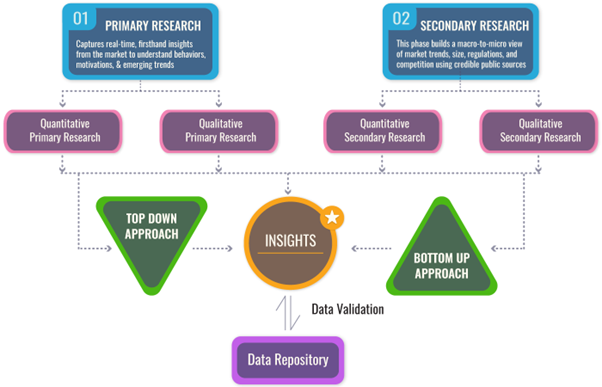
We follow a comprehensive, multi-phase research framework designed to deliver accurate, strategic, and decision-ready intelligence. Our process integrates primary and secondary research , both quantitative and qualitative , along with dual modeling techniques ( top-down and bottom-up) and a final layer of validation through our proprietary in-house repository.
PRIMARY RESEARCH
Primary research captures real-time, firsthand insights from the market to understand behaviors, motivations, and emerging trends.
1. Quantitative Primary Research
Objective: Generate statistically significant data directly from market participants.
Approaches:- Structured surveys with customers, distributors, and field agents
- Mobile-based data collection for point-of-sale audits and usage behavior
- Phone-based interviews (CATI) for market sizing and product feedback
- Online polling around industry events and digital campaigns
- Purchase frequency by customer type
- Channel performance across geographies
- Feature demand by application or demographic
2. Qualitative Primary Research
Objective: Explore decision-making drivers, pain points, and market readiness.
Approaches:- In-depth interviews (IDIs) with executives, product managers, and key decision-makers
- Focus groups among end users and early adopters
- Site visits and observational research for consumer products
- Informal field-level discussions for regional and cultural nuances
SECONDARY RESEARCH
This phase helps establish a macro-to-micro understanding of market trends, size, regulation, and competitive dynamics, sourced from credible and public domain information.
1. Quantitative Secondary Research
Objective: Model market value and segment-level forecasts based on published data.
Sources include:- Financial reports and investor summaries
- Government trade data, customs records, and regulatory statistics
- Industry association publications and economic databases
- Channel performance and pricing data from marketplace listings
- Revenue splits, pricing trends, and CAGR estimates
- Supply-side capacity and volume tracking
- Investment analysis and funding benchmarks
2. Qualitative Secondary Research
Objective: Capture strategic direction, innovation signals, and behavioral trends.
Sources include:- Company announcements, roadmaps, and product pipelines
- Publicly available whitepapers, conference abstracts, and academic research
- Regulatory body publications and policy briefs
- Social and media sentiment scanning for early-stage shifts
- Strategic shifts in market positioning
- Unmet needs and white spaces
- Regulatory triggers and compliance impact
DUAL MODELING: TOP-DOWN + BOTTOM-UP
To ensure robust market estimation, we apply two complementary sizing approaches:
Top-Down Modeling:- Start with broader industry value (e.g., global or regional TAM)
- Apply filters by segment, geography, end-user, or use case
- Adjust with primary insights and validation benchmarks
- Ideal for investor-grade market scans and opportunity mapping
- Aggregate from the ground up using sales volumes, pricing, and unit economics
- Use internal modeling templates aligned with stakeholder data
- Incorporate distributor-level or region-specific inputs
- Most accurate for emerging segments and granular sub-markets
DATA VALIDATION: IN-HOUSE REPOSITORY
We close the loop with proprietary data intelligence built from ongoing projects, industry monitoring, and historical benchmarking. This repository includes:
- Multi-sector market and pricing models
- Key trendlines from past interviews and forecasts
- Benchmarked adoption rates, churn patterns, and ROI indicators
- Industry-specific deviation flags and cross-check logic
- Catches inconsistencies early
- Aligns projections across studies
- Enables consistent, high-trust deliverables