

Wood Protection Chemicals Market Size and Forecast (2020 - 2033), Global and Regional Growth, Trend, Share, and Industry Analysis Report Coverage: By Product Type (Preservatives, Flame Retardants, Water Repellents, Insecticides, Others), By Application (Residential, Commercial & Industrial), By End-Use (Construction, Furniture & Decking, Marine), And Geography
2025-12-12
Chemicals & Materials
Jaya Bundele (Research Analyst)
Description
Wood
Protection Chemicals Market Overview
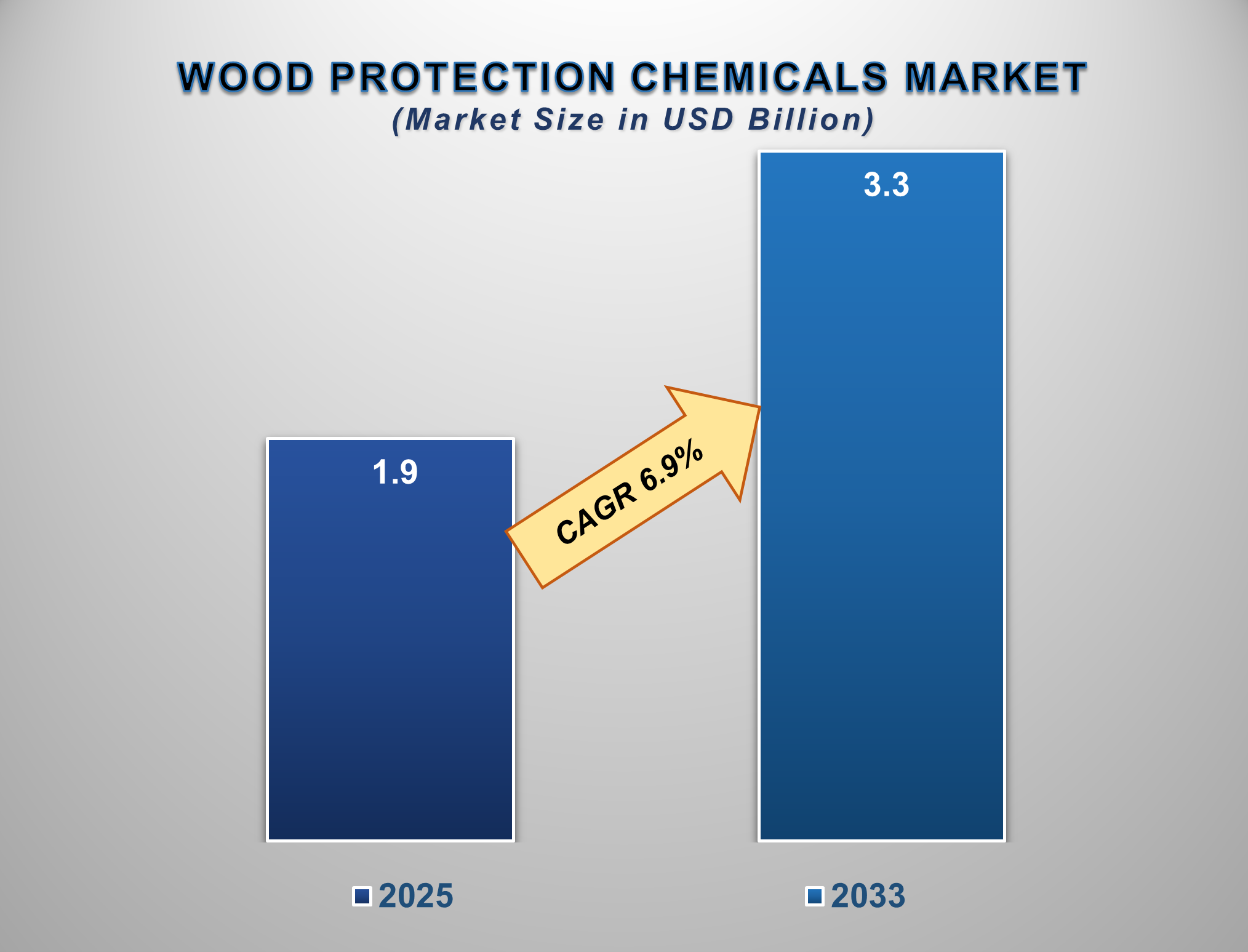
The Wood Protection Chemicals Market is set for steady growth from 2025 to 2033, driven by rising global construction activity, increasing demand for durable and sustainable building materials, and stringent fire safety regulations. The market is projected to be valued at approximately USD 1.9 billion in 2025 and is forecasted to reach nearly USD 3.3 billion by 2033, exhibiting a compound annual growth rate (CAGR) of 6.9% during this period.
Wood protection chemicals are specialized
formulations designed to extend the lifespan of wood by protecting it from
biological decay (fungi, termites), moisture, fire, and UV radiation. The
market's expansion is underpinned by the growing preference for wood as a
renewable and aesthetically pleasing construction material, necessitating
treatments to enhance its performance and longevity. The construction boom in
emerging economies, coupled with the renovation and repair activities in
developed regions, is fueling demand.
Furthermore, technological advancements leading to more effective,
low-toxicity, and environmentally friendly formulations are creating new market
opportunities. North America and Europe are established markets with strict
regulatory standards, while the Asia-Pacific region is expected to witness the
fastest growth due to rapid urbanization and infrastructure development.
Wood Protection Chemicals Market Drivers and
Opportunities
Growth in Construction and Infrastructure Development is the
Primary Market Driver
The most significant driver for the wood
protection chemicals market is the robust growth in the global construction
industry, particularly in residential and commercial sectors. Wood is a
fundamental material for framing, decking, fencing, and structural components.
As construction volumes rise, so does the need to protect these investments
from degradation, ensuring structural integrity and safety. This is especially
critical in regions with high humidity, termite prevalence, or significant
rainfall, where untreated wood is highly susceptible to damage.
Stringent Fire Safety Regulations and Sustainability Trends
are Accelerating Market Growth
Increasingly stringent building codes and fire
safety regulations across the globe are mandating the use of fire-retardant-treated wood in various applications, from residential buildings
to public infrastructure. This regulatory push is a major growth factor for flame-retardant chemicals. Simultaneously, the global focus on
sustainability is driving the use of wood as a renewable and
carbon-sequestering resource. To maximize its sustainability benefits,
protecting wood to ensure a long service life is paramount, creating a
consistent demand for high-performance preservatives and coatings.
Development of Bio-Based and Hybrid Formulations Presents
Significant Opportunities
The shift towards eco-friendly and low-VOC
(Volatile Organic Compound) products represents a major growth frontier.
Significant opportunities exist in the research and development of bio-based
wood protection chemicals derived from natural sources, which offer an
effective and environmentally responsible alternative to traditional synthetic
chemicals. Additionally, the development of multi-functional hybrid
formulations that combine preservative, water-repellent, and UV-resistant
properties in a single treatment is gaining traction. For manufacturers,
investing in R&D for these advanced, sustainable, and integrated solutions
is a key strategy to capture value from environmentally conscious consumers and
industrial clients.
Wood Protection Chemicals Market Scope
|
Report Attributes |
Description |
|
Market Size in 2025 |
USD 1.9 Billion |
|
Market Forecast in 2033 |
USD 3.3 Billion |
|
CAGR % 2025-2033 |
6.9% |
|
Base Year |
2024 |
|
Historic Data |
2020-2024 |
|
Forecast Period |
2025-2033 |
|
Report USP |
Product Portfolio,
Technological Analysis, Company Market Share, Company Heatmap, Pricing
Analysis, Growth Factors and more |
|
Segments Covered |
●
By Product Type ●
By Application ●
By End-user |
|
Regional Scope |
●
North America, ●
Europe, ●
APAC, ●
Latin America ●
Middle East and
Africa |
|
Country Scope |
1)
U.S. 2)
Canada 3)
Germany 4)
UK 5)
France 6)
Spain 7)
Italy 8)
Switzerland 9)
China 10)
Japan 11)
India 12)
Australia 13)
South Korea 14)
Brazil 15)
Mexico 16)
Argentina 17)
South Africa 18)
Saudi Arabia 19)
UAE |
Wood Protection Chemicals Market Report
Segmentation Analysis
The global Wood Protection
Chemicals Market industry analysis is segmented by Product Type, by
Application, by End-Use, and by Region.
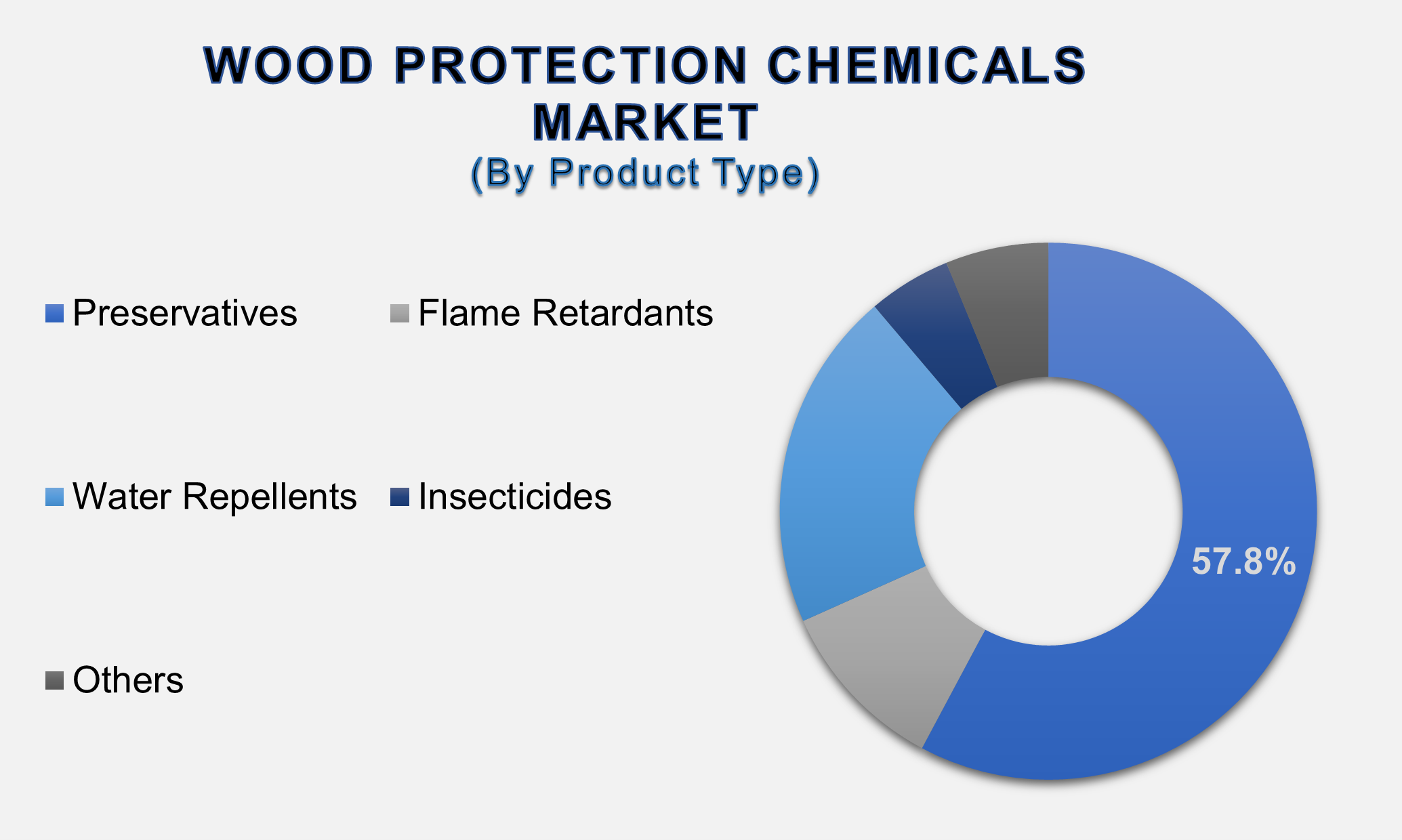
The Preservatives segment
is anticipated to command a significant market share in 2025.
The
Product Type segment is categorized into Preservatives, Flame Retardants, Water
Repellents, Insecticides, and Others. Preservatives, which protect wood from
fungal decay and insect attack, form the backbone of the market. Their
dominance is due to the fundamental need to prevent biological degradation,
which is the primary cause of wood failure in most environments. The widespread
use of pressure-treated lumber in residential construction and outdoor
applications ensures consistent and high demand for this segment.
The wood protection chemicals market relies heavily on preservatives, the dominant product segment, which are categorized by their composition and application. Water-based preservatives form the largest category, led by Alkaline Copper Quat (ACQ) and Copper Azole (CA), which use copper as a fungicide paired with other biocides to protect against decay and insects in residential applications like decking and fencing. Borates offer a low-toxicity alternative but are primarily used for interior framing, as they can leach out when exposed to weather.
For
extreme-duty industrial applications such as railroad ties and utility poles,
heavy-duty oil-based preservatives like creosote and pentachlorophenol are
employed for their superior durability and water resistance, though their use
is restricted due to environmental concerns. Light Organic Solvent
Preservatives (LOSP) are used where a clean, paintable finish is required, such
as in window frames and millwork. The market is also seeing emerging trends
with the development of systems that reduce copper content and the exploration
of bio-based alternatives derived from natural oils and extracts, driven by
growing demand for more environmentally benign and sustainable wood protection
solutions.
The Residential
application segment is projected to hold the largest market share.
The
Application segment is divided into Residential and Commercial &
Industrial. The Residential segment is the most lucrative, driven by
high-volume use of treated wood in single-family and multi-family housing
projects. Key applications include decking, fencing, sill plates, roof trusses,
and landscaping. The DIY (Do-It-Yourself) trend for home improvement projects,
such as building or refurbishing decks and fences, also contributes
significantly to the consumption of wood protection chemicals in this segment.
The Construction end-use
segment is projected to maintain its dominance.
The
Construction segment's leading position is a direct reflection of wood's
extensive use as a building material. From structural framing and sheathing to
windows, doors, and exterior cladding, wood requires protection at multiple
stages of construction. The growth in green building standards, which often favors wood for its sustainability credentials, further bolsters
the demand for protective chemicals in this sector to ensure the long-term
durability and performance of wooden structures.
The following segments are
part of an in-depth analysis of the global Wood Protection Chemicals Market:
|
Market
Segments |
|
|
By Product
Type |
●
Preservatives ●
Flame Retardants ●
Water Repellents ●
Insecticides ●
Others |
|
By Application
|
●
Residential
Application ●
Commercial
Application ●
Industrial
Application |
|
By End-use |
●
Construction ●
Furniture &
Decking ●
Marine ●
Other |
Wood Protection Chemicals Market Share Analysis
by Region
The Asia Pacific region
is anticipated to hold the largest portion of the Wood Protection Chemicals
Market globally throughout the forecast period.
Asia-Pacific's
dominance is attributed to its massive and ongoing construction and
infrastructure boom, particularly in countries like China, India, and Southeast
Asian nations. Rapid urbanization, rising disposable incomes, and government
investments in residential and commercial projects are driving unprecedented
consumption of construction materials, including treated wood. The region's
warm and humid climate in many areas also necessitates the use of wood
preservatives to prevent decay, creating a vast and growing market for these
products.
China
and India are undergoing unprecedented urban transformations, driving massive
demand for construction materials, including treated wood. China's urbanization
rate surged from about 36% in 2000 to over 65% of its population residing in
cities by 2023, a shift involving hundreds of millions of people. This has been
fueled by government initiatives and immense infrastructure investment,
creating sprawling megacities and new urban centers. Similarly, India's urban
population is projected to grow rapidly, potentially reaching over 800 million
by 2050, with its government actively promoting smart city development and
industrial corridors to manage this growth.
This
breakneck urbanization directly fuels the wood protection chemicals market. The
construction boom necessitates vast quantities of wood for everything from
concrete formwork and structural framing to interior finishes, decking, and
fencing. Furthermore, the warm, humid climates prevalent in large parts of both
countries accelerate wood decay from fungi and increase the threat of termite
infestations, making chemical treatment not just an option but a necessity for
material longevity and structural safety. Consequently, the Asia-Pacific
region, led by China and India, has become the dominant and fastest-growing
market for wood preservatives and flame retardants, as the scale of urban
development creates a sustained, high-volume demand for durable, protected
building materials.
Wood Protection Chemicals Market Competition
Landscape Analysis
The global wood protection
chemicals market is moderately consolidated and competitive, featuring a mix of
large multinational chemical corporations and specialized chemical formulators.
Competition is based on product efficacy, technological innovation, regulatory
compliance, price, and distribution network. Key strategies include heavy
investment in R&D to develop more sustainable and effective formulations;
strategic mergers and acquisitions to expand product portfolios and geographic
reach; and forming strong partnerships with wood treaters and large
construction material suppliers. Adherence to stringent environmental and
safety regulations (e.g., EPA, REACH) is critical for market participation.
Global Wood Protection
Chemicals Market Recent Developments News:
- In February 2025, LANXESS AG launched a new generation of wood
preservatives with a reduced environmental footprint, targeting the
residential decking and fencing market.
- In December 2024, Koppers Holdings Inc. completed the acquisition of
a regional wood treater to strengthen its distribution network in the
European market.
- In October 2024, BASF SE introduced a novel fire-retardant coating
for engineered wood products (like CLT) used in mass timber construction,
addressing the growing demand for tall wood buildings.
- In August 2024, a consortium of
leading manufacturers allied to
promote the use of pressure-treated wood in sustainable construction
projects, highlighting its longevity and environmental benefits.
The Global Wood
Protection Chemicals Market Is Dominated by a Few Large Companies, such as
●
BASF SE
●
LANXESS AG
●
Koppers Holdings Inc.
●
Lonza Group Ltd.
●
Arch Lonza (Lonza)
●
RPM International Inc.
(Tremco)
●
Akzo Nobel N.V.
●
The Sherwin-Williams
Company
●
PPG Industries, Inc.
●
Kurt Obermeier GmbH
& Co. KG
●
Janssen Preservation
& Protection
●
Hoover Color Corp.
●
Rio Tinto Minerals
● Other Prominent Players
Frequently Asked Questions
Jaya Bundele (Research Analyst)
Jaya Bundele is a skilled Research Analyst with 4+ years of experience in market intelligence, consumer insights, competitive analysis, and industry forecasting across the consumer goods, agriculture, and food & beverage sectors. She specializes in market sizing, trend analysis, growth opportunity mapping, and strategic secondary research for global and regional markets.
Her expertise lies in transforming complex industry data into actionable business strategies that help organizations identify emerging trends, understand customer behavior, and gain a competitive edge. With a strong focus on data-driven insights, business intelligence, and future market trends, Jaya delivers high-quality research solutions aligned with evolving industry demands and market dynamics.
1. Global Wood Protection
Chemicals Market Introduction and Market Overview
1.1.
Objectives
of the Study
1.2.
Global
Wood Protection Chemicals Market Scope and Market Estimation
1.2.1.Global Electronic Toll
Collection Overall Market Size (US$ Bn), Market CAGR (%), Market forecast (2025
- 2033)
1.2.2.Global Wood Protection
Chemicals Market Revenue Share (%) and Growth Rate (Y-o-Y) from 2020 - 2033
1.3.
Market
Segmentation
1.3.1.Product Type of Global Wood
Protection Chemicals Market
1.3.2.Application of Global Wood
Protection Chemicals Market
1.3.3.End-use of Global Wood
Protection Chemicals Market
1.3.4.Region of Global Wood
Protection Chemicals Market
2. Executive
Summary
2.1.
Demand
Side Trends
2.2.
Key
Market Trends
2.3.
Market
Demand (US$ Bn) Analysis 2020 – 2024 and forecast, 2025 – 2033
2.4.
Demand
and Opportunity Assessment
2.5.
Technological
Advancements
2.6.
Key
Developments
2.7.
Market
Entry Strategies
2.8.
Market
Dynamics
2.8.1.Drivers
2.8.2.Limitations
2.8.3.Opportunities
2.8.4.Impact Analysis of Drivers
and Restraints
2.9.
Porter’s
Five Forces Analysis
2.10.
PEST
Analysis
3. Global
Wood Protection Chemicals Market Estimates
& Historical Trend Analysis (2020 - 2024)
4. Global
Wood Protection Chemicals Market Estimates
& Forecast Trend Analysis, by Product Type
4.1.
Global
Wood Protection Chemicals Market Revenue (US$ Bn) Estimates and Forecasts, by Product
Type, 2020 - 2033
4.1.1.Preservatives
4.1.2.Flame Retardants
4.1.3.Water Repellents
4.1.4.Insecticides
4.1.5.Others
5. Global
Wood Protection Chemicals Market Estimates
& Forecast Trend Analysis, by Application
5.1.
Global
Wood Protection Chemicals Market Revenue (US$ Bn) Estimates and Forecasts, by Application,
2020 - 2033
5.1.1.Residential Application
5.1.2.Commercial Application
5.1.3.Industrial Application
6. Global
Wood Protection Chemicals Market Estimates
& Forecast Trend Analysis, by End-use
6.1.
Global
Wood Protection Chemicals Market Revenue (US$ Bn) Estimates and Forecasts, by End-use
2020 - 2033
6.1.1.Construction
6.1.2.Furniture & Decking
6.1.3.Marine
6.1.4.Other
7. Global
Wood Protection Chemicals Market Estimates
& Forecast Trend Analysis, by region
7.1.
Global
Wood Protection Chemicals Market Revenue (US$ Bn) Estimates and Forecasts, by region,
2020 - 2033
7.1.1.North America
7.1.2.Europe
7.1.3.Asia Pacific
7.1.4.Middle East & Africa
7.1.5.Latin America
8. North America Wood
Protection Chemicals Market: Estimates
& Forecast Trend Analysis
8.1.
North
America Wood Protection Chemicals Market Assessments & Key Findings
8.1.1.North America Wood
Protection Chemicals Market Introduction
8.1.2.North America Wood
Protection Chemicals Market Size Estimates and Forecast (US$ Billion) (2020 - 2033)
8.1.2.1. By Product
Type
8.1.2.2. By Application
8.1.2.3. By End-use
8.1.2.4.
By
Country
8.1.2.4.1. The U.S.
8.1.2.4.2. Canada
9. Europe Wood
Protection Chemicals Market: Estimates
& Forecast Trend Analysis
9.1.
Europe
Wood Protection Chemicals Market Assessments & Key Findings
9.1.1.Europe Wood Protection
Chemicals Market Introduction
9.1.2.Europe Wood Protection
Chemicals Market Size Estimates and Forecast (US$ Billion) (2020 - 2033)
9.1.2.1. By Product
Type
9.1.2.2. By Application
9.1.2.3. By End-use
9.1.2.4.
By
Country
9.1.2.4.1.
Germany
9.1.2.4.2.
Italy
9.1.2.4.3.
U.K.
9.1.2.4.4.
France
9.1.2.4.5.
Spain
9.1.2.4.6.
Switzerland
9.1.2.4.7. Rest
of Europe
10. Asia Pacific Wood
Protection Chemicals Market: Estimates
& Forecast Trend Analysis
10.1.
Asia
Pacific Market Assessments & Key Findings
10.1.1.
Asia
Pacific Wood Protection Chemicals Market Introduction
10.1.2.
Asia
Pacific Wood Protection Chemicals Market Size Estimates and Forecast (US$ Billion)
(2020 - 2033)
10.1.2.1. By Product
Type
10.1.2.2. By Application
10.1.2.3. By End-use
10.1.2.4.
By
Country
10.1.2.4.1. China
10.1.2.4.2. Japan
10.1.2.4.3. India
10.1.2.4.4. Australia
10.1.2.4.5. South Korea
10.1.2.4.6. Rest of Asia Pacific
11. Middle East & Africa Wood
Protection Chemicals Market: Estimates
& Forecast Trend Analysis
11.1.
Middle
East & Africa Market Assessments & Key Findings
11.1.1.
Middle East & Africa Wood Protection Chemicals Market
Introduction
11.1.2.
Middle East & Africa Wood Protection Chemicals Market
Size Estimates and Forecast (US$ Billion) (2020 - 2033)
11.1.2.1. By Product
Type
11.1.2.2. By Application
11.1.2.3. By End-use
11.1.2.4.
By
Country
11.1.2.4.1. UAE
11.1.2.4.2. Saudi
Arabia
11.1.2.4.3. South
Africa
11.1.2.4.4. Rest
of MEA
12. Latin America
Wood Protection Chemicals Market:
Estimates & Forecast Trend Analysis
12.1.
Latin
America Market Assessments & Key Findings
12.1.1.
Latin
America Wood Protection Chemicals Market Introduction
12.1.2.
Latin
America Wood Protection Chemicals Market Size Estimates and Forecast (US$ Billion)
(2020 - 2033)
12.1.2.1. By Product
Type
12.1.2.2. By Application
12.1.2.3. By End-use
12.1.2.4.
By
Country
12.1.2.4.1. Brazil
12.1.2.4.2. Argentina
12.1.2.4.3. Mexico
12.1.2.4.4. Rest
of LATAM
13. Country Wise Market:
Introduction
14.
Competition
Landscape
14.1.
Global
Wood Protection Chemicals Market Product Mapping
14.2.
Global
Wood Protection Chemicals Market Concentration Analysis, by Leading Players /
Innovators / Emerging Players / New Entrants
14.3.
Global
Wood Protection Chemicals Market Tier Structure Analysis
14.4.
Global
Wood Protection Chemicals Market Concentration & Company Market Shares (%)
Analysis, 2024
15.
Company
Profiles
15.1.
BASF SE
15.1.1.
Company
Overview & Key Stats
15.1.2.
Financial
Performance & KPIs
15.1.3.
Product
Portfolio
15.1.4.
SWOT
Analysis
15.1.5.
Business
Strategy & Recent Developments
* Similar details would be provided for all the players
mentioned below
15.2. LANXESS AG
15.3. Koppers
Holdings Inc.
15.4. Lonza Group
Ltd.
15.5. Arch Lonza
(Lonza)
15.6. RPM
International Inc. (Tremco)
15.7. Akzo Nobel
N.V.
15.8. The
Sherwin-Williams Company
15.9. PPG
Industries, Inc.
15.10. Kurt
Obermeier GmbH & Co. KG
15.11. Janssen
Preservation & Protection
15.12. Hoover Colour
Corp.
15.13. Rio Tinto
Minerals
15.14. Other
Prominent Players
16. Research
Methodology
16.1.
External
Transportations / Databases
16.2.
Internal
Proprietary Database
16.3.
Primary
Research
16.4.
Secondary
Research
16.5.
Assumptions
16.6.
Limitations
16.7.
Report
FAQs
17. Research
Findings & Conclusion
Our Research Methodology
"Insight without rigor is just noise."
We follow a comprehensive, multi-phase research framework designed to deliver accurate, strategic, and decision-ready intelligence. Our process integrates primary and secondary research , both quantitative and qualitative , along with dual modeling techniques ( top-down and bottom-up) and a final layer of validation through our proprietary in-house repository.
PRIMARY RESEARCH
Primary research captures real-time, firsthand insights from the market to understand behaviors, motivations, and emerging trends.
1. Quantitative Primary Research
Objective: Generate statistically significant data directly from market participants.
Approaches:- Structured surveys with customers, distributors, and field agents
- Mobile-based data collection for point-of-sale audits and usage behavior
- Phone-based interviews (CATI) for market sizing and product feedback
- Online polling around industry events and digital campaigns
- Purchase frequency by customer type
- Channel performance across geographies
- Feature demand by application or demographic
2. Qualitative Primary Research
Objective: Explore decision-making drivers, pain points, and market readiness.
Approaches:- In-depth interviews (IDIs) with executives, product managers, and key decision-makers
- Focus groups among end users and early adopters
- Site visits and observational research for consumer products
- Informal field-level discussions for regional and cultural nuances
SECONDARY RESEARCH
This phase helps establish a macro-to-micro understanding of market trends, size, regulation, and competitive dynamics, sourced from credible and public domain information.
1. Quantitative Secondary Research
Objective: Model market value and segment-level forecasts based on published data.
Sources include:- Financial reports and investor summaries
- Government trade data, customs records, and regulatory statistics
- Industry association publications and economic databases
- Channel performance and pricing data from marketplace listings
- Revenue splits, pricing trends, and CAGR estimates
- Supply-side capacity and volume tracking
- Investment analysis and funding benchmarks
2. Qualitative Secondary Research
Objective: Capture strategic direction, innovation signals, and behavioral trends.
Sources include:- Company announcements, roadmaps, and product pipelines
- Publicly available whitepapers, conference abstracts, and academic research
- Regulatory body publications and policy briefs
- Social and media sentiment scanning for early-stage shifts
- Strategic shifts in market positioning
- Unmet needs and white spaces
- Regulatory triggers and compliance impact
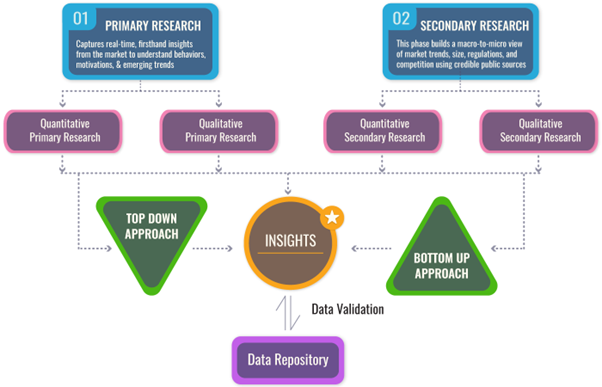
DUAL MODELING: TOP-DOWN + BOTTOM-UP
To ensure robust market estimation, we apply two complementary sizing approaches:
Top-Down Modeling:- Start with broader industry value (e.g., global or regional TAM)
- Apply filters by segment, geography, end-user, or use case
- Adjust with primary insights and validation benchmarks
- Ideal for investor-grade market scans and opportunity mapping
- Aggregate from the ground up using sales volumes, pricing, and unit economics
- Use internal modeling templates aligned with stakeholder data
- Incorporate distributor-level or region-specific inputs
- Most accurate for emerging segments and granular sub-markets
DATA VALIDATION: IN-HOUSE REPOSITORY
We close the loop with proprietary data intelligence built from ongoing projects, industry monitoring, and historical benchmarking. This repository includes:
- Multi-sector market and pricing models
- Key trendlines from past interviews and forecasts
- Benchmarked adoption rates, churn patterns, and ROI indicators
- Industry-specific deviation flags and cross-check logic
- Catches inconsistencies early
- Aligns projections across studies
- Enables consistent, high-trust deliverables