

Workspace As a Service Market Size and Forecast (2020 - 2033), Global and Regional Growth, Trend, Share, and Industry Analysis Report Coverage: By Type (Desktop as a Service (DaaS), Application as a Service), By Deployment (Public Cloud, Private Cloud, Hybrid Cloud), By End-User (IT & Telecommunications, BFSI, Healthcare, Manufacturing, Government, Education, Others) And Geography
2025-11-26
Healthcare
Swetal (Research Analyst)
Description
Workspace As a Service
Market Overview
The Workspace as a Service (WaaS) market is
positioned for a period of dynamic and sustained expansion from 2025 to 2033,
fueled by the global shift towards hybrid work models, the imperative for
digital transformation, and the growing need for secure, scalable, and
cost-effective IT solutions. The market is projected to be valued at
approximately USD 17.7 billion in 2025 and is forecasted to reach nearly USD
52.6 billion by 2033, exhibiting a robust compound annual growth rate (CAGR) of
15.3% during this period.
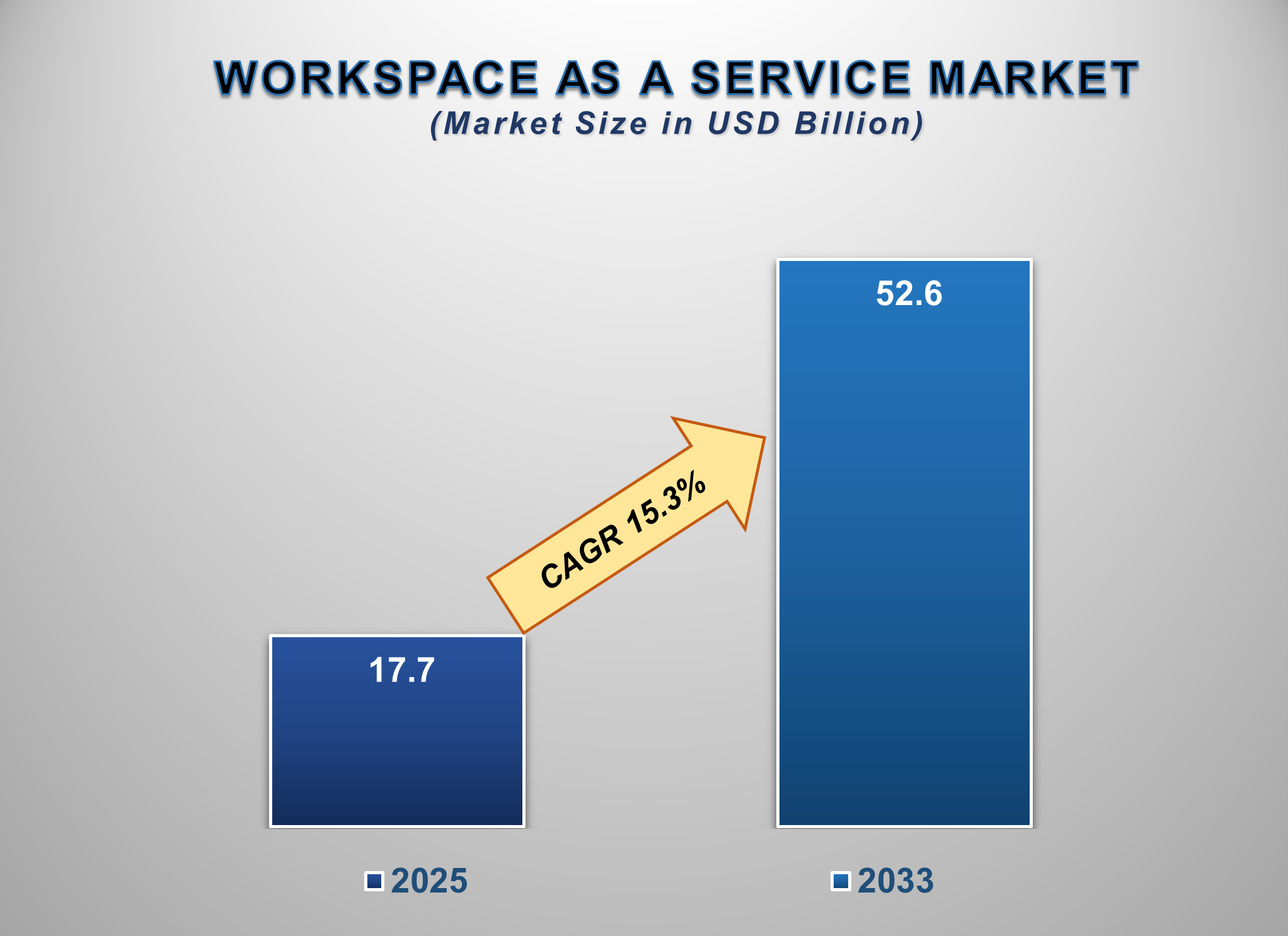
Workspace as a Service is a cloud-based delivery model that provides a unified platform for delivering virtual desktops, applications, and data to any device, anywhere. It bundles the infrastructure, platform, and software needed to provide a complete, managed desktop experience. The market growth is primarily driven by the permanent adoption of remote and hybrid work policies, which require organizations to provide seamless and secure access to corporate resources.
Furthermore, the pressing need for business
continuity and disaster recovery, coupled with the desire to reduce capital
expenditure on hardware and simplify IT management, is creating massive demand.
Technological advancements such as the integration of advanced security
protocols like Zero Trust, improvements in virtualization technology for a
better user experience, and the adoption of AI for automated management and
performance optimization are key market enablers. North America remains the
dominant regional market due to early technology adoption and a high
concentration of WaaS providers, while the Asia-Pacific region is expected to
witness the fastest growth, driven by rapid digitalization and expanding IT
infrastructure.
Workspace As a Service Market Drivers and
Opportunities
The Permanence of Hybrid
and Remote Work Models is a Foundational Market Driving Workspace As a Service
Market
The global pandemic served as a catalyst,
fundamentally altering work culture and proving the viability of distributed
workforces. As organizations formalize long-term hybrid work strategies, WaaS
has become a critical enabler. It provides the agility, security, and
consistent user experience required to support a workforce that is no longer
tethered to a physical office. WaaS solutions allow employees to access their
personalized digital workspace from any location or device, ensuring
productivity and collaboration without compromising on security or IT control.
This structural shift in how and where work is done ensures a sustained,
non-discretionary demand for WaaS solutions.
The Imperative for
Enhanced Security and Business Continuity is a Primary Growth Engine
With the perimeter of the corporate network
dissolving, securing endpoints and data has become a top priority. WaaS offers
a more secure alternative to traditional distributed computing models by
centralizing data and applications in the cloud or a secure data center, rather
than on vulnerable endpoint devices. This significantly reduces the risk of
data loss and mitigates threats from malware and ransomware. Furthermore, WaaS
provides inherent business continuity and disaster recovery capabilities. In the
event of a local outage or disruption, employees can instantly reconnect to
their virtual workspace from an alternate location, minimizing downtime and
ensuring operational resilience. This security and continuity value proposition
is a powerful driver, especially for regulated industries like BFSI and
healthcare.
Digital Transformation
and the Shift to OPEX Models Present Significant Opportunities
The overarching trend of digital transformation,
where businesses are modernizing their IT estates for greater agility, is
creating fertile ground for WaaS adoption.
WaaS aligns perfectly with the shift from Capital Expenditure (CAPEX) to
Operational Expenditure (OPEX), allowing organizations to pay a predictable
subscription fee instead of making large upfront investments in hardware refresh
cycles. This opportunity is further amplified by the development of more
specialized and performance-optimized WaaS offerings. Key areas of innovation
include the emergence of GPU-powered DaaS for power users in engineering and
design, the integration of unified communications and collaboration tools
directly into the workspace, and the use of analytics to provide insights into
user experience and resource utilization, enabling proactive management and
cost optimization.
Workspace As a Service Market Scope
|
Report Attributes |
Description |
|
Market Size in 2025 |
USD 17.7 Billion |
|
Market Forecast in 2033 |
USD 52.6 Billion |
|
CAGR % 2025-2033 |
15.3% |
|
Base Year |
2024 |
|
Historic Data |
2020-2024 |
|
Forecast Period |
2025-2033 |
|
Report USP |
Product Portfolio, Application Analysis, Company Market Share,
Company Heatmap, Regulatory Landscape, Growth Factors and more |
|
Segments Covered |
●
By Type ●
By Deployment ●
By Application ●
By End-user |
|
Regional Scope |
●
North America, ●
Europe, ●
APAC, ●
Latin America ●
Middle East and Africa |
|
Country Scope |
1)
U.S. 2)
Canada 3)
Germany 4)
UK 5)
France 6)
Spain 7)
Italy 8)
Switzerland 9)
China 10)
Japan 11)
India 12)
Australia 13)
South Korea 14)
Brazil 15)
Mexico 16)
Argentina 17)
South Africa 18)
Saudi Arabia 19) UAE |
Workspace As a Service Market Report Segmentation Analysis
The global Workspace as a Service
market industry analysis is segmented by Type, by Deployment, by End-User, and
by Region.
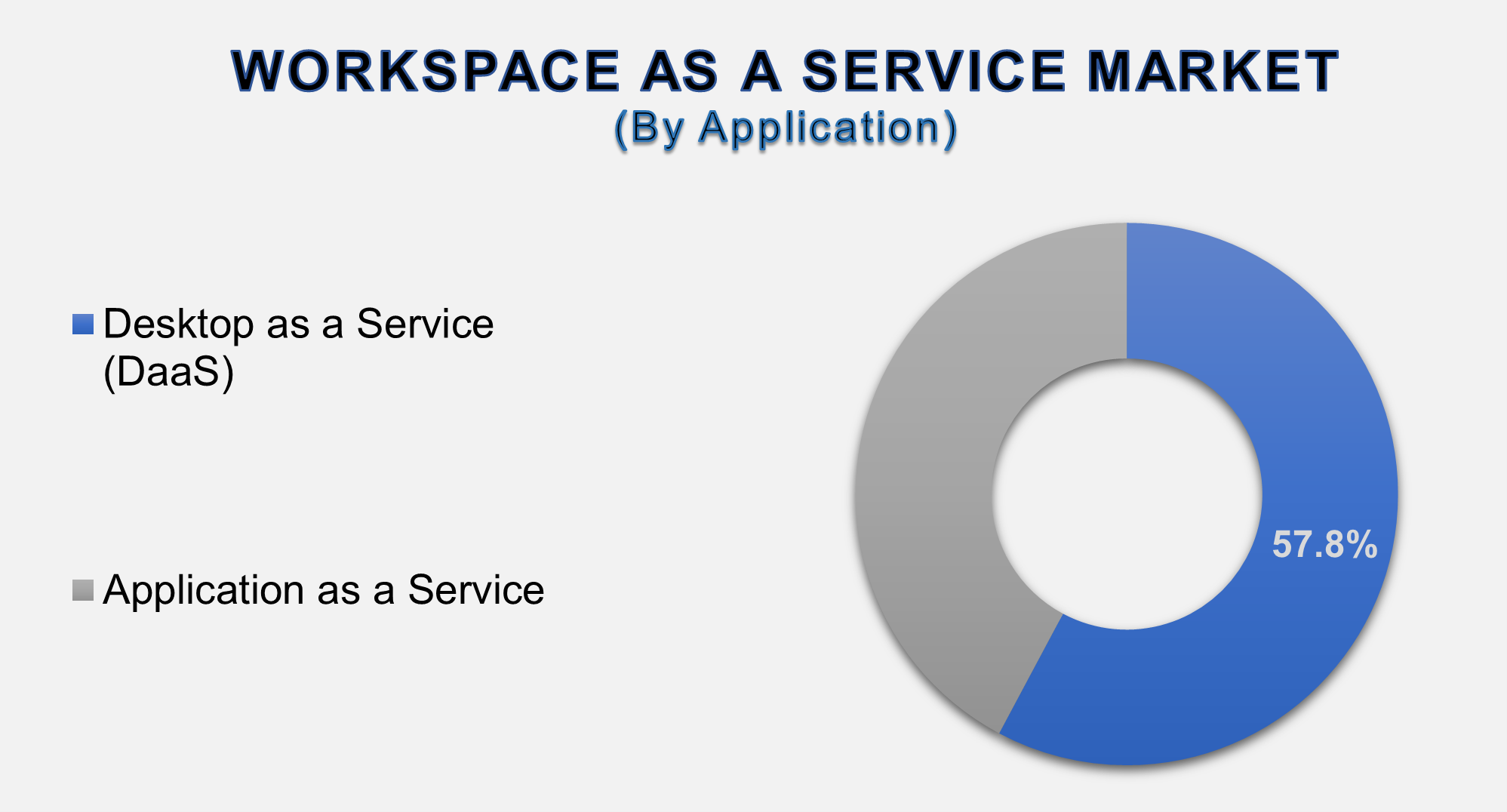
The Desktop as a Service (DaaS) segment is anticipated to
command a significant share in the global Workspace as a Service Market during
the forecast period.
Based on type, the market is divided into Desktop
as a Service (DaaS) and Application as a Service. The DaaS segment is the
dominant and fastest-growing category. Its prominence is due to its comprehensive
nature, delivering a full, managed virtual desktop infrastructure (VDI) from
the cloud. This eliminates the need for companies to manage the backend
infrastructure, offering a true turnkey solution that is highly scalable and
simplifies IT operations, making it particularly attractive for small and
medium-sized businesses.
The IT & Telecommunications segment dominated the market
in 2025 and is projected to grow at a significant CAGR during the forecast
period.
Based on application, the market is segmented
into IT & Telecommunications, BFSI, Healthcare, Manufacturing, Government,
Education, and Others. The IT & Telecommunications segment holds a
substantial share. This is a natural fit, as IT companies were early adopters
of remote work and possess the in-house skills to leverage cloud technologies
effectively. They use WaaS to provide secure, flexible development and testing
environments and to support a globally distributed workforce.
The IT & Telecommunications segment's
dominance is a direct reflection of the sector's inherent characteristics: a
digitally native workforce, a culture of technology adoption, and project-based
work that benefits from flexible resource allocation. For IT companies, WaaS is
not just a tool for remote work but a strategic asset that enables them to
rapidly scale up or down for projects, provide contractors with secure access
without provisioning physical hardware, and maintain stringent security protocols
for sensitive intellectual property and client data. The ability to deliver a
high-performance development environment from the cloud is a key factor driving
adoption within this segment.
The Large Enterprises segment is expected to hold the largest
market share in 2025.
By end-user, the market is divided into Large
Enterprises and Small & Medium Enterprises (SMEs). The Large Enterprises
segment is the largest end-user. This is attributed to their complex IT
environments, significant security and compliance requirements, and larger
budgets for digital transformation initiatives. Large enterprises are
leveraging WaaS to standardize desktop management across thousands of users and
to support a global, mobile workforce.
The following segments
are part of an in-depth analysis of the global Workspace As a Service Market:
|
Market Segments |
|
|
By Type |
●
Desktop as a Service
(DaaS) ●
Application as a
Service |
|
By Deployment |
●
Public Cloud ●
Private Cloud ●
Hybrid Cloud |
|
By Application |
●
IT &
Telecommunications ●
BFSI ●
Healthcare ●
Manufacturing ●
Others |
|
By End-user |
●
Large Enterprises ●
Small & Medium
Enterprises (SMEs) |
Workspace As a Service Market Share Analysis by Region
The North America region is anticipated to hold the largest
portion of the Workspace as a Service Market globally throughout the forecast
period.
North America is the leading segment, holding a
dominant share. This leadership is anchored by the early and widespread
adoption of cloud technologies, the presence of major WaaS vendors, and a
mature corporate sector that has aggressively embraced hybrid work. High
internet penetration, strong IT infrastructure, and a focus on cybersecurity
and operational efficiency collectively contribute to the region's market
supremacy.
The dominance of North America, particularly the
United States, in the WaaS market is underpinned by a robust ecosystem of
technology innovators and early-adopter enterprises. The region is home to the
world's largest cloud hyperscalers (AWS, Microsoft Azure, and
Google Cloud), whose infrastructure is the
foundation for most WaaS offerings. Furthermore, a competitive business
landscape and the need for agility force enterprises to adopt
productivity-enhancing technologies like WaaS rapidly. High awareness of
cybersecurity threats and stringent data protection regulations in industries
like finance and healthcare drive the adoption of the centralized security
model that WaaS provides, creating a strong, compliance-driven demand.
Workspace As a Service Market Competition Landscape Analysis
The global Workspace as a Service market is competitively
intense and features a diverse landscape of technology giants, specialized
virtualization vendors, and telecom service providers. Competition is based on
factors such as performance and user experience, security features, global
scale and reliability, pricing flexibility, and the strength of partner
ecosystems. Key strategies observed in the market include continuous innovation
in virtualization protocols to improve graphics performance and reduce latency,
strategic partnerships with cloud hyperscalers and hardware OEMs, and
acquisitions to consolidate market position and acquire new technologies. A
strong focus on developing value-added services around security, monitoring,
and management is also a key differentiator.
Global Workspace As a Service Market Recent Developments
News:
- In January 2025, Citrix Systems, a part of Cloud
Software Group, announced a new partnership with a major
telecommunications provider to offer a fully managed DaaS solution
tailored for the mid-market.
- In November 2024, VMware, by Broadcom, enhanced its VMware Horizon
Cloud platform with integrated Zero Trust security capabilities and
improved Microsoft Teams optimization for a superior user experience.
- In September 2024, Amazon Web Services (AWS)
launched a new tier of its Amazon WorkSpaces DaaS product, specifically
designed for graphics-intensive workloads in the media and entertainment
industry.
- In July 2024, Microsoft Corporation integrated new AI-powered
analytics into Windows 365 and Azure Virtual Desktop to provide IT
administrators with proactive insights into endpoint performance and user
connectivity issues.
The Global Workspace As a
Service Market is Dominated by a Few Large Companies, such as
●
Microsoft Corporation
●
Amazon Web Services,
Inc.
●
Citrix Systems (Cloud
Software Group)
●
VMware, Inc.
(Broadcom)
●
Google LLC
●
IBM Corporation
●
Cisco Systems, Inc.
●
Nutanix, Inc.
●
Oracle Corporation
●
Hewlett Packard
Enterprise Development LP
●
Cloud Software
Group
●
EVOXYB
●
Unisys Corporation
●
Datacom Group Ltd.
●
Rackspace Technology
● Other Prominent Players
Frequently Asked Questions
Swetal (Research Analyst)
Swetal is a Research Analyst with 4+ years of experience specializing in healthcare market research, medical devices, healthcare IT, and medical technology industry analysis. Her expertise includes competitive intelligence, secondary research, market trend forecasting, and healthcare business insights across global healthcare ecosystems.
She contributes to advanced market research reports by analyzing regulatory frameworks, emerging healthcare technologies, competitive landscapes, and innovation trends shaping the medical industry. With a strong focus on accurate market intelligence, strategic insights, and healthcare industry trends, Swetal supports businesses in making informed, data-backed decisions in a rapidly transforming healthcare environment.
1. Global Workspace As a
Service Market Introduction and Market Overview
1.1.
Objectives
of the Study
1.2.
Global
Workspace as a Service Market Scope and Market Estimation
1.2.1.Global Electronic Toll
Collection Overall Market Size (US$ Bn), Market CAGR (%), Market forecast (2025
- 2033)
1.2.2.Global Workspace As a
Service Market Revenue Share (%) and Growth Rate (Y-o-Y) from 2020 - 2033
1.3.
Market
Segmentation
1.3.1.Type of Global Workspace
As a Service Market
1.3.2.Deployment of Global
Workspace As A Service Market
1.3.3.Application of Global Workspace
As a Service Market
1.3.4.End-user of Global Workspace
As a Service Market
1.3.5.Region of Global Workspace
As a Service Market
2.
Executive Summary
2.1.
Demand
Side Trends
2.2.
Key
Market Trends
2.3.
Market
Demand (US$ Bn) Analysis 2020 – 2024 and Forecast, 2025 – 2033
2.4.
Demand
and Opportunity Assessment
2.5. Pricing Analysis
2.6.
Key
Developments
2.7.
Market
Entry Strategies
2.8.
Market
Dynamics
2.8.1.Drivers
2.8.2.Limitations
2.8.3.Opportunities
2.8.4.Impact Analysis of Drivers
and Restraints
2.9.
Porter’s
Five Forces Analysis
2.10.
PEST
Analysis
3. Global
Workspace As a Service Market Estimates
& Historical Trend Analysis (2020 - 2024)
4. Global
Workspace As a Service Market Estimates
& Forecast Trend Analysis, by Type
4.1.
Global
Workspace As a Service Market Revenue (US$ Bn) Estimates and Forecasts, by Type,
2020 - 2033
4.1.1.Desktop as a Service
(DaaS)
4.1.2.Application as a Service
5. Global
Workspace As a Service Market Estimates
& Forecast Trend Analysis, by Deployment
5.1.
Global
Workspace As a Service Market Revenue (US$ Bn) Estimates and Forecasts, by Type,
2020 - 2033
5.1.1.Public Cloud
5.1.2.Private Cloud
5.1.3.Hybrid Cloud
6. Global
Workspace As a Service Market Estimates
& Forecast Trend Analysis, by Application
6.1.
Global
Workspace As a Service Market Revenue (US$ Bn) Estimates and Forecasts, by Application,
2020 - 2033
6.1.1.IT &
Telecommunications
6.1.2.BFSI
6.1.3.Healthcare
6.1.4.Manufacturing
6.1.5.Others
7. Global
Workspace As a Service Market Estimates
& Forecast Trend Analysis, by End-user
7.1.
Global
Workspace As a Service Market Revenue (US$ Bn) Estimates and Forecasts, by End-user,
2020 - 2033
7.1.1.Large Enterprises
7.1.2.Small & Medium
Enterprises (SMEs)
8. Global
Workspace As a Service Market Estimates
& Forecast Trend Analysis, by Region
8.1.
Global
Workspace As a Service Market Revenue (US$ Bn) Estimates and Forecasts, by Region,
2020 - 2033
8.1.1.North America
8.1.2.Europe
8.1.3.Asia Pacific
8.1.4.Middle East & Africa
8.1.5.Latin America
9. North America Workspace
As a Service Market: Estimates &
Forecast Trend Analysis
9.1. North America Workspace As
a Service Market Assessments & Key Findings
9.1.1.North America Workspace As
a Service Market Introduction
9.1.2.North America Workspace As
a Service Market Size Estimates and Forecast (US$ Billion) (2020 - 2033)
9.1.2.1.
By Type
9.1.2.2.
By Application
9.1.2.3.
By End-user
9.1.2.4. By Country
9.1.2.4.1. The U.S.
9.1.2.4.2. Canada
10. Europe Workspace
As a Service Market: Estimates &
Forecast Trend Analysis
10.1. Europe Workspace As a
Service Market Assessments & Key Findings
10.1.1. Europe Workspace As a
Service Market Introduction
10.1.2. Europe Workspace As a
Service Market Size Estimates and Forecast (US$ Billion) (2020 - 2033)
10.1.2.1.
By Type
10.1.2.2.
By Deployment
10.1.2.3.
By Application
10.1.2.4.
By End-user
10.1.2.5. By Country
10.1.2.5.1.
Germany
10.1.2.5.2.
Italy
10.1.2.5.3.
U.K.
10.1.2.5.4.
France
10.1.2.5.5.
Spain
10.1.2.5.6.
Switzerland
10.1.2.5.7. Rest
of Europe
11. Asia Pacific Workspace
As a Service Market: Estimates &
Forecast Trend Analysis
11.1. Asia Pacific Market
Assessments & Key Findings
11.1.1.
Asia
Pacific Workspace As a Service Market Introduction
11.1.2.
Asia
Pacific Workspace As a Service Market Size Estimates and Forecast (US$ Billion)
(2020 - 2033)
11.1.2.1.
By Type
11.1.2.2.
By Deployment
11.1.2.3.
By Application
11.1.2.4.
By End-user
11.1.2.5. By Country
11.1.2.5.1. China
11.1.2.5.2. Japan
11.1.2.5.3. India
11.1.2.5.4. Australia
11.1.2.5.5. South Korea
11.1.2.5.6. Rest of Asia Pacific
12. Middle East & Africa Workspace
As a Service Market: Estimates &
Forecast Trend Analysis
12.1. Middle East & Africa
Market Assessments & Key Findings
12.1.1. Middle
East & Africa
Workspace As a Service Market Introduction
12.1.2. Middle
East & Africa
Workspace As a Service Market Size Estimates and Forecast (US$ Billion) (2020 -
2033)
12.1.2.1.
By Type
12.1.2.2.
By Deployment
12.1.2.3.
By Application
12.1.2.4.
By End-user
12.1.2.5. By Country
12.1.2.5.1. UAE
12.1.2.5.2. Saudi
Arabia
12.1.2.5.3. South
Africa
12.1.2.5.4. Rest
of MEA
13. Latin America
Workspace As a Service Market:
Estimates & Forecast Trend Analysis
13.1. Latin America Market
Assessments & Key Findings
13.1.1. Latin America Workspace As
a Service Market Introduction
13.1.2. Latin America Workspace As
a Service Market Size Estimates and Forecast (US$ Billion) (2020 - 2033)
13.1.2.1.
By Type
13.1.2.2.
By Deployment
13.1.2.3.
By Application
13.1.2.4.
By End-user
13.1.2.5. By Country
13.1.2.5.1. Brazil
13.1.2.5.2. Argentina
13.1.2.5.3. Mexico
13.1.2.5.4. Rest
of LATAM
14.
Country
Wise Market: Introduction
15.
Competition
Landscape
15.1. Global Workspace As a
Service Market Product Mapping
15.2. Global Workspace As a
Service Market Concentration Analysis, by Leading Players / Innovators /
Emerging Players / New Entrants
15.3. Global Workspace As a
Service Market Tier Structure Analysis
15.4. Global Workspace As a
Service Market Concentration & Company Market Shares (%) Analysis, 2024
16.
Company
Profiles
16.1.
Microsoft Corporation
16.1.1.
Company
Overview & Key Stats
16.1.2.
Financial
Performance & KPIs
16.1.3.
Product
Portfolio
16.1.4.
SWOT
Analysis
16.1.5.
Business
Strategy & Recent Developments
* Similar details would be provided for all the players
mentioned below
16.2.
Amazon Web Services, Inc.
16.3.
Citrix Systems (Cloud Software Group)
16.4.
VMware, Inc. (Broadcom)
16.5.
Google LLC
16.6.
IBM Corporation
16.7.
Cisco Systems, Inc.
16.8.
Nutanix, Inc.
16.9.
Oracle Corporation
16.10.
Hewlett Packard Enterprise Development LP
16.11.
Cloud Software Group
16.12.
EVOXYB
16.13.
Unisys Corporation
16.14.
Datacom Group Ltd.
16.15.
Rackspace Technology
16.16.
Other Prominent Players
17. Research
Methodology
17.1. External Transportations /
Databases
17.2. Internal Proprietary
Database
17.3. Primary Research
17.4. Secondary Research
17.5. Assumptions
17.6. Limitations
17.7. Report FAQs
18. Research
Findings & Conclusion
Our Research Methodology
"Insight without rigor is just noise."
We follow a comprehensive, multi-phase research framework designed to deliver accurate, strategic, and decision-ready intelligence. Our process integrates primary and secondary research , both quantitative and qualitative , along with dual modeling techniques ( top-down and bottom-up) and a final layer of validation through our proprietary in-house repository.
PRIMARY RESEARCH
Primary research captures real-time, firsthand insights from the market to understand behaviors, motivations, and emerging trends.
1. Quantitative Primary Research
Objective: Generate statistically significant data directly from market participants.
Approaches:- Structured surveys with customers, distributors, and field agents
- Mobile-based data collection for point-of-sale audits and usage behavior
- Phone-based interviews (CATI) for market sizing and product feedback
- Online polling around industry events and digital campaigns
- Purchase frequency by customer type
- Channel performance across geographies
- Feature demand by application or demographic
2. Qualitative Primary Research
Objective: Explore decision-making drivers, pain points, and market readiness.
Approaches:- In-depth interviews (IDIs) with executives, product managers, and key decision-makers
- Focus groups among end users and early adopters
- Site visits and observational research for consumer products
- Informal field-level discussions for regional and cultural nuances
SECONDARY RESEARCH
This phase helps establish a macro-to-micro understanding of market trends, size, regulation, and competitive dynamics, sourced from credible and public domain information.
1. Quantitative Secondary Research
Objective: Model market value and segment-level forecasts based on published data.
Sources include:- Financial reports and investor summaries
- Government trade data, customs records, and regulatory statistics
- Industry association publications and economic databases
- Channel performance and pricing data from marketplace listings
- Revenue splits, pricing trends, and CAGR estimates
- Supply-side capacity and volume tracking
- Investment analysis and funding benchmarks
2. Qualitative Secondary Research
Objective: Capture strategic direction, innovation signals, and behavioral trends.
Sources include:- Company announcements, roadmaps, and product pipelines
- Publicly available whitepapers, conference abstracts, and academic research
- Regulatory body publications and policy briefs
- Social and media sentiment scanning for early-stage shifts
- Strategic shifts in market positioning
- Unmet needs and white spaces
- Regulatory triggers and compliance impact

DUAL MODELING: TOP-DOWN + BOTTOM-UP
To ensure robust market estimation, we apply two complementary sizing approaches:
Top-Down Modeling:- Start with broader industry value (e.g., global or regional TAM)
- Apply filters by segment, geography, end-user, or use case
- Adjust with primary insights and validation benchmarks
- Ideal for investor-grade market scans and opportunity mapping
- Aggregate from the ground up using sales volumes, pricing, and unit economics
- Use internal modeling templates aligned with stakeholder data
- Incorporate distributor-level or region-specific inputs
- Most accurate for emerging segments and granular sub-markets
DATA VALIDATION: IN-HOUSE REPOSITORY
We close the loop with proprietary data intelligence built from ongoing projects, industry monitoring, and historical benchmarking. This repository includes:
- Multi-sector market and pricing models
- Key trendlines from past interviews and forecasts
- Benchmarked adoption rates, churn patterns, and ROI indicators
- Industry-specific deviation flags and cross-check logic
- Catches inconsistencies early
- Aligns projections across studies
- Enables consistent, high-trust deliverables