

Wound Closure Market Size and Forecast (2025–2033), Global and Regional Growth, Trend, Share, and Industry Analysis Report Coverage: By Product Type (Sutures, Hemostatic Agents, Staplers, Others), By Application (Orthopedics, Gynecology and Obstetrics, General Surgery, Ophthalmology, Cardiology, Others), By End-user (Hospitals & ASCs, Specialty Clinics, Others), and Geography
2026-01-02
Healthcare
Swetal (Research Analyst)
Description
Wound
Closure Market Overview
The global Wound Closure Market is poised for steady growth, reaching USD 24.2 billion by 2033, up from USD 14.1 billion in 2025, advancing at a CAGR of 7.3% during the forecast period. Market expansion is driven by the rising volume of surgical procedures, increasing traumatic injuries, and the growing prevalence of chronic wounds associated with diabetes, obesity, and vascular diseases. The rapid uptake of minimally invasive and robotic-assisted surgeries continues to elevate the demand for advanced wound closure solutions, including absorbable sutures, topical hemostatic agents, and innovative stapling devices.
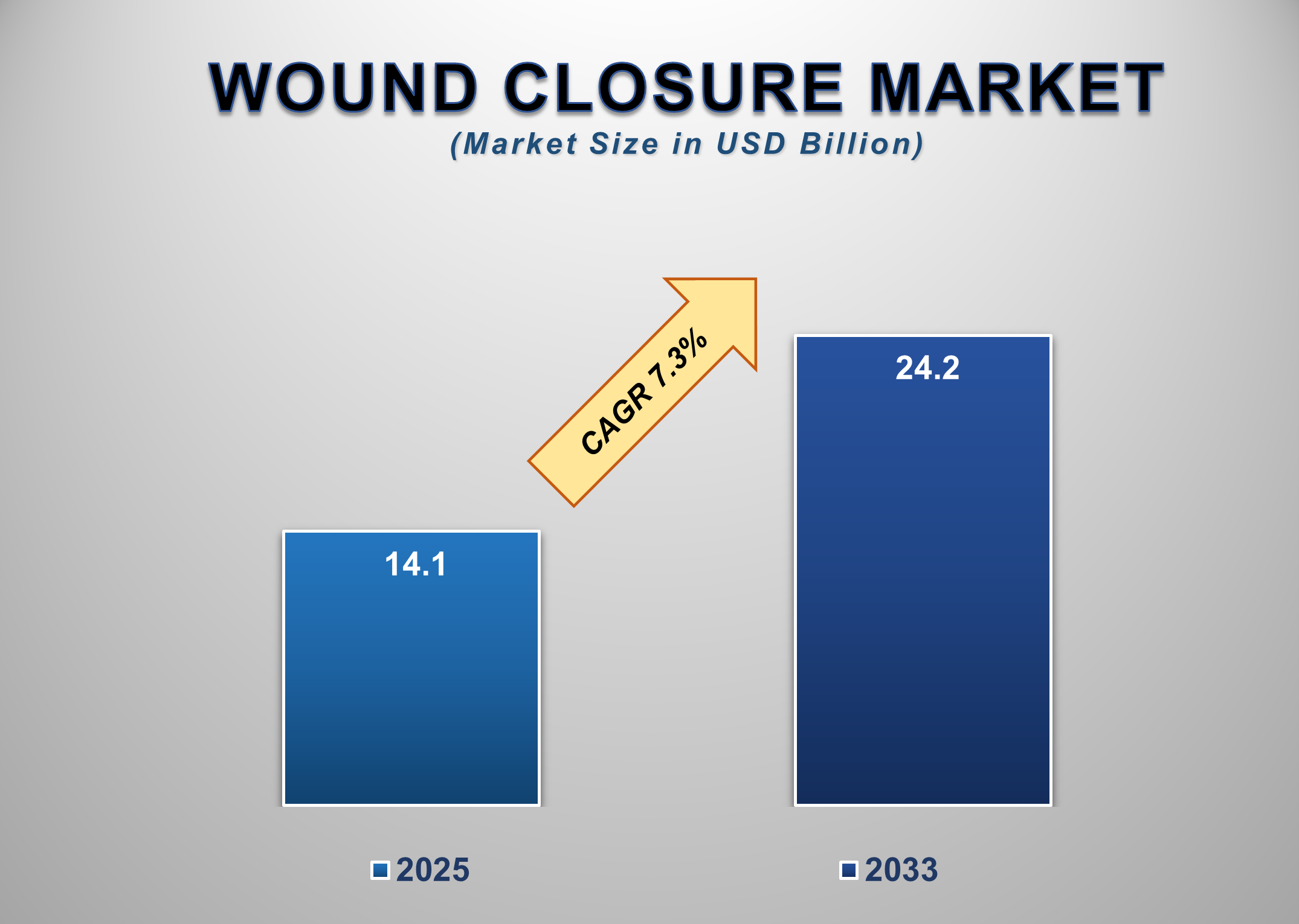
Healthcare systems worldwide are prioritizing faster wound healing, reduced hospital stays, and improved surgical outcomes, contributing to higher adoption of reliable closure products across hospitals and ambulatory surgical centers. Technological advancements such as antibacterial-coated sutures, bioengineered sealants, and combination hemostats support improved infection control and better hemostatic performance, further boosting market penetration. Additionally, the rising aging population is leading to higher surgical needs, especially orthopedic and cardiovascular procedures, thereby sustaining long-term demand. However, product pricing and regulatory complexities continue to influence market dynamics.
Wound Closure Market Drivers and Opportunities
Rising Surgical Volume
and Trauma Cases are Driving the Growth of the Wound Closure Market
The increasing global surgical
burden remains a primary factor accelerating the growth of the wound closure
market. A significant rise in elective, trauma-related, and chronic
disease–associated surgeries has created sustained demand for sutures, staplers,
hemostatic agents, and combination wound closure products. Orthopedic,
bariatric, cardiovascular, and gynecological surgeries continue to expand,
driven by aging populations, higher obesity rates, and rising sports-related
injuries. Additionally, road accidents and trauma incidents, particularly in
Asia-Pacific and Latin America, are contributing substantially to the uptake of
wound closure materials across emergency care settings. As healthcare systems
strive to improve surgical outcomes and minimize postoperative complications,
there is heightened adoption of advanced closure solutions that reduce
scarring, promote faster recovery, and minimize infection risk. Innovations
such as absorbable sutures, antimicrobial coatings, plasma-derived sealants,
and minimally invasive stapling systems are increasingly being integrated into
surgical workflows. Hospitals and ambulatory surgical centers are also adopting
highly efficient hemostatic agents to manage blood loss and increase procedural
precision. The growing availability of skilled surgeons and improved access to
surgical care in emerging markets further supports expansion. Collectively,
rising surgical volume and trauma incidence significantly reinforce market
momentum and long-term growth prospects.
Increasing Adoption of
Advanced Hemostatic Agents and Minimally Invasive Stapling Technologies is
Fueling Market Expansion
The wound closure market is
witnessing strong traction from advanced hemostatic agents and next-generation
stapling devices, which are rapidly replacing traditional suturing techniques
in several procedures. Surgeons prefer modern hemostats such as active,
passive, and combination agents owing to their ability to achieve rapid
coagulation, reduce intraoperative bleeding, and improve procedural efficiency.
Combination hemostats, in particular, are gaining popularity for their enhanced
adhesive strength and extended applicability across cardiovascular, orthopedic,
and neurological surgeries. Minimally invasive surgical (MIS) procedures
continue to surge globally, increasing the demand for powered staplers and
precision-driven closure systems that enhance accuracy while reducing operative
time. Innovations such as battery-powered staplers, absorbable clips, and
robotic-compatible closure tools are driving adoption, especially across
hospitals and ASCs focused on improving workflow optimization. Additionally,
the integration of antimicrobial materials and bioresorbable technologies is
supporting improved postoperative outcomes. The rising need to reduce surgical
site infections (SSIs), improve wound healing, and shorten recovery time
further strengthens the market shift toward advanced wound closure products. As
hospitals increasingly prioritize efficiency, safety, and patient-centric
results, technologically enhanced closure systems are emerging as essential
tools, thereby supporting sustained market growth.
Growing Penetration of
Wound Closure Products in Emerging Markets is Expected to Create Significant
Opportunities Worldwide
Emerging regions are becoming key
growth hubs for the global wound closure market due to expanding healthcare
infrastructure, rising surgical procedures, and increased investment in
hospital capacity development. Countries across Asia-Pacific, the Middle East,
and Latin America are witnessing rapid advancements in trauma care systems and
specialized surgical departments, creating substantial demand for affordable
and effective wound closure products. The rising incidence of chronic diseases
such as diabetes and cardiovascular disorders is contributing to higher
surgical interventions, especially in low- and middle-income countries. Several
global manufacturers are strategically entering these markets with localized
manufacturing, cost-optimized product lines, and expanded distribution networks
to address affordability constraints. Government initiatives supporting
universal health coverage, improvements in emergency care services, and
increasing adoption of ambulatory surgical centers further open new opportunities
for product adoption. Additionally, growing awareness of infection control and
wound management practices is driving adoption of advanced closure solutions
such as coated sutures, bioresorbable sealants, and modern hemostatic agents.
As surgical care becomes more accessible and patient awareness increases,
emerging markets present a significant long-term opportunity for scalable,
innovative, and cost-effective wound closure solutions.
Wound Closure Market
Scope
|
Report Attributes |
Description |
|
Market Size in 2025 |
USD 14.1 Billion |
|
Market Forecast in 2033 |
USD 24.2 Billion |
|
CAGR % 2025-2033 |
7.3% |
|
Base Year |
2024 |
|
Historic Data |
2020-2024 |
|
Forecast Period |
2025-2033 |
|
Report USP |
Production, Consumption,
Company Share, Company Heatmap, Company Production Capacity, Growth Factors
and more |
|
Segments Covered |
●
By Product Type ●
By Application ●
By End-user |
|
Regional Scope |
●
North America ●
Europe ●
APAC ●
Latin America ●
Middle East and
Africa |
|
Country Scope |
1)
U.S. 2)
Canada 3)
Germany 4)
UK 5)
France 6)
Spain 7)
Italy 8)
Switzerland 9)
China 10)
Japan 11)
India 12)
Australia 13)
South Korea 14)
Brazil 15)
Mexico 16)
Argentina 17)
South Africa 18)
Saudi Arabia 19)
UAE |
Wound Closure Market
Report Segmentation Analysis
The global wound closure market
is segmented by product type, by application, by end-user, and by geography.
Sutures Segment Accounted
for the Largest Market Share in the Global Wound Closure Market
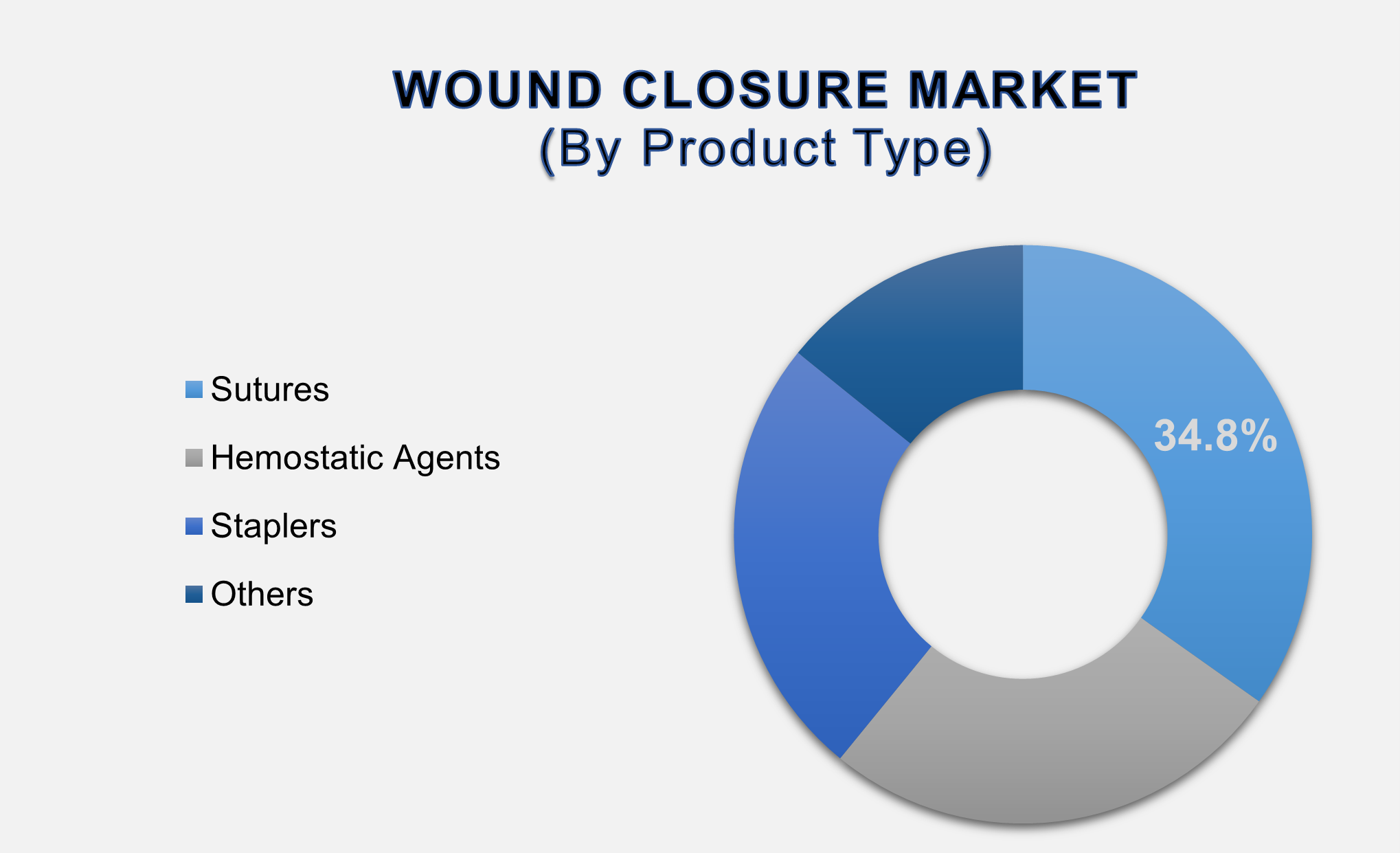
The Sutures segment held the largest market share in 2025, accounting for 34.8%, driven by their widespread usage across nearly all surgical disciplines and wound types. Sutures remain the most preferred closure solution due to their reliability, versatility, and cost-effectiveness, making them indispensable across general surgery, orthopedics, gynecology, cardiology, ophthalmology, and trauma care. Surgeons continue to rely on both absorbable and non-absorbable sutures depending on the anatomical site, tissue type, and procedural requirements. Innovations such as antimicrobial-coated sutures, barbed sutures, synthetic bioresorbable materials, and enhanced tensile-strength filaments are supporting improved wound healing and infection control. The high volume of routine surgical procedures, including cesarean sections, appendectomies, hernia repairs, and trauma suturing, contributes to consistent demand worldwide. Emerging economies with rising surgical infrastructure further strengthen segment growth. Despite increased adoption of staplers and sealants in specific procedures, sutures maintain dominance due to broad applicability, surgeon familiarity, and cost advantages, ensuring their continued leadership in the wound closure market.
Orthopedics Segment
Dominated the Global Wound Closure Market Owing to High Surgical Volume and
Increasing Trauma Cases
The
Orthopedics segment represents the largest application category in the wound
closure market, supported by a steady rise in joint replacement procedures,
fracture repairs, ligament reconstruction surgeries, and sports-related
interventions. The global aging population, rising road accidents, and growing
prevalence of osteoporosis contribute significantly to the expanding orthopedic
surgical burden. These procedures often involve deep tissue layers, requiring
multiple closure techniques such as sutures, staplers, and advanced hemostatic
agents to ensure stability and reduce postoperative complications. Increasing
adoption of minimally invasive orthopedic surgeries also drives demand for
specialized closure products designed to reduce scarring and accelerate
healing. Hospitals and orthopedic specialty centers are integrating modern
closure systems such as barbed sutures, absorbable clips, and biologically
active hemostats to improve patient recovery outcomes. With orthopedic
surgeries continuing to increase across North America, Europe, and
Asia-Pacific, this segment is expected to maintain strong growth momentum
throughout the forecast period.
Hospitals & ASCs
Segment Accounted for the Largest Share in the Wound Closure Market Owing to
High Surgical Capacity and Infrastructure Strength
The Hospitals & Ambulatory
Surgical Centers (ASCs) segment leads the wound closure market due to the
extensive volume of surgical procedures conducted in these facilities and their
ability to adopt advanced wound closure technologies. Hospitals and ASCs
possess the infrastructure required for complex procedures in orthopedics,
cardiology, neurology, gynecology, and general surgery, all of which require a
diverse range of closure methods. Increasing preference for outpatient
surgeries, supported by advancements in minimally invasive techniques,
continues to boost demand for efficient closure devices that minimize operative
time and enhance recovery. These healthcare settings also maintain high usage
of hemostatic agents, powered staplers, and bioresorbable sutures to reduce
infection risks and improve postoperative outcomes. Moreover, growing
investment in surgical suites, the rise of day-care procedures, and the
availability of skilled clinicians further support the segment. dominance. With
global healthcare systems expanding capacity, the hospitals & ASCs segment
is expected to remain the leading end-user category throughout the forecast
period.
The following segments are
part of an in-depth analysis of the global Wound Closure Market:
|
Market
Segments |
|
|
By Product
Type |
●
Sutures o
Absorbable o
Non-Absorbable ●
Hemostatic Agents o
Active Hemostats o
Passive Hemostats o
Combination
Hemostats o
Others ●
Staplers o
Powered o
Manual ●
Others |
|
By Application |
●
Orthopedics ●
Gynecology and
Obstetrics ●
General Surgery ●
Ophthalmology ●
Cardiology ●
Others |
|
By End-user |
●
Hospitals & ASCs ●
Specialty Clinics ●
Others |
Wound Closure Market Share Analysis by Region
The Asia Pacific region
is projected to hold the largest share of the global Wound Closure Market over
the forecast period.
Asia-Pacific dominated the global
wound closure market with a 39.9% share in 2025, driven by rapid expansion of
healthcare infrastructure, rising surgical volumes, and increasing trauma
incidence, particularly in China and India. The region continues to benefit
from improving access to surgical care, a growing middle-class population, and
government initiatives aimed at strengthening hospital capacity and emergency
response systems. Additionally, the rising prevalence of chronic diseases
contributes to higher procedural demand across general surgery, orthopedics,
and cardiovascular care.
North America, meanwhile, is
expected to register the fastest CAGR, supported by advanced surgical
technologies, increasing adoption of minimally invasive surgeries, and strong
reimbursement structures. Europe maintains a steady share driven by high-quality
healthcare systems and early adoption of innovative wound closure technologies.
Latin America and the Middle East & Africa are emerging growth regions due
to increasing investments in hospital expansion, medical tourism, and rising
awareness of infection control practices. Overall, regional growth is shaped by
infrastructure development, surgical accessibility, and evolving clinical
standards.
Wound Closure Market Competition Landscape
Analysis
The wound
closure market is moderately consolidated, with leading players such as Johnson
& Johnson, Medtronic, Baxter International, Abbott Laboratories, B. Braun
Melsungen, Smith & Nephew, 3M, Teleflex, and Stryker dominating global
distribution. These companies focus on expanding portfolios through the
development of antimicrobial sutures, powered stapling systems, bioresorbable
sealants, and advanced hemostatic agents.
Global Wound Closure Market Recent Developments
News:
- In March 2024, Intuitive
Surgical received U.S. FDA 510(k) clearance for the da Vinci 5, its
next-generation multiport robotic-assisted surgical system, enhancing
capabilities for minimally invasive procedures.
- In February 2024, Boston
Scientific Corporation announced that the UK's National Institute for
Health and Care Excellence (NICE) confirmed the safety and efficacy of
endoscopic sleeve gastroplasty (ESG) using its OverStitch™ endoscopic
suturing system, supporting its use as a minimally invasive weight-loss
procedure.
- In August 2023, Healthium
Medtech Limited launched TRUMAS, a range of synthetic absorbable sutures
in India, designed to improve performance and ease of use in minimally
invasive surgeries.
The Global Wound Closure Market is dominated by a
few large companies, such as
●
Johnson & Johnson
●
Medtronic
●
Baxter International
●
Abbott Laboratories
●
B. Braun Melsungen
●
Smith & Nephew
●
3M
●
Integra LifeSciences
●
Merit Medical Systems
●
Teleflex
●
Cardinal Health
●
Stryker
●
Derma Sciences
●
Molnlycke Health Care
●
Hartmann Group
●
Lohmann & Rauscher
●
Dynarex
●
Dukal
●
Covidien
●
Ethicon
● Other Prominent Players
Frequently Asked Questions
Swetal (Research Analyst)
Swetal is a Research Analyst with 4+ years of experience specializing in healthcare market research, medical devices, healthcare IT, and medical technology industry analysis. Her expertise includes competitive intelligence, secondary research, market trend forecasting, and healthcare business insights across global healthcare ecosystems.
She contributes to advanced market research reports by analyzing regulatory frameworks, emerging healthcare technologies, competitive landscapes, and innovation trends shaping the medical industry. With a strong focus on accurate market intelligence, strategic insights, and healthcare industry trends, Swetal supports businesses in making informed, data-backed decisions in a rapidly transforming healthcare environment.
1. Global Wound Closure
Market Introduction and Market Overview
1.1.
Objectives
of the Study
1.2.
Global
Wound Closure Market Scope and Market Estimation
1.2.1.Global Wound Closure
Market Overall Market Size (US$ Bn), Market CAGR (%), Market forecast (2025 - 2033)
1.2.2.Global Wound Closure
Market Revenue Share (%) and Growth Rate (Y-o-Y) from 2020 - 2033
1.3.
Market
Segmentation
1.3.1.Product Type of Global Wound
Closure Market
1.3.2.Application of Global Wound
Closure Market
1.3.3.End-user of Global Wound
Closure Market
1.3.4.Region of Global Wound
Closure Market
2. Executive
Summary
2.1.
Demand
Side Trends
2.2.
Key
Market Trends
2.3.
Market
Demand (US$ Bn) Analysis 2020 – 2024 and Forecast, 2025 – 2033
2.4.
Demand
and Opportunity Assessment
2.5.
Demand
Supply Scenario
2.6.
Market
Dynamics
2.6.1.Drivers
2.6.2.Limitations
2.6.3.Opportunities
2.6.4.Impact Analysis of Drivers
and Restraints
2.7.
Emerging
Trends for Wound Closure Market
2.8.
Porter’s
Five Forces Analysis
2.9.
PEST
Analysis
2.10.
Key
Regulation
3. Global
Wound Closure Market Estimates
& Historical Trend Analysis (2020 - 2024)
4.
Global Wound Closure
Market Estimates & Forecast Trend
Analysis, by Product Type
4.1.
Global
Wound Closure Market Revenue (US$ Bn) Estimates and Forecasts, by Product Type,
2020 - 2033
4.1.1.Sutures
4.1.1.1.
Absorbable
4.1.1.2.
Non-Absorbable
4.1.2.Hemostatic Agents
4.1.2.1.
Active
Hemostats
4.1.2.2.
Passive
Hemostats
4.1.2.3.
Combination
Hemostats
4.1.2.4.
Others
4.1.3.Staplers
4.1.3.1.
Powered
4.1.3.2.
Manual
4.1.4.Others
5.
Global Wound Closure
Market Estimates & Forecast Trend
Analysis, by Application
5.1.
Global
Wound Closure Market Revenue (US$ Bn) Estimates and Forecasts, by Application, 2020
- 2033
5.1.1.Orthopedics
5.1.2.Gynecology and Obstetrics
5.1.3.General Surgery
5.1.4.Ophthalmology
5.1.5.Cardiology
5.1.6.Others
6.
Global Wound Closure
Market Estimates & Forecast Trend
Analysis, by End-user
6.1.
Global
Wound Closure Market Revenue (US$ Bn) Estimates and Forecasts, by End-user, 2020
- 2033
6.1.1.Hospitals & ASCs
6.1.2.Specialty Clinics
6.1.3.Others
7. Global
Wound Closure Market Estimates
& Forecast Trend Analysis, by region
1.1.
Global
Wound Closure Market Revenue (US$ Bn) Estimates and Forecasts, by region, 2020
- 2033
1.1.1.North America
1.1.2.Europe
1.1.3.Asia Pacific
1.1.4.Middle East & Africa
1.1.5.Latin America
8. North America Wound
Closure Market: Estimates &
Forecast Trend Analysis
8.1.
North
America Wound Closure Market Assessments & Key Findings
8.1.1.North America Wound
Closure Market Introduction
8.1.2.North America Wound
Closure Market Size Estimates and Forecast (US$ Billion) (2020 - 2033)
8.1.2.1. By Product
Type
8.1.2.2. By Application
8.1.2.3. By End-user
8.1.2.4.
By
Country
8.1.2.4.1.
The
U.S.
8.1.2.4.2.
Canada
9. Europe Wound
Closure Market: Estimates &
Forecast Trend Analysis
9.1.
Europe
Wound Closure Market Assessments & Key Findings
9.1.1.Europe Wound Closure
Market Introduction
9.1.2.Europe Wound Closure
Market Size Estimates and Forecast (US$ Billion) (2020 - 2033)
9.1.2.1. By Product
Type
9.1.2.2. By Application
9.1.2.3. By End-user
9.1.2.4.
By
Country
9.1.2.4.1. Germany
9.1.2.4.2. Italy
9.1.2.4.3. U.K.
9.1.2.4.4. France
9.1.2.4.5. Spain
9.1.2.4.6. Switzerland
9.1.2.4.7.
Rest of Europe
10. Asia Pacific Wound
Closure Market: Estimates &
Forecast Trend Analysis
10.1.
Asia
Pacific Market Assessments & Key Findings
10.1.1.
Asia
Pacific Wound Closure Market Introduction
10.1.2.
Asia
Pacific Wound Closure Market Size Estimates and Forecast (US$ Billion) (2020 - 2033)
10.1.2.1. By Product
Type
10.1.2.2. By Application
10.1.2.3. By End-user
10.1.2.4.
By
Country
10.1.2.4.1. China
10.1.2.4.2. Japan
10.1.2.4.3. India
10.1.2.4.4. Australia
10.1.2.4.5. South Korea
10.1.2.4.6.
Rest
of Asia Pacific
11. Middle East & Africa Wound
Closure Market: Estimates &
Forecast Trend Analysis
11.1.
Middle
East & Africa Market Assessments & Key Findings
11.1.1.
Middle East & Africa Wound Closure Market Introduction
11.1.2.
Middle East & Africa Wound Closure Market Size Estimates
and Forecast (US$ Billion) (2020 - 2033)
11.1.2.1. By Product
Type
11.1.2.2. By Application
11.1.2.3. By End-user
11.1.2.4.
By
Country
11.1.2.4.1. South
Africa
11.1.2.4.2. UAE
11.1.2.4.3. Saudi
Arabia
11.1.2.4.4.
Rest of MEA
12. Latin America
Wound Closure Market: Estimates &
Forecast Trend Analysis
12.1.
Latin
America Market Assessments & Key Findings
12.1.1.
Latin
America Wound Closure Market Introduction
12.1.2.
Latin
America Wound Closure Market Size Estimates and Forecast (US$ Billion) (2020 - 2033)
12.1.2.1. By Product
Type
12.1.2.2. By Application
12.1.2.3. By End-user
12.1.2.4.
By
Country
12.1.2.4.1. Brazil
12.1.2.4.2. Mexico
12.1.2.4.3. Argentina
12.1.2.4.4.
Rest of LATAM
13. Country Wise Market:
Introduction
14.
Competition
Landscape
14.1.
Global
Wound Closure Market Product Mapping
14.2.
Global
Wound Closure Market Concentration Analysis, by Leading Players / Innovators /
Emerging Players / New Entrants
14.3.
Global
Wound Closure Market Tier Structure Analysis
14.4.
Global
Wound Closure Market Concentration & Company Market Shares (%) Analysis,
2024
15.
Company
Profiles
15.1. Johnson
& Johnson
15.1.1.
Company
Overview & Key Stats
15.1.2.
Financial
Performance & KPIs
15.1.3.
Product
Portfolio
15.1.4.
SWOT
Analysis
15.1.5.
Business
Strategy & Recent Developments
* Similar details would be provided for all
the players mentioned below
15.2. Medtronic
15.3. Baxter
International
15.4. Abbott
Laboratories
15.5. B. Braun
Melsungen
15.6. Smith &
Nephew
15.7. 3M
15.8. Integra
LifeSciences
15.9. Merit Medical
Systems
15.10. Teleflex
15.11. Cardinal
Health
15.12. Stryker
15.13. Derma
Sciences
15.14. Molnlycke
Health Care
15.15. Hartmann
Group
15.16. Lohmann &
Rauscher
15.17. Dynarex
15.18. Dukal
15.19. Covidien
15.20. Ethicon
15.21. Other
Prominent Players
16. Research
Methodology
16.1.
External
Transportations / Databases
16.2.
Internal
Proprietary Database
16.3.
Primary
Research
16.4.
Secondary
Research
16.5.
Assumptions
16.6.
Limitations
16.7.
Report
FAQs
17. Research
Findings & Conclusion
Our Research Methodology
"Insight without rigor is just noise."
We follow a comprehensive, multi-phase research framework designed to deliver accurate, strategic, and decision-ready intelligence. Our process integrates primary and secondary research , both quantitative and qualitative , along with dual modeling techniques ( top-down and bottom-up) and a final layer of validation through our proprietary in-house repository.
PRIMARY RESEARCH
Primary research captures real-time, firsthand insights from the market to understand behaviors, motivations, and emerging trends.
1. Quantitative Primary Research
Objective: Generate statistically significant data directly from market participants.
Approaches:- Structured surveys with customers, distributors, and field agents
- Mobile-based data collection for point-of-sale audits and usage behavior
- Phone-based interviews (CATI) for market sizing and product feedback
- Online polling around industry events and digital campaigns
- Purchase frequency by customer type
- Channel performance across geographies
- Feature demand by application or demographic
2. Qualitative Primary Research
Objective: Explore decision-making drivers, pain points, and market readiness.
Approaches:- In-depth interviews (IDIs) with executives, product managers, and key decision-makers
- Focus groups among end users and early adopters
- Site visits and observational research for consumer products
- Informal field-level discussions for regional and cultural nuances
SECONDARY RESEARCH
This phase helps establish a macro-to-micro understanding of market trends, size, regulation, and competitive dynamics, sourced from credible and public domain information.
1. Quantitative Secondary Research
Objective: Model market value and segment-level forecasts based on published data.
Sources include:- Financial reports and investor summaries
- Government trade data, customs records, and regulatory statistics
- Industry association publications and economic databases
- Channel performance and pricing data from marketplace listings
- Revenue splits, pricing trends, and CAGR estimates
- Supply-side capacity and volume tracking
- Investment analysis and funding benchmarks
2. Qualitative Secondary Research
Objective: Capture strategic direction, innovation signals, and behavioral trends.
Sources include:- Company announcements, roadmaps, and product pipelines
- Publicly available whitepapers, conference abstracts, and academic research
- Regulatory body publications and policy briefs
- Social and media sentiment scanning for early-stage shifts
- Strategic shifts in market positioning
- Unmet needs and white spaces
- Regulatory triggers and compliance impact
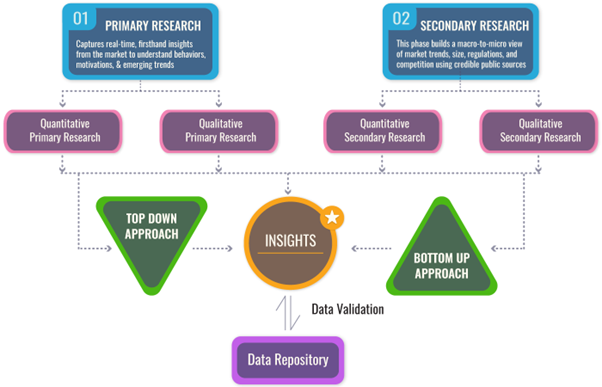
DUAL MODELING: TOP-DOWN + BOTTOM-UP
To ensure robust market estimation, we apply two complementary sizing approaches:
Top-Down Modeling:- Start with broader industry value (e.g., global or regional TAM)
- Apply filters by segment, geography, end-user, or use case
- Adjust with primary insights and validation benchmarks
- Ideal for investor-grade market scans and opportunity mapping
- Aggregate from the ground up using sales volumes, pricing, and unit economics
- Use internal modeling templates aligned with stakeholder data
- Incorporate distributor-level or region-specific inputs
- Most accurate for emerging segments and granular sub-markets
DATA VALIDATION: IN-HOUSE REPOSITORY
We close the loop with proprietary data intelligence built from ongoing projects, industry monitoring, and historical benchmarking. This repository includes:
- Multi-sector market and pricing models
- Key trendlines from past interviews and forecasts
- Benchmarked adoption rates, churn patterns, and ROI indicators
- Industry-specific deviation flags and cross-check logic
- Catches inconsistencies early
- Aligns projections across studies
- Enables consistent, high-trust deliverables