

Brain Imaging Devices Market Size and Forecast (2020 - 2033), Global and Regional Growth, Trend, Share, and Industry Analysis Report Coverage: By Product Type (Computed Tomography (CT), Magnetic Resonance Imaging (MRI), Positron Emission Tomography (PET), Electroencephalography (EEG), Magnetoencephalography (MEG), and Others), By Application (Neurodegenerative Disorders, Psychiatric Disorders, Brain Tumors, Cerebrovascular Diseases, Trauma, and Others), By End-User (Hospitals, Diagnostic Imaging Centers, Neurology & Neurosurgery Centers, Research & Academic Institutes) And Geography
2025-12-12
Healthcare
Swetal (Research Analyst)
Description
Brain
Imaging Devices Market Overview
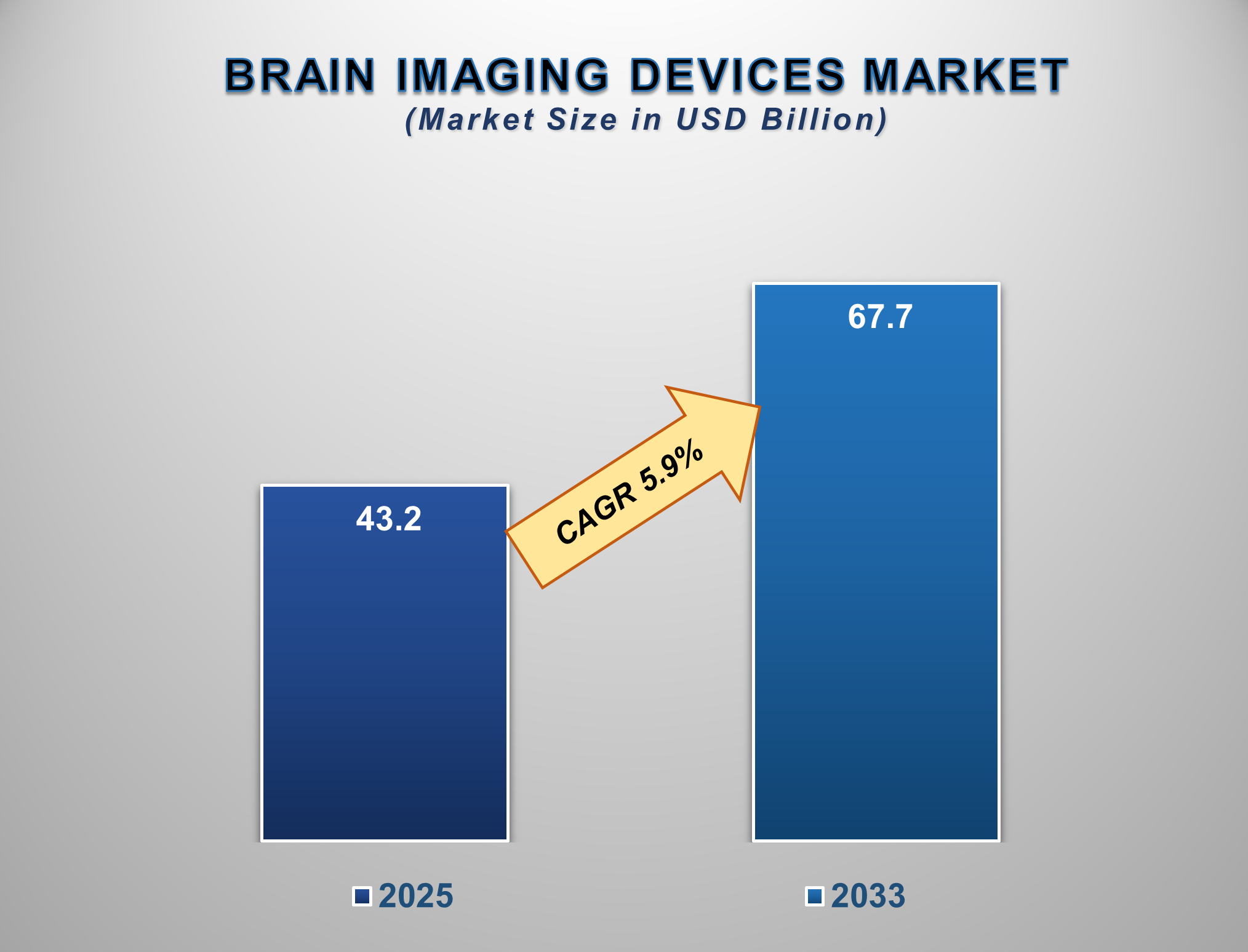
The Brain Imaging Devices Market is poised for substantial growth from 2025 to 2033, driven by the escalating global burden of neurological disorders and the continuous advancement of neuroimaging technologies. The market is projected to be valued at approximately USD 43.2 billion in 2025 and is forecasted to reach nearly USD 67.7 billion by 2033, exhibiting a compound annual growth rate (CAGR) of 5.9% during this period.
Brain imaging devices are critical diagnostic
and research tools used to visualize the structure and function of the brain.
These devices play a pivotal role in the diagnosis, treatment planning, and
monitoring of a wide range of conditions, including Alzheimer's disease,
Parkinson's disease, brain tumors, stroke, and epilepsy.
The market's expansion is underpinned by factors
such as the growing aging population, which is more susceptible to
neurodegenerative diseases; rising awareness
about early diagnosis of neurological conditions; and increasing investments in neuroscience research. Technological
innovations leading to higher resolution, faster scanning times, and the
integration of artificial intelligence (AI) for image analysis are further
propelling market adoption. North America currently holds the largest market
share, while the Asia-Pacific region is expected to witness the fastest growth,
fueled by improving healthcare infrastructure and rising healthcare
expenditure.
Brain Imaging Devices Market Drivers and
Opportunities
Rising Prevalence of Neurological and Psychiatric Disorders
is the Primary Market Driver
The increasing global incidence and prevalence
of neurological disorders such as dementia, stroke, epilepsy, and brain tumors,
alongside a growing recognition of psychiatric conditions, is the most
significant driver for the brain imaging devices market. The aging population
is a key contributor, as age is a major risk factor for neurodegenerative
diseases like Alzheimer's. Early and accurate diagnosis is crucial for
effective disease management and intervention, creating a sustained and growing
demand for advanced imaging techniques like MRI and PET scans. Furthermore, the
destigmatization of mental health issues is leading to higher diagnosis rates
for conditions like depression and schizophrenia, where neuroimaging is
increasingly used in research and clinical practice to understand brain
pathophysiology.
The prevalence of neurological and psychiatric
disorders in the United States represents a massive and growing public health
crisis. Collectively, conditions such as Alzheimer's disease and other
dementias, stroke, epilepsy, depression, and anxiety disorders affect tens of
millions of Americans. An estimated one in six U.S. adults lives with a mental
illness, while nearly 6 million are living with Alzheimer's, a number projected to rise sharply with the aging baby boomer
population. The economic burden is staggering, costing hundreds of billions of
dollars annually in healthcare services, lost productivity, and caregiving.
This high prevalence, driven by an aging demographic and increased awareness,
creates sustained and critical demand for diagnostic tools, treatments, and
support services, placing significant strain on the national healthcare system.
Technological Advancements and Multimodal Imaging Integration
are Driving Market Evolution
Continuous technological innovation is a major
catalyst for market growth. Advancements such as high-field and
ultra-high-field MRI systems, hybrid PET-MRI scanners, and portable EEG devices
are enhancing diagnostic capabilities. The integration of artificial
intelligence and machine learning for automated image interpretation, lesion
detection, and predictive analytics is revolutionizing the field, improving
accuracy and efficiency. The trend towards multimodal imaging, which combines
the strengths of different technologies (e.g., functional and structural data),
provides a more comprehensive view of brain health and is becoming a gold
standard in both clinical and research settings, pushing demand for advanced
and integrated systems.
Expansion into Emerging Markets and Point-of-Care
Applications Presents Significant Opportunities
The significant unmet medical need in emerging
economies of Asia, Latin America, and Africa presents a major growth frontier.
Improving healthcare infrastructure, rising disposable incomes, and increasing
government initiatives to modernize diagnostic capabilities are key
opportunities in these regions. For manufacturers, developing cost-effective
and robust imaging solutions tailored for these markets is a crucial strategy.
Simultaneously, the miniaturization of technology is creating opportunities for
point-of-care brain imaging. Portable EEG devices and compact ultrasound
systems for transcranial Doppler (TCD) are
enabling rapid assessment in emergency departments, ambulances, and intensive
care units, opening new avenues for market expansion beyond traditional
radiology departments.
Brain Imaging Devices Market Scope
|
Report Attributes |
Description |
|
Market Size in 2025 |
USD 43.2 Billion |
|
Market Forecast in 2033 |
USD 67.7 Billion |
|
CAGR % 2025-2033 |
5.9% |
|
Base Year |
2024 |
|
Historic Data |
2020-2024 |
|
Forecast Period |
2025-2033 |
|
Report USP |
Product Portfolio,
Technological Analysis, Company Market Share, Company Heatmap, Pricing
Analysis, Growth Factors and more |
|
Segments Covered |
●
By Product Type ●
By Application ●
By End-user |
|
Regional Scope |
●
North America, ●
Europe, ●
APAC, ●
Latin America ●
Middle East and
Africa |
|
Country Scope |
1)
U.S. 2)
Canada 3)
Germany 4)
UK 5)
France 6)
Spain 7)
Italy 8)
Switzerland 9)
China 10)
Japan 11)
India 12)
Australia 13)
South Korea 14)
Brazil 15)
Mexico 16)
Argentina 17)
South Africa 18)
Saudi Arabia 19)
UAE |
Brain Imaging Devices Market Report Segmentation
Analysis
The global Brain Imaging Devices
Market industry analysis is segmented by Product Type, by Application, by
End-User, and by Region.
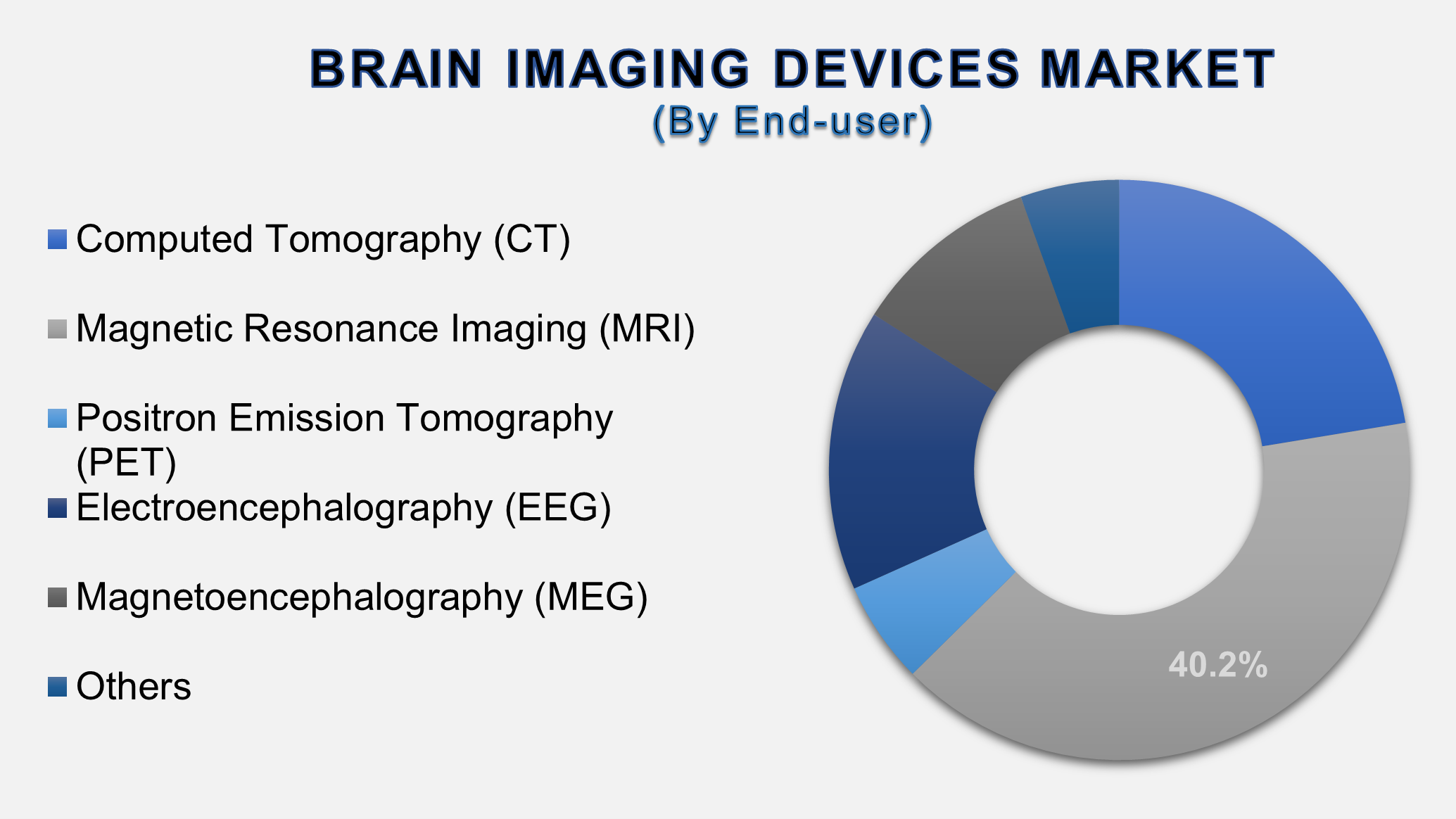
The Magnetic Resonance
Imaging (MRI) segment is anticipated to command a dominant market share in
2025.
The Product Type segment is categorized into CT, MRI, PET, EEG, MEG, and Others. The Magnetic Resonance Imaging (MRI) segment commands a dominant market share due to its unparalleled ability to provide high-resolution, non-invasive images of both brain structure and function without ionizing radiation. It is the modality of choice for diagnosing a wide spectrum of neurological conditions, from tumors and vascular malformations to multiple sclerosis and dementia. Technological advancements, such as functional MRI (fMRI) and diffusion tensor imaging (DTI), have expanded its applications into mapping brain activity and neural pathways, solidifying its indispensable role in neuroscience research and clinical diagnostics. Its versatility, superior soft-tissue contrast, and ongoing innovations make it the cornerstone of modern brain imaging.
The Research &
Academic Institutes segment is projected to be the fastest-growing.
The
End-User segment is divided into Hospitals, Diagnostic Imaging Centers,
Neurology & Neurosurgery Centers, and Research & Academic Institutes.
The Research & Academic Institutes segment is projected to be the
fastest-growing end-user, driven by a massive global increase in funding for
neuroscience research. Governments and private organizations are heavily
investing in initiatives to unravel the complexities of the brain, such as
mapping neural connections and understanding the biological basis of psychiatric
and neurodegenerative diseases. This research relies heavily on advanced and
often multimodal imaging technologies. The collaboration between academia and
industry to develop new diagnostic biomarkers and therapeutic targets further
fuels the demand for high-end imaging systems like 7T MRI, high-density EEG,
and combined PET-MRI scanners within research settings.
The Neurodegenerative
Disorders application segment is projected to exhibit strong growth.
The
Application segment includes Neurodegenerative Disorders, Psychiatric
Disorders, Brain Tumors, Cerebrovascular Diseases, Trauma, and Others. The
Neurodegenerative Disorders application segment exhibits strong growth due to
the rapidly aging global population, which is leading to a significant increase
in the prevalence of conditions like Alzheimer's disease and Parkinson's
disease. There is a pressing clinical need for early and differential diagnosis
to initiate timely treatment and for monitoring disease progression in clinical
trials for new therapies. Advanced imaging techniques, particularly MRI for
volumetric analysis and PET scans using specific biomarkers (e.g., amyloid
PET), are becoming critical tools in this fight. As the number of affected individuals
rises and the pipeline for neurodegenerative disease therapeutics expands, the
reliance on brain imaging for patient stratification and outcome measurement is
set to grow substantially.
The following segments are
part of an in-depth analysis of the global Brain Imaging Devices Market:
|
Market
Segments |
|
|
By Product
Type |
●
Computed Tomography
(CT) ●
Magnetic Resonance
Imaging (MRI) ●
Positron Emission
Tomography (PET) ●
Electroencephalography
(EEG) ●
Magnetoencephalography
(MEG) ●
Others |
|
By Application |
●
Neurodegenerative
Disorders ●
Psychiatric
Disorders ●
Brain Tumors ●
Cerebrovascular
Diseases ●
Trauma ●
Others |
|
By End-user |
●
Hospitals ●
Diagnostic Imaging
Centers ●
Neurology &
Neurosurgery Centers ●
Research &
Academic Institutes |
Brain Imaging Devices Market Share Analysis by
Region
The North America region
is anticipated to hold the largest portion of the Brain Imaging Devices Market
globally throughout the forecast period.
North
America's dominance is attributed to its advanced healthcare infrastructure,
high healthcare expenditure, strong presence of leading market players, and favorable reimbursement policies for advanced diagnostic imaging
procedures. The region has a high adoption rate of cutting-edge technologies, a
robust clinical research ecosystem, and a significant patient population
suffering from neurological disorders. These factors, combined with extensive
R&D activities, solidify North America's position as the largest regional
market.
In
addition, the large and aging population in countries like China, Japan, and
India is creating a massive patient pool requiring diagnosis and treatment.
Furthermore, rising disposable incomes are making advanced diagnostic
procedures more accessible. Local manufacturing and initiatives to increase the
penetration of medical imaging equipment in tier-2 and tier-3 cities are also
contributing to the rapid market expansion in the region.
Brain Imaging Devices Market Competition
Landscape Analysis
The global brain imaging
devices market is highly competitive and consolidated, dominated by a few major
international conglomerates. Competition is intense and based on factors such
as image quality, technological innovation (e.g., AI integration, low-dose
scanning), product portfolio breadth, service and maintenance support, and
strategic partnerships with research institutions. Key strategies include
significant investment in R&D to launch next-generation systems, expansion
in high-growth emerging markets through localized offerings, and mergers &
acquisitions to consolidate market position and acquire novel technologies.
Global Brain Imaging
Devices Market Recent Developments News:
- In February 2025, Siemens Healthineers received FDA approval for its
new 7T Terra MRI scanner, offering enhanced resolution for neuroscientific
and clinical research.
- In December 2024, GE Healthcare launched its "SIGNATM
PET/MR" system with new AI-based algorithms to reduce scan time and
improve image quantification for neurological applications.
- In September 2024, Philips entered a strategic partnership with a
leading European university hospital to co-develop AI-powered software for
the automated detection of early-stage brain tumors using MRI data.
- In June 2024, Canon Medical Systems Corporation introduced a new
high-slice CT scanner with advanced neurological perfusion protocols aimed
at improving stroke diagnosis and management.
The Global Brain Imaging
Devices Market Is Dominated by a Few Large Companies, such as
●
GE Healthcare
●
Siemens Healthineers
●
Philips
●
Canon Medical Systems
Corporation
●
Fujifilm Holdings
Corporation
●
Hitachi, Ltd.
●
Medtronic plc
●
Nihon Kohden
Corporation
●
Elekta AB
●
Brainlab AG
●
Shimadzu Corporation
●
MinFound Medical
Systems Co., Ltd.
●
NeuroLogica Corp
(Samsung)
● Other Prominent Players
Frequently Asked Questions
Swetal (Research Analyst)
Swetal is a Research Analyst with 4+ years of experience specializing in healthcare market research, medical devices, healthcare IT, and medical technology industry analysis. Her expertise includes competitive intelligence, secondary research, market trend forecasting, and healthcare business insights across global healthcare ecosystems.
She contributes to advanced market research reports by analyzing regulatory frameworks, emerging healthcare technologies, competitive landscapes, and innovation trends shaping the medical industry. With a strong focus on accurate market intelligence, strategic insights, and healthcare industry trends, Swetal supports businesses in making informed, data-backed decisions in a rapidly transforming healthcare environment.
1. Global Brain Imaging
Devices Market Introduction and Market Overview
1.1.
Objectives
of the Study
1.2.
Global
Brain Imaging Devices Market Scope and Market Estimation
1.2.1.Global Electronic Toll
Collection Overall Market Size (US$ Mn), Market CAGR (%), Market forecast (2025
- 2033)
1.2.2.Global Brain Imaging
Devices Market Revenue Share (%) and Growth Rate (Y-o-Y) from 2020 - 2033
1.3.
Market
Segmentation
1.3.1.Product Type of Global Brain
Imaging Devices Market
1.3.2.Application of Global Brain
Imaging Devices Market
1.3.3.End-user of Global Brain
Imaging Devices Market
1.3.4.Region of Global Brain
Imaging Devices Market
2. Executive
Summary
2.1.
Demand
Side Trends
2.2.
Key
Market Trends
2.3.
Market
Demand (US$ Mn) Analysis 2020 – 2024 and forecast, 2025 – 2033
2.4.
Demand
and Opportunity Assessment
2.5.
Technological
Advancements
2.6.
Regulatory
Scenario by Region
2.7.
Key
Developments
2.8.
Market
Entry Strategies
2.9.
Market
Dynamics
2.9.1.Drivers
2.9.2.Limitations
2.9.3.Opportunities
2.9.4.Impact Analysis of Drivers
and Restraints
2.10.
Porter’s
Five Forces Analysis
2.11.
PEST
Analysis
3. Global
Brain Imaging Devices Market Estimates
& Historical Trend Analysis (2020 - 2024)
4. Global
Brain Imaging Devices Market Estimates
& Forecast Trend Analysis, by Product Type
4.1.
Global
Brain Imaging Devices Market Revenue (US$ Mn) Estimates and Forecasts, by Product
Type, 2020 - 2033
4.1.1.Computed Tomography (CT)
4.1.2.Magnetic Resonance Imaging
(MRI)
4.1.3.Positron Emission
Tomography (PET)
4.1.4.Electroencephalography
(EEG)
4.1.5.Magnetoencephalography
(MEG)
4.1.6.Others
5. Global
Brain Imaging Devices Market Estimates
& Forecast Trend Analysis, by Application
5.1.
Global
Brain Imaging Devices Market Revenue (US$ Mn) Estimates and Forecasts, by Application,
2020 - 2033
5.1.1.Neurodegenerative
Disorders
5.1.2.Psychiatric Disorders
5.1.3.Brain Tumors
5.1.4.Cerebrovascular Diseases
5.1.5.Trauma
5.1.6.Others
6. Global
Brain Imaging Devices Market Estimates
& Forecast Trend Analysis, by End-user
6.1.
Global
Brain Imaging Devices Market Revenue (US$ Mn) Estimates and Forecasts, by End-user
2020 - 2033
6.1.1.Hospitals
6.1.2.Diagnostic Imaging Centers
6.1.3.Neurology &
Neurosurgery Centers
6.1.4.Research & Academic
Institutes
7. Global
Brain Imaging Devices Market Estimates
& Forecast Trend Analysis, by region
7.1.
Global
Brain Imaging Devices Market Revenue (US$ Mn) Estimates and Forecasts, by region,
2020 - 2033
7.1.1.North America
7.1.2.Europe
7.1.3.Asia Pacific
7.1.4.Middle East & Africa
7.1.5.Latin America
8. North America Brain
Imaging Devices Market: Estimates &
Forecast Trend Analysis
8.1.
North
America Brain Imaging Devices Market Assessments & Key Findings
8.1.1.North America Brain
Imaging Devices Market Introduction
8.1.2.North America Brain
Imaging Devices Market Size Estimates and Forecast (US$ Billion) (2020 - 2033)
8.1.2.1. By Product
Type
8.1.2.2. By Application
8.1.2.3. By End-user
8.1.2.4.
By
Country
8.1.2.4.1. The U.S.
8.1.2.4.2. Canada
9. Europe Brain
Imaging Devices Market: Estimates &
Forecast Trend Analysis
9.1.
Europe
Brain Imaging Devices Market Assessments & Key Findings
9.1.1.Europe Brain Imaging
Devices Market Introduction
9.1.2.Europe Brain Imaging
Devices Market Size Estimates and Forecast (US$ Billion) (2020 - 2033)
9.1.2.1. By Product
Type
9.1.2.2. By Application
9.1.2.3. By End-user
9.1.2.4.
By
Country
9.1.2.4.1.
Germany
9.1.2.4.2.
Italy
9.1.2.4.3.
U.K.
9.1.2.4.4.
France
9.1.2.4.5.
Spain
9.1.2.4.6.
Switzerland
9.1.2.4.7. Rest
of Europe
10. Asia Pacific Brain
Imaging Devices Market: Estimates &
Forecast Trend Analysis
10.1.
Asia
Pacific Market Assessments & Key Findings
10.1.1.
Asia
Pacific Brain Imaging Devices Market Introduction
10.1.2.
Asia
Pacific Brain Imaging Devices Market Size Estimates and Forecast (US$ Billion)
(2020 - 2033)
10.1.2.1. By Product
Type
10.1.2.2. By Application
10.1.2.3. By End-user
10.1.2.4.
By
Country
10.1.2.4.1. China
10.1.2.4.2. Japan
10.1.2.4.3. India
10.1.2.4.4. Australia
10.1.2.4.5. South Korea
10.1.2.4.6. Rest of Asia Pacific
11. Middle East & Africa Brain
Imaging Devices Market: Estimates &
Forecast Trend Analysis
11.1.
Middle
East & Africa Market Assessments & Key Findings
11.1.1.
Middle East & Africa Brain Imaging Devices Market
Introduction
11.1.2.
Middle East & Africa Brain Imaging Devices Market Size Estimates
and Forecast (US$ Billion) (2020 - 2033)
11.1.2.1. By Product
Type
11.1.2.2. By Application
11.1.2.3. By End-user
11.1.2.4.
By
Country
11.1.2.4.1. UAE
11.1.2.4.2. Saudi
Arabia
11.1.2.4.3. South
Africa
11.1.2.4.4. Rest
of MEA
12. Latin America
Brain Imaging Devices Market: Estimates
& Forecast Trend Analysis
12.1.
Latin
America Market Assessments & Key Findings
12.1.1.
Latin
America Brain Imaging Devices Market Introduction
12.1.2.
Latin
America Brain Imaging Devices Market Size Estimates and Forecast (US$ Billion)
(2020 - 2033)
12.1.2.1. By Product
Type
12.1.2.2. By Application
12.1.2.3. By End-user
12.1.2.4.
By
Country
12.1.2.4.1. Brazil
12.1.2.4.2. Argentina
12.1.2.4.3. Mexico
12.1.2.4.4. Rest
of LATAM
13. Country Wise Market:
Introduction
14.
Competition
Landscape
14.1.
Global
Brain Imaging Devices Market Product Mapping
14.2.
Global
Brain Imaging Devices Market Concentration Analysis, by Leading Players /
Innovators / Emerging Players / New Entrants
14.3.
Global
Brain Imaging Devices Market Tier Structure Analysis
14.4.
Global
Brain Imaging Devices Market Concentration & Company Market Shares (%)
Analysis, 2024
15.
Company
Profiles
15.1.
GE Healthcare
15.1.1.
Company
Overview & Key Stats
15.1.2.
Financial
Performance & KPIs
15.1.3.
Product
Portfolio
15.1.4.
SWOT
Analysis
15.1.5.
Business
Strategy & Recent Developments
* Similar details would be provided for all the players
mentioned below
15.2. Siemens
Healthineers
15.3. Philips
15.4. Canon Medical
Systems Corporation
15.5. Fujifilm
Holdings Corporation
15.6. Hitachi, Ltd.
15.7. Medtronic plc
15.8. Nihon Kohden
Corporation
15.9. Elekta AB
15.10. Brainlab AG
15.11. Shimadzu
Corporation
15.12. MinFound
Medical Systems Co., Ltd.
15.13. NeuroLogica
Corp (Samsung)
15.14. Other
Prominent Players
16. Research
Methodology
16.1.
External
Transportations / Databases
16.2.
Internal
Proprietary Database
16.3.
Primary
Research
16.4.
Secondary
Research
16.5.
Assumptions
16.6.
Limitations
16.7.
Report
FAQs
17. Research
Findings & Conclusion
Our Research Methodology
"Insight without rigor is just noise."
We follow a comprehensive, multi-phase research framework designed to deliver accurate, strategic, and decision-ready intelligence. Our process integrates primary and secondary research , both quantitative and qualitative , along with dual modeling techniques ( top-down and bottom-up) and a final layer of validation through our proprietary in-house repository.
PRIMARY RESEARCH
Primary research captures real-time, firsthand insights from the market to understand behaviors, motivations, and emerging trends.
1. Quantitative Primary Research
Objective: Generate statistically significant data directly from market participants.
Approaches:- Structured surveys with customers, distributors, and field agents
- Mobile-based data collection for point-of-sale audits and usage behavior
- Phone-based interviews (CATI) for market sizing and product feedback
- Online polling around industry events and digital campaigns
- Purchase frequency by customer type
- Channel performance across geographies
- Feature demand by application or demographic
2. Qualitative Primary Research
Objective: Explore decision-making drivers, pain points, and market readiness.
Approaches:- In-depth interviews (IDIs) with executives, product managers, and key decision-makers
- Focus groups among end users and early adopters
- Site visits and observational research for consumer products
- Informal field-level discussions for regional and cultural nuances
SECONDARY RESEARCH
This phase helps establish a macro-to-micro understanding of market trends, size, regulation, and competitive dynamics, sourced from credible and public domain information.
1. Quantitative Secondary Research
Objective: Model market value and segment-level forecasts based on published data.
Sources include:- Financial reports and investor summaries
- Government trade data, customs records, and regulatory statistics
- Industry association publications and economic databases
- Channel performance and pricing data from marketplace listings
- Revenue splits, pricing trends, and CAGR estimates
- Supply-side capacity and volume tracking
- Investment analysis and funding benchmarks
2. Qualitative Secondary Research
Objective: Capture strategic direction, innovation signals, and behavioral trends.
Sources include:- Company announcements, roadmaps, and product pipelines
- Publicly available whitepapers, conference abstracts, and academic research
- Regulatory body publications and policy briefs
- Social and media sentiment scanning for early-stage shifts
- Strategic shifts in market positioning
- Unmet needs and white spaces
- Regulatory triggers and compliance impact
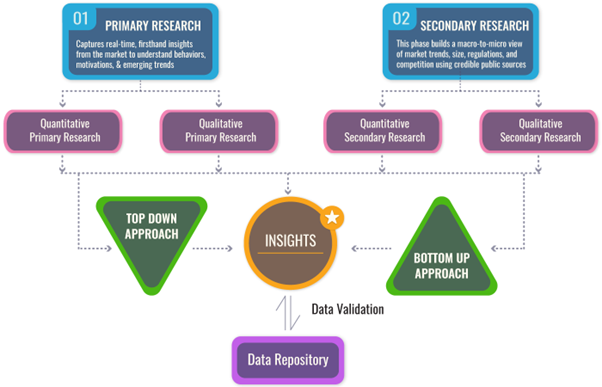
DUAL MODELING: TOP-DOWN + BOTTOM-UP
To ensure robust market estimation, we apply two complementary sizing approaches:
Top-Down Modeling:- Start with broader industry value (e.g., global or regional TAM)
- Apply filters by segment, geography, end-user, or use case
- Adjust with primary insights and validation benchmarks
- Ideal for investor-grade market scans and opportunity mapping
- Aggregate from the ground up using sales volumes, pricing, and unit economics
- Use internal modeling templates aligned with stakeholder data
- Incorporate distributor-level or region-specific inputs
- Most accurate for emerging segments and granular sub-markets
DATA VALIDATION: IN-HOUSE REPOSITORY
We close the loop with proprietary data intelligence built from ongoing projects, industry monitoring, and historical benchmarking. This repository includes:
- Multi-sector market and pricing models
- Key trendlines from past interviews and forecasts
- Benchmarked adoption rates, churn patterns, and ROI indicators
- Industry-specific deviation flags and cross-check logic
- Catches inconsistencies early
- Aligns projections across studies
- Enables consistent, high-trust deliverables