

Salad Dressings and Mayonnaise Market Size and Forecast (2025 - 2033), Global and Regional Growth, Trend, Share and Industry Analysis Report Coverage: By Type (Salad Dressings, Mayonnaise); By Ingredient Source (Conventional, Organic & Natural, Plant-Based / Vegan); By Packaging Type (Jars, Sachets & Pouches, Bottles, Tubes & Containers); By Distribution Channel (Supermarkets & Hypermarkets, Convenience Stores, Online Retail/E-commerce, Specialty & Gourmet Stores, Food Service / HoReCa); and Geography
2025-11-26
Consumer Products
Jaya Bundele (Research Analyst)
Description
Salad Dressings & Mayonnaise Market Overview
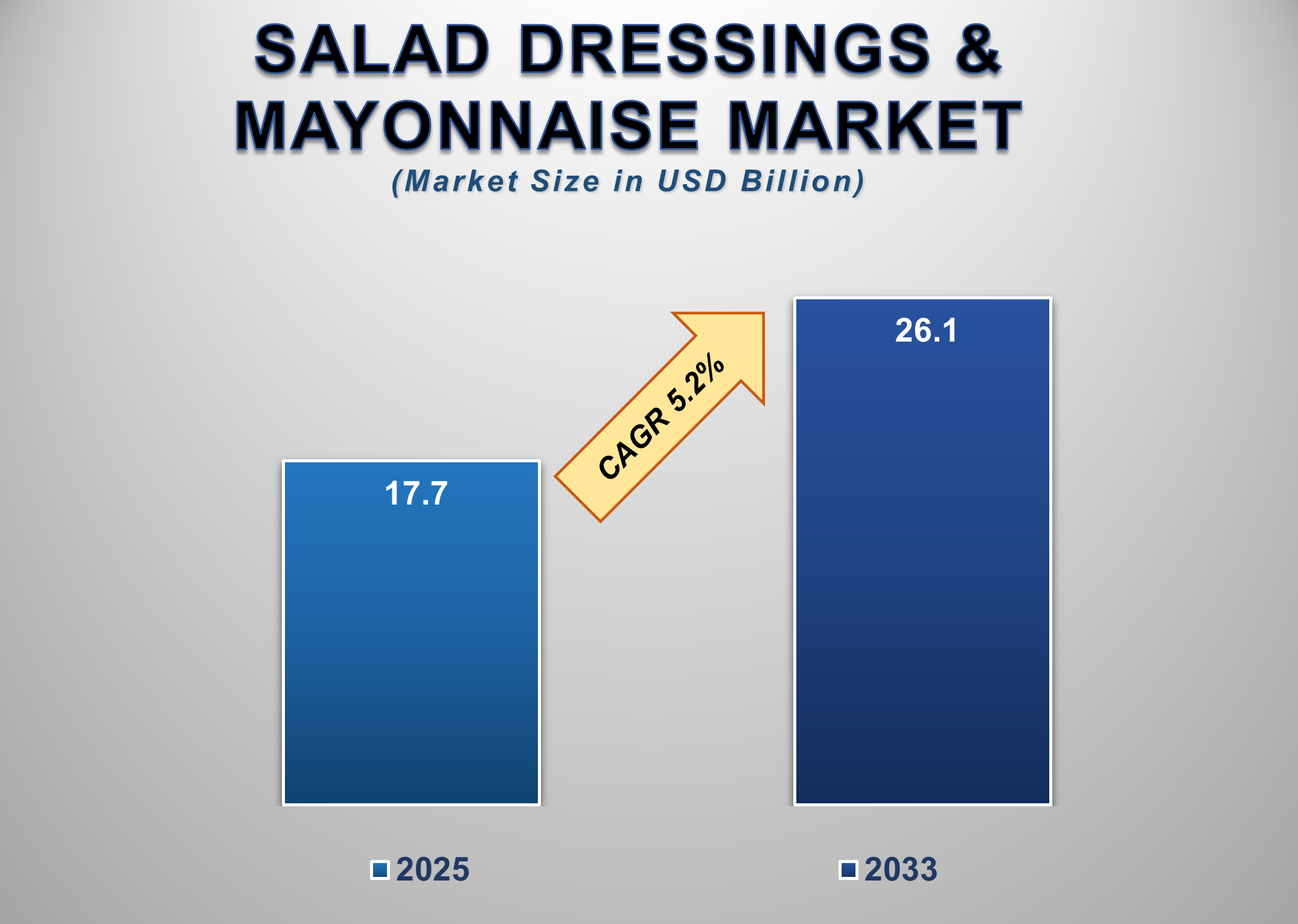
The Global Salad Dressings & Mayonnaise Market is experiencing robust expansion driven by evolving consumer dietary habits, rising health consciousness, and the growing global trend of convenient and ready-to-eat food products. The market was valued at USD 17.7 billion in 2025 and is projected to reach USD 26.1 billion by 2033, expanding at a CAGR of 5.2% during the forecast period.
Salad dressings and mayonnaise
are integral components of modern culinary practices, widely used across
households, restaurants, and the food service industry. The rising adoption of
Western-style diets, increasing global urbanization, and a growing preference
for flavorful, nutritious, and convenient meal options are major factors
boosting market growth. Moreover, the expansion of international fast-food
chains and the availability of diverse dressing varieties ranging from low-fat
to vegan and organic formulations have further contributed to widespread market
acceptance.
Salad Dressings &
Mayonnaise Market Drivers and Opportunities
Rising health awareness and demand for nutritious,
clean-label products are driving market growth
The global shift toward healthier lifestyles and balanced
nutrition is a primary growth driver for the salad dressings and mayonnaise
market. Consumers are increasingly conscious about the nutritional value of the
foods they consume, resulting in heightened demand for products with reduced
fat, sugar, and artificial additives. This has prompted manufacturers to
reformulate traditional dressings and mayonnaise with functional ingredients
such as olive oil, avocado oil, and yogurt bases that offer better nutritional
profiles.
The clean-label movement, emphasizing transparency, natural
ingredients, and minimal processing, has further reshaped consumer preferences.
Health-conscious buyers are actively seeking gluten-free, non-GMO, and organic
variants, while also favoring plant-based alternatives. In response, global
brands are expanding product lines to include vegan and eggless mayonnaise
options catering to ethical and dietary concerns.
Additionally, the increasing adoption of salads as a main course
meal in urban diets has significantly boosted dressing consumption. The
influence of social media-driven food trends and culinary innovation is also
enhancing consumer experimentation with new flavors, leading to strong demand
growth across both premium and mid-range product segments.
Expansion of food service and retail channels is fueling
market penetration
The rapid expansion of the global food service sector, including
quick-service restaurants (QSRs), cafés, and gourmet dining establishments, is
a major factor propelling the salad dressings and mayonnaise market. As the
global restaurant industry continues to rebound post-pandemic, sauces and
condiments have become indispensable ingredients for menu diversification and
flavor enhancement. Manufacturers are forming long-term supply partnerships
with food chains and catering services to ensure consistent demand and brand
visibility. Simultaneously, the proliferation of organized retail and
e-commerce has expanded consumer access to a diverse array of dressings and
mayonnaise products. Online grocery platforms and direct-to-consumer channels
have allowed brands to reach broader audiences with greater convenience and
personalized offerings. Furthermore, the integration of smart packaging,
improved shelf life, and portion-controlled formats is supporting product
innovation across various retail platforms.
Emerging markets in Asia-Pacific and Latin America are witnessing
rapid growth in both modern trade and HoReCa channels, presenting lucrative
opportunities for established players to expand geographically and diversify
their distribution networks.
The rising popularity of plant-based and vegan formulations
presents lucrative opportunities
The global rise in veganism and flexitarian diets is creating
substantial opportunities for innovation within the salad dressings and
mayonnaise market. With growing consumer demand for sustainable, ethical, and
plant-based alternatives, food manufacturers are investing heavily in eggless,
dairy-free, and allergen-friendly product development. Plant-derived
ingredients such as chickpea protein, aquafaba, and soy have become
increasingly popular as emulsifying bases in vegan mayonnaise and creamy salad
dressings.
Additionally, the rising environmental awareness among consumers
is pushing brands to adopt eco-friendly sourcing and sustainable packaging
solutions. Startups and premium brands are capitalizing on this trend by
introducing artisanal, organic, and superfood-infused dressings that align with
modern health and ethical preferences.
As regulatory support and consumer acceptance of vegan foods
continue to strengthen globally, the plant-based product segment is anticipated
to experience double-digit growth in the coming years. Companies that innovate
with natural flavorings, functional ingredients, and environmentally
responsible packaging are well-positioned to capitalize on this evolving
consumer landscape.
Salad Dressings &
Mayonnaise Market Scope
|
Report Attributes |
Description |
|
Market Size in 2025 |
USD 17.7 Billion |
|
Market Forecast in 2033 |
USD 26.1 Billion |
|
CAGR % 2025-2033 |
5.2% |
|
Base Year |
2024 |
|
Historic Data |
2020-2024 |
|
Forecast Period |
2025-2033 |
|
Report USP |
Production, Consumption,
Company Share, Company Heatmap, Company Production Capacity, Growth Factors,
and more |
|
Segments Covered |
●
By Type ●
By Ingredient
Source ●
By Packaging Type ●
By Distribution
Channel |
|
Regional Scope |
●
North America, ●
Europe, ●
APAC, ●
Latin America ●
Middle East and
Africa |
|
Country Scope |
1)
U.S. 2)
Canada 3)
Germany 4)
UK 5)
France 6)
Spain 7)
Italy 8)
Switzerland 9)
China 10)
Japan 11)
India 12)
Australia 13)
South Korea 14)
Brazil 15)
Mexico 16)
Argentina 17)
South Africa 18)
Saudi Arabia 19)
UAE |
Salad Dressings &
Mayonnaise Market Report Segmentation Analysis
The global Salad Dressings & Mayonnaise Market is segmented by
Type, by Ingredient Source, by Packaging Type, by Distribution Channel, and by
Region.
The
Salad Dressings segment accounted for the largest
market share in the global Salad Dressings & Mayonnaise market
By
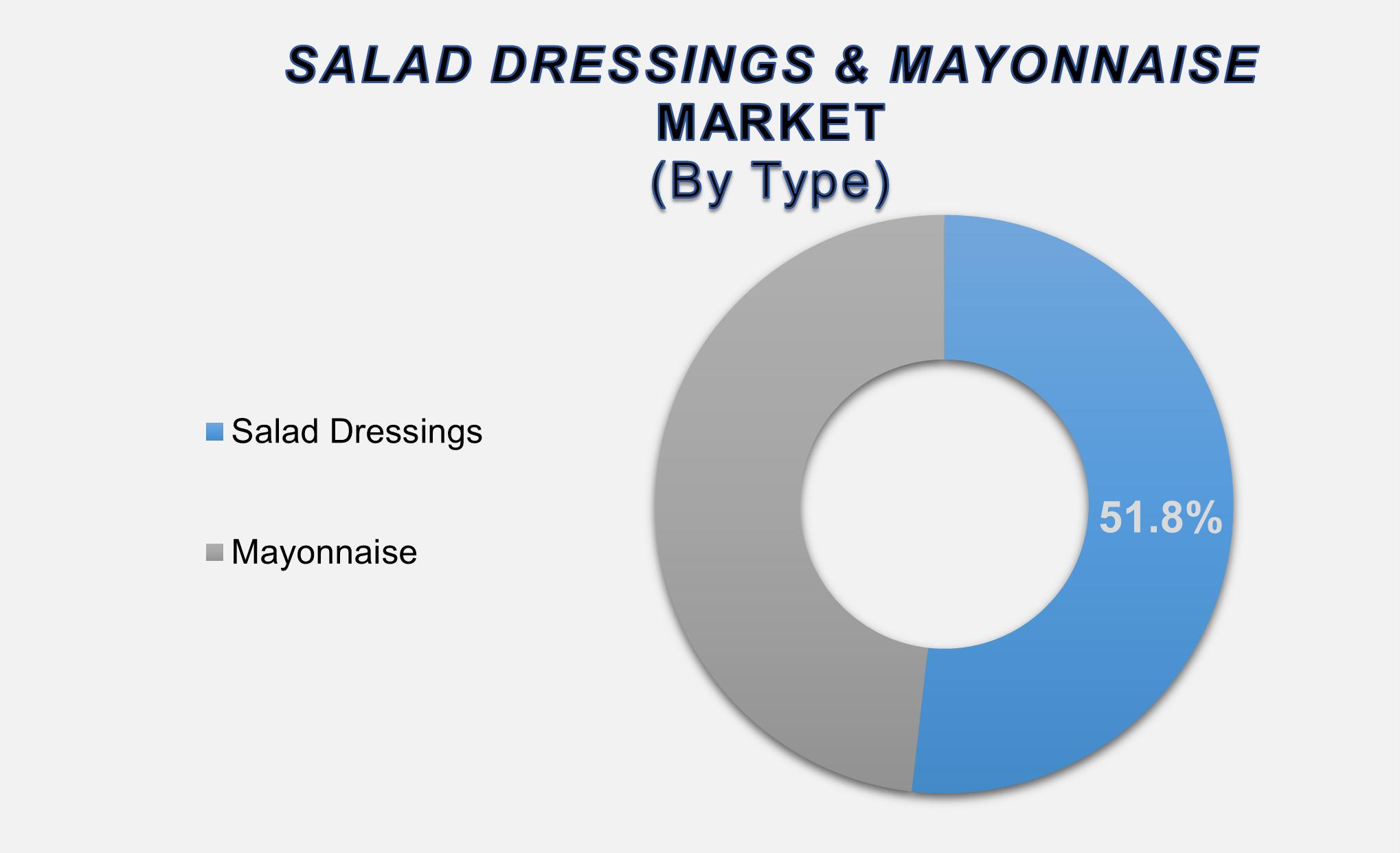
Type, the market is divided into Salad Dressings and Mayonnaise. The Salad
Dressings segment dominated the market in 2025 with a share of 51.8%, driven by
increasing global consumption of salads as a staple meal option among
health-conscious consumers. The rising popularity of international cuisines,
including Mediterranean and continental dishes, has expanded the use of diverse
dressing varieties such as vinaigrettes, creamy blends, and yogurt-based
sauces. The introduction of premium, low-calorie, and functional dressings
infused with herbs, superfoods, and probiotics has further diversified product
offerings. Brands are focusing on reformulations that balance flavor with
nutritional benefits, appealing to wellness-oriented demographics. The growing
presence of salad bars, online recipe platforms, and meal kit services also
contributes to the strong growth of this segment globally.
The Conventional ingredient source segment holds the largest market share
in the Salad Dressings & Mayonnaise market
By Ingredient Source, the market is segmented into Conventional,
Organic & Natural, and Plant-Based / Vegan. The Conventional segment
currently leads the market, supported by its affordability, accessibility, and
widespread consumer familiarity. Despite the growing shift toward organic and
vegan options, conventional salad dressings and mayonnaise continue to account
for a significant share in both household and food service applications.
However, manufacturers are increasingly enhancing conventional formulations
with cleaner ingredient profiles and minimal additives to align with modern
health trends. While the conventional segment dominates in volume, the organic
and vegan categories are expected to register higher CAGR growth, driven by
increasing health awareness and ethical consumption preferences.
The Jars packaging type segment leads the global Salad Dressings
& Mayonnaise market
By
Packaging Type, the market is categorized into Jars, Sachets & Pouches,
Bottles, and Tubes & Containers. The Jars segment accounted for the largest
market share in 2025, owing to their durability, premium appeal, and
suitability for both retail and food service usage. Glass and PET jars provide
excellent product visibility and shelf presentation, making them preferred
formats for high-end brands and home consumption. Meanwhile, sachets and
pouches are gaining traction in emerging markets and food delivery services due
to their portability and single-use convenience. Manufacturers are also
adopting recyclable and biodegradable materials to enhance sustainability
across packaging lines, reflecting growing environmental awareness among
consumers and retailers alike.
The following segments are
part of an in-depth analysis of the global Salad Dressings & Mayonnaise
market:
|
Market Segments |
|
|
By Type |
●
Salad Dressings ●
Mayonnaise |
|
By Ingredient
Source |
●
Conventional ●
Organic &
Natural ●
Plant-Based / Vegan |
|
By Packaging
Type |
●
Jars ●
Sachets &
Pouches ●
Bottles ●
Tubes &
Containers |
|
By
Distribution Channel |
●
Supermarkets &
Hypermarkets ●
Convenience Stores ●
Online Retail /
E-commerce ●
Specialty &
Gourmet Stores ●
Food Service /
HoReCa |
Salad Dressings &
Mayonnaise Market Share Analysis by Region
North America is
anticipated to hold the biggest portion of the Salad Dressings & Mayonnaise
Market globally throughout the forecast period.
North America accounted for the
largest market share of 51.3% in 2025, driven by high consumer preference for
convenience foods, strong retail penetration, and the well-established presence
of leading global brands such as Kraft Heinz, Unilever, and McCormick. The
region’s mature food service industry and rising demand for customized and
gourmet condiments further reinforce its dominance. Consumer inclination toward
low-fat, organic, and vegan products is also reshaping product innovation in
the region. The U.S., in particular, is witnessing increased adoption of
clean-label and functional salad dressings with natural ingredients.
Conversely, the Asia-Pacific
region is anticipated to record the fastest CAGR during the forecast period.
The growth is supported by rapid urbanization, expanding middle-class
populations, and increasing Western food influence. Countries such as China, India,
and Japan are seeing strong growth in both retail and HoReCa consumption. Local
brands, coupled with global entrants, are leveraging e-commerce and modern
trade channels to cater to evolving regional tastes and preferences.
Salad Dressings &
Mayonnaise Market Competition Landscape Analysis
The global salad dressings and
mayonnaise market is moderately consolidated, with leading multinational
players dominating key markets alongside regional and artisanal producers.
Competition centers around flavor innovation, health-oriented product launches,
sustainable packaging, and omnichannel distribution strategies.
Global Salad Dressings
& Mayonnaise Market Recent Developments News:
- In September 2025,
Dole introduced its Apple Harvest Premium Salad Kit, a seasonal fall
offering featuring a spring mix base, aged cheddar cheese, brown sugar
pecans, and apple cider vinaigrette. Designed to meet consumer interest in
restaurant-quality salads at home, the launch was supported by refreshed
packaging across Dole’s core product portfolio.
- In April 2025,
Hidden Valley launched seven new ranch flavor varieties and a redesigned
"Easy Squeeze" bottle with an improved applicator for better
control. The expansion addressed growing demand for flavor customization
and included both widely available and retailer-exclusive options to boost
in-store traffic.
The Global Salad Dressings & Mayonnaise Market Is Dominated by a Few Large Companies, such as
●
Kraft Heinz Company
●
Nestlé
●
McCormick &
Company
●
The J.M. Smucker
Company
●
Unilever
●
Kewpie Corporation
●
Nando’s
●
Veeba Professional
●
Ken’s Foods
●
Naturally Fresh
●
Sir Kensington’s
●
Primal Kitchen
●
Tessemae’s
●
Bolthouse Farms
●
Brianna's Fine Salad
Dressings
●
Litehouse Inc.
●
Marzetti Company
●
Walden Farms
●
Newman’s Own
●
Stonewall Kitchen
● Others
Frequently Asked Questions
Jaya Bundele (Research Analyst)
Jaya Bundele is a skilled Research Analyst with 4+ years of experience in market intelligence, consumer insights, competitive analysis, and industry forecasting across the consumer goods, agriculture, and food & beverage sectors. She specializes in market sizing, trend analysis, growth opportunity mapping, and strategic secondary research for global and regional markets.
Her expertise lies in transforming complex industry data into actionable business strategies that help organizations identify emerging trends, understand customer behavior, and gain a competitive edge. With a strong focus on data-driven insights, business intelligence, and future market trends, Jaya delivers high-quality research solutions aligned with evolving industry demands and market dynamics.
1. Global Salad Dressings
& Mayonnaise Market Introduction and Market Overview
1.1.
Objectives
of the Study
1.2.
Global
Salad Dressings & Mayonnaise Market Scope and Market Estimation
1.2.1.Global Salad Dressings
& Mayonnaise Overall Market Size (US$ Bn), Market CAGR (%), Market forecast
(2025 - 2033)
1.2.2.Global Salad Dressings
& Mayonnaise Market Revenue Share (%) and Growth Rate (Y-o-Y) from 2020 - 2033
1.3.
Market
Segmentation
1.3.1.Type of Global Salad
Dressings & Mayonnaise Market
1.3.2.Ingredient Source of
Global Salad Dressings & Mayonnaise Market
1.3.3.Packaging Type of Global Salad
Dressings & Mayonnaise Market
1.3.4.Distribution Channel of
Global Salad Dressings & Mayonnaise Market
1.3.5.Region of Global Salad
Dressings & Mayonnaise Market
2.
Executive Summary
2.1.
Demand
Side Trends
2.2.
Key
Market Trends
2.3.
Market
Demand (US$ Bn) Analysis 2020 – 2024 and Forecast, 2025 – 2033
2.4.
Demand
and Opportunity Assessment
2.5.
Key
Developments
2.6.
Overview
of Tariff, Regulatory Landscape and Standards
2.7.
Market
Entry Strategies
2.8.
Market
Dynamics
2.8.1.Drivers
2.8.2.Limitations
2.8.3.Opportunities
2.8.4.Impact Analysis of Drivers
and Restraints
2.9.
Porter’s
Five Forces Analysis
2.10.
PEST
Analysis
3. Global
Salad Dressings & Mayonnaise Market
Estimates & Historical Trend Analysis (2020 - 2024)
4. Global
Salad Dressings & Mayonnaise Market
Estimates & Forecast Trend Analysis, by Type
4.1.
Global
Salad Dressings & Mayonnaise Market Revenue (US$ Bn) Estimates and
Forecasts, by Type, 2020 - 2033
4.1.1.Salad Dressings
4.1.2.Mayonnaise
5. Global
Salad Dressings & Mayonnaise Market
Estimates & Forecast Trend Analysis, by Ingredient
Source
5.1.
Global
Salad Dressings & Mayonnaise Market Revenue (US$ Bn) Estimates and
Forecasts, by Ingredient Source, 2020 - 2033
5.1.1.Conventional
5.1.2.Organic & Natural
5.1.3.Plant-Based / Vegan
6. Global
Salad Dressings & Mayonnaise Market
Estimates & Forecast Trend Analysis, by Packaging
Type
6.1.
Global
Salad Dressings & Mayonnaise Market Revenue (US$ Bn) Estimates and
Forecasts, by Packaging Type, 2020 - 2033
6.1.1.Jars
6.1.2.Sachets & Pouches
6.1.3.Bottles
6.1.4.Tubes & Containers
7. Global
Salad Dressings & Mayonnaise Market
Estimates & Forecast Trend Analysis, by Distribution
Channel
7.1.
Global
Salad Dressings & Mayonnaise Market Revenue (US$ Bn) Estimates and
Forecasts, by Distribution Channel, 2020 - 2033
7.1.1.Supermarkets &
Hypermarkets
7.1.2.Convenience Stores
7.1.3.Online Retail / E-commerce
7.1.4.Specialty & Gourmet
Stores
7.1.5.Food Service / HoReCa
8. Global
Salad Dressings & Mayonnaise Market
Estimates & Forecast Trend Analysis, by Region
8.1.
Global
Salad Dressings & Mayonnaise Market Revenue (US$ Bn) Estimates and
Forecasts, by Region, 2020 - 2033
8.1.1.North America
8.1.2.Europe
8.1.3.Asia Pacific
8.1.4.Middle East & Africa
8.1.5.Latin America
9. North America Salad
Dressings & Mayonnaise Market:
Estimates & Forecast Trend Analysis
9.1. North America Salad
Dressings & Mayonnaise Market Assessments & Key Findings
9.1.1.North America Salad
Dressings & Mayonnaise Market Introduction
9.1.2.North America Salad
Dressings & Mayonnaise Market Size Estimates and Forecast (US$ Billion) (2020
- 2033)
9.1.2.1.
By Type
9.1.2.2.
By Ingredient Source
9.1.2.3.
By Packaging Type
9.1.2.4.
By Distribution Channel
9.1.2.5. By Country
9.1.2.5.1. The U.S.
9.1.2.5.2. Canada
10. Europe Salad
Dressings & Mayonnaise Market:
Estimates & Forecast Trend Analysis
10.1. Europe Salad Dressings
& Mayonnaise Market Assessments & Key Findings
10.1.1. Europe Salad Dressings
& Mayonnaise Market Introduction
10.1.2. Europe Salad Dressings
& Mayonnaise Market Size Estimates and Forecast (US$ Billion) (2020 - 2033)
10.1.2.1.
By Type
10.1.2.2.
By Ingredient Source
10.1.2.3.
By Packaging Type
10.1.2.4.
By Distribution Channel
10.1.2.5. By Country
10.1.2.5.1.
Germany
10.1.2.5.2.
Italy
10.1.2.5.3.
U.K.
10.1.2.5.4.
France
10.1.2.5.5.
Spain
10.1.2.5.6.
Switzerland
10.1.2.5.7. Rest
of Europe
11. Asia Pacific Salad
Dressings & Mayonnaise Market:
Estimates & Forecast Trend Analysis
11.1. Asia Pacific Market
Assessments & Key Findings
11.1.1.
Asia
Pacific Salad Dressings & Mayonnaise Market Introduction
11.1.2.
Asia
Pacific Salad Dressings & Mayonnaise Market Size Estimates and Forecast
(US$ Billion) (2020 - 2033)
11.1.2.1.
By Type
11.1.2.2.
By Ingredient Source
11.1.2.3.
By Packaging Type
11.1.2.4.
By Distribution Channel
11.1.2.5. By Country
11.1.2.5.1. China
11.1.2.5.2. Japan
11.1.2.5.3. India
11.1.2.5.4. Australia
11.1.2.5.5. South Korea
11.1.2.5.6. Rest of Asia Pacific
12. Middle East & Africa Salad
Dressings & Mayonnaise Market:
Estimates & Forecast Trend Analysis
12.1. Middle East & Africa
Market Assessments & Key Findings
12.1.1. Middle
East & Africa
Salad Dressings & Mayonnaise Market Introduction
12.1.2. Middle
East & Africa
Salad Dressings & Mayonnaise Market Size Estimates and Forecast (US$ Billion)
(2020 - 2033)
12.1.2.1.
By Type
12.1.2.2.
By Ingredient Source
12.1.2.3.
By Packaging Type
12.1.2.4.
By Distribution Channel
12.1.2.5. By Country
12.1.2.5.1. UAE
12.1.2.5.2. Saudi
Arabia
12.1.2.5.3. South
Africa
12.1.2.5.4. Rest
of MEA
13. Latin America
Salad Dressings & Mayonnaise Market:
Estimates & Forecast Trend Analysis
13.1. Latin America Market
Assessments & Key Findings
13.1.1. Latin America Salad
Dressings & Mayonnaise Market Introduction
13.1.2. Latin America Salad
Dressings & Mayonnaise Market Size Estimates and Forecast (US$ Billion) (2020
- 2033)
13.1.2.1.
By Type
13.1.2.2.
By Ingredient Source
13.1.2.3.
By Packaging Type
13.1.2.4.
By Distribution Channel
13.1.2.5. By Country
13.1.2.5.1. Brazil
13.1.2.5.2. Argentina
13.1.2.5.3. Mexico
13.1.2.5.4. Rest
of LATAM
14.
Country
Wise Market: Introduction
15.
Competition
Landscape
15.1. Global Salad Dressings
& Mayonnaise Market Product Mapping
15.2. Global Salad Dressings
& Mayonnaise Market Concentration Analysis, by Leading Players / Innovators
/ Emerging Players / New Entrants
15.3. Global Salad Dressings
& Mayonnaise Market Tier Structure Analysis
15.4. Global Salad Dressings
& Mayonnaise Market Concentration & Company Market Shares (%) Analysis,
2024
16.
Company
Profiles
16.1.
Kraft Heinz Company
16.1.1.
Company
Overview & Key Stats
16.1.2.
Financial
Performance & KPIs
16.1.3.
Product
Portfolio
16.1.4.
SWOT
Analysis
16.1.5.
Business
Strategy & Recent Developments
* Similar details would be provided for all the players
mentioned below
16.2.
Nestlé
16.3.
McCormick & Company
16.4.
The J.M. Smucker Company
16.5.
Unilever
16.6.
Kewpie Corporation
16.7.
Nando's
16.8.
Veeba Professional
16.9.
Ken's Foods
16.10.
Naturally Fresh
16.11.
Sir Kensington's
16.12.
Primal Kitchen
16.13.
Tessemae's
16.14.
Bolthouse Farms
16.15.
Briannas Fine Salad Dressings
16.16.
Litehouse Inc.
16.17.
Marzetti Company
16.18.
Walden Farms
16.19.
Newman's Own
16.20.
Stonewall Kitchen
16.21.
Others
17. Research
Methodology
17.1. External Transportations /
Databases
17.2. Internal Proprietary
Database
17.3. Primary Research
17.4. Secondary Research
17.5. Assumptions
17.6. Limitations
17.7. Report FAQs
18. Research
Findings & Conclusion
Our Research Methodology
"Insight without rigor is just noise."
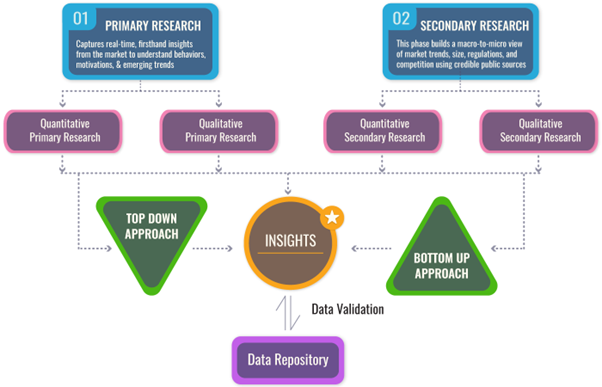
We follow a comprehensive, multi-phase research framework designed to deliver accurate, strategic, and decision-ready intelligence. Our process integrates primary and secondary research , both quantitative and qualitative , along with dual modeling techniques ( top-down and bottom-up) and a final layer of validation through our proprietary in-house repository.
PRIMARY RESEARCH
Primary research captures real-time, firsthand insights from the market to understand behaviors, motivations, and emerging trends.
1. Quantitative Primary Research
Objective: Generate statistically significant data directly from market participants.
Approaches:- Structured surveys with customers, distributors, and field agents
- Mobile-based data collection for point-of-sale audits and usage behavior
- Phone-based interviews (CATI) for market sizing and product feedback
- Online polling around industry events and digital campaigns
- Purchase frequency by customer type
- Channel performance across geographies
- Feature demand by application or demographic
2. Qualitative Primary Research
Objective: Explore decision-making drivers, pain points, and market readiness.
Approaches:- In-depth interviews (IDIs) with executives, product managers, and key decision-makers
- Focus groups among end users and early adopters
- Site visits and observational research for consumer products
- Informal field-level discussions for regional and cultural nuances
SECONDARY RESEARCH
This phase helps establish a macro-to-micro understanding of market trends, size, regulation, and competitive dynamics, sourced from credible and public domain information.
1. Quantitative Secondary Research
Objective: Model market value and segment-level forecasts based on published data.
Sources include:- Financial reports and investor summaries
- Government trade data, customs records, and regulatory statistics
- Industry association publications and economic databases
- Channel performance and pricing data from marketplace listings
- Revenue splits, pricing trends, and CAGR estimates
- Supply-side capacity and volume tracking
- Investment analysis and funding benchmarks
2. Qualitative Secondary Research
Objective: Capture strategic direction, innovation signals, and behavioral trends.
Sources include:- Company announcements, roadmaps, and product pipelines
- Publicly available whitepapers, conference abstracts, and academic research
- Regulatory body publications and policy briefs
- Social and media sentiment scanning for early-stage shifts
- Strategic shifts in market positioning
- Unmet needs and white spaces
- Regulatory triggers and compliance impact
DUAL MODELING: TOP-DOWN + BOTTOM-UP
To ensure robust market estimation, we apply two complementary sizing approaches:
Top-Down Modeling:- Start with broader industry value (e.g., global or regional TAM)
- Apply filters by segment, geography, end-user, or use case
- Adjust with primary insights and validation benchmarks
- Ideal for investor-grade market scans and opportunity mapping
- Aggregate from the ground up using sales volumes, pricing, and unit economics
- Use internal modeling templates aligned with stakeholder data
- Incorporate distributor-level or region-specific inputs
- Most accurate for emerging segments and granular sub-markets
DATA VALIDATION: IN-HOUSE REPOSITORY
We close the loop with proprietary data intelligence built from ongoing projects, industry monitoring, and historical benchmarking. This repository includes:
- Multi-sector market and pricing models
- Key trendlines from past interviews and forecasts
- Benchmarked adoption rates, churn patterns, and ROI indicators
- Industry-specific deviation flags and cross-check logic
- Catches inconsistencies early
- Aligns projections across studies
- Enables consistent, high-trust deliverables