

Soybean Food & Beverage Products Market Size and Forecast (2025–2033), Global and Regional Growth, Trend, Share, and Industry Analysis Report Coverage: By Type (Soybean Food Products, Soybean Additives/Ingredients, Soybean Oil), By Application (Bakery & Confectionery, Animal Feed, Dairy Products, Functional Food & Supplements, Meat Products, Infant Foods, Other Applications), By Source (GM, Non-GM/GE), By Distribution Channel (Supermarkets, Hypermarkets, Specialty Stores, Online Retailers, Convenience Stores, Departmental Stores, Other Distribution Channels), and Geography
2025-12-18
Consumer Products
Jaya Bundele (Research Analyst)
Description
Soybean
Food & Beverage Products Market Overview
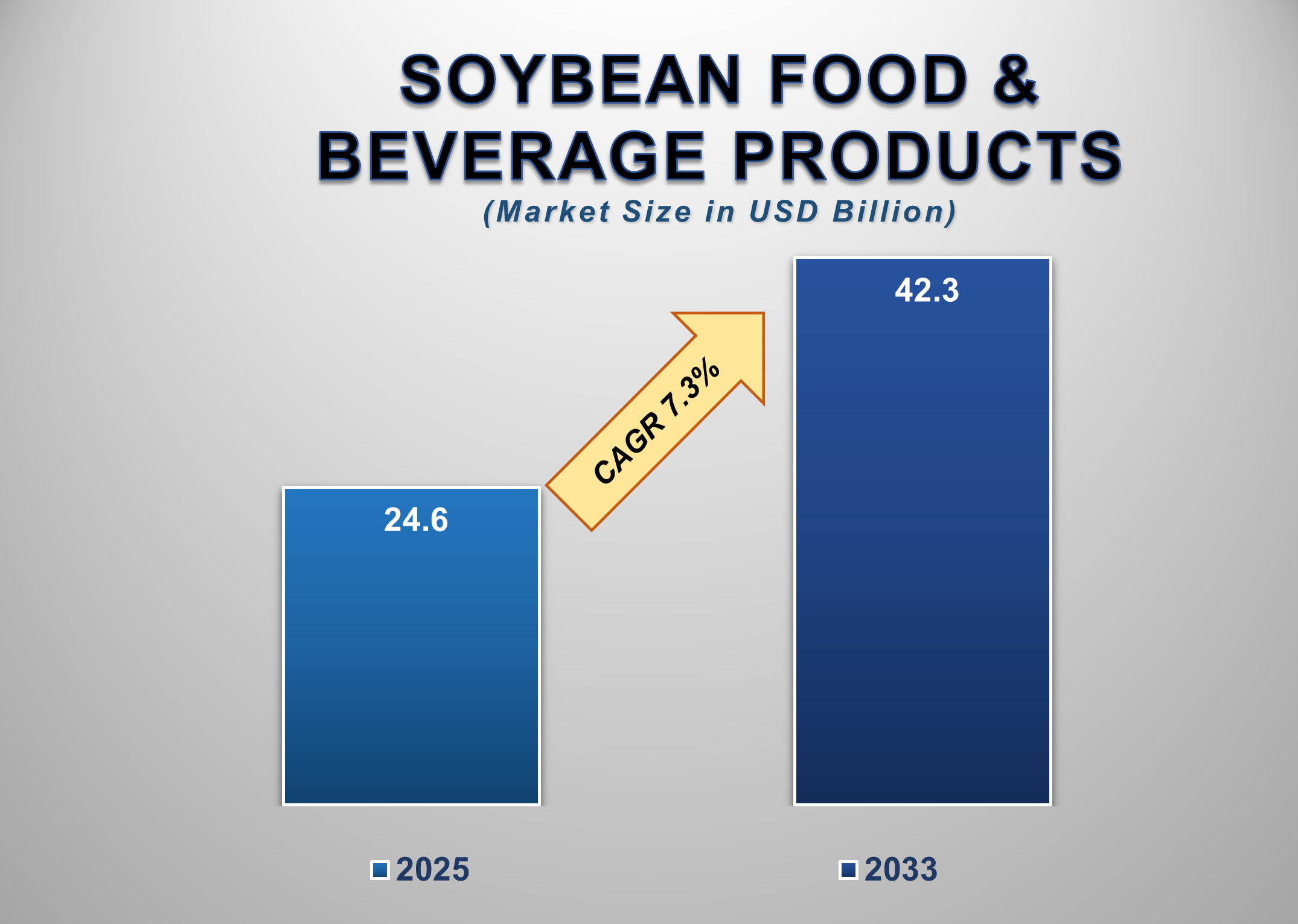
The Global Soybean Food & Beverage Products Market is projected to grow from USD 24.6 billion in 2025 to USD 42.3 billion by 2033, registering a CAGR of 7.3% during the forecast period. The growth is primarily driven by the rising shift toward plant-based diets, increasing demand for protein-rich food products, and the expanding use of soy derivatives across bakery, dairy alternative, functional food, and meat substitute applications. As consumers become more health-conscious and aware of sustainable food sources, soybean-based ingredients are gaining significant traction due to their high protein content, essential amino acids, and low environmental footprint.
Soybean food products currently
account for 53.8% of the market share, supported by the rapid expansion of
ready-to-eat soy foods, tofu, tempeh, soy milk, textured vegetable protein
(TVP), and soy-based meat analogues. From a sourcing standpoint, GM soybeans
dominate the supply chain, driven by their strong global availability, higher
yield efficiency, and cost-effectiveness.
Soybean
Food & Beverage Products Market Drivers and Opportunities
Rising Plant-Based Food
Adoption Is Driving the Growth of the Soybean Food & Beverage Products
Market
A significant factor driving the
growth of the Soybean Food & Beverage Products Market is the exponential
rise in plant-based and vegan food consumption worldwide. As consumers
increasingly shift away from traditional animal-derived products due to health,
ethical, and environmental concerns, soybean-based foods have emerged as one of
the most widely adopted alternatives due to their versatility and nutritional
richness. Soybean food products offer complete proteins comparable to animal
protein, making them ideal for vegan diets, high-protein diets, sports
nutrition, and weight management applications. In addition, rising cases of
lactose intolerance and dairy allergies are further boosting the demand for
soy-based dairy alternatives such as soy milk, soy yogurt, soy cheese, and soy
protein beverages. Manufacturers are also focusing heavily on new product
innovations, including flavored soy beverages, fortified soy snacks, organic
tofu, and soy-based meat substitutes, appealing to both health-conscious consumers
and flexitarian populations.
Government initiatives supporting
sustainable farming and the promotion of plant-based protein sources are also
contributing to market expansion. As the global food industry moves toward
cleaner labels and environmentally friendly products, soy-based foods are
gaining mainstream acceptance across supermarkets, online retail platforms,
restaurants, and food service chains, significantly driving market growth.
Increasing Use of Soy
Ingredients in Functional Foods and Nutraceuticals Is Driving Market Expansion
Another major driver shaping the
market is the expanding application of soy-derived ingredients in functional
foods, dietary supplements, sports nutrition, and nutraceutical formulations.
Soy protein isolates, concentrates, fibers, and oils are increasingly used by
manufacturers to enhance nutritional value, improve product texture, and
deliver targeted health benefits. Consumers are increasingly demanding products
that support heart health, hormonal balance, weight management, and muscle
development, all areas where soy ingredients have scientifically supported
advantages.
Soy isoflavones, in particular,
are gaining attention for their antioxidant and anti-inflammatory properties,
driving their incorporation into supplements focused on women’s health,
menopausal support, and bone strength. Meanwhile, soy lecithin and soy fiber
are becoming widely used in bakery, confectionery, beverage, and snacking
applications due to their emulsifying and stabilizing properties.
The growth of the fitness and
wellness industry, coupled with rising consumer interest in clean-label and
plant-derived supplements, is making soy one of the most preferred sources of
alternative protein. Food manufacturers, sports nutrition brands, and dietary
supplement companies are significantly expanding their portfolios, further
fueling demand for soybean ingredients across global markets.
Growth of Sustainable and
Clean-Label Products Is Creating Significant Opportunities in The Global
Soybean Food & Beverage Products Market
The rising consumer preference
for sustainable, environmentally friendly, and clean-label food products
presents a major opportunity for the soybean food and beverage industry. As
concerns over climate change and resource-intensive livestock farming grow,
plant-based proteins are increasingly being recognized as a sustainable
alternative. Soybeans require significantly less land, water, and energy to
produce compared to animal protein sources, making them highly attractive to
eco-conscious consumers and global food manufacturers working to lower carbon
footprints. Additionally, the increasing availability of non-GMO and organic
soybean products is opening new avenues for premium food categories and
natural-label products. Health-conscious consumers are increasingly seeking soy
foods that are minimally processed, free from artificial additives, and
responsibly sourced—which is driving innovation in organic tofu, non-GMO soy
milk, soy-based nutritional snacks, and allergen-friendly soy ingredients.
Furthermore, food brands are
exploring the use of soy protein in next-generation plant-based meat products
as they attempt to mimic the texture and sensory properties of animal meat.
With restaurant chains and food service companies expanding meat-free menus
globally, soybean-based ingredients are positioned to gain substantial growth
momentum in the coming years.
Soybean Food & Beverage
Products Market Scope
|
Report Attributes |
Description |
|
Market Size in 2025 |
USD 24.6 Billion |
|
Market Forecast in 2033 |
USD 42.3 Billion |
|
CAGR % 2025-2033 |
7.3% |
|
Base Year |
2024 |
|
Historic Data |
2020-2024 |
|
Forecast Period |
2025-2033 |
|
Report USP |
Production, Consumption,
Company Share, Company Heatmap, Company Production Capacity, Growth Factors,
and more |
|
Segments Covered |
●
By Type,
Application, Source, Distribution Channel |
|
Regional Scope |
●
North America ●
Europe ●
APAC ●
Latin America ●
Middle East and
Africa |
|
Country Scope |
1)
U.S. 2)
Canada 3)
Germany 4)
UK 5)
France 6)
Spain 7)
Italy 8)
Switzerland 9)
China 10)
Japan 11)
India 12)
Australia 13)
South Korea 14)
Brazil 15)
Mexico 16)
Argentina 17)
South Africa 18)
Saudi Arabia 19)
UAE |
Soybean Food & Beverage
Products Market Report Segmentation Analysis
The Soybean Food & Beverage
Products Market is segmented by Type, by Application, by Source, by
Distribution Channel, and by Geography.
The Soybean Food Products
Segment Accounted for the Largest Market Share
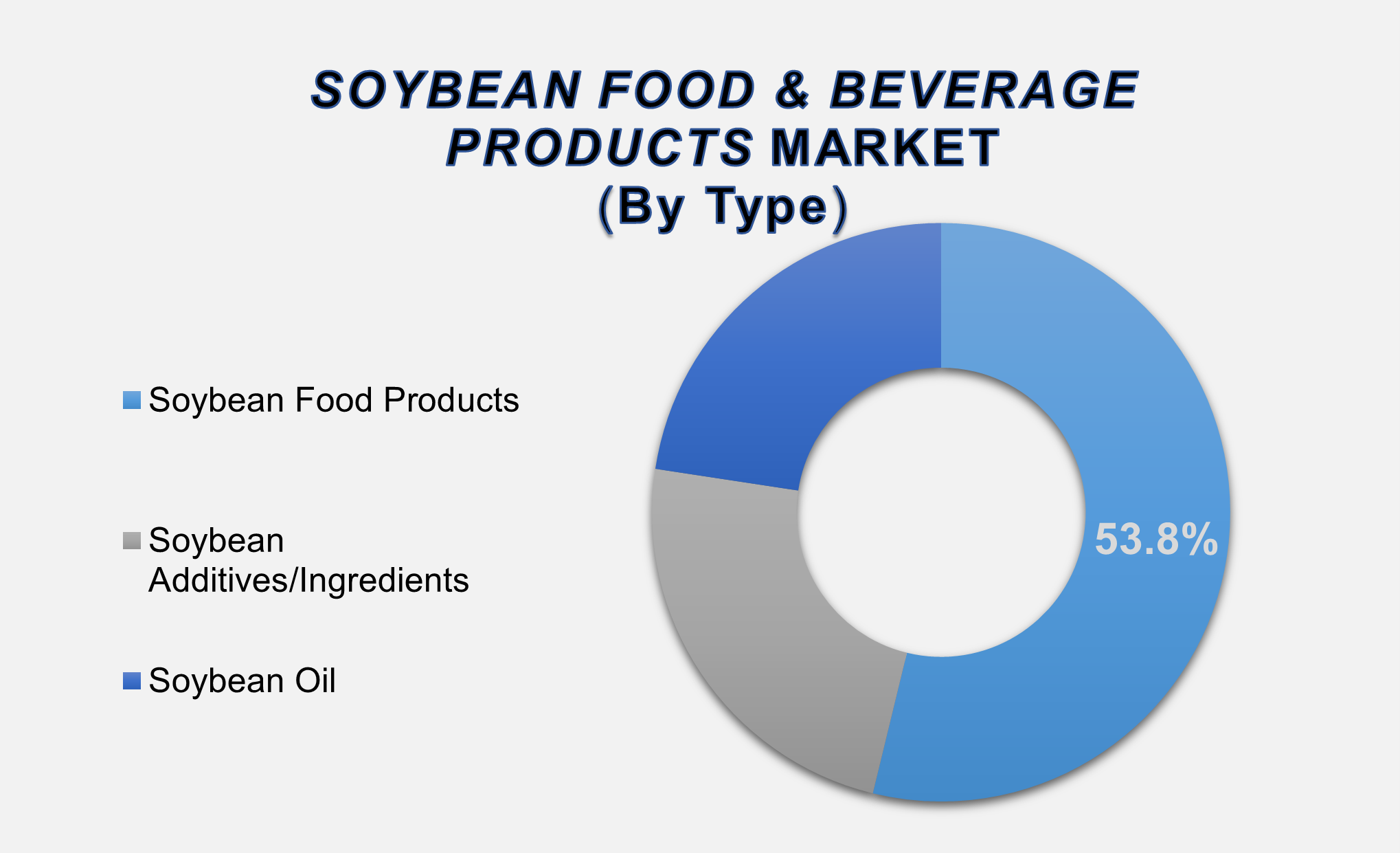
Soybean Food Products accounted
for the largest market share of 53.8%, driven by strong consumer demand for
plant-based, protein-rich, and sustainable food options. This segment includes
tofu, soy milk, tempeh, textured vegetable protein (TVP), soy snacks, fermented
soy foods, and emerging plant-based meat analogues, all experiencing strong
growth due to rising health awareness and shifting dietary preferences. These
products appeal to vegetarians, vegans, and flexitarians seeking healthier
alternatives to meat and dairy. Increased product availability across
supermarkets, hypermarkets, and online platforms is further strengthening
segment penetration. Manufacturers are also innovating with flavored tofu,
fortified soy beverages, organic soy snacks, and non-GMO variants, broadening
consumer appeal. With nutritional superiority, affordability, and broad
culinary versatility, soybean food products will continue to dominate the
market throughout the forecast period.
The Bakery & Confectionery
Segment Accounted for the Largest Share in the Global Soybean Food &
Beverage Products Market
The Bakery & Confectionery
segment accounted for the largest share of the Soybean Food & Beverage
Products Market, driven by the increasing use of soy derivatives such as soy
flour, soy protein concentrates, soy lecithin, and defatted soy in baked goods
and confectionery items. Soy ingredients offer functional benefits such as
improved dough handling, enhanced texture, extended shelf life, and better
moisture retention, making them highly preferred by commercial bakery
manufacturers. In confectionery applications, soy lecithin acts as an excellent
emulsifier, improving viscosity, product smoothness, and cocoa butter reduction
in chocolates. Rising demand for protein-enriched bakery foods, gluten-free
formulations, and plant-based snacks has further strengthened soy adoption. Soy
flour and soy protein isolates are widely incorporated into bread, cookies,
cakes, pastries, protein bars, and sugar confectionery products to boost
nutritional value. With consumers increasingly seeking high-protein,
fiber-rich, and clean-label bakery items, manufacturers are innovating with
soy-enriched variants across mainstream and premium product lines.
GM Soybeans Dominated the
Source Segment
GM Soybeans held the dominant
share of the source segment due to their extensive global production, high
yield efficiency, and cost-effectiveness. GM crops provide strong resistance to
pests and environmental stress, ensuring a stable supply for food, beverage,
and animal feed industries. Their competitive pricing and large-scale
availability make them the preferred choice for mass manufacturing of soy
products such as soy protein, soy oil, soy lecithin, and soy flour. While
demand for non-GMO soy is rising in premium, organic, and clean-label
categories, GM soy’s efficiency advantages continue to support its widespread
use in mainstream food production. The segment is expected to maintain its
leadership over the forecast period.
The following segments are
part of an in-depth analysis of the global Soybean Food & Beverage Products
Market:
|
Market
Segments |
|
|
By Type |
●
Soybean Food
Products ●
Soybean
Additives/Ingredients ●
Soybean Oil |
|
By Application |
●
Bakery &
Confectionery ●
Animal Feed ●
Dairy Products ●
Functional Food
& Supplements ●
Meat Products ●
Infant Foods ●
Other Applications |
|
By Source |
●
GM ●
Non-GM/GE |
|
By
Distribution Channel |
●
Supermarkets ●
Hypermarkets ●
Specialty Stores ●
Online Retailers ●
Convenience stores ●
Departmental stores ●
Other Distribution
Channels |
Soybean Food & Beverage Products Market Share
Analysis by Region
The North America region is
projected to hold the largest share of the global Soybean Food & Beverage
Products market over the forecast period.
North America dominated the
market with a 40.1% share, driven by strong demand for plant-based foods,
robust processing infrastructure, and high consumer acceptance of soy-based
dairy alternatives, snacks, and meat substitutes. The United States leads the
region, supported by sophisticated retail distribution, rapid product
innovation, and the significant presence of global manufacturers such as ADM,
Cargill, DuPont, and WhiteWave Foods.
Asia-Pacific, however, is
expected to record the highest CAGR during the forecast period. Soy foods are
deeply rooted in regional diets, particularly in China, Japan, Indonesia, and
South Korea, where tofu, soy milk, tempeh, and edamame are consumed regularly.
Rising disposable incomes, urbanization, and health awareness further support
market growth. APAC also benefits from strong soybean farming, processing, and
supply chain presence. Europe shows solid growth driven by veganism and the
rise of flexitarian diets, while Latin America and the Middle East & Africa
are gradually expanding due to rising health consciousness and increased market
penetration of functional foods.
Soybean Food & Beverage
Products Market Competition Landscape Analysis
The market is
moderately fragmented, with companies focusing on production expansion, non-GMO
product development, sustainability-led sourcing, and new product innovation.
Key players include Archer Daniels Midland, Cargill, DuPont, Kerry Group, The
Scoular Company, Fuji Oil Group, House Foods Group, WhiteWave Foods, Eden
Foods, Pulmuone, Dean Foods, Hain Celestial Group, Northern Soy, American Soy
Products, Sanitarium Health and Wellbeing, Sojaprotein, Soy Austria, Alpro,
Vitasoy, and Kikkoman. These companies are investing in plant-based product
launches, organic soy expansions, and fortified food formulations to strengthen
market presence.
Global Soybean Food & Beverage Products Market Recent
Developments News:
- In April 2025, COFCO
International expanded its Brazilian operations through strategic hiring
and the construction of a new export terminal, strengthening its
end-to-end agricultural supply chain and enhancing its global trade
footprint.
- In February 2023, Morinaga
Nutritional Foods acquired Tofurky, boosting its tofu production
capabilities and diversifying its plant-based product portfolio to meet
growing consumer demand.
- In March 2022, Otsuka
Pharmaceuticals introduced SOYJOY Nutrition Bars, a line of soy-based
snack bars designed to offer convenient, health-conscious nutrition for
on-the-go consumers.
The Global Soybean Food & Beverage Products Market
is dominated by a few large companies, such as
●
Archer Daniels Midland
●
Cargill
●
DuPont
●
Kerry Group
●
The Scoular Company
●
Fuji Oil Group
●
House Foods Group
●
WhiteWave Foods
●
Eden Foods
●
Pulmuone
●
Dean Foods
●
Hain Celestial Group
●
Northern Soy
●
American Soy Products
●
Sanitarium Health and
Wellbeing
●
Sojaprotein
●
Soy Austria
●
Alpro
●
Vitasoy
●
Kikkoman
● Other Prominent Players
Frequently Asked Questions
Jaya Bundele (Research Analyst)
Jaya Bundele is a skilled Research Analyst with 4+ years of experience in market intelligence, consumer insights, competitive analysis, and industry forecasting across the consumer goods, agriculture, and food & beverage sectors. She specializes in market sizing, trend analysis, growth opportunity mapping, and strategic secondary research for global and regional markets.
Her expertise lies in transforming complex industry data into actionable business strategies that help organizations identify emerging trends, understand customer behavior, and gain a competitive edge. With a strong focus on data-driven insights, business intelligence, and future market trends, Jaya delivers high-quality research solutions aligned with evolving industry demands and market dynamics.
1. Global Soybean Food &
Beverage Products Market Introduction and Market Overview
1.1.
Objectives
of the Study
1.2.
Global
Soybean Food & Beverage Products Market Scope and Market Estimation
1.2.1.Global Soybean Food &
Beverage Products Market Overall Market Size (US$ Bn), Market CAGR (%), Market
forecast (2025 - 2033)
1.2.2.Global Soybean Food &
Beverage Products Market Revenue Share (%) and Growth Rate (Y-o-Y) from 2020 - 2033
1.3.
Market
Segmentation
1.3.1.Type of Global Soybean
Food & Beverage Products Market
1.3.2.Application of Global Soybean
Food & Beverage Products Market
1.3.3.Source of Global Soybean
Food & Beverage Products Market
1.3.4.Distribution Channel of
Global Soybean Food & Beverage Products Market
1.3.5.Region of Global Soybean
Food & Beverage Products Market
2. Executive
Summary
2.1.
Demand
Side Trends
2.2.
Key
Market Trends
2.3.
Market
Demand (US$ Bn) Analysis 2020 – 2024 and Forecast, 2025 – 2033
2.4.
Demand
and Opportunity Assessment
2.5.
Demand
Supply Scenario
2.6.
Market
Dynamics
2.6.1.Drivers
2.6.2.Limitations
2.6.3.Opportunities
2.6.4.Impact Analysis of Drivers
and Restraints
2.7.
Emerging
Trends for Soybean Food & Beverage Products Market
2.8.
Porter’s
Five Forces Analysis
2.9.
PEST
Analysis
2.10.
Key
Regulation
3. Global
Soybean Food & Beverage Products Market
Estimates & Historical Trend Analysis (2020 - 2024)
4.
Global Soybean Food &
Beverage Products Market Estimates
& Forecast Trend Analysis, by Type
4.1.
Global
Soybean Food & Beverage Products Market Revenue (US$ Bn) Estimates and
Forecasts, by Type, 2020 - 2033
4.1.1.Soybean Food Products
4.1.2.Soybean
Additives/Ingredients
4.1.3.Soybean Oil
5.
Global Soybean Food &
Beverage Products Market Estimates
& Forecast Trend Analysis, by Application
5.1.
Global
Soybean Food & Beverage Products Market Revenue (US$ Bn) Estimates and
Forecasts, by Application, 2020 - 2033
5.1.1.Bakery & Confectionery
5.1.2.Animal Feed
5.1.3.Dairy Products
5.1.4.Functional Food &
Supplements
5.1.5.Meat Products
5.1.6.Infant Foods
5.1.7.Other Applications
6.
Global Soybean Food &
Beverage Products Market Estimates
& Forecast Trend Analysis, by Source
6.1.
Global
Soybean Food & Beverage Products Market Revenue (US$ Bn) Estimates and
Forecasts, by Source, 2020 - 2033
6.1.1.GM
6.1.2.Non-GM/GE
7.
Global Soybean Food &
Beverage Products Market Estimates
& Forecast Trend Analysis, by Distribution Channel
7.1.
Global
Soybean Food & Beverage Products Market Revenue (US$ Bn) Estimates and
Forecasts, by Distribution Channel, 2020 - 2033
7.1.1.Supermarkets
7.1.2.Hypermarkets
7.1.3.Specialty Stores
7.1.4.Online Retailers
7.1.5.Convenience stores
7.1.6.Departmental stores
7.1.7.Other Distribution
Channels
8. Global
Soybean Food & Beverage Products Market
Estimates & Forecast Trend Analysis, by region
1.1.
Global
Soybean Food & Beverage Products Market Revenue (US$ Bn) Estimates and
Forecasts, by region, 2020 - 2033
1.1.1.North America
1.1.2.Europe
1.1.3.Asia Pacific
1.1.4.Middle East & Africa
1.1.5.Latin America
9. North America Soybean
Food & Beverage Products Market:
Estimates & Forecast Trend Analysis
9.1.
North
America Soybean Food & Beverage Products Market Assessments & Key
Findings
9.1.1.North America Soybean Food
& Beverage Products Market Introduction
9.1.2.North America Soybean Food
& Beverage Products Market Size Estimates and Forecast (US$ Billion) (2020
- 2033)
9.1.2.1. By Type
9.1.2.2. By Application
9.1.2.3. By Source
9.1.2.4. By Distribution
Channel
9.1.2.5.
By
Country
9.1.2.5.1. The U.S.
9.1.2.5.2. Canada
10. Europe Soybean
Food & Beverage Products Market:
Estimates & Forecast Trend Analysis
10.1.
Europe
Soybean Food & Beverage Products Market Assessments & Key Findings
10.1.1.
Europe
Soybean Food & Beverage Products Market Introduction
10.1.2.
Europe
Soybean Food & Beverage Products Market Size Estimates and Forecast (US$ Billion)
(2020 - 2033)
10.1.2.1. By Type
10.1.2.2. By Application
10.1.2.3. By Source
10.1.2.4. By Distribution
Channel
10.1.2.5.
By
Country
10.1.2.5.1.
Germany
10.1.2.5.2.
Italy
10.1.2.5.3.
U.K.
10.1.2.5.4.
France
10.1.2.5.5.
Spain
10.1.2.5.6.
Switzerland
10.1.2.5.7. Rest
of Europe
11. Asia Pacific Soybean
Food & Beverage Products Market:
Estimates & Forecast Trend Analysis
11.1.
Asia
Pacific Market Assessments & Key Findings
11.1.1.
Asia
Pacific Soybean Food & Beverage Products Market Introduction
11.1.2.
Asia
Pacific Soybean Food & Beverage Products Market Size Estimates and Forecast
(US$ Billion) (2020 - 2033)
11.1.2.1. By Type
11.1.2.2. By Application
11.1.2.3. By Source
11.1.2.4. By Distribution
Channel
11.1.2.5.
By
Country
11.1.2.5.1. China
11.1.2.5.2. Japan
11.1.2.5.3. India
11.1.2.5.4. Australia
11.1.2.5.5. South Korea
11.1.2.5.6. Rest of Asia Pacific
12. Middle East & Africa Soybean
Food & Beverage Products Market:
Estimates & Forecast Trend Analysis
12.1.
Middle
East & Africa Market Assessments & Key Findings
12.1.1.
Middle East & Africa Soybean Food & Beverage Products
Market Introduction
12.1.2.
Middle East & Africa Soybean Food & Beverage Products
Market Size Estimates and Forecast (US$ Billion) (2020 - 2033)
12.1.2.1. By Type
12.1.2.2. By Application
12.1.2.3. By Source
12.1.2.4. By Distribution
Channel
12.1.2.5.
By
Country
12.1.2.5.1. South
Africa
12.1.2.5.2. UAE
12.1.2.5.3. Saudi
Arabia
12.1.2.5.4. Rest
of MEA
13. Latin America
Soybean Food & Beverage Products Market: Estimates & Forecast Trend Analysis
13.1.
Latin
America Market Assessments & Key Findings
13.1.1.
Latin
America Soybean Food & Beverage Products Market Introduction
13.1.2.
Latin
America Soybean Food & Beverage Products Market Size Estimates and Forecast
(US$ Billion) (2020 - 2033)
13.1.2.1. By Type
13.1.2.2. By Application
13.1.2.3. By Source
13.1.2.4. By Distribution
Channel
13.1.2.5.
By
Country
13.1.2.5.1. Brazil
13.1.2.5.2. Mexico
13.1.2.5.3. Argentina
13.1.2.5.4. Rest
of LATAM
14. Country Wise Market:
Introduction
15.
Competition
Landscape
15.1.
Global
Soybean Food & Beverage Products Market Product Mapping
15.2.
Global
Soybean Food & Beverage Products Market Concentration Analysis, by Leading
Players / Innovators / Emerging Players / New Entrants
15.3.
Global
Soybean Food & Beverage Products Market Tier Structure Analysis
15.4.
Global
Soybean Food & Beverage Products Market Concentration & Company Market
Shares (%) Analysis, 2023
16.
Company
Profiles
16.1. Archer
Daniels Midland
16.1.1.
Company
Overview & Key Stats
16.1.2.
Financial
Performance & KPIs
16.1.3.
Product
Portfolio
16.1.4.
SWOT
Analysis
16.1.5.
Business
Strategy & Recent Developments
*
Similar details would be provided for all the players mentioned below
16.2. Cargill
16.3. DuPont
16.4. Kerry Group
16.5. The Scoular
Company
16.6. Fuji Oil
Group
16.7. House Foods
Group
16.8. WhiteWave
Foods
16.9. Eden Foods
16.10. Pulmuone
16.11. Dean Foods
16.12. Hain
Celestial Group
16.13. Northern Soy
16.14. American Soy
Products
16.15. Sanitarium
Health and Wellbeing
16.16. Sojaprotein
16.17. Soy Austria
16.18. Alpro
16.19. Vitasoy
16.20. Kikkoman
16.21. Other
Prominent Players
17. Research
Methodology
17.1.
External
Transportations / Databases
17.2.
Internal
Proprietary Database
17.3.
Primary
Research
17.4.
Secondary
Research
17.5.
Assumptions
17.6.
Limitations
17.7.
Report
FAQs
18. Research
Findings & Conclusion
Our Research Methodology
"Insight without rigor is just noise."
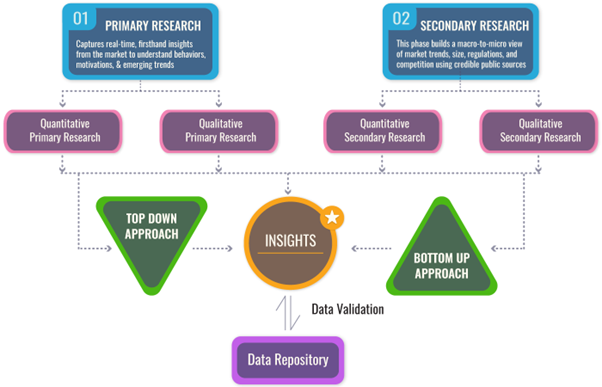
We follow a comprehensive, multi-phase research framework designed to deliver accurate, strategic, and decision-ready intelligence. Our process integrates primary and secondary research , both quantitative and qualitative , along with dual modeling techniques ( top-down and bottom-up) and a final layer of validation through our proprietary in-house repository.
PRIMARY RESEARCH
Primary research captures real-time, firsthand insights from the market to understand behaviors, motivations, and emerging trends.
1. Quantitative Primary Research
Objective: Generate statistically significant data directly from market participants.
Approaches:- Structured surveys with customers, distributors, and field agents
- Mobile-based data collection for point-of-sale audits and usage behavior
- Phone-based interviews (CATI) for market sizing and product feedback
- Online polling around industry events and digital campaigns
- Purchase frequency by customer type
- Channel performance across geographies
- Feature demand by application or demographic
2. Qualitative Primary Research
Objective: Explore decision-making drivers, pain points, and market readiness.
Approaches:- In-depth interviews (IDIs) with executives, product managers, and key decision-makers
- Focus groups among end users and early adopters
- Site visits and observational research for consumer products
- Informal field-level discussions for regional and cultural nuances
SECONDARY RESEARCH
This phase helps establish a macro-to-micro understanding of market trends, size, regulation, and competitive dynamics, sourced from credible and public domain information.
1. Quantitative Secondary Research
Objective: Model market value and segment-level forecasts based on published data.
Sources include:- Financial reports and investor summaries
- Government trade data, customs records, and regulatory statistics
- Industry association publications and economic databases
- Channel performance and pricing data from marketplace listings
- Revenue splits, pricing trends, and CAGR estimates
- Supply-side capacity and volume tracking
- Investment analysis and funding benchmarks
2. Qualitative Secondary Research
Objective: Capture strategic direction, innovation signals, and behavioral trends.
Sources include:- Company announcements, roadmaps, and product pipelines
- Publicly available whitepapers, conference abstracts, and academic research
- Regulatory body publications and policy briefs
- Social and media sentiment scanning for early-stage shifts
- Strategic shifts in market positioning
- Unmet needs and white spaces
- Regulatory triggers and compliance impact
DUAL MODELING: TOP-DOWN + BOTTOM-UP
To ensure robust market estimation, we apply two complementary sizing approaches:
Top-Down Modeling:- Start with broader industry value (e.g., global or regional TAM)
- Apply filters by segment, geography, end-user, or use case
- Adjust with primary insights and validation benchmarks
- Ideal for investor-grade market scans and opportunity mapping
- Aggregate from the ground up using sales volumes, pricing, and unit economics
- Use internal modeling templates aligned with stakeholder data
- Incorporate distributor-level or region-specific inputs
- Most accurate for emerging segments and granular sub-markets
DATA VALIDATION: IN-HOUSE REPOSITORY
We close the loop with proprietary data intelligence built from ongoing projects, industry monitoring, and historical benchmarking. This repository includes:
- Multi-sector market and pricing models
- Key trendlines from past interviews and forecasts
- Benchmarked adoption rates, churn patterns, and ROI indicators
- Industry-specific deviation flags and cross-check logic
- Catches inconsistencies early
- Aligns projections across studies
- Enables consistent, high-trust deliverables