
Could New Tariffs Increase the Cost of Medical Devices and Pharmaceuticals?
 Could New Tariffs Increase the Cost of Medical Devices and Pharmaceuticals?
Published on July 15, 2026 | Category: Healthcare
For decades now, the industries of
medical devices and pharmaceuticals have had highly integrated global supply
chains that were engineered for efficiency, specialization, and economies of
scale. Active
pharmaceutical ingredients (APIs), for instance, can come from one nation, be
formulated in another country, and be packed
in yet another nation before being delivered
to patients via global distribution chains. In a similar vein, medical devices
are increasingly assembled using parts that are sourced from various regions
globally.
However, this scenario is now
changing.
With countries around the globe
implementing new tariff regimes, industrial policies, and domestic
manufacturing preferences, healthcare companies are stepping into an era where
trade policies are just as important as scientific innovations. While trade policies
were initially considered logistical challenges, today, they are evolving into
strategic issues that have implications for manufacturing, pricing, sourcing,
and investments.
The key question here is not
whether the tariffs will affect the health care industry but to what extent.
Why Tariffs Matter More Than Ever
Tariffs are generally implemented to protect domestic
industries, minimize import dependency, or handle geopolitical issues. Whereas
such measures will undoubtedly help improve the nation’s manufacturing
capabilities in the future, they pose immediate cost implications to globally
integrated healthcare supply chains.
Contrary to many other consumer products,
pharmaceutical and medical
device products require strict regulatory approvals, validations of
manufacturing processes, and specialized vendors. It is not possible to swap
overseas manufacturers immediately without going through all of these
processes.
Therefore, any tariff increase, even if minimal, poses
some serious cost implications.
Such cost implications include:
✔
Increase in procurement costs for API, excipient,
electronics, semiconductors, specialty
polymers, stainless steel, and manufacturing equipment.
✔
Increased cost of manufacturing due to higher
input costs across different manufacturing stages.
✔
Increase in carrying costs due to higher
inventory levels to minimize trade risks.
✔
Increase in sourcing lead times due to vendor
diversification and regional manufacturing.
✔
Margin compression for manufacturers working
under fixed reimbursements and supply agreements.
To many businesses, tariffs have become more than trade policies; they have become catalysts for supply chain transformation.
Which Segments Face the Highest
Exposure?
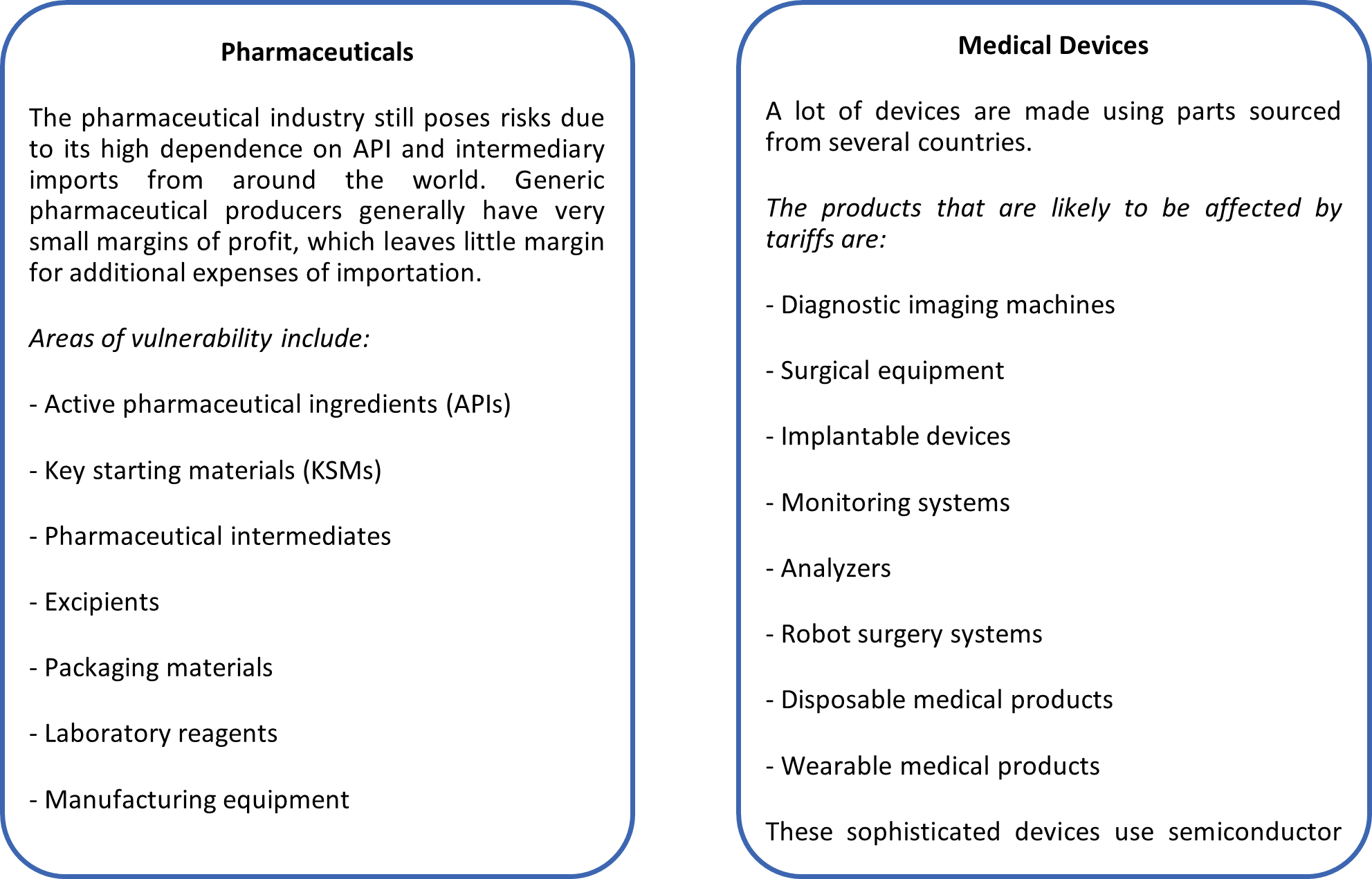
The impact of tariffs will vary across the healthcare
sector. The extent of exposure is dependent upon supplier concentration,
manufacturing complexity, regulatory flexibility, and geographic exposure.
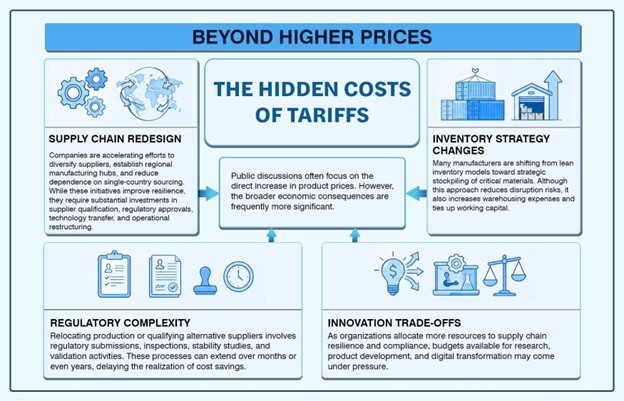
Beyond Higher Prices: The Hidden
Costs of Tariffs
Strategic Responses Emerging
Across the Industry
The top healthcare organizations are
viewing tariff policies as one element of their larger supply chain resiliency
strategy, not in isolation from other actions being taken.
Here are some of the more prominent
strategic moves being made:
⮚
Multi-Regional Manufacturing: Manufacturing
operations are being set up closer to key demand centers to avoid having too
much of their supply chain exposed across borders.
⮚
Supplier Diversification: Dual sourcing or
multiple sourcing is becoming more common as companies move away from relying
on a single country for key parts and active pharmaceutical ingredients.
⮚
Digital Supply Chain Visibility: More investments
are being made by firms in artificial intelligence-driven analytical software
for assessing risks and supply chain visibility.
⮚
Localization of Critical Products: Efforts are
being made by governments and manufacturers alike to bolster domestic
manufacturing of critical pharmaceutical
products and medical technologies.
⮚ Supplier Partnership: As opposed to procurement costs alone, resiliency is now a key factor being used when considering supplier partners.
Market Intelligence Perspective
Today’s round of tariffs is symptomatic of a more
fundamental change in the structure of healthcare manufacturing rather than a
mere trade disagreement.
Previously, all supply chain management was based on
cost effectiveness. Currently, however, resilience and regionality are equally
important competitive assets.
Those businesses that map supplier dependency,
diversify their sources, build regional manufacturing capability, and
incorporate geopolitical intelligence in supply chain design will be better
prepared to deal with any future policy changes.
While tariffs will raise costs, they will also act as motivation to create a resilient and flexible healthcare supply chain.
Conclusion
It is no longer a question of whether tariffs are
going to affect the healthcare industry; they have been doing it.
This effect goes further than import duties into the
field of manufacturing, purchasing practices, investments, research and
development priorities, and accessibility for patients. While certain
organizations might struggle with increased costs and margins, others will
leverage this time to reshape their supply chains, increase their regional
manufacturing capabilities, and strengthen resilience.
In an ever more volatile geopolitical environment,
success will belong to those organizations that understand that tariffs mean
more than additional cost; they are a signal for reconsidering the entire
supply chain strategy in the field of healthcare products.
The competitive advantage of the future will be
determined by more than just medical discoveries—it will also include
well-planned and resilient supply chains.
Related Reports -
Breast
Fillers Market Size, Share, Growth, Forecast 2026 to 2034
Hyaluronic
Acid Products Market Size, Share, Forecasts to 2034
Optical
Imaging Market Size, Share, Growth, Forecasts to 2034
Disposable Ureteroscopy Market Size, Trends, Forecasts to 2034
About M2Square Consultancy
We specialize in decoding complexity.
From market forecasting to customer behavior analysis, our services are
designed to bridge the gap between uncertainty and opportunity. Our offerings
span the entire insight lifecycle, including Consulting, Tailored Research,
Syndicated Studies, Trend Tracking, Competitive Intelligence, Pricing and
Channel analysis, GTM Strategy, and more. Using a blend of qualitative
expertise and data science, we deliver bespoke solutions that inform bold
business moves.
Contact:
Website:https://m2squareconsultancy.com/
Email:sales@m2squareconsultancy.com
Phone (IN): +91 80978 74280
Phone (US): +1 929 447 0100
Enquiry Form
Latest Blogs

The Future of Personalized Vaccines
Vaccines have been following a standard paradigm for decade...
July 24, 2026

The Strategic Shift from Globalization to Regionalization in Pharmaceutical Manufacturing
The past emphasis on centralizing efficiency could not addr...
July 24, 2026

Robotics in Healthcare: From Surgery to Pharmacy Automation
Medical robots, when mentioned, often come to mind in relat...
July 24, 2026
Related Blogs
The Future of Personalized Vaccines
Vaccines have been following a standard paradigm for decade...
July 24, 2026
Read More
The Strategic Shift from Globalization to Regionalization in Pharmaceutical Manufacturing
The past emphasis on centralizing efficiency could not addr...
July 24, 2026
Read More
Robotics in Healthcare: From Surgery to Pharmacy Automation
Medical robots, when mentioned, often come to mind in relat...
July 24, 2026
Read More