
Hospital-at-Home: A Permanent Shift in Care Delivery or the Blueprint for Future Healthcare?
 Hospital-at-Home: A Permanent Shift in Care Delivery or the Blueprint for Future Healthcare?
Published on July 15, 2026 | Category: Healthcare
From
Hospital Walls to Patients' Homes: A Healthcare Revolution in Motion
The
healthcare system is about to enter a new era in which the idea of the hospital
is no longer limited to the physical location of facilities. With innovations
in telemonitoring, teleconsulting, connected medical devices, and clinical
services at home, healthcare providers can deliver acute care services right in
the patient's home. The solution, developed initially as an emergency measure
during the COVID-19 outbreak, quickly turned out to be strategic for better
patient outcomes, healthcare cost reduction, and relieving the pressure from
the overloaded hospitals.
Hospital at Home (HaH) appears to be becoming a permanent part of the modern healthcare system. It does not mean that the solution is going to substitute hospitals but rather extends their functionality, letting the clinically appropriate patients receive hospital-level treatment in a comfortable environment under constant control of healthcare providers. While healthcare systems struggle with high demand, labor shortages, and the transition to value-based healthcare, HaH becomes an inevitable part of it.
Why
Is the Traditional Hospital Model Under Increasing Pressure?
The
requirement for healthcare services is outstripping conventional hospitals'
ability to handle it. There are aging populations, a high number of chronic
diseases, higher costs of providing care, and an existing shortage of medical
professionals that places unprecedented stress on hospitals across the globe.
Building new infrastructure is both financially unsustainable and ineffective.
With Hospital-at-Home programs, acute care services can be offered outside the hospital without jeopardizing the quality of care or its safety. In other words, it is possible to make use of all the available beds and provide better care by means of technology-assisted monitoring.
Hospital-at-Home
Is More Than Home Care; It Is a Connected Care Ecosystem
The
contemporary Hospital at Home model goes way beyond the conventional concept of
home health care. It encompasses the incorporation of doctors, nurses,
specialists, remote patient monitoring devices, telehealth software, artificial
intelligence, electronic health records, and predictive analytics to create a
care system that can offer the same level of care in patients' homes as in
hospitals.
This system caters to a wide array of medical conditions, such as heart failure, pneumonia, COPD, complications of diabetes, cancer supportive care, postoperative treatment, and infections.
Five Strategic Forces Accelerating Hospital-at-Home Adoption
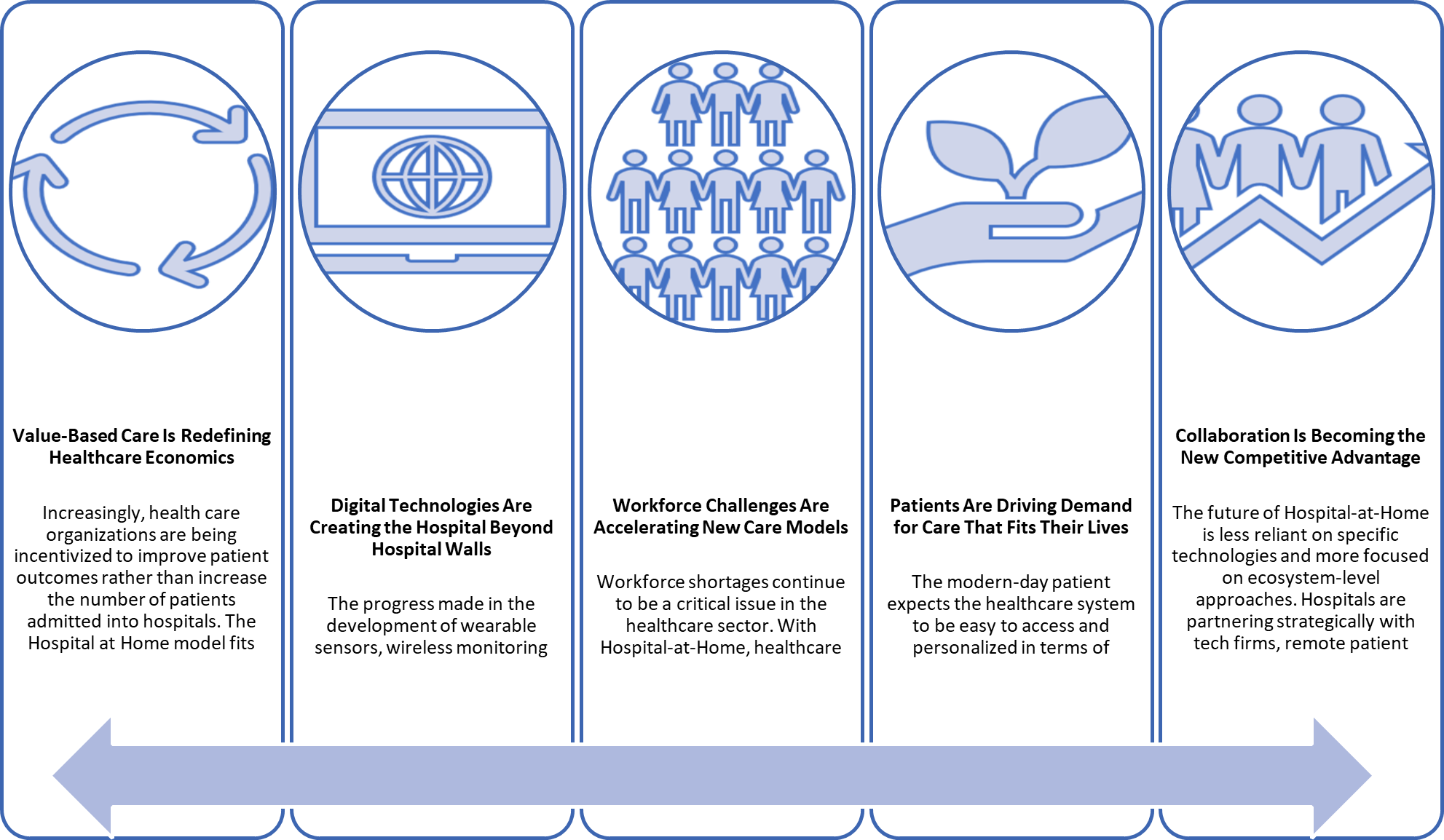
Beyond
Better Care: The Economic Case for Hospital-at-Home
Hospital-at-Home not only involves a new method of providing medical care but also is a business strategy. With reduced hospital occupancy rates, shortened stays at hospitals, and fewer unnecessary hospital readmissions, efficiency in operations can be achieved by healthcare institutions while also keeping costs under control. Patients receive customized care in a more convenient setting.
Technology
Will Define the Next Generation of Home-Based Acute Care
The future development of Hospital at Home services would be highly dependent on intelligent technology. With artificial intelligence, prediction of risks would be possible, while with IoMT devices, information about patients would be collected 24/7. The use of predictive analysis would lead to timely medical intervention, virtual nurses would expand the workforce, cloud-based platforms would help with care coordination, and robots might assist with medication and other procedures in the future.
Challenges
That Healthcare Leaders Cannot Ignore
Hospital-at-home continues to face major hurdles to adoption even as its popularity rises. There is inconsistency in reimbursement schemes, regulation is still developing, and a lot of institutions require more development in terms of technological infrastructure for adoption. Issues of cybersecurity, interoperability within the health platform, workforce training, and assessment of patient eligibility will remain key considerations in the coming years as adoption increases. It all depends on whether these issues are sorted out.
Looking
Ahead: The Next Decade of Hospital-at-Home
Hospital-at-Home is poised to move way past the limits of where it currently applies itself within the coming decade. The emergence of new tools from artificial intelligence and predictive analytics to remote diagnostics and connected medicine will enable widespread implementation of the approach in a variety of areas, from oncology to cardiology and postoperative care as well as respiratory conditions and chronic illnesses. Instead of questioning the possibility of whether Hospital-at-Home will be implemented permanently, healthcare professionals are now concerned about scaling it up fast enough to cope with growing demand.
Strategic
Takeaway
The
hospital at home model can be described as one of the major transitions in
health service provision since the advent of telemedicine technology. It is
transforming the locus of care, the way healthcare assets are used, and what
patients are expecting from the contemporary healthcare system. Those
institutions that make strategic investments in digital platforms, care
ecosystems, and home-based clinical models are better poised for success.
Related Reports –
Breast Fillers Market Size, Share,
Growth, Forecast 2026 to 2034
Dermatology
Devices Market Size, Trends, Share, Forecasts to 2034
Oncology
Nutrition Market Size, Trends, Share, Forecasts to 2034
Chromatography
Reagents Market Size, Share, Trends to 2034
About M2Square Consultancy
We specialize in decoding complexity. From market forecasting to
customer behavior analysis, our services are designed to bridge the gap between
uncertainty and opportunity. Our offerings span the entire insight lifecycle,
including Consulting, Tailored Research, Syndicated Studies, Trend Tracking,
Competitive Intelligence, Pricing and Channel analysis, GTM Strategy, and more.
Using a blend of qualitative expertise and data science, we deliver bespoke
solutions that inform bold business moves.
Contact:
Website:https://m2squareconsultancy.com/
Email:sales@m2squareconsultancy.com
Phone (IN): +91 80978 74280
Phone (US): +1 929 447 0100
Enquiry Form
Latest Blogs

The Future of Personalized Vaccines
Vaccines have been following a standard paradigm for decade...
July 24, 2026

The Strategic Shift from Globalization to Regionalization in Pharmaceutical Manufacturing
The past emphasis on centralizing efficiency could not addr...
July 24, 2026
Robotics in Healthcare: From Surgery to Pharmacy Automation
Medical robots, when mentioned, often come to mind in relat...
July 24, 2026
Related Blogs
The Future of Personalized Vaccines
Vaccines have been following a standard paradigm for decade...
July 24, 2026
Read More
The Strategic Shift from Globalization to Regionalization in Pharmaceutical Manufacturing
The past emphasis on centralizing efficiency could not addr...
July 24, 2026
Read More
Robotics in Healthcare: From Surgery to Pharmacy Automation
Medical robots, when mentioned, often come to mind in relat...
July 24, 2026
Read More