The Future of Personalized Vaccines
 The Future of Personalized Vaccines
Published on July 24, 2026 | Category: Healthcare
Vaccines have been following a standard paradigm for
decades in which one vaccine is created to protect millions of people from a
particular infection. This strategy has produced some outstanding public health
successes, ranging from the eradication of smallpox to reductions in conditions
like polio and measles.
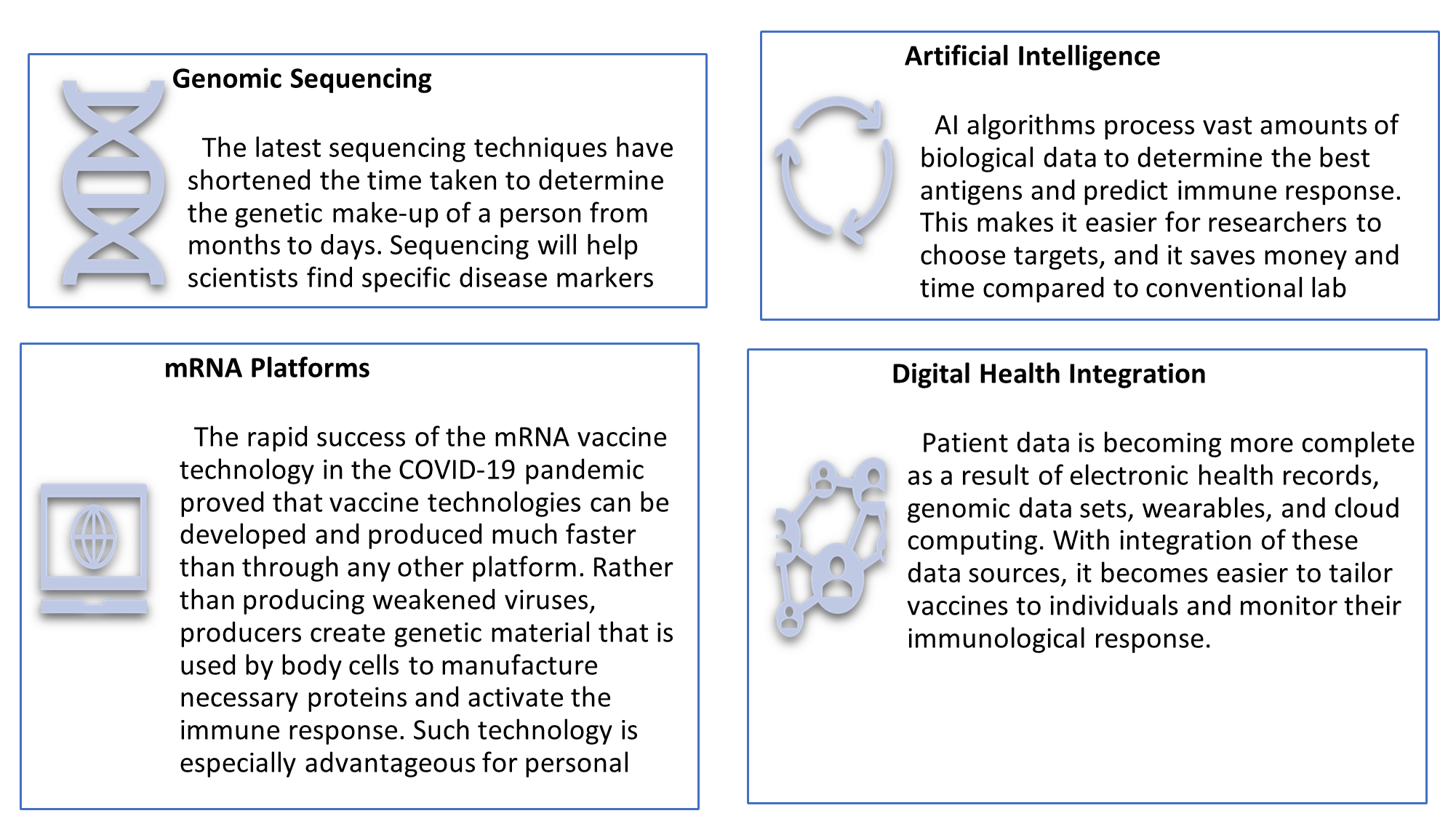
Technological innovations in fields like genomics, AI, mRNA technology, and bioinformatics bring the development of personalized vaccines closer and closer to reality. Initially emerging in the field of cancer treatment, personalized vaccines are now branching out into the treatment of infectious, autoimmune, and rare diseases, indicating a revolution that is expected to happen in the way immunity will be built in the future. Instead of substituting current vaccines, personalized vaccines will complement them, providing more personalized protection when traditional vaccines fail to do so.
Why Does the Traditional Vaccine Model Have Limits?
Traditional vaccines have worked exceptionally well
since they help trigger wide-ranging immune responses to pathogens that
commonly infect individuals. However, there are times when they do not work
effectively for all people. Many factors affect vaccine efficacy, such as
genetics, age, medical conditions, and immune response, among others. In some
infections, such as cancers, each individual's tumors have different genetic
compositions, hence making it difficult to develop universal vaccines.
Rapidly evolving infections and new diseases make it difficult to come up with vaccines that would be effective against them. Personalized vaccines seek to solve these issues by developing vaccines that suit individual characteristics.
From "One-Size-Fits-All" to
Precision Immunity
Vaccines are now designed not only for diseases but
also based on patients themselves.
It starts with:
⮚
Personal genomics or tumor sequencing
⮚
Identification of patient-specific biomarkers or
antigens
⮚
Prediction of best immune targets with the help
of AI
⮚
Design of vaccine candidate
⮚
Production of tailored vaccine dosage through
flexible platforms, like mRNA vaccines
And as a result, a vaccine is created that activates an extremely specific immune response to the features of the disease that are unique to this particular patient. This approach is regarded as one of the breakthroughs in the field of vaccinology after recombinant vaccines.
Cancer Is Leading the Personalized
Vaccine Revolution
Cancer has been the battlefield for personalized
vaccine development innovation. Tumors are known to consist of hundreds or even
thousands of mutations. Certain mutations lead to neoantigens, which are
proteins that exist only on the cancer cell. Personalized cancer vaccines help
train the immune system to recognize these neoantigens, destroying cancer cells
without affecting the rest of the body.
Clinical trials have shown promising results in different cancers like melanoma, lung cancer, colorectal cancer, and pancreatic cancer, especially in combination with other cancer therapies like checkpoint inhibitors. Advancements in personalized cancer vaccines have also helped develop technologies like genomics sequencing, AI-based antigen prediction, and scalable manufacturing.
The Technologies Making
Personalization Possible
Opportunities Beyond Cancer
While oncology is the primary focus of personalized
vaccines at present, their potential use in the future is more extensive.
Personalized vaccines may be considered for:
●
Persistent viral infections
●
Autoimmune disorders
●
Rare genetic conditions
●
New infectious diseases
●
High-risk patients with compromised immunity
In the future, personalized vaccines could even become dynamic as the pathogens mutate or the individual’s immune system changes.
Challenges That Must Be Solved
Although scientific advances continue at an
accelerated pace, there still exist certain substantial obstacles to
personalized vaccines becoming commonplace clinical practices.
●
Complexity of Manufacturing Process: Contrary to
standard vaccines that are manufactured in bulk quantities, personalized
vaccines frequently require individualized production, thus posing certain
difficulties for drugmakers.
●
Costs and Scalability: Since personalized
vaccines use genomic sequencing, machine learning to analyze the genetic code,
and a tailored manufacturing process, these
vaccines cost much more than regular ones. Cost-effectiveness and scalability
are crucial issues.
●
Regulatory Adjustments: There are adjustments
made by regulatory organizations for assessing personalized medicines; however,
providing uniform safety, efficacy, and quality of individually manufactured
vaccines is problematic.
● Data Security and Confidentiality: Data privacy and security are critical factors for personalized vaccines since genomic information of patients needs to be kept private.
Looking Ahead: From Population Health
to Individualized Prevention
The future of vaccination is unlikely to do away with
universal vaccination of populations. Traditional vaccines will still be vital
in the prevention of mass infectious diseases. Nonetheless, personalized
vaccines are likely to introduce yet another dimension to preventive medicine,
namely, one that ties immunization to the genetics, diseases, and immunity of
the recipient. With faster sequencing technology, improved AI models, and more
versatile manufacturing, personalized vaccines could soon move from being rare
treatment options to becoming an integral part of precision medicine. Those organizations that get ready now to
work in genomics, AI, digital medicine, and manufacturing flexibility are
likely to emerge as leaders of the coming era of vaccines. In the next ten
years, the discussion about personalized vaccines is not likely to focus on
whether they will change healthcare but rather on how fast they will bring
about change.
Related Reports –
Hyaluronic
Acid Products Market Size, Share, Forecasts to 2034
Optical
Imaging Market Size, Share, Growth, Forecasts to 2034
Disposable
Ureteroscopy Market Size, Trends, Forecasts to 2034
Microfluidics
Market Size, Share, Growth, Trends, Forecasts to 2034
Non-Insulin Therapies for Diabetes
Market Size, Forecasts to 2034
About M2Square Consultancy
We specialize in decoding complexity. From market forecasting to
customer behavior analysis, our services are designed to bridge the gap between
uncertainty and opportunity. Our offerings span the entire insight lifecycle,
including Consulting, Tailored Research, Syndicated Studies, Trend Tracking,
Competitive Intelligence, Pricing and Channel analysis, GTM Strategy, and more.
Using a blend of qualitative expertise and data science, we deliver bespoke
solutions that inform bold business moves.
Contact:
Website:https://m2squareconsultancy.com/
Email:sales@m2squareconsultancy.com
Phone (IN): +91 80978 74280
Phone (US): +1 929 447 0100
Enquiry Form
Latest Blogs

The Strategic Shift from Globalization to Regionalization in Pharmaceutical Manufacturing
The past emphasis on centralizing efficiency could not addr...
July 24, 2026

Robotics in Healthcare: From Surgery to Pharmacy Automation
Medical robots, when mentioned, often come to mind in relat...
July 24, 2026

Longevity Science: The Emerging Healthcare Opportunity
Consider a healthcare industry where the main aim is not th...
July 23, 2026
Related Blogs
The Strategic Shift from Globalization to Regionalization in Pharmaceutical Manufacturing
The past emphasis on centralizing efficiency could not addr...
July 24, 2026
Read More
Robotics in Healthcare: From Surgery to Pharmacy Automation
Medical robots, when mentioned, often come to mind in relat...
July 24, 2026
Read More
Longevity Science: The Emerging Healthcare Opportunity
Consider a healthcare industry where the main aim is not th...
July 23, 2026
Read More