
Longevity Science: The Emerging Healthcare Opportunity
 Longevity Science: The Emerging Healthcare Opportunity
Published on July 23, 2026 | Category: Healthcare
Consider a healthcare industry where the main aim is not the treatment of heart disease, diabetes, or Alzheimer's once the problems arise but rather postponing the onset of biological aging that makes one vulnerable to all those illnesses. This vision is no longer a theoretical concept for scientists to discuss in laboratories. This vision becomes the backbone of one of the most dynamic spheres within the field of healthcare longevity science. Differing from conventional medicine, whose mission is to treat patients already affected by diseases, longevity science seeks to maintain biological integrity and robustness through time. Thus, the aim is not only living longer but also staying healthier longer. As more and more people grow older, the demand for such an approach only increases together with health-related expenditures.
A New Lens on Aging
For many years now, aging had been seen as a process
that was out of reach for medicine, and nothing much could have been done about
it. Researchers were working on curing various diseases without considering
aging as an inevitable process.
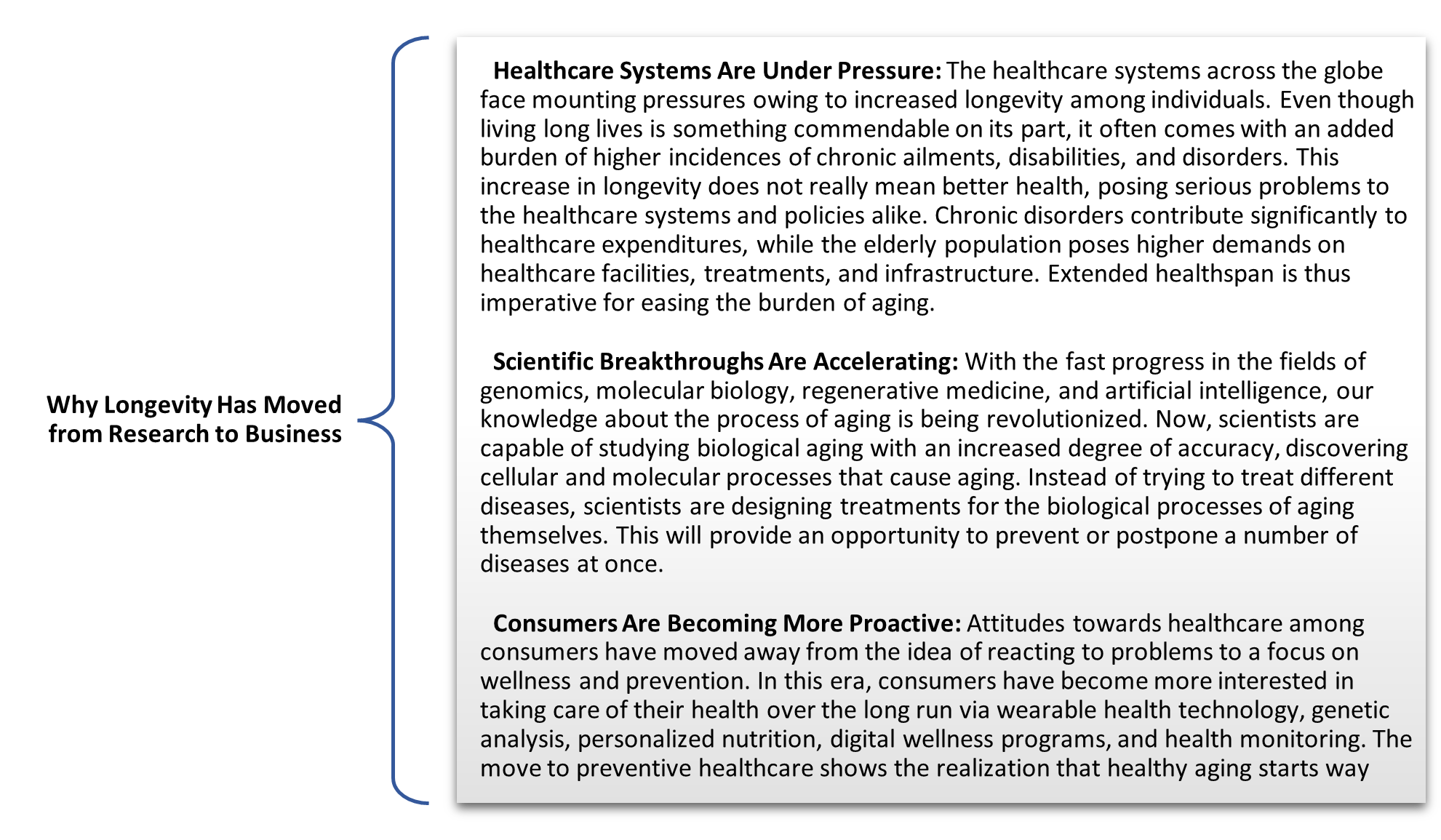
Many scientists are beginning to realize that aging is the main underlying risk factor for many chronic conditions. As opposed to dealing with each disease individually, researchers are seeking ways through which they can deal with the biology of each condition at once. This means that if the mechanisms can be manipulated, the effects will be felt in many diseases at once.
Why Longevity Has Moved from Research
to Business Strategy
Where
Innovation Is Happening
The
Ripple Effect Across the Healthcare Industry
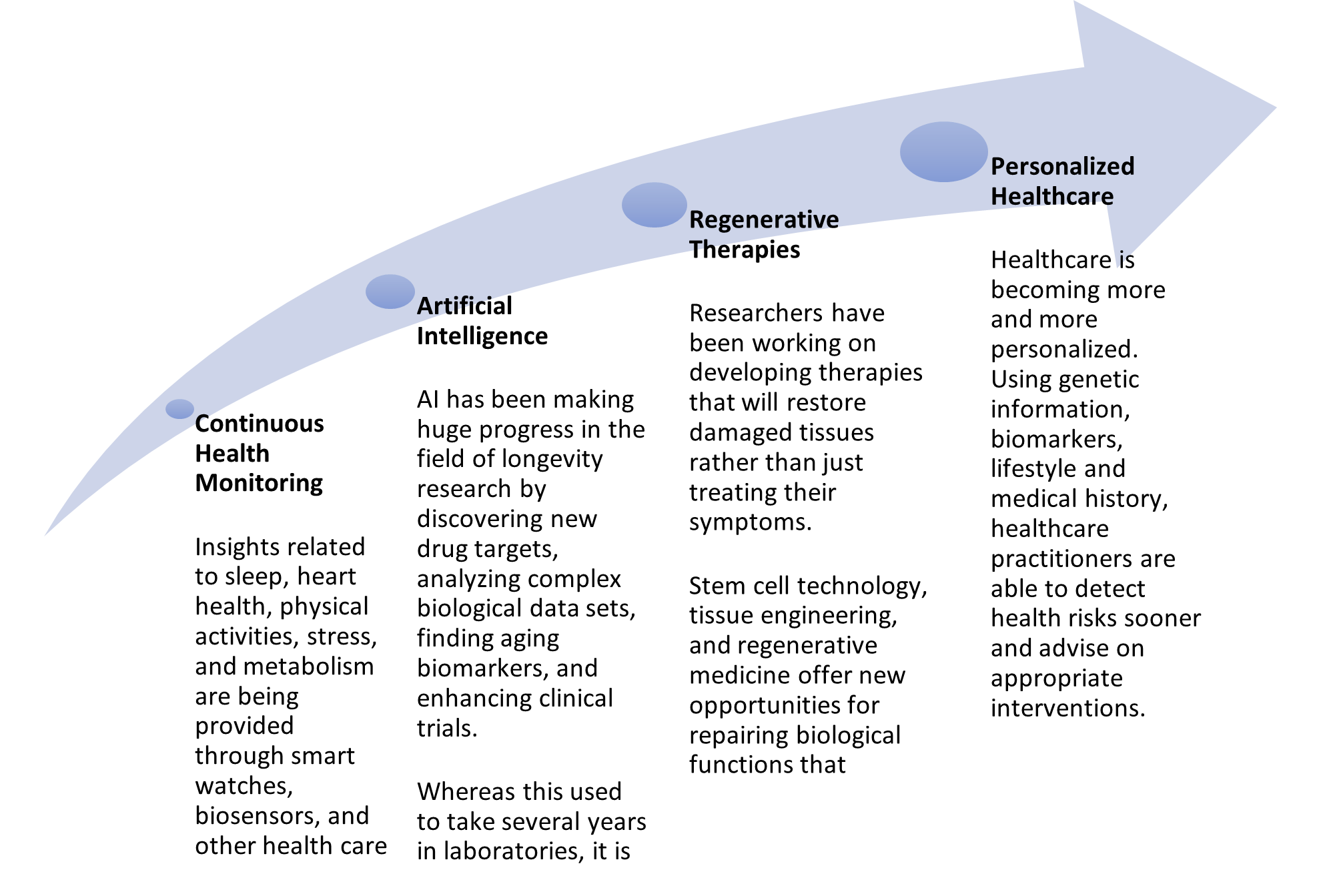
Longevity science is opening new possibilities that
are not limited to scientific laboratories. The pharmaceutical industry is
adding new drugs to its portfolio, which target biological aging instead of
specific diseases only. The medical
device companies are developing new monitoring devices that will enable
preventive care both in and out of clinical environments. The diagnostic
companies are making investments in advanced biomarker analysis for the
determination of biological age, inflammation, and metabolism status. Digital
health companies are combining AI technology with personalized coaching and
monitoring services to help people make better health-related decisions. Even
insurance providers are now rethinking their traditional business models to
encourage people to live healthy lives through preventive care and other
activities.
The
Challenges Behind the Promise
Though
much has been achieved, longevity medicine remains an ongoing area. Many
therapies are still being developed, and it takes many years of rigorous
studies to prove their long-term efficiency. Another issue here lies in
regulatory processes. The majority of health care organizations grant permits
for the use of treatment methods for particular diseases, but not aging, which
complicates commercialization. Access is yet another issue to consider. It
appears that most of the new technologies that have been invented in the field
of longevity medicine are costly. It raises the question of accessibility of
their effects for everyone.
Why
Healthcare Leaders Are Paying Attention
Proactive
health organizations are increasingly looking at longevity not just as a
scientific development but as an emerging strategy. Instead of being forced to
deal with disease associated with aging, such organizations are creating
capacities to help with early diagnosis, individualized treatment, prediction,
and prevention. Future success may have less to do with effective treatments of
diseases and more with postponing their development. Healthcare organizations
that adopt this transformation now will be prepared for future challenges.
Looking
Beyond Lifespan
Proactive
health organizations are increasingly looking at longevity not just as a
scientific development but as an emerging strategy. Instead of being forced to
deal with disease associated with aging, such organizations are creating
capacities to help with early diagnosis, individualized treatment, prediction,
and prevention. Future success may have less to do with effective treatments of
diseases and more with postponing their development. Healthcare organizations
that adopt this transformation now will be prepared for future challenges.
Related Reports –
Thoracic
Surgery Devices Market Size, Growth, Forecasts to 2034
Telemedicine
Market Size, Share Analysis, Forecasts to 2034
Nuclear
Imaging Market Size. Growth Analysis, Forecasts to 2034
Ophthalmology
Devices Market Size, Share, Forecasts to 2034
About M2Square Consultancy
We specialize in decoding complexity. From market forecasting to
customer behavior analysis, our services are designed to bridge the gap between
uncertainty and opportunity. Our offerings span the entire insight lifecycle,
including Consulting, Tailored Research, Syndicated Studies, Trend Tracking,
Competitive Intelligence, Pricing and Channel analysis, GTM Strategy, and more.
Using a blend of qualitative expertise and data science, we deliver bespoke
solutions that inform bold business moves.
Contact:
Website:https://m2squareconsultancy.com/
Email:sales@m2squareconsultancy.com
Phone (IN): +91 80978 74280
Phone (US): +1 929 447 0100
Enquiry Form
Latest Blogs

The Future of Personalized Vaccines
Vaccines have been following a standard paradigm for decade...
July 24, 2026

The Strategic Shift from Globalization to Regionalization in Pharmaceutical Manufacturing
The past emphasis on centralizing efficiency could not addr...
July 24, 2026

Robotics in Healthcare: From Surgery to Pharmacy Automation
Medical robots, when mentioned, often come to mind in relat...
July 24, 2026
Related Blogs
The Future of Personalized Vaccines
Vaccines have been following a standard paradigm for decade...
July 24, 2026
Read More
The Strategic Shift from Globalization to Regionalization in Pharmaceutical Manufacturing
The past emphasis on centralizing efficiency could not addr...
July 24, 2026
Read More
Robotics in Healthcare: From Surgery to Pharmacy Automation
Medical robots, when mentioned, often come to mind in relat...
July 24, 2026
Read More