
How Geopolitical Instability Is Driving API Supply Chain Diversification: Strategic Imperatives for Pharmaceutical Manufacturers in 2026
 How Geopolitical Instability Is Driving API Supply Chain Diversification: Strategic Imperatives for Pharmaceutical Manufacturers in 2026
Published on July 22, 2026 | Category: Healthcare
The global pharmaceutical industry
is entering a new era where supply
chain resilience has become as critical as manufacturing efficiency.
Escalating geopolitical tensions, evolving trade policies, regional conflicts,
sanctions, export restrictions, and increasing regulatory scrutiny are
fundamentally reshaping how pharmaceutical companies source active
pharmaceutical ingredients (APIs). Organizations that once prioritized
cost optimization are now balancing procurement strategies with risk
diversification, regional manufacturing capabilities, and long-term supply
security.
Based on our market intelligence analysis, pharmaceutical companies are expected to increase investments in multi-regional API sourcing strategies over the next five years, with dual sourcing, localized manufacturing, and strategic inventory planning emerging as key priorities. Companies that proactively diversify their API supply chains are likely to strengthen business continuity, improve regulatory compliance, reduce procurement risks, and enhance long-term profitability.
Where can APIs be sourced
with the lowest business risk?
For more than two decades, the global pharmaceutical industry
has relied heavily on concentrated API manufacturing hubs, particularly across
Asia. While this model has delivered significant cost advantages, recent
geopolitical developments have exposed the vulnerabilities of excessive
supplier concentration.
Recent disruptions, including conflicts in the Middle East and Eastern Europe, trade restrictions between major economies, Red Sea shipping disruptions, energy price volatility, and increasing regulatory interventions, have demonstrated that pharmaceutical supply chains can no longer depend on a single sourcing geography. This strategic transition is accelerating one of the largest transformations in pharmaceutical procurement seen in decades.
Current Market Overview
The active pharmaceutical ingredient (API) industry
represents the foundation of global pharmaceutical
manufacturing. Generic medicines, branded therapeutics, biologics,
vaccines, oncology drugs, and specialty pharmaceuticals all depend on stable
API availability.
Today's procurement decisions
extend beyond pricing considerations and increasingly evaluate the following:
●
Supplier
resilience
●
Manufacturing
redundancy
●
Regulatory
compliance
●
Political
stability
●
Trade
accessibility
●
Transportation
reliability
●
ESG
performance
●
Supply
chain transparency
Large pharmaceutical companies are redesigning
procurement models to ensure uninterrupted production under rapidly changing
geopolitical conditions.
Exclusive Market Intelligence: Five Structural Changes
Reshaping API Supply Chains
1. Dual and Multi-Sourcing Is
Becoming the New Industry Standard: Historically, many pharmaceutical manufacturers relied on a
single API supplier to maximize purchasing efficiency.
Our analysis indicates that this approach is rapidly
becoming obsolete.
Leading pharmaceutical companies are increasingly
qualifying multiple suppliers across different regions to minimize operational
disruption.
Business Impact
●
Lower
production stoppage risk
●
Improved
regulatory flexibility
●
Greater
pricing leverage
●
Enhanced
supply continuity
Strategic Insight
Organizations implementing
qualified dual-sourcing programs are expected to recover more quickly from
geopolitical disruptions than companies dependent on single-source procurement
models.
2. Regional Manufacturing Is
Gaining Momentum: Governments
worldwide are prioritizing domestic pharmaceutical manufacturing through
financial incentives, industrial policies, and strategic healthcare
initiatives.
Significant investments are
being directed toward:
●
North
America
●
Europe
●
India
●
Southeast
Asia
●
Gulf
Cooperation Council (GCC) countries
These initiatives aim to reduce dependence on
concentrated manufacturing ecosystems while strengthening national healthcare
security.
Exclusive Insight
Our assessment suggests that
regional API manufacturing investments are increasingly targeting high-value
therapeutic categories, including oncology, antibiotics, sterile injectables,
and critical care medicines, where uninterrupted supply is strategically
essential.
3. Procurement Decisions Are
Becoming Risk-Based Rather Than Cost-Based: Supply chain leaders now incorporate geopolitical risk
into supplier evaluation frameworks.
Key procurement metrics now
include the following:
●
Political
stability
●
Export
dependency
●
Trade
agreement exposure
●
Energy
availability
●
Logistics
resilience
●
Regulatory
inspection history
●
Environmental
compliance
This represents a major evolution from traditional
cost-driven sourcing models.
4. Inventory Strategies Are
Being Redesigned: The
pharmaceutical sector has traditionally operated under lean inventory
principles.
Following repeated supply disruptions, manufacturers
are increasingly adopting strategic inventory models that balance efficiency
with resilience.
Common approaches include:
●
Safety
stock optimization
●
Regional
warehousing
●
Strategic
API reserves
●
Distributed
inventory networks
Although inventory costs increased modestly, the
financial impact is significantly lower than prolonged production
interruptions.
5. Digital Supply Chain
Intelligence Is Becoming a Competitive Advantage: Artificial intelligence, predictive analytics, and
digital procurement platforms are transforming API sourcing decisions.
Modern supply chain teams
increasingly use the following:
●
Real-time
supplier monitoring
●
Geopolitical
risk dashboards
●
Predictive
logistics analytics
●
AI-powered
procurement forecasting
●
Supplier
financial risk assessment
Organizations leveraging digital intelligence can
identify potential disruptions before they affect manufacturing operations.
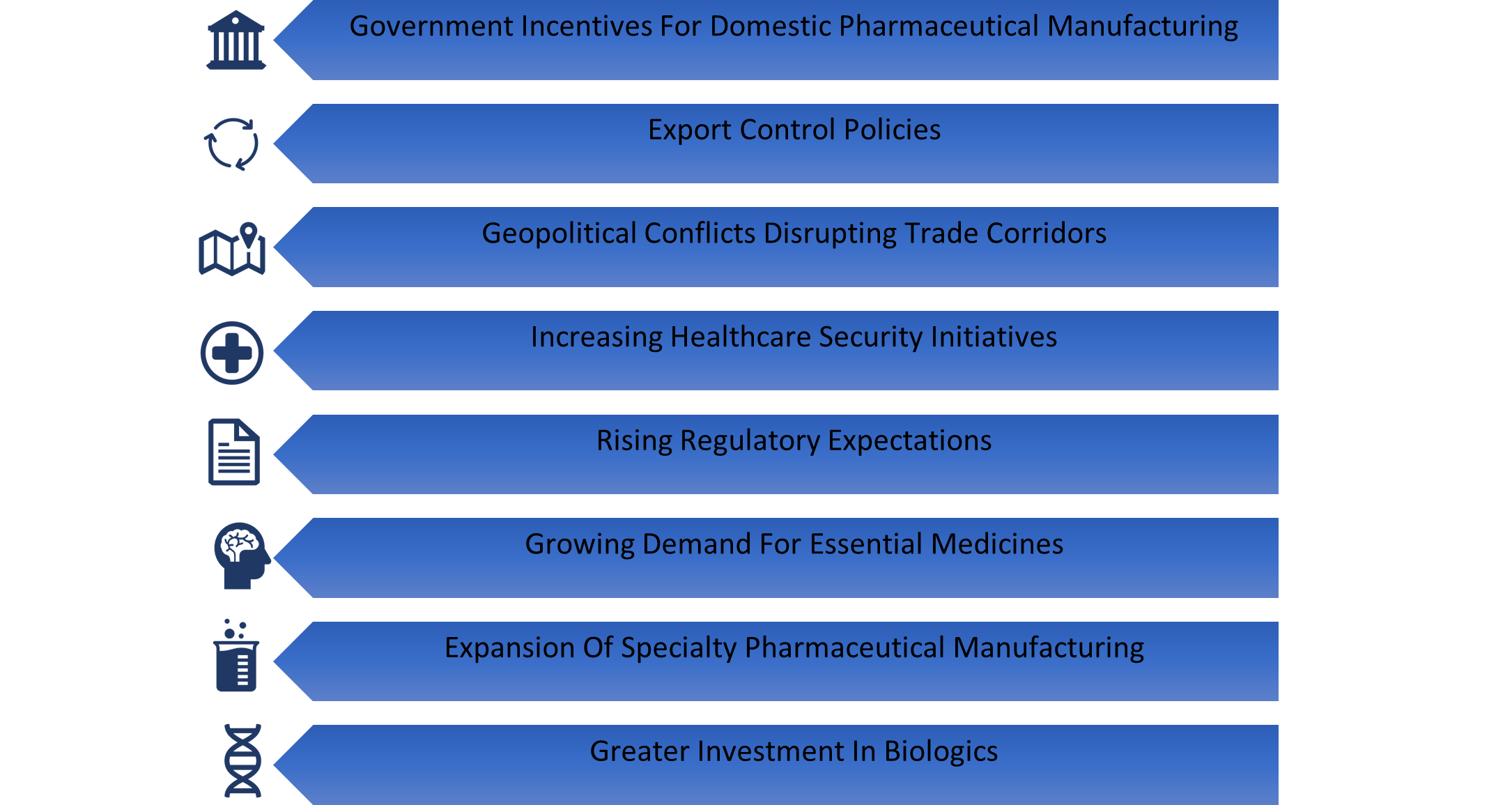
Market Drivers Accelerating
Diversification
Key Challenges
Despite growing momentum, diversification presents
several operational challenges.
|
Challenge |
Business Impact |
|
Supplier Qualification Timelines |
Delayed Diversification |
|
Regulatory Approvals |
Extended Commercialization |
|
Higher Manufacturing Costs |
Margin Pressure |
|
Technology Transfer Complexity |
Longer Implementation Periods |
|
Limited Regional Capacity |
Supply Bottlenecks |
Regional
Opportunity Assessment
|
Regin |
Opportunity Outlook |
Key Growth Drivers |
|
Region |
Opportunity Outlook |
Key Growth Drivers |
|
North America |
|
Domestic manufacturing incentives,
healthcare security initiatives |
|
Europe |
|
Strategic autonomy, regulatory
compliance, regional API investments |
|
India |
|
Large manufacturing base, government
production incentives, skilled workforce |
|
Southeast Asia |
|
Alternative sourcing destination,
expanding manufacturing ecosystem |
|
Middle East |
|
Healthcare diversification,
pharmaceutical investments, logistics infrastructure |
|
Latin America |
|
Local manufacturing expansion, regional
healthcare demand |
Competitive Intelligence:
Industry participants are actively strengthening supply chain resilience through strategic investments.
Current Competitive Strategies
●
Multi-country
manufacturing expansion
●
API
production capacity additions
●
Strategic
acquisitions
●
Long-term
supplier agreements
●
Digital
procurement transformation
●
Regional
distribution hubs
●
Vertical
integration initiatives
Companies capable of combining manufacturing scale
with geographic diversification are expected to strengthen competitive
positioning throughout the forecast period.
Technology Transforming API Supply Chains
The next generation of pharmaceutical procurement will
increasingly rely on digital technologies.
High-Impact Technologies
●
Artificial
Intelligence
●
Predictive
Supply Chain Analytics
●
Blockchain
Traceability
●
IoT-Based
Manufacturing Monitoring
●
Digital
Twin Supply Chain Simulation
●
Robotic
Process Automation
●
Cloud-Based
Procurement Platforms
These technologies improve visibility while reducing
operational uncertainty.
Proprietary Framework: API
Supply Chain Resilience Scorecard
Our analysts evaluate
supply chain resilience across six strategic pillars.
|
Assessment Category |
Strategic Importance |
|
Geographic Diversification |
Very High |
|
Regulatory Compliance |
Very High |
|
Supplier Redundancy |
High |
|
Digital Visibility |
High |
|
Logistics Flexibility |
High |
|
Inventory Readiness |
Medium-High |
This framework enables
pharmaceutical companies to benchmark supplier networks and prioritize
resilience investments based on overall business risk.
Future Outlook (2026–2032)
Our long-term market outlook
suggests that API supply chain diversification will evolve from a risk
mitigation initiative into a core competitive differentiator.
Key developments expected over the
next five to seven years include:
●
Accelerated
regional API manufacturing investments
●
Greater
adoption of AI-driven procurement systems
●
Increased
strategic partnerships between pharmaceutical companies and CDMOs
●
Higher
government funding for domestic pharmaceutical production
●
Stronger
regulatory requirements for supply chain transparency
●
Expansion
of resilient, multi-regional sourcing ecosystems
Organizations that diversify early
are likely to gain strategic advantages through enhanced operational
continuity, improved regulatory readiness, and stronger market responsiveness.
Conclusion
Geopolitical instability is no longer a temporary
disruption; it has become a defining force reshaping global pharmaceutical
supply chains. The industry's strategic focus has shifted from minimizing
procurement costs to maximizing supply resilience, regulatory readiness, and
long-term business continuity. Organizations that embrace diversified sourcing,
digital supply chain intelligence, and regional manufacturing partnerships will
be better equipped to navigate future uncertainties and sustain competitive advantage.
The next phase of pharmaceutical leadership will be
defined not by who manufactures APIs at the lowest cost, but by who can ensure
uninterrupted access to critical ingredients when global conditions are at
their most unpredictable.
Request a Customized Market Intelligence Assessment
Looking to evaluate API sourcing
opportunities, benchmark supplier strategies, or identify the next high-growth
manufacturing region?
Our market intelligence experts
provide:
●
Custom
API market assessments
●
Competitive
benchmarking and vendor intelligence
●
Regional
opportunity mapping
●
Supply
chain risk analysis
●
Investment
opportunity evaluations
●
Regulatory
and policy impact assessments
●
Strategic
sourcing recommendations
●
Executive-level
market forecasts
Connect with our analysts today to
request a customized sample report and discover how actionable intelligence can
strengthen your pharmaceutical supply chain strategy in an increasingly complex
global market.
Related Reports –
Clinical
Trials Outsourcing Market Size and Forecast to 2034
Pharmaceutical
Logistics Market Size, Share, Trends to 2033
Pharmaceutical
Supply Chain Management Market Size to 2033
Biologics
Contract Manufacturing Market Size, Forecasts to 2033
About M2Square Consultancy
We specialize in decoding complexity. From market forecasting to
customer behavior analysis, our services are designed to bridge the gap between
uncertainty and opportunity. Our offerings span the entire insight lifecycle,
including Consulting, Tailored Research, Syndicated Studies, Trend Tracking,
Competitive Intelligence, Pricing and Channel analysis, GTM Strategy, and more.
Using a blend of qualitative expertise and data science, we deliver bespoke
solutions that inform bold business moves.
Contact:
Website:https://m2squareconsultancy.com/
Email:sales@m2squareconsultancy.com
Phone (IN): +91 80978 74280
Phone (US): +1 929 447 0100
Enquiry Form
Latest Blogs

The Future of Personalized Vaccines
Vaccines have been following a standard paradigm for decade...
July 24, 2026

The Strategic Shift from Globalization to Regionalization in Pharmaceutical Manufacturing
The past emphasis on centralizing efficiency could not addr...
July 24, 2026

Robotics in Healthcare: From Surgery to Pharmacy Automation
Medical robots, when mentioned, often come to mind in relat...
July 24, 2026
Related Blogs
The Future of Personalized Vaccines
Vaccines have been following a standard paradigm for decade...
July 24, 2026
Read More
The Strategic Shift from Globalization to Regionalization in Pharmaceutical Manufacturing
The past emphasis on centralizing efficiency could not addr...
July 24, 2026
Read More
Robotics in Healthcare: From Surgery to Pharmacy Automation
Medical robots, when mentioned, often come to mind in relat...
July 24, 2026
Read More